⚡ QC News

The latest news and developments in quantum computing

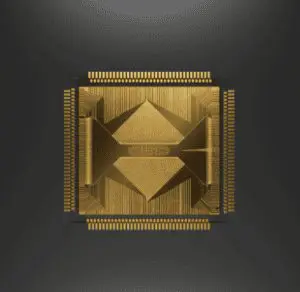
A stylized representation shows a graphene lattice with red dots indicating energy levels on a dark background.
Quantum Error Correction September 18, 2026

Researchers Survey Compilation Designs for Reliable Quantum Computation

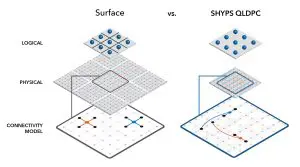
With IBM now fielding a 1121-qubit processor and neutral atom arrays exceeding 6100 qubits, scaling quantum computers has begun to outpace our ability to reliably control them. Achieving dependable results demands sophisticated new compilers that manage errors across both software and hardware layers. This survey maps the emerging design principles for these fault-tolerant systems, moving beyond simple circuit optimisation towards encoding-aware computation.
This abstract artwork features glowing purple energy connecting two spherical forms against a stark black background.
Quantum Algorithms September 18, 2026

Researchers Find Faster Spin Information Transfer with Long-Range Links

Information now traverses complex spin networks more rapidly than previously thought possible without extensive system design. Lowering the power-law exponent α within these systems confines excitation to fewer energy states, unexpectedly accelerating information transfer. This reveals an inherent property of long-range quantum interaction enabling new modes of propagation not seen in exclusively nearest-neighbour settings.
The building is illuminated with bright blue light, showcasing a modern architectural design against a dark night sky.
Quantum Computing Business News September 18, 2026

$4M NIST grant funds quantum researchers at EPB Quantum Center

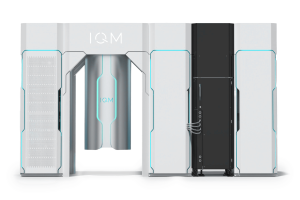
EPB today launched the IonQ Forte Enterprise quantum computer at EPB Quantum Center, bringing commercial quantum computing and networking together in one facility for the first time. Funded by a $4 million grant from the National Institute of Standards and Technology (NIST), the initiative has brought eight graduate researchers to Chattanooga.
Alpine F1 Team and SEALSQ boost simulations with quantum tech
Quantum Security September 18, 2026

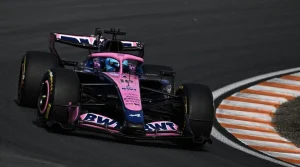
Alpine F1 Team and SEALSQ boost simulations with quantum tech

BWT Alpine Formula One Team and SEALSQ advance Formula One’s first quantum security partnership with hybrid quantum-classical simulation. Building on a partnership launched in November 2025, the project introduces technology from ColibriTD to extract additional insight from the team’s computing and testing resources, with a focus on the 2026 Formula One technical reset.
DOE Puts Up $215 Million to Build Fault-Tolerant Quantum Computers
Quantum Hardware September 17, 2026

DOE Puts Up $215 Million Competition to Build Fault-Tolerant Quantum Computers

Department of Energy (DOE) today announced the Quantum Genesis Q Competition, an initiative with up to $215 million in planned funding to demonstrate the world’s first fault-tolerant scientifically relevant quantum computers (SRQCs). Applicants are invited to submit proposals to deploy quantum computers with at least 100 logical qubits, capable of performing hundreds of millions fault-tolerant operations.
LSEG and Microsoft Quantum test new data analysis with Quantum Development Kit
Quantum Algorithms September 17, 2026

LSEG and Microsoft Quantum test new data analysis with Quantum Development Kit

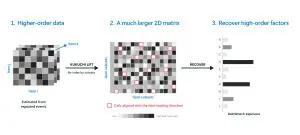
LSEG and Microsoft are evaluating the Microsoft Quantum Development Kit (QDK) for analytics, a new library of quantum algorithms and tools designed for advanced data analysis, focusing first on Quantum TensorPrincipal Component Analysis (Quantum Tensor PCA). This approach helps identify weak signals in noisy, high-dimensional datasets, where important patterns can be buried within complex data across fields like financial services and life sciences.
Researchers Review Quantum Computing’s Role in Smart Grids
Quantum Research News September 17, 2026

Researchers Review Quantum Computing’s Role in Smart Grids

Can existing optimisation algorithms adequately manage increasingly complex power grids burdened by fluctuating renewable energy sources? Quantum algorithms such as HHL and QAOA now offer potential solutions for large systems of linear equations and combinatorial optimization problems respectively, exceeding previous capabilities in these areas. This review consolidates knowledge regarding how this emerging technology might reshape smart grid monitoring, planning, control and security protocols.
Researchers Link Nonlocal Magic to Many-Body Localization Transition
Quantum Error Correction September 16, 2026

Researchers Link Nonlocal Magic to Many-Body Localization Transition

Entanglement’s hidden organisation is now revealed through nonlocal magic, exposing structures missed by standard measures like entanglement entropy. This new diagnostic tracks spectral reorganization, a dome-shaped evolution appearing between chaotic behaviour and many-body localisation, even when overall entanglement remains constant. Detailed analysis demonstrates how this ‘magic’ decays with system size, offering valuable insight into phase transitions within complex quantum systems.
Geneva Team Distils Magic States with Qubit Recycling
Quantum Error Correction September 16, 2026

Geneva Team Distils Magic States with Qubit Recycling

Constant sized support state distillation with qubit recycling Previously, building dependable quantum computers demanded ever-increasing numbers of qubits to correct errors during complex calculations. New protocols now achieve diagonal states within the Clifford hierarchy using a fixed quantity of logical qubits regardless of computational distance. This advance unlocks potential efficiencies by recursively doubling codes and reusing idle qubits, including a notably concise $111 to 1 protocol for |T⟩$ state distillation.
Researchers Find Large Gaps in AI’s Quantum Engineering Reliability
Quantum Error Correction September 16, 2026

Researchers Find Large Gaps in AI’s Quantum Engineering Reliability

Seventeen advanced artificial intelligence agents designed to manage complex quantum experiments yielded wildly different outcomes when subjected to identical challenges. This disparity emerged from the first systematic evaluation using QIQCBench, a new benchmark comprising forty-nine expert-designed tasks assessing autonomous quantum engineering capabilities. The work introduces Quantum-Harbour, enabling detailed verification of an AI’s reasoning during operation, not just its final result.
IBM Research Team Bounds Quantum Circuit Complexity Growth
Quantum Research News September 16, 2026

IBM Research Team Bounds Quantum Circuit Complexity Growth

One gate at a time: complexity growth in random quantum circuits Until now, quantifying how quickly simulating quantum computations becomes classically intractable relied upon approximations yielding polynomial improvements only. New calculations demonstrate that computational resources required for these simulations grow almost linearly with time, specifically as Ω(T / log T), up to times around 4ⁿ. This represents an improvement by a factor of poly(n) over existing bounds, offering fresh insight into fundamental limits of quantum computation.
The logo of Anderon, a new standalone IBM company, and quantum wafer
Quantum Hardware September 16, 2026

IBM’s Anderon gets $1 billion to build US quantum wafers

Anderon, an IBM Company, finalized an agreement with the U.S. Department of Commerce for a $1 billion CHIPS award to accelerate R&D for a U.S.-based pure-play quantum foundry. Funding will help scale and expand access to quantum wafer technology, backed by an additional $1 billion investment from IBM.
A high-angle shot reveals a detailed computer chip resting on a dark, textured surface with glowing blue circuit lines.
Quantum Computing Business News September 15, 2026

Mitsubishi Electric backs OptQC’s optical quantum computer build

Mitsubishi Electric Corporation’s ME Innovation Fund invested in OptQC Corp., a Japanese startup developing optical quantum computer hardware. Optical quantum computing offers superior qubit scalability and energy efficiency, as the technology transitions from research to practical, industrial applications.
Logical advantage of Pinnacle confirmed on spin-qubit hardware
Quantum Hardware September 14, 2026

Logical advantage of Pinnacle confirmed on spin-qubit hardware

Iceberg Quantum and Diraq confirm Pinnacle’s logical advantage for spin qubits using NVIDIA CUDA-Q Logical. The work demonstrated how Iceberg Quantum’s Pinnacle architecture can be implemented on Diraq's spin-qubit hardware platform while preserving Pinnacle's logical performance advantage, enabling Diraq to achieve a target 1,000 logical qubits with just 150,000 physical qubits.
A glowing lattice of binary cells above a circuit board
Quantum Hardware September 10, 2026

Altera FPGAs now support Riverlane’s quantum error correction interface

Altera and Riverlane partnered to help quantum hardware developers build flexible control and error-correction systems using Altera FPGAs, validating Riverlane’s QECi interface on Agilex 7 FPGAs. This enables low-latency quantum error correction and faster system integration, standardizing data exchange between quantum control systems and QEC hardware.
Xanadu and AMD speed up quantum computing with Backline link
Quantum Hardware September 10, 2026

Xanadu and AMD speed up quantum computing with Backline link

Xanadu and AMD announced Backline, an open-platform solution co-designed for rapid communications between quantum and classical computing hardware, including CPUs, GPUs, and FPGAs. Backline addresses the challenge of establishing ultra-low-latency communication, expected to operate within microseconds, between quantum devices and classical processors.
Researchers Find Heat Unlocks New Topology in Cold Atoms
Physics September 10, 2026

Researchers Find Heat Unlocks New Topology in Cold Atoms

Effective symmetry-protected topological states can now emerge even when base conditions reveal only fully gapped, broken symmetries. Previously, manipulating ground state properties was essential for achieving topology; however, this work demonstrates thermal control engineers entirely new phases unavailable at absolute zero. These findings expand possibilities for utilising temperature within future quantum technologies.
Researchers Find Quantum States Defying Simple Multiplication Rules
Quantum Research News September 10, 2026

Universität zu Cologne refines understanding of quantum limits

Until now, quantum communication protocols relied on an assumption about how channels combine, that averaging them always behaved predictably during transmission. New results demonstrate explicit instances where combining identical quantum channels violates this expectation, failing to produce a simple averaged output state. This stronger deviation from expected behaviour reveals inherent limitations within established methods for quantifying communication capacity.
Two glowing spheres joined by a bright filament
Quantum Algorithms September 10, 2026

Cambridge Team Bounds Four-Colouring of Cycles Using Quantum Methods

Directed cycles defy four-colouring via one-way quantum communication, despite unlimited computational power and message size. This establishes an algorithmic limit surpassing previous boundaries set by non-signaling and bounded-dependence models, achieved through analysis of inherent structural properties rather than causality constraints. The advance unlocks new techniques for determining limits within the quantum LOCAL computation framework.
Researchers Simulate Polymers Using up to 1000 Qubits
Quantum Error Correction September 10, 2026

Researchers Simulate Polymers Using up to 1000 Qubits

Representing complex chemical reactions typically demands ever increasing computational power as detail increases. However, new circuits achieve an exponential reduction in required memory, scaling logarithmically with system size rather than linearly. This advance unlocks simulations requiring only approximately ten thousand to one hundred thousand gate operations at one thousand system qubits.
Researchers Characterise Rules Building Quantum Error Correction
Quantum Error Correction September 10, 2026

Researchers Characterise Rules Building Quantum Error Correction

Until now, building quantum error correction has relied on established methods with limited potential for expansion. New work provides an explicit mathematical description, based on ‘cyclotomic sets’, extending these techniques to a wider range of codes and determining when resulting pairs are optimally structured within a defined system. Consequently, constructing demonstrably newer and lengthier codes becomes possible, edging closer to scalable fault tolerance.
Quantum Computers Cut Nonlocal Gates for Distributed Computing
Quantum Error Correction September 10, 2026

Quantum Computers Cut Nonlocal Gates for Distributed Computing

Directly realising even basic operations like fanout within a distributed quantum computer demands considerable communication between processing units. This work introduces circuits that reduce required non-local operations when performing this essential function, a key step towards scalable architectures. By utilising transversal operations on Bivariate Bicycle encoded code blocks, it offers a systematic way to implement large logical fanout across multiple processors.
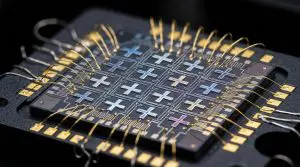
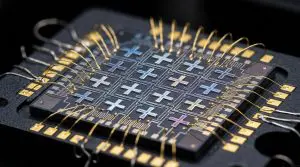
A qubit chip with cross-shaped resonators and gold bonds
Quantum Computing Business News September 8, 2026

IonQ Superion 256 platform aims for quantum chip manufacturing at scale

IonQ announced IonQ Superion 256, its sixth-generation quantum computing platform, and the first in the Superion platform expected for all future compute products. The company fabricated its first fully integrated 256-qubit quantum processing units (QPUs) at SkyWater, designed to be built by the hundreds rather than one at a time.
A dense array of brightly coloured optical fibers extends outwards against a dark background, creating a futuristic and dynamic visual effect.
Quantum Computing News September 7, 2026

Sparrow Quantum’s source sends half a billion photons per second

Sparrow Quantum’s deterministic photon source delivers more than 500 million single photons per second into a single-mode fiber, reported as the highest single-photon flux to date. Operating at 1 GHz, the source combines gigahertz repetition rate with more than 50% fiber efficiency, high single-photon purity, and two-photon indistinguishability.
A satellite orbits Earth in a dark blue space, transmitting data streams amidst a starry night sky.
Technology News September 5, 2026

Quantum Zeitgeist Weekly Digest

Welcome to this week’s quantum technology digest. This compilation covers advances across hardware development, software tools, and early applications of quantum computing. Several articles demonstrate IBM’s continued leadership, with updates to its processors, error mitigation techniques, and simulation capabilities.
A young man stands outdoors on a sidewalk, surrounded by green foliage and a light-coloured building.
Quantum Research News September 4, 2026

Finding quantum advantage requires focused circuits

Finding the quantum advantage in Chicago finding quantum advantage chicago Fascinated by how the movement of planets could be anticipated through an understanding of gravity, Su-un Lee was originally drawn to physics through its grand-scale logic. .
A vibrant pixel art scene depicts a futuristic town with medieval and modern buildings under a moonlit sky.
Technology News August 31, 2026

Quantum Zeitgeist Weekly Digest

This week stands out with substantial investment news. Both Pasqal’s Nasdaq listing and the Canadian government’s funding of Xanadu signal increasing confidence in the commercial viability of quantum technologies. Alongside financial commitments, research continues to address core challenges. Developments range from faster qubit tuning and improved cooling methods to advances in quantum error correction and molecular simulation tools.
Watercolour illustration of Michael Biercuk, founder and chief executive of Q-CTRL, standing in a dark T-shirt in front of a whiteboard of sketched control-software diagrams
Quantum People August 30, 2026

Michael Biercuk, The Q-CTRL Founder Whose Error Suppression Software Runs on IBM, Rigetti and Diraq Machines

Michael Biercuk founded Q-CTRL in 2017 to sell control software that suppresses qubit errors on any hardware, and by September 2024 IBM, Rigetti, Oxford Quantum Circuits and Diraq were all shipping it inside competing machines. The firmer half of the company is now a magnetic navigation business, and better control does not by itself make machines this small useful.
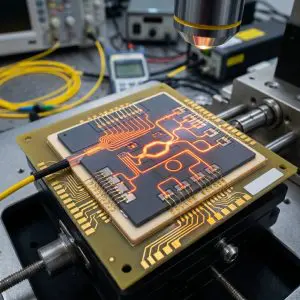
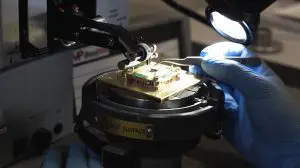
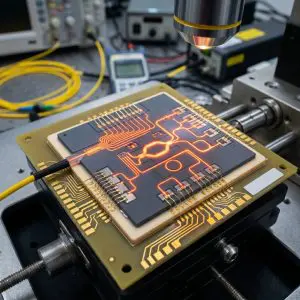
A complex electronic circuit board is positioned on a metallic base, illuminated by a bright microscope beam in a laboratory setting.
Quantum Hardware August 28, 2026

Canada invests $195M in Xanadu for quantum computer manufacturing

government of canada invests cad 195 million in xanadu to build the quantum supply chain, with the funding representing the largest investment in quantum manufacturing in Canadian history. The commitment, through the Strategic Response Fund, anchors Xanadu’s plan to manufacture components of fault-tolerant utility-scale quantum computers in Canada.
IEEE Quantum Week 2026 title card, Toronto, 13 to 18 September 2026
Quantum Features August 28, 2026

IEEE Quantum Week 2026, Register Now

IEEE Quantum Week 2026 runs in Toronto from 13 to 18 September, carrying the largest programme the conference has published, with 372 technical papers, 47 workshops and 48 tutorials. Eleven keynote speakers lead it. Register now.
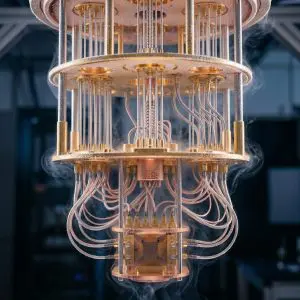
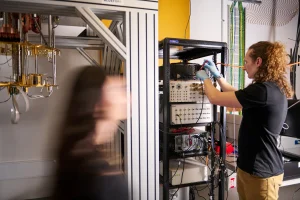
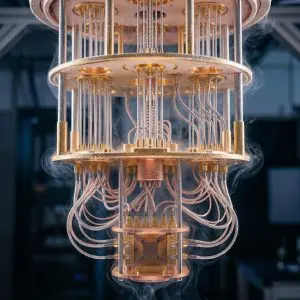
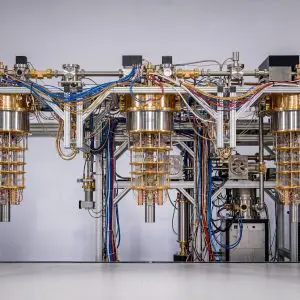
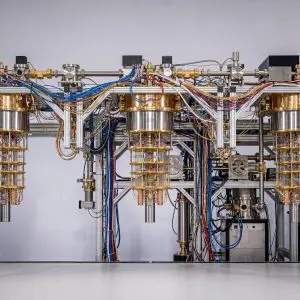
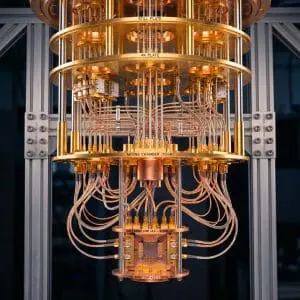
A dilution-refrigerator quantum computer
Quantum Computing Business News August 28, 2026

Pasqal To Begin Trading On NASDAQ As PSQL

Pasqal, a global leader in neutral-atom quantum computing, announced the composition of the Board of Directors of Pasqal Holding SA following its business combination with Bleichroeder Acquisition Corp. Ordinary shares of the combined company are expected to begin trading on Nasdaq under the ticker symbol "PSQL" on August 28, 2026.
A mesh of network nodes above a server hall
Quantum Networks August 26, 2026

Quantum networks can now optimize connections without full noise maps

Quantum networks are a backbone of future quantum technologies, playing a role in communication and scalable quantum computing. A self-configuring approach integrating superposed quantum paths with variational quantum optimization techniques allows networks to dynamically optimize noisy paths, establishing high-fidelity connections without detailed characterization of quantum channels.
A luminous, curved structure dominates the dark space, radiating outwards with a bright golden core and blue lines.
Photonic Computing August 24, 2026

Researchers Prove Conjecture Supporting GBS Quantum Advantage

Until now, proving the computational difficulty of simulating quantum systems required limiting assumptions about their complexity. This work removes those limitations by confirming a key property, the ‘hiding conjecture’, holds true regardless of the number of squeezed input modes employed in Gaussian boson sampling. Completing this proof strengthens arguments that this particular task may offer a viable path towards demonstrating practical quantum advantage over conventional computers.
Two vibrant blue and green Earths are connected by swirling, luminous white lines against a dark, starry space background.
Quantum Physics August 24, 2026

Colorado Team Finds Universe Broadly Linked by Entanglement

Is cosmic connectivity limited by vast interstellar distances? Evidence suggests not, as observations now reveal characteristics consistent with ‘small-world’ networks across large swathes of the universe. This inference, drawn from existing cosmographic data rather than simulation, indicates entangled particle chains may reduce average separation between points previously thought unreachable.
A young cyclist delivers a rolled-up newspaper through a vibrant, stylized city street scene with bright colours.
Quantum Computing News August 23, 2026

Quantum Zeitgeist Weekly Digest

Welcome to this week’s quantum technology digest. We’ve assembled the ten most impactful stories from the past seven days, covering advances in hardware, algorithms, and commercialization. This week demonstrates the breadth of activity in the field, with developments ranging from error correction tools to potential impacts on cryptocurrency security. Several articles point to a clear […]
A close-up shot reveals a complex arrangement of interlocking gears in shades of gold, silver, and black.
Quantum Research News August 22, 2026

Oxford Team Confirms Quantum Theory’s Universal Nature

Preserving established algebraic relationships within combined systems disallows any attempt to treat subsystems as both classically and quantum mechanically consistent. This constraint, rooted in how dynamics evolve, builds upon Werner Heisenberg’s original work on electromagnetic field quantization by focusing on fundamental limitations imposed by consistency itself. Consequently, full quantisation becomes necessary when linking already-quantum entities to gravity or electromagnetism, revealing deeper boundaries for physical theory.
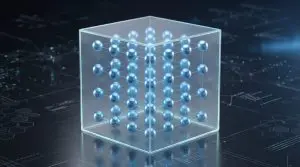
A transparent cube filled with blue spheres sits on a dark, futuristic surface covered in glowing circuit lines.
Quantum Algorithms August 22, 2026

Researchers Speed Quantum Error Correction by up to 42 Times

Clock rates for quantum error correction have increased by up to 42. 1 times existing methods when applied to systems simulating over two thousand qubits. This leap forward stems from ONEX, a new framework that restructures complex compilation tasks into simpler one-dimensional problems solved within practical timescales.
A complex, iridescent geometric sphere floats against a backdrop of a dark, starry space with swirling nebulae.
Quantum Mechanics August 21, 2026

Everettian Mechanics Avoids Distant Effects with Zero Causal Processes

Confirming that Everettian quantum mechanics avoids ‘spooky action at a distance’ addresses longstanding concerns about its compatibility with relativity; however, the researchers acknowledge this work doesn't fully resolve debates surrounding wavefunction branching itself. Some interpretations, like those initially proposed by von Neumann, necessitate an instantaneous collapse of possibilities upon measurement, a concept successfully sidestepped within many worlds theory but still debated amongst physicists. Still, acknowledging lingering debate over how ‘branching’, the splitting of universes in Everettian quantum mechanics, actually happens is important context for understanding this complex theory. The researchers demonstrate that avoiding instantaneous connections across vast distances remains a key strength of many worlds interpretations despite these ongoing discussions about branching itself. Researchers at the University of Oxford have clarified how Everettian quantum mechanics sidesteps ‘spooky action at a distance’, addressing concerns about its compatibility with Einstein’s theory of relativity; this work focuses on branching, the splitting of universes within the many worlds interpretation, as an emergent phenomenon rather than a causal process.
Two glowing purple spheres are connected by a vibrant blue wave pattern against a dark background.
Quantum Networks August 21, 2026

Researchers Achieve 94% Fidelity in Entanglement Swapping

The researchers’ success in boosting entanglement swapping rates offers a clear path towards practical quantum networks; however, the current system relies on meticulously controlled laboratory conditions and readily available components which may not translate seamlessly to real-world deployments. While utilising off-the-shelf filters simplifies construction, scaling beyond sixteen frequency modes presents an unresolved challenge, maintaining high fidelity as complexity increases is far from guaranteed. Still, acknowledging the need for more robust and easily deployable systems is crucial; current limitations regarding laboratory control and scaling do not diminish this achievement’s significance as a vital stepping stone towards practical quantum communication networks. The team successfully demonstrated high-fidelity entanglement swapping across sixteen different frequencies using readily available components, representing substantial progress in increasing data transmission rates. Researchers at the University of Bristol have achieved a significant increase in entanglement swapping rates; this crucial process links quantum bits over long distances for secure communication and distributed computing.
This artwork depicts intricate gears and cosmic elements arranged within a dark, space-like setting, dominated by gold, silver, and blue hues.
Quantum Physics August 21, 2026

Researchers Link Quantum Agency to Mutual Acknowledgement

Previously obscured connections between quantum theory and philosophical traditions now come into focus. This work establishes that an agent’s status within QBism fundamentally relies on acknowledgement from other agents, revealing a ‘mutually recognitive conception of agency’. Tracing themes through Merleau-Ponty and Hegel unlocks conceptual tools for rigorously justifying this unique ontological commitment.
Two glowing purple spheres are connected by a vibrant blue wave pattern against a dark background.
Quantum Networks August 21, 2026

Stony Brook Team Maps Limits of Entangled Bell Mixtures

Zero tolerance for disturbance defines a new limit in quantum communication, even minimal disruption completely erases both entanglement and steerability with certain noisy signals. This research precisely maps how these fragile quantum abilities appear and disappear as interference increases, revealing ordered chains of operational limits. Closed-form solutions now offer benchmarks for maintaining useful connections despite imperfect qubits.
Two spheres, a dark grey one and a transparent bubble, rest on a reflective grey surface in a dark studio setting.
Quantum Physics August 21, 2026

University of York Team Defines Limits of Quantum Superposition

No extension of the Quantum Tensor Product admits a Superposition principle. Until now, defining superposition relied on complex mathematical structures rather than direct experimental observation. This work establishes operational ‘superposition principles’ rooted in prepare-and-measure experiments, demonstrating no larger compositional structure beyond the standard quantum framework satisfies them.
The graphic displays the name “Quantum Innovation Summit” with a stylized circular icon and is set against a white background.
Quantum Features August 19, 2026

Quantum summit in Dubai will focus on tech sovereignty

The Quantum Innovation Summit 2026 will convene its third edition from 28 to 30 September 2026 at the Grand Hyatt Dubai Conference & Exhibition Centre, bringing together institutions focused on technological sovereignty, national resilience, economic competitiveness and trusted international partnerships. The Summit connects quantum computing, communications and sensing with artificial intelligence (AI), cybersecurity and other advanced technologies.
This image shows a long corridor filled with rows of servers, illuminated with blue and white lighting.
Quantum Computing Business News August 12, 2026

Quantinuum’s most accurate quantum computer joins Oracle Cloud

Quantinuum and Oracle announced a multi-year strategic partnership to bring quantum computing to Oracle Cloud Infrastructure (OCI). Quantinuum’s most accurate commercial quantum computer, Helios, will be deployed in a US-based OCI AI data center as an OCI service, alongside OCI’s high-performance computing and GPU infrastructure.

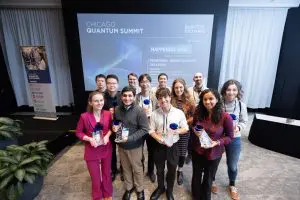
A group of young people stand together holding awards in a modern conference room with a large screen.
Quantum Research News August 10, 2026

Boeing prize will honor early quantum researchers this December

Applications are open for the sixth cohort of Boeing Quantum Creators, a prize recognizing early-career researchers for work in quantum information science and engineering. The 2026 honorees will present their work at the Q2B x Chicago Quantum Summit, held December 8–10 at Marriott Marquis Chicago and McCormick Place.
A sleek, futuristic server unit sits on a dark surface, illuminated by red lines and featuring a minimalist design.
Quantum Computing Business News August 7, 2026

TuringQ files for IPO, a first for Chinese Quantum Computing

Chinese photonic quantum computing firm TuringQ entered IPO tutoring with the Shanghai branch of the China Securities Regulatory Commission, intensifying competition to become China's first listed quantum computing firm. The company plans an IPO with Guotai Haitong Securities as its sponsor, reflecting a shift toward commercialization and a broader rush by Chinese hard-tech companies to tap public markets.


The word “Pasqal” is prominently displayed against a blue background filled with circuit board patterns and glowing bubbles.
Quantum Computing Business News August 6, 2026

Pasqal closer to merger and market entry

Pasqal’s Form F-4 was declared effective by the SEC, advancing its merger with Bleichroeder, and paving the way for expanded work—including materials science applications with partners like Los Alamos.
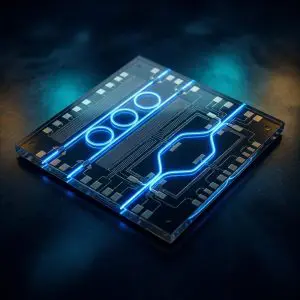
A transparent microchip rests on a dark, textured surface illuminated with vibrant blue and golden light, creating a futuristic effect.
Quantum Physics August 3, 2026

Extensible Photonics Achieves Universal Quantum Gate Sets

Extensible universal photonic quantum computing with nonlinearity is demonstrated, and the research achieves universal quantum gate sets. Shang Yu, Jinzhao Sun, and Kuan-Cheng Chen are among the authors affiliated with institutions including Imperial College London and Queen Mary University of London.

A dilution refrigerator being worked on in a laboratory
Quantum Physics July 29, 2026

Rigetti Superconducting Bridges Track Qubit Temperature With Millikelvin Precision

Accurate knowledge of the on-chip temperature is essential for understanding and optimizing the performance of superconducting qubits, yet direct thermometry at millikelvin temperatures remains challenging. Researchers demonstrate a complementary on-chip thermometry method based on superconducting Dayem bridges integrated on the same chip as transmon qubits, obtaining a local, quantitative measure of the chip temperature from I-V measurements.
Gold dilution refrigerator of a quantum computer
Quantum Physics July 27, 2026

Log-Law Scaling of Entanglement Confirmed on Quantum Computer

The investigation of strongly-correlated quantum matter is difficult due to the curse of dimensionality and intricate entanglement structures, particularly near continuous quantum phase transitions. Researchers demonstrate log-law scaling of subsystem entanglement entropies at criticality on a digital quantum computer, using the multiscale entanglement renormalization ansatz (MERA) and a holographic scheme on a fully-connected trapped-ion quantum computer.
A complex electronic circuit board glows with vibrant blue and gold hues, showcasing intricate pathways and components.
Quantum Research News July 25, 2026

VW and Porsche Researchers Explore The Merits Of Deep Parameterised Quantum Circuits

A central challenge in quantum machine learning is understanding the scaling behavior of parameterized quantum circuits, particularly how performance on unseen data changes as the number of trainable parameters increases. Researchers show that gradient-based parameterized quantum circuits can exhibit improved performance on unseen data as model size increases, displaying the phenomenon of double descent.
This digitally rendered artwork showcases a complex quantum computer design with glowing blue and gold lines, highlighting its intricate circuitry.
Quantum Research News July 24, 2026

Neutral Atom Plan Targets 1000-Qubit Quantum Processor by 2032

Adrian J. Menssen, Tout Wang, Michael Gullans, Tom Manovitz, Jacob M. Taylor, Jason Cong, Josiah Sinclair, Ziv Aqua, Daniel J. Blumenthal, J. Pablo Bonilla Ataides, Johannes Borregaard, Antoine Browaeys, Paola Cappellaro, Soonwon Choi, Alexandre Cooper, Robin Côté, Jacob P. Covey, Alexandre Dauphin, Ivana Dimitrova, Matt Eichenfield, Dirk Englund, Jacob Freedman, Akihisa Goban, Brandon Grinkemeyer, Andi Gu, and Ruonan Han authored a strategic plan for neutral atom quantum computation, targeting a 1000-qubit quantum processor by 2032. The plan involves collaborations across institutions including Massachusetts Institute of Technology, Harvard University, NIST/University of Maryland, and the Weizmann Institute of Science.
Stacked graphene sheets inside a high-tech chassis
Quantum Hardware July 22, 2026

QuEra’s 78-Site Graphene System Validates Quantum Thermodynamic Sampling

Neutral-atom quantum hardware is a promising platform for programmable many-body physics, and this work develops and validates a framework for extracting thermodynamic properties of materials using such hardware. As a test case, researchers consider nitrogen-doped graphene and map material energetics onto a Rydberg-atom Hamiltonian suitable for quantum annealing, utilizing a 78-site system with Monte Carlo sampling.
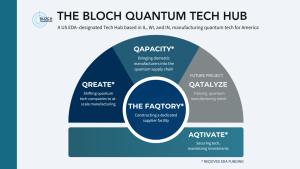
The graphic depicts a circular diagram illustrating the Block Quantum Tech Hub’s initiatives, set against a dark blue background.
Quantum Computing Business News July 21, 2026

CQE-Led Bloch Hub Drives $55M Quantum Prairie Expansion

The CQE-led Bloch Quantum Tech Hub has raised $55 million to build a US quantum supply chain, following a US Economic Development Administration award. This positions the Illinois-Wisconsin-Indiana region to lead US quantum manufacturing, leveraging existing Midwest manufacturing capacity, talent, and industry base.
Abstract machine-learning landscape with a descending sphere
Physics July 19, 2026

ETH Zurich Details Loss Mechanisms in High-Coherence Resonators

Loss mechanisms in high-coherence multimode mechanical resonators coupled to superconducting circuits are detailed, with research conducted at the Department of Physics, ETH Zurich, CH-8093 Zurich, Switzerland and the Quantum Center, ETH Zurich, CH-8093 Zurich, Switzerland. Raquel Garcia-Belles and Alexander Anferov contributed equally to this work.
A complex circuit board with numerous interconnected components is displayed against a dark blue background, illuminated with glowing teal lines.
Quantum Research News July 18, 2026

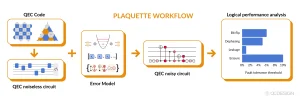
Binary Gauss Stabilizers Simplify Quantum Error Correction Without Extra Qubits

Gauge theories and quantum error-correcting codes share a common structure, both utilizing constraints to define a subspace of the Hilbert space—stabilizers in error correction, and Gauss law in gauge theories. This work introduces binary Gauss stabilizers, an alternative to Gauss operators, to build practical error-correcting codes without adding extra qubits.
A vibrant, abstract wave pattern glows against a dark background, creating a dynamic and visually engaging design.
Quantum Research News July 18, 2026

How Yokohama National University Maps Grover Walk Robustness

Yokohama National University researchers study the effect of magnetic vector potentials on periodic Grover walks on finite graphs, regarding the vector potential as a perturbation of a periodic Grover walk and investigating the robustness of its periodicity. Analysis reveals the response to perturbations depends on the spectral structure of the underlying graph, with a Hermitian matrix characterizing robustness when the graph possesses at least one non-simple eigenvalue.
Logic gate diagram with bidirectional signal arrows
Quantum Research News July 15, 2026

Magic Gate Teleportation Simplifies Feedforward for Quantum Computing

Quantum gate teleportation is a technique for implementing logical gates in fault-tolerant quantum computation, and this work develops a theory of protocols—called magic gate teleportation—that implement non-Clifford gates on input states without revealing information about them. These protocols encode the input state into a stabilizer code, followed by a logical non-Clifford gate, offering a new understanding of resource states for quantum computing.
This graphic depicts interconnected glowing circles against a dark background, representing complex networks and data processing.
Quantum Computing News July 15, 2026

NVIDIA QEC Ising Decoding Cuts Color Code Errors Over 347x

NVIDIA Ising Decoding has achieved a greater than 347x improvement in logical error rate and 7.3x faster runtime compared to Chromobius for d=31, suggesting color codes are a viable option for practical, fault-tolerant quantum computation. This decoding pipeline utilizes 3D convolutional neural networks to enable scalable and accurate real-time decoding for quantum processor units.
A three-dimensional representation of a paraboloid function is shown within a glass cube, set against a blurred mathematical background.
Quantum Machine Learning July 13, 2026

Quantum Reservoir Expressivity Confirmed on IBM Hardware via ORS Score

Quantum reservoirs present a hardware-friendly approach to quantum machine learning by utilizing fixed random dynamics and classical readout, rather than trainable circuits. Evaluating performance relies on reservoir selection, and this work introduces a scalable framework—based on order-statistics expressivity and effective rank—to diagnose these systems.
Superconducting qubit die showing Josephson junction features
Quantum Research News July 13, 2026

University of Basel Proposes New Superconducting Qubit Design

Researchers at the University of Basel propose a new superconducting qubit design, singlet-triplet qubits, which integrate quantum dots with Josephson junctions and do not require spin-orbit interaction. This design combines the benefits of spin-based quantum computing and circuit quantum electrodynamics, potentially broadening material options and simplifying control with minimal overhead.
A vintage black microphone stands on a white table against a stark white background, creating a minimalist composition.
Technology News July 12, 2026

Quantum Zeitgeist Weekly Digest

Welcome to this week’s quantum technology digest. We’ve assembled the top ten stories demonstrating rapid progress across multiple areas of quantum development, from hardware advancements to software applications and growing commercial adoption.
A luminous, circular orb emits a bright light, surrounded by swirling blue and grey waves against a dark background.
Quantum Sensors July 11, 2026

Physicists Contrast Quantum Sensors For Materials Science

Advancements in chemistry and materials science require improved analytical tools to overcome limitations in sensitivity, resolution, and throughput. This review explores optically pumped magnetometers (OPMs) and nitrogen-vacancy (NV) centers as potential platforms for molecular and materials analysis, contrasting their magnetic sensitivity and resolution capabilities.
The dashboard of a red Nissan 350Z is visible through the windshield, showing speed, RPM, and distance travelled.
Quantum Research News July 10, 2026

Researchers, including John Preskill, Explore Five Keys to Verifiable Quantum Advantage

Identifying when quantum physics truly outperforms classical physics is a central challenge in quantum technology, despite the promise of capabilities like computational speedups and measurement precision. Researchers from Caltech and MIT are examining key properties to define and navigate the pursuit of verifiable quantum advantages across multiple areas of application.
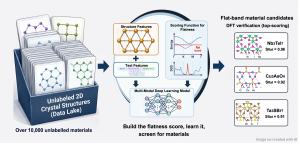
The image displays a complex diagram illustrating a computational approach for screening 2D crystal materials, utilizing data and machine learning.
Quantum Research News July 9, 2026

The University of Manchester’s Physics-Informed Scoring Accelerates 2D Material Discovery

Researchers at The University of Manchester have created a new machine-learning method to accelerate the discovery of two-dimensional materials with potentially unusual quantum properties. The approach uses physics-informed scoring to identify materials likely to exhibit “flat bands,” a characteristic linked to phenomena like superconductivity and magnetism.
A small dark printed circuit board with a glowing cyan zigzag light line running across its surface, set on a dark reflective background.
Quantum Research News July 9, 2026

RISC-V Vector Engine Addresses 128 Qubits With One Instruction

Xiaorang Guo and Kun Qin detail a vectorized quantum control architecture built on the RISC-V Vector engine, addressing 128 qubits with a single instruction and restoring pipeline execution within 80 nanoseconds after a mid-circuit measurement. The design was evaluated with compiler toolchains and FPGA prototypes.
This abstract artwork depicts a complex network of glowing lines and geometric shapes set against a dark, futuristic background.
Quantum Research News July 8, 2026

Max Planck Institute for the Science of Light: Researchers Use AI to Design Improved Quantum Error Correction Codes

Reducing the cost of a logical qubit to one-tenth that of current surface codes, a new method automates the discovery of quantum error correction designs. This breakthrough utilises large language models to evolve algebraic structures, generating competitive low-density parity-check code families previously inaccessible to conventional methods. The approach extends beyond established designs, successfully constructing codes based on non-abelian groups.
Researchers Find Near-Perfect Quantum Data Transmission Via Weighting
Quantum Research News September 22, 2026

Researchers Find Near-Perfect Quantum Data Transmission Via Weighting

Pretty good quantum state transfer can now be achieved by weighting only an edge connecting to a pathway’s endpoint with a transcendental number. Previously, similar results required adjustments to both vertex and edge weights or solely relied upon vertex weighting for effective transmission. This approach demonstrates efficient information relay along pathways within circulant graphs using minimal network alterations.
AI researchers explore graph theory and linear algebra at NU event
Artificial Intelligence September 22, 2026

AI researchers explore graph theory and linear algebra at NU event

The first International Conference on Mathematics and Artificial Intelligence (ICMAI 2026) brought together 90 participants from Kazakhstan, Russia, Saudi Arabia, the United Arab Emirates, Hungary, Azerbaijan and China to discuss current research at the intersection of mathematics and artificial intelligence. The conference, organized by the School of Computing Sciences and Artificial Intelligence (SCAI) and the Institute of Smart Systems and Artificial Intelligence (ISSAI), featured seven plenary lectures, 32 sectional talks and four hands-on workshops.

A network of glowing nodes and lines connects across a dark background, utilizing shades of blue, purple, and white
Quantum Hardware September 22, 2026

SDT will manufacture IonQ’s quantum memory in South Korea

IonQ and SDT announced a strategic partnership, with IonQ supplying SDT with a Superion 256 quantum computer and its silicon-vacancy (SiV) quantum memory module. SDT plans to establish a dedicated quantum manufacturing and system-integration facility in Gumi, South Korea, for IonQ’s SiV quantum memory packaging and manufacturing.
A blue sound wave graphic stretches across a dark black background, creating a dynamic visual representation of audio
Quantum Hardware September 22, 2026

planqc and LOGIQC to Build Error-Corrected Quantum Computer

planqc and the LOGIQC consortium are among six selected to compete in Germany’s Quantum Computing Competition (QCC), an initiative of the Federal Ministry of Research, Technology and Space (BMFTR) to advance error-corrected quantum computing. With up to €640 million in funding planned, the competition aims to establish at least two error-corrected quantum computers by 2030.
Researchers Map Slowed Quantum Data Spread under Constraints
Physics September 22, 2026

Researchers Map Slowed Quantum Data Spread under Constraints

The time it takes for connections within quantum systems differs from how much detail can be recovered after incomplete measurement. New work using kicked Ising chains demonstrates this disparity via ‘partial projected ensembles’, revealing information spreads at a rate slower than previously thought. This approach offers improved spatial resolution compared to existing methods examining complex quantum dynamics.


Aviatrix offers five free post-quantum policies for cloud networks
Quantum Cryptography September 22, 2026

Aviatrix offers five free post-quantum policies for cloud networks

Aviatrix announced Harvest and Decrypt Protection, the first post-quantum protection that encrypts and governs what a compromised workload can reach, delivering post-quantum encryption and Communication Governance as one policy in software. Aviatrix Harvest Protection comes with five free policies, arriving a month before federal civilian agencies must file post-quantum migration plans on October 22, 2026.