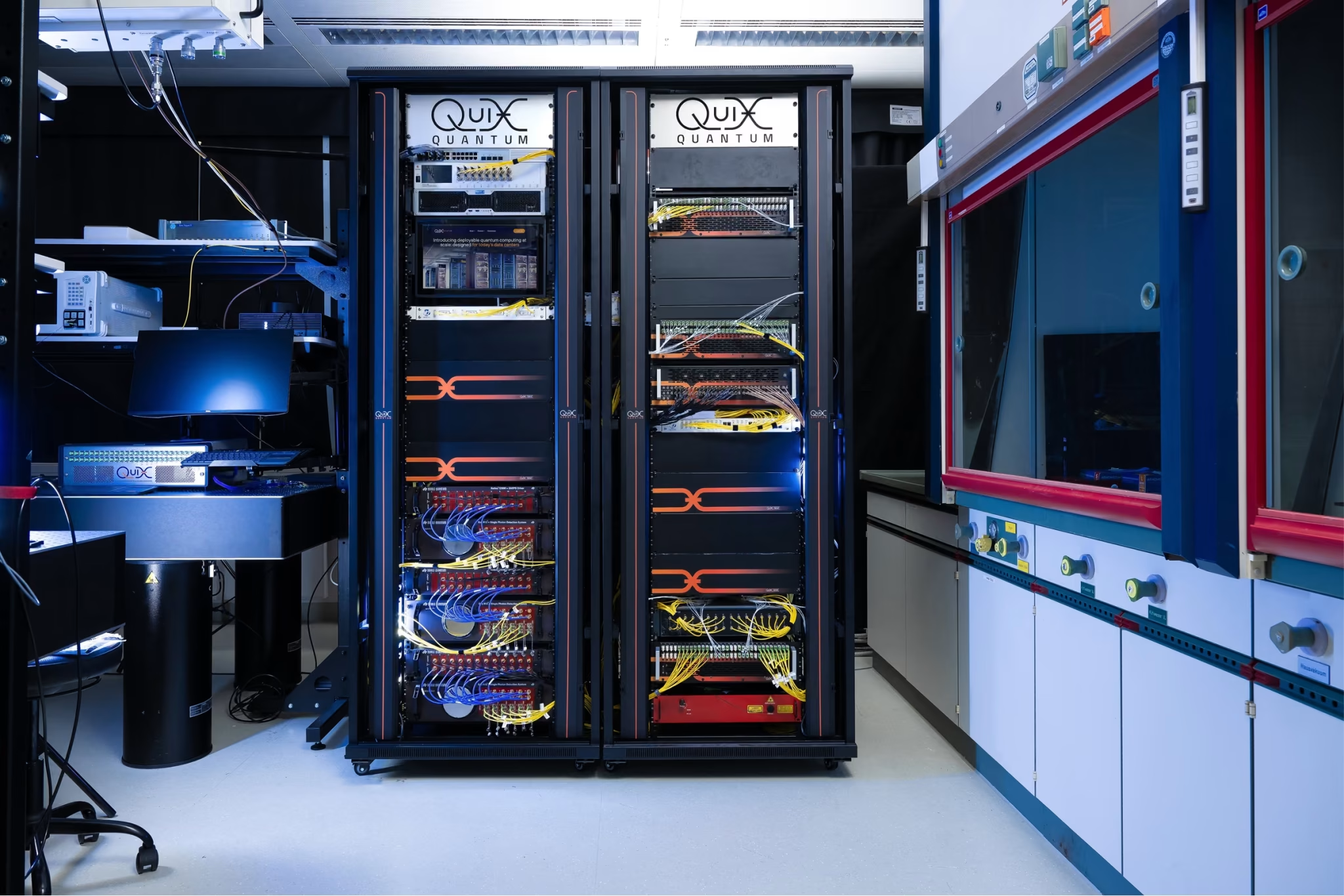
On July 14, 2026, QuiX Quantum announced Carina, a universal photonic quantum computing architecture designed for installation in standard data centers and intended as a foundation for future fault-tolerant systems. Unlike earlier special-purpose photonic systems limited to tasks like boson sampling, Carina is engineered to implement a universal gate-set, enabling it to run any gate-based quantum algorithm; the compact, room-temperature system integrates photon generation, multiplexing, and control technologies into a single stack. Developed within the DLR Quantum Computing Initiative, Carina addresses a long-standing challenge in the field, as Prof. Milburn of University of Queensland explains, “When Manny Knill, Raymond Laflamme and I published our linear optics quantum computing scheme in 2001, the central question was whether the probabilistic nature of photon-photon interactions could be tamed into something computationally universal.” According to Dr.-Ing. Stefan Hengesbach, CEO of QuiX Quantum, Carina.
The announcement of Carina by QuiX Quantum marks a pivotal shift in the pursuit of practical quantum computation; it is the first universal photonic quantum computing architecture engineered for deployment directly within customer data centers. This system, born from the Universal Photonic Quantum Computer (UPQC) project within the DLR Quantum Computing Initiative, integrates the essential technologies for measurement-based photonic quantum computing into a cohesive platform. The compact, room-temperature design of Carina distinguishes it from many competing quantum approaches that rely on extensive cryogenic infrastructure, simplifying deployment and integration with existing classical computing resources. The answer was yes in principle, but the engineering path looked formidable.” QuiX Quantum’s approach, combining photon generation, multiplexing, and fast feed-forward control, is demonstrably tackling that formidable path. Carina’s architecture builds upon recent advancements from QuiX, including the Feed Forward Control Unit and Photonic Assembly Control Unit, which facilitate real-time operation and standardized control of photonic chips. “Carina marks a major milestone for QuiX and the photonic quantum computing industry toward deploying utility-scale quantum systems at customer sites,” said Dr.-Ing. Stefan Hengesbach, CEO of QuiX Quantum. The company has demonstrated a production-ready method of error mitigation, suppressing qubit errors to levels compatible with scalable, fault-tolerant quantum computing, and outlined its Dedalo architecture to advance toward logical qubits. Prof. White, University of Queensland, emphasizes that “Quantum photonics aims to bring quantum technologies to a broader audience by leveraging the remarkable capabilities of the semiconductor fabrication industry,” and Carina represents a significant step in realizing that vision, offering a system designed for end users, not just laboratory research.
Carina marks a major milestone for QuiX and the photonic quantum computing industry towards deploying utility-scale quantum systems at customer sites.
Dr.-Ing. Stefan Hengesbach, CEO of QuiX Quantum
Feed Forward & Assembly Control Units Support System Integration
The current state of quantum computing system integration is characterized by a fragmented approach; many platforms still rely on specialized, often cumbersome, operating environments that hinder practical deployment. Extensive cryogenic infrastructure, for example, presents significant challenges for maintenance, integration, and scalability. QuiX Quantum’s recent advancements, specifically the development of Feed Forward Control Units (FFCU) and Photonic Assembly Control Units (PACU), represent a shift toward addressing these practical limitations, forming a crucial component of the newly announced Carina architecture. These units are not merely add-ons, but integral to enabling real-time operation and rack-based integration, essential steps for moving photonic quantum systems beyond the laboratory setting. The FFCU, according to QuiX, converts single-photon detector signals into control actions on photonic integrated circuits, while the PACU provides a standardized control layer for photonic chips and assemblies. Together, they support the monitoring and serviceability required for deployment in standard data center environments.
This focus on system-level engineering is particularly notable given the historical divide within the field, as described by Dr.-Ing. Stefan Hengesbach, CEO of QuiX Quantum: “The field has been split between systems that could be commercialized quickly but were not built for universal, fault-tolerant computing, and architectures with long-term scalability potential that remained difficult to deploy.” Carina, therefore, aims to bridge this gap by integrating these control systems directly into a universal photonic quantum computing architecture. This achievement, combined with the company’s Dedalo architecture white paper, focused on advancing from physical to logical qubits, highlights a holistic approach to building a complete, deployable quantum system. Robin Wittland, CCO of QuiX Quantum, emphasizes this point: The company’s strategy centers on building a full machine, controllable, maintainable, and scalable, rather than solely focusing on photonic chip design.
When Manny Knill, Raymond Laflamme and I published our linear optics quantum computing scheme in 2001, the central question was whether the probabilistic nature of photon-photon interactions could be tamed into something computationally universal.
Prof. Milburn, University of Queensland
QuiX Quantum’s recent unveiling of Carina isn’t simply the launch of another quantum computer; it represents a deliberate step toward addressing the practical hurdles of scaling photonic quantum systems, a challenge that has long shadowed theoretical advancements. Milburn notes that Carina moves beyond proof-of-concept demonstrations to a commercially viable architecture designed for integration into existing data center infrastructure. This focus on universality is coupled with a significant achievement in error mitigation. The company’s approach isn’t solely about the quantum processor itself, but the surrounding ecosystem. Stefan Hengesbach, CEO of QuiX Quantum, stated, “Carina is bringing those two requirements together into a universal architecture for installation into real customer environments.” The architecture’s design deliberately sidesteps the need for extensive cryogenic infrastructure, a common barrier to deployment for many quantum platforms. Instead, Carina leverages components compatible with optical networking and rack-based infrastructure, aiming to allow customers to begin building the operational layer around photonic quantum computing even before fully utility-scale systems are available.
What QuiX Quantum is showing with Carina and its measurement-based approach is that this path is not only tractable but navigable with integrated photonics.


See today’s quantum computing news on Quantum Zeitgeist for the latest breakthroughs in qubits, hardware, algorithms, and industry deals.