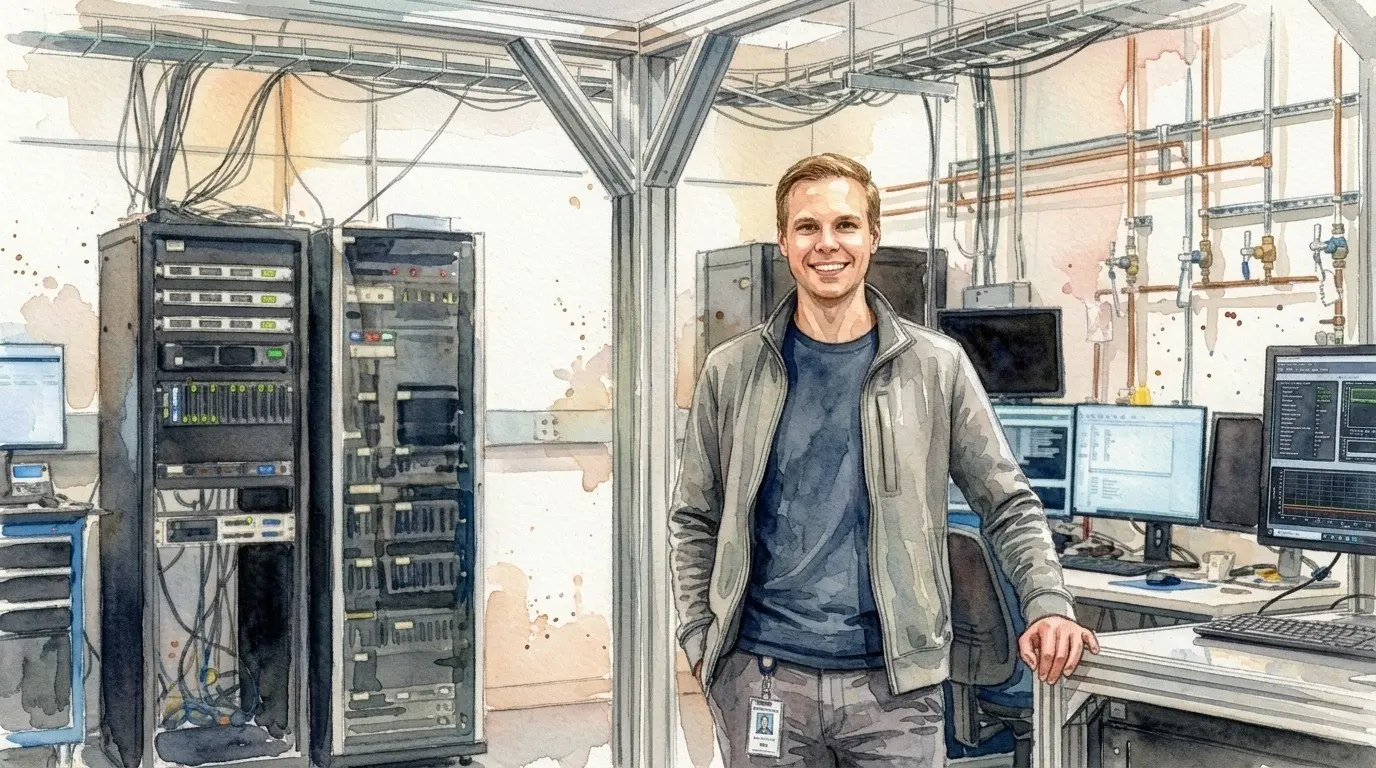
The venture investor who seeded a neutral-atom quantum company, then left the boardroom to run it and take it public.
He funded the company before he ran it. Matthew Kinsella was Infleqtion’s first institutional investor and joined its board in July 2018. In April 2024 he succeeded Scott Faris as chief executive.
He took Infleqtion public. The shares began trading on the New York Stock Exchange in February 2026, under his leadership. Infleqtion says that made it the first listed neutral-atom quantum company.
Infleqtion builds on neutral atoms. Atoms held in optical tweezers are identical by nature, which removes a manufacturing problem superconducting chips still have. The trade is slower gates.
His team reached its 2026 computing milestone. In September 2026 Infleqtion reported 30 entangled logical qubits built from 80 physical qubits. Its next target is 100 logical qubits by 2028.
The sensing business already has customers. Clocks and inertial sensors built on the same atomic physics sell today. The company reports as one segment, so it does not say how much of its revenue they account for.
The listing paid for the roadmap. Churchill expected the deal to bring Infleqtion more than $550 million before costs. The half-year report records $528.2 million delivered at closing, after redemptions, and the listing put the work on a quarterly reporting clock.
- The investor who wrote the first check, then took the job
- He was Infleqtion’s first institutional investor and joined its board in July 2018
- Infleqtion reached the New York Stock Exchange in February 2026
- Sensing sells today while the computers are still being built
- Identical atoms remove a manufacturing problem and cost gate speed
- In September 2026 his team ran 30 logical qubits on one machine
- Frequently asked questions
The investor who wrote the first check, then took the job
Matthew Kinsella is chief executive of Infleqtion. The firm is based in Louisville, Colorado, and builds quantum computers and sensors from neutral atoms. He did not start as a physicist. He was the venture investor who wrote the firm its first institutional check. Under him the company began trading on the New York Stock Exchange in February 2026, and Infleqtion says that made it the first neutral-atom quantum company to be listed in public.
Kinsella was an investor for nearly 20 years before succeeding Scott Faris as chief executive in April 2024. He came from Maverick Ventures. The press release that named him said he was a partner there and had led its stake in Infleqtion, while the annual report gives his title as managing director.
He was Infleqtion’s first institutional investor and joined its board in July 2018
Before Infleqtion, Matthew Kinsella spent his career at Maverick. It is a venture fund that backs companies at the early and growth stages. The company’s annual report says he worked there from August 2005 to April 2024, and sat on the boards of many private firms while he was there. He had earned a bachelor of business administration in finance from the University of Notre Dame in 2005.
He joined Infleqtion’s board in July 2018. That was more than ten years after Dana Anderson set up the company in Colorado in 2007. The annual report calls Kinsella its first institutional investor, which means the first fund, as opposed to individuals, to put money in.
Kinsella’s degree is in finance, not physics. The annual report on Matthew Kinsella credits him with “nearly two decades of investment experience across public equities and venture capital.” In its list of the people who run the firm, that investing record sits next to Anderson’s work on cold atoms and the quantum software skills of Pranav Gokhale, who runs the technology side.
Infleqtion reached the New York Stock Exchange in February 2026
Infleqtion was formed as a Colorado corporation on 7 February 2007 under the name ColdQuanta. It moved its legal home to Delaware in June 2018. In 2022 it took the name it has now. Its founder, Dana Anderson, is a cold-atom physicist and a professor at the University of Colorado, and he now serves as the firm’s chief science officer. The firm designs quantum computers that use neutral atoms. It also sells quantum sensors, such as atomic clocks, radio-frequency (RF) receivers, and inertial sensors, which track how things move.
Under Kinsella, the firm merged with Churchill Capital Corp X on 13 February 2026. Its shares began trading on the New York Stock Exchange under the ticker INFQ on 17 February 2026. Churchill had promised, before the deal closed, to bring Infleqtion over $550 million in gross proceeds, which means the cash raised before any fees or costs are taken out.
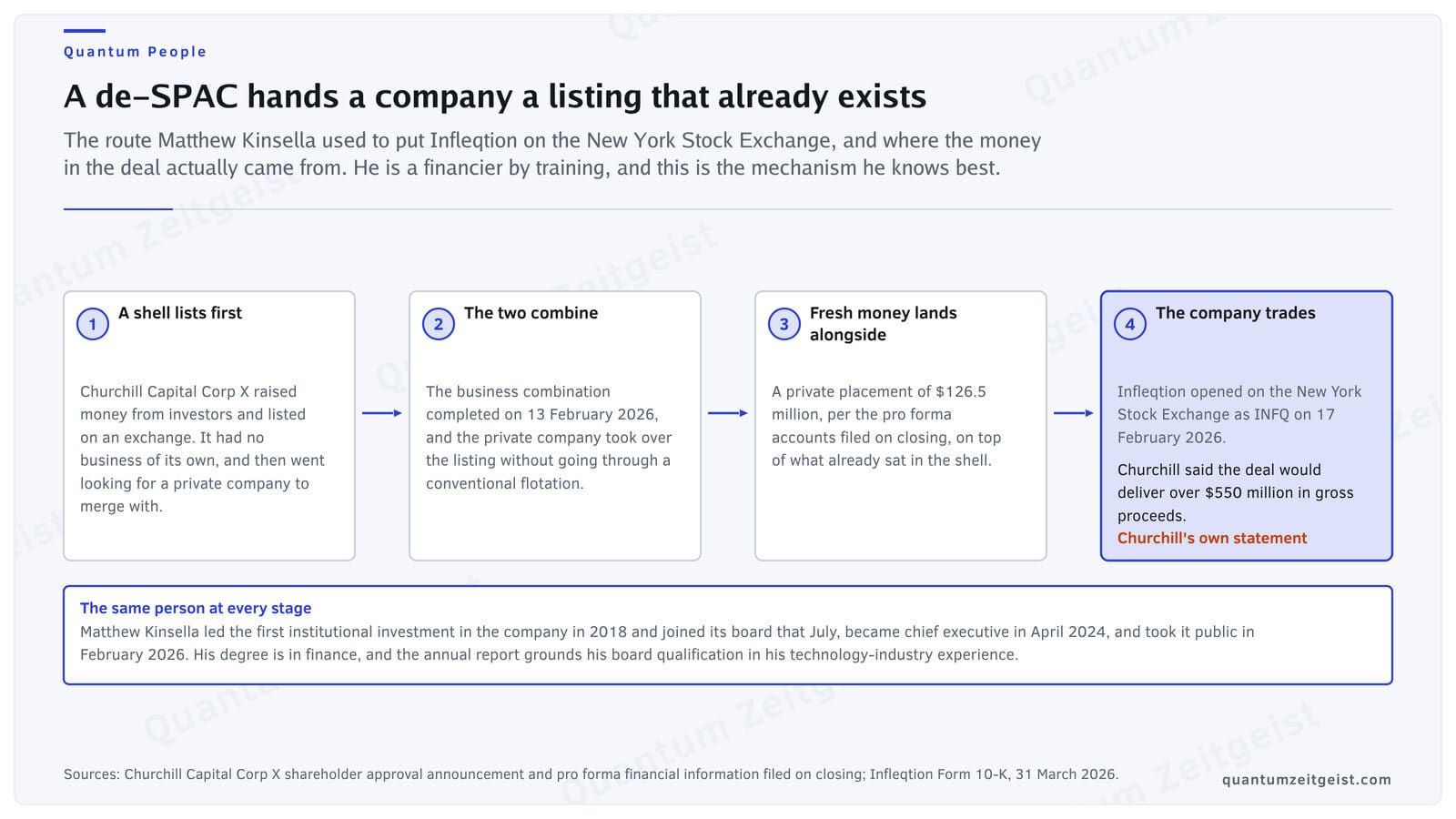 Tap the diagram to open it full size.
That figure took in nearly all the cash in the shell’s trust account, plus a private placement sold to investors alongside it. The pro forma accounts filed on closing put that placement at $126.5 million. That was 12,654,760 shares at $10.00 each. Churchill said the money would speed up Infleqtion’s roadmap and its product sales, and the half-year report records $528.2 million delivered at closing, after some shareholders took their cash back.
Going public was as much about money as strategy. The same report says the company expects losses and higher spending “for the foreseeable future as we invest in the development and commercialization of our technologies.” A listing gives that work access to a deeper pool of money, from public investors who can buy and sell the shares every day, and in return it brings quarterly reporting and clear targets. The shares opened at $14.25 and closed at $15.59 on 17 February 2026, have traded between $8.52 and $21.28 since, and closed at $11.04 on 9 October 2026.
Its second-quarter report needed more time. On 17 August 2026 a notice said the company had found an error in how it booked revenue, and would revise its figures for 2024, 2025 and the first quarter of 2026. It said the adjustments “were not material” and “primarily affect the timing of revenue recognition”, and it tied the error to a material weakness it had already disclosed, a “lack of sufficient accounting personnel.” On 18 August an amended filing corrected the second-quarter results release and the 2026 revenue outlook.
Sensing sells today while the computers are still being built
Infleqtion sells sensors today while it is still building its computers. Its annual report says its quantum clocks and RF sensors are already “sensing the world with superior precision relative to classical state-of-the-art systems.” Money from sensor sales and research contracts gives it what it calls “immediate market validation.” The company reports as a single segment, which means it gives one set of figures for the whole business, so it does not say how much of its revenue the sensors earn.
The report says its service revenue is “derived primarily from governmental contract revenue for research-related projects, commercial service revenue and revenue from our subscription services.” Kinsella set out the plan in April 2024. “Our focus on clocks, RF, compute, and quantum-enabled AI software presents growing and near-term revenue opportunities,” he said in the release. The computers are the bigger goal and the longer wait, so the sensors show how the firm earns money today, while the computing roadmap shows how it plans to grow.
Identical atoms remove a manufacturing problem and cost gate speed
Neutral-atom quantum computing uses single atoms as its qubits, the units that hold its data. Tightly focused laser beams called optical tweezers hold them in place. Every atom of a given element is the same as every other, so the approach offers a path to large arrays of matching qubits that can be moved and linked in flexible ways. The same atom physics that drives these computers also lies behind precise sensors and atomic clocks. That is why Infleqtion can do both at once.
Quantum sensing is for jobs where great precision matters. Timing, navigation and picking up faint signals are the examples. Under Kinsella the firm aims those products at defence, aerospace and commercial buyers, a market that does not need to wait for fault-tolerant computers, which can fix their own errors as they run.
Infleqtion grew out of decades of work on cold atoms, which ran under the ColdQuanta name until 2022. Kinsella has run both its computing and its sensing lines since April 2024, and he took them to market as a listed company.
The approach gives up speed. Neutral-atom gates, the basic steps of a program, take microseconds, against the tens of nanoseconds a superconducting chip needs, but the atoms keep their quantum state long enough that this can be lived with. To read an atom out, you shine light on it and collect the light it scatters, which is slower than the microwave readout a superconducting chip uses. Error correction needs fast measurement, over and over. That readout speed is still being worked on, not a solved problem.
In September 2026 his team ran 30 logical qubits on one machine
On 24 September 2026 Infleqtion said its Sqale computer had run 30 entangled logical qubits, built from 80 physical qubits. A logical qubit is a group of physical qubits that software makes work together as one, so that a slip in any single atom can be caught before it spoils the answer. The company called it a key milestone on its 2026 roadmap. Its target is 100 logical qubits by 2028, and it says it already has “three customers for logical qubit circuits” on the machine.
He gave the credit to his team. “Getting 30 logical qubits to work together is hard, and our team has done it,” he said in the announcement filed with the SEC. He added that the company was already working on applications with customers, and that the goal was a quantum computer able to take on problems they cannot solve today.
Frequently asked questions
Who is Matthew Kinsella?
What company does Matthew Kinsella lead?
When did he become CEO of Infleqtion?
What did Matthew Kinsella do before Infleqtion?
What is Infleqtion known for?
Did Infleqtion go public under his leadership?
What is neutral-atom quantum computing?
What education does Matthew Kinsella have?
Why is Matthew Kinsella significant in quantum computing?
Legal disclaimer
Quantum Zeitgeist does not provide personal investment or financial advice, and does not act as a personal financial, legal, or institutional investment adviser. We do not individually advocate the purchase or sale of any security or investment, or the use of any particular financial strategy, and all investment strategies carry the risk of loss for some or even all of your capital.
Before pursuing any financial strategy discussed here, or relying on information within this website, you should always consult a licensed financial adviser. Any analysis we provide is for informational purposes only, does not take your circumstances into account, and should not be treated as an individualised recommendation, since the securities mentioned may not be suitable for all investors.




See today’s quantum computing news on Quantum Zeitgeist for the latest breakthroughs in qubits, hardware, algorithms, and industry deals.