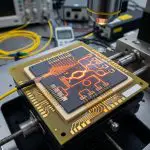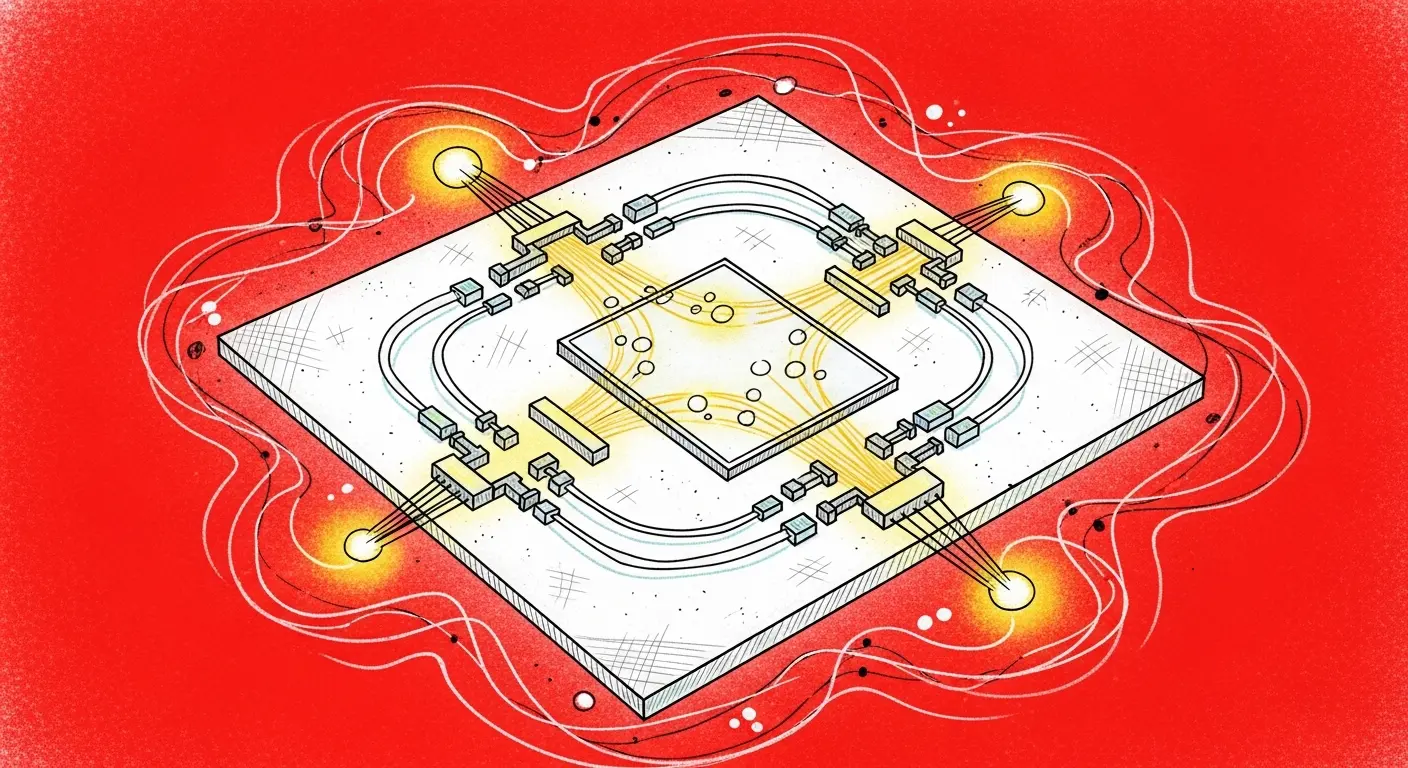
1. The unit is a two-level quantum system in continuous superposition. Where a classical bit is either 0 or 1, the quantum unit is described by |ψ⟩ = α|0⟩ + β|1⟩ with complex amplitudes α and β satisfying |α|² + |β|² = 1, the full surface of the Bloch sphere as the space of states.
2. Seven physical implementations ship in 2026 hardware. Superconducting transmons (IBM, Google, Rigetti, IQM), trapped ions (IonQ, Quantinuum, AQT), neutral atoms (QuEra, Pasqal, Atom Computing), photons (Xanadu, PsiQuantum, Quandela), silicon spin (Intel, Diraq, Quantum Motion), cat qubits (Alice and Bob), and NV-centre diamond (Quantum Brilliance) all encode qubits in physically different two-level systems.
3. Single-qubit gates rotate the state on the Bloch sphere. The Pauli X, Y, Z gates, the Hadamard, the phase gate, and the T gate together generate every single-qubit operation up to a global phase; the Hadamard plus T is the canonical universal single-qubit set.
4. Two-qubit gates entangle qubits. The CNOT (controlled-NOT), CZ (controlled-Z), iSWAP, and SWAP gates are the most-used two-qubit primitives; one Hadamard plus one CNOT on |00⟩ produces the |Φ+⟩ Bell state, the canonical first quantum-information lab experiment.
5. Measurement collapses the state and yields a classical bit. Reading the state in the standard (Z) basis yields 0 with probability |α|² and 1 with probability |β|², after which the system is in the corresponding basis state. The pre-measurement superposition is destroyed; the no-cloning theorem prevents copying it first.
6. Decoherence sets the lifetime. T1 (energy-relaxation time) and T2 (dephasing time) are the two timescales every modality reports; trapped-ion qubits coherence is seconds, neutral atoms tens of seconds, superconducting transmons hundreds of microseconds, photonic qubits effectively transit-time limited.
7. Logical qubits are built from many physical qubits. A logical bit of quantum information is encoded into many physical qubits through a quantum error correction code; today’s logical qubits cost dozens to thousands of physical qubits each, and the QuEra January 2026 96-logical-qubit demonstration uses 448 physical atoms and a [[16,6,4]] qLDPC code.
8. The primitive is universal across applications. The same hardware runs Shor’s factoring algorithm, Grover’s search, variational chemistry, machine learning, simulation, and quantum-key-distribution protocols. The architectural choice is which physical type maps best to the specific workload, the fidelity-versus-qubit-count tradeoff, and the operational footprint of the modality.
The qubit without the maths
The simplest mental picture is a coin balanced on its edge. A classical bit is the coin already landed, heads or tails, one or zero, full stop. A quantum bit is the coin still spinning, with both heads and tails still in play, and the spinning state itself is a fully describable thing in quantum mechanics even though the coin has not landed yet. When the system is finally measured (the coin lands), it collapses to one of the two faces, and the probability of each outcome is set by exactly how the unit was spinning before measurement. The strange part is that the spinning has structure that classical bits cannot have. Two qubits can be set up so that even though neither one has landed yet, their landings will always match (or always disagree) when finally measured, a correlation stronger than any classical pair of spinning coins can produce. Many qubits can be set up so that the joint pre-measurement state explores more configurations than a classical computer could enumerate in any reasonable time, the resource that makes quantum computing more powerful than classical computing on specific algorithms. The physical implementations are varied. Some qubits are tiny circuits cooled to a hundredth of a degree above absolute zero so that the electrical currents flowing in them are quantum-mechanically coherent. Some are individual atoms held in vacuum and addressed with precisely-tuned laser pulses. Some are individual photons running through silicon-photonic chips. Some are electrons trapped on a silicon chip, the same kind of silicon that powers a regular processor. Each of these systems can be put into the coin-still-spinning superposition, and each lets you read out a 0 or 1 at the end of the computation. The economics of qubits is brutal. Physical qubits make errors at rates around one in 1,000 to one in 10,000 per gate, far worse than classical-bit error rates, and a useful quantum algorithm needs billions of operations. The fix is logical qubits, where many physical qubits are wired together through a quantum-error-correction code to produce one well-protected logical unit. Today’s logical qubits cost dozens to thousands of physical qubits each, and the central engineering race of 2026 is to drive that ratio down while keeping logical-error rates low enough for useful computation to finish before decoherence wins.What is a qubit, exactly?
It is a two-level quantum system whose state lives in a two-dimensional complex Hilbert space spanned by the orthonormal basis vectors |0⟩ and |1⟩. The general pure state is |ψ⟩ = α|0⟩ + β|1⟩ with complex amplitudes α and β satisfying the normalisation condition |α|² + |β|² = 1. The two amplitudes carry the full state information up to a global phase, and the surface of the Bloch sphere is the geometric picture of every possible pure-state configuration.|ψ⟩ = α|0⟩ + β|1⟩
where |α|² + |β|² = 1
and α, β are complex amplitudesA brief history of the qubit
The concept as a formal abstraction was introduced by Benjamin Schumacher in 1995 in the same paper that proved the quantum equivalent of Shannon’s noiseless source-coding theorem (the foundational result of quantum information theory). The underlying physics, of course, predates the name: the two-level quantum systems that Schumacher’s qubit formalised had been studied since the 1920s in atomic physics, since the 1960s in NMR, and since the 1980s in the proposals for quantum computing from Paul Benioff, Richard Feynman, and David Deutsch. Schumacher’s contribution was the formal abstraction that decoupled the unit of quantum information from any specific physical implementation. The 2020s have been the decade when the modality moved from research-grade demonstration to commercial production. IBM Quantum exposed real-customer qubits via cloud APIs starting in 2016, IonQ went public on NYSE in 2021, Quantinuum announced its Helios system with 98 physical qubits and 48 logical qubits in November 2025, and QuEra demonstrated 96 logical qubits from 448 physical atoms in January 2026. The 2026 state of the art is millions of physical qubits across the deployed industry fleet, spread across seven distinct physical implementations.Qubit versus classical bit
The cleanest comparison runs along five dimensions.| Dimension | Classical bit | Qubit |
|---|---|---|
| State space | Two values: 0 or 1 | Continuous superposition of |0⟩ and |1⟩, full surface of the Bloch sphere |
| Copying | Trivially copyable; classical RAID and ECC work fine | Forbidden by the no-cloning theorem; cannot copy an unknown qubit |
| Measurement | Non-destructive; can read repeatedly without changing the state | Destructive; measurement collapses the qubit to a basis state and the pre-measurement superposition is gone |
| Error rate | Roughly 10^-17 per operation (thermal noise far below the bit-flip energy barrier) | 10^-3 to 10^-4 per gate on the 2026 best published hardware; logical qubits push this lower through QEC |
| Entanglement | None; classical correlations require shared randomness | Joint states cannot in general be factored into single-qubit states; the resource behind quantum advantage |
The Bloch sphere
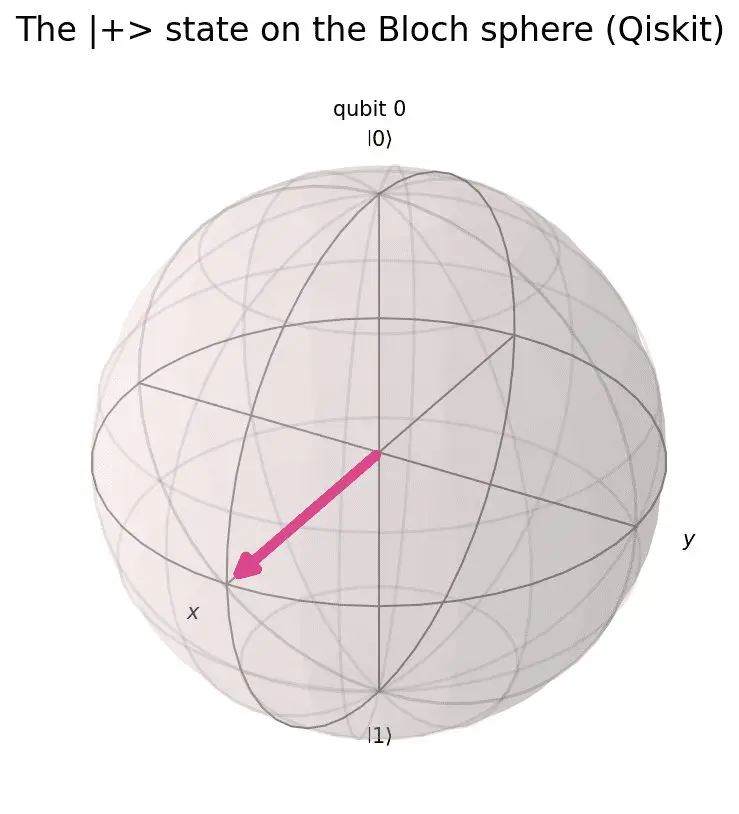
plot_bloch_vector output for the |+⟩ state, the equal superposition (|0⟩+|1⟩)/√2 produced by a Hadamard gate on |0⟩. Every pure single-qubit state is a point on this unit sphere, and every single-qubit gate is a rotation that moves the arrow across its surface.|ψ⟩ = cos(θ/2)|0⟩ + e^{iφ}sin(θ/2)|1⟩
θ = 0: |0⟩ (north pole)
θ = π: |1⟩ (south pole)
θ = π/2: (|0⟩+e^{iφ}|1⟩)/√2 (equator)The seven physical qubit implementations of 2026
The same abstract qubit picture maps onto seven different physical-system choices in 2026 production hardware. The choice of physical implementation drives gate fidelity, qubit-count ceiling, coherence time, operational temperature, and capital expenditure per qubit.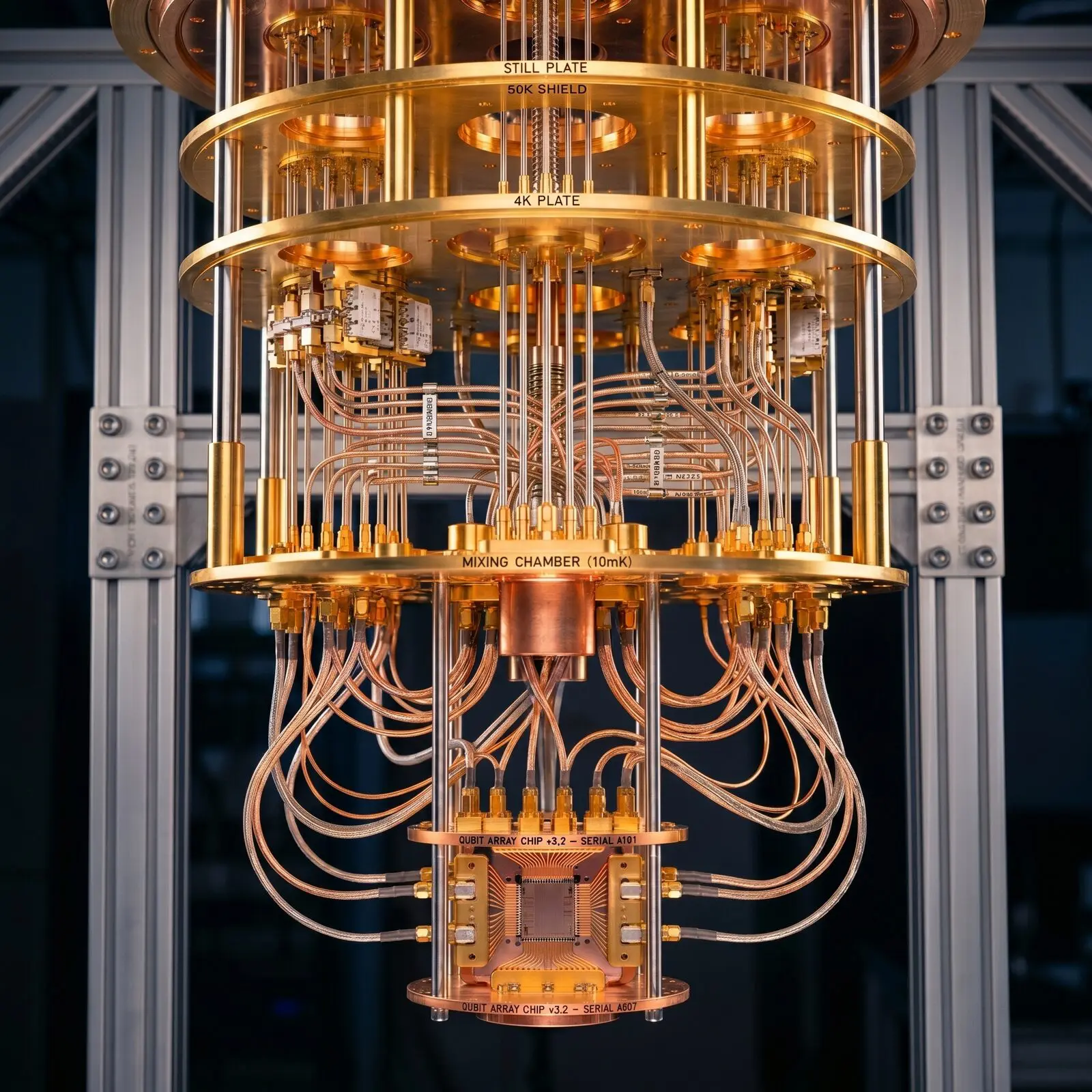
The seven implementations at a glance
The fidelity leader at 99.99% two-qubit gates on IonQ Forte. Vendors: IonQ, Quantinuum, AQT, eleQtron, Universal Quantum. Encoding uses two long-lived hyperfine or optical-clock energy levels of a single atomic ion (ytterbium, calcium, barium) held in a radio-frequency Paul trap. Coherence times are seconds, the longest of any modality. See our trapped-ion pillar.
The steepest qubit-count scaling curve in the industry. Vendors: QuEra, Pasqal, Atom Computing, Infleqtion, planqc. Encoding uses two long-lived ground or hyperfine states of a single neutral atom (rubidium-87, strontium-88, strontium-87) trapped in optical tweezers; two-qubit gates use the Rydberg blockade. QuEra demonstrated 96 logical qubits on 448 physical atoms in January 2026. See our neutral-atom pillar.
The only modality that runs at room temperature. Vendors: PsiQuantum, Xanadu, Quandela, ORCA, QuiX, Aegiq, Sparrow Quantum, Photonic Inc, TuringQ, OptQC, plus the networking layer (Nu Quantum, Qunnect). Encoding lives in the polarisation, time-bin, or path-degree of an individual photon (discrete-variable) or the squeezed-light state of a continuous-variable mode. See our photonic pillar.
The modality with the deepest classical-fabrication compatibility. Vendors: Intel, Diraq, Equal1, SiQuance, Quantum Motion. Encoding is the spin state of a single electron in a silicon quantum dot, addressed with microwave pulses and ESR techniques. Standard CMOS-foundry fabrication is the structural advantage, and intel reported 12-qubit production arrays in late 2024.
Information lives in the superposition of coherent states of a microwave cavity. Vendor: Alice and Bob (Paris, Boson 4 system at 16 cat qubits with one-hour bit-flip lifetime as of September 2025). The bosonic-mode encoding provides hardware-level bit-flip suppression, dramatically reducing the physical count per logical qubit compared to standard surface-code architectures.
The room-temperature solid-state option. Vendors: Quantum Brilliance (Australia, room-temperature diamond NV-centre quantum computers), XeedQ (Germany). Encoding is the electron spin of a nitrogen-vacancy defect in diamond. Strong photonic interfaces make NV diamond a natural fit for quantum networking, and Quantum Brilliance shipped a 5-qubit NV-centre system to Pawsey Supercomputing Centre in 2024.
Single-qubit and two-qubit gates
A quantum gate is a unitary operation that transforms the state, the quantum-mechanical analogue of a classical logic gate. Single-qubit gates rotate the state on the Bloch sphere; two-qubit gates entangle and are what make quantum computing more powerful than classical computing.Single-qubit gates
Combines a bit flip with a phase flip, a 180-degree rotation around the y-axis of the Bloch sphere. Together with X and Z it generates every Pauli operation up to global phase.
Flips the sign of the |1⟩ amplitude, a 180-degree rotation around the z-axis. Pauli Z plus Pauli X generates every Pauli operation up to global phase.
Takes |0⟩ to (|0⟩+|1⟩)/√2 and |1⟩ to (|0⟩-|1⟩)/√2. The Hadamard is the canonical superposition-creator and is the first gate in every Bell-state preparation circuit.
Adds a phase to the |1⟩ amplitude. S is a 90-degree z-rotation, T is a 45-degree z-rotation. T is the canonical non-Clifford gate and is what makes a quantum circuit universal in the fault-tolerant setting.
Continuous-angle rotations around the three Bloch-sphere axes. Standard parametrised gates used in variational algorithms and quantum machine learning.
Two-qubit gates
The most-used two-qubit gate. Flips the target qubit if the control qubit is |1⟩, leaves it alone if the control is |0⟩. One Hadamard plus one CNOT on |00⟩ produces the maximally-entangled Bell state |Φ+⟩ = (|00⟩+|11⟩)/√2.
Adds a -1 phase to the |11⟩ component, leaves the others unchanged. CZ is the dominant native two-qubit gate on neutral-atom Rydberg-blockade hardware and is locally equivalent to CNOT.
Exchanges the |01⟩ and |10⟩ components with a 90-degree phase. iSWAP is the native gate on many superconducting platforms because it is what tunable couplers naturally produce.
Exchanges the states of two qubits without entanglement. Useful for moving information around a chip but not by itself a source of quantum advantage.
A three-qubit gate (controlled-controlled-NOT) that flips the third qubit if both controls are |1⟩. Toffoli is universal for classical computation and useful as a primitive in quantum algorithms.
The native trapped-ion two-qubit gate. Uses a shared motional mode of the ion chain to entangle two qubits through state-dependent forces with laser pulses, the workhorse gate on IonQ and Quantinuum hardware.
Measurement and the no-cloning theorem
Reading the state in the standard (Z) basis returns 0 with probability |α|² and 1 with probability |β|², after which the system is in the corresponding basis state (|0⟩ or |1⟩). The pre-measurement superposition is gone, and the only thing left is a classical bit and the device in the matching basis state. Measuring in a different basis (X, Y, or an arbitrary direction on the Bloch sphere) projects onto that basis instead, but the destructive nature of the projection is the same. The no-cloning theorem (Wootters and Zurek, 1982) proves that no quantum operation can produce a copy of an unknown quantum state. The proof is short: if a cloning operation existed, it would have to be linear (unitarity demands this), but the cloning map is non-linear when applied to superposition states. The no-cloning result is what makes quantum cryptography secure (an eavesdropper cannot copy the quantum-channel transmission and read it later) and what makes quantum error correction non-trivial (you cannot just keep a backup copy of the encoded state). The combination of measurement destruction and no-cloning is why quantum error correction needs the elaborate stabilizer-and-syndrome machinery rather than a simple repetition code. See our guide to quantum error correction for the full treatment of how the field works around these constraints.Decoherence and the T1, T2 lifetimes
A real hardware unit is never perfectly isolated from its environment. Every coupling between the system and the surroundings (stray electromagnetic fields, thermal phonons, scattered photons, control-pulse noise) drives decoherence, the process where the encoded information leaks into the environment and the state degrades from a pure superposition to a classical mixture. Two timescales characterise the decoherence dynamics. T1 is the energy-relaxation time, the timescale over which a state in |1⟩ spontaneously relaxes to |0⟩. T2 is the dephasing time, the timescale over which the relative phase between |0⟩ and |1⟩ amplitudes randomises. T2 is always less than or equal to 2 T1; in practice T2 is often the binding constraint for quantum-algorithm design because phase information drives quantum interference and quantum interference is the source of the algorithmic speedup over classical computation.| Modality | Best published T1 | Best published T2 | 2026 leader |
|---|---|---|---|
| Superconducting transmon | ~300 microseconds | ~200 microseconds | IBM Heron R2 |
| Trapped ion | seconds to hours (effectively unlimited) | ~10 seconds | IonQ Forte, Quantinuum Helios |
| Neutral atom | ~1-10 seconds | ~1 second | QuEra, Pasqal, Atom Computing |
| Photonic | Limited by transmission rather than coherence | Transit-time limited | Xanadu, PsiQuantum |
| Silicon spin | ~1 second (isotopically purified silicon) | ~1 millisecond | Diraq, Intel |
| Cat qubit (bosonic) | ~1 hour bit-flip lifetime | Phase-flip corrected by outer code | Alice and Bob Boson 4 (Sep 2025) |
| NV-centre diamond | ~1 millisecond at room temperature | ~1 millisecond | Quantum Brilliance |
Physical versus logical qubits
A physical unit is a single hardware element with its native physical error rate (one in to one in per gate in 2026 best-published hardware). A logical unit is a protected encoded state built from many physical qubits through a quantum-error-correction code with a much lower effective error rate. Logical qubits are what useful quantum algorithms actually run on, and the 2024-2026 wave of demonstrations (QuEra 96 logical qubits in January 2026, Quantinuum Helios 48 logical qubits in November 2025, Atom Computing 24 logical qubits in November 2024 with Microsoft, Google Willow with one verified logical qubit in December 2024) crossed the threshold from theoretical certainty to working hardware.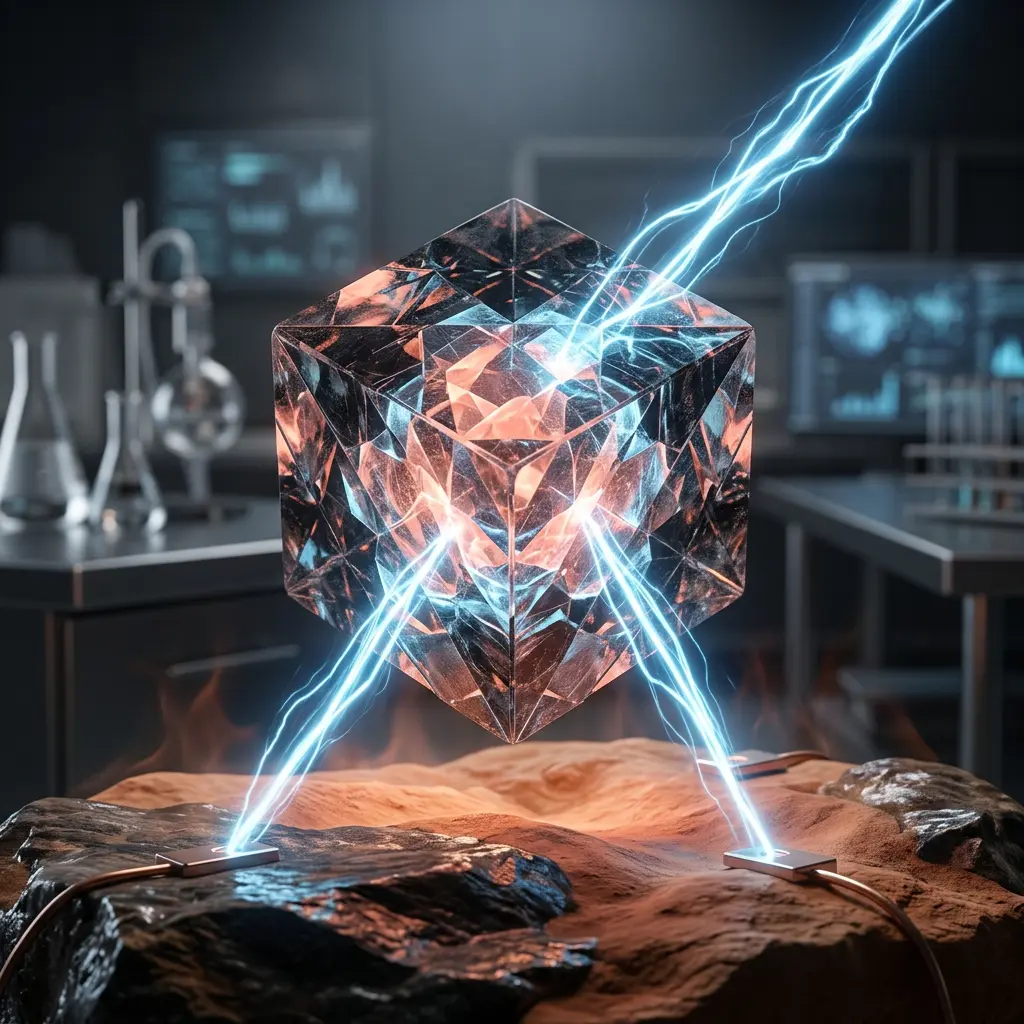

Primary sources
The references below are the canonical primary sources for the qubit as a formal concept and the foundational no-cloning result. Every entry links to a stable primary URL.
- Schumacher. “Quantum coding.” Phys. Rev. A 51, 2738 (1995). The paper that introduced the qubit as a formal unit of quantum information.
- Wootters and Zurek. “A single quantum cannot be cloned.” Nature 299, 802-803 (1982). The no-cloning theorem for an unknown qubit.
- Nielsen and Chuang. “Quantum Computation and Quantum Information.” qubit, Bloch sphere, and gate-set foundational textbook, Cambridge University Press. The standard graduate-level reference.
Further reading and tutorials
Each link below is a deeper companion piece on the QZ site. Start with the parent guide if you want the bigger picture, then drop into the maths and history primers for the foundations behind the qubit.
- What is quantum computing? The complete 2026 guide, the parent pillar this article belongs to.
- Quantum mechanics basics for quantum developers, a hands-on primer on the physics every qubit engineer needs.
- An introduction to Hilbert space, the mathematical setting the qubit lives in.
- The double-slit experiment, where superposition first showed up in the lab a century before the word qubit existed.
- History of quantum computing, a chronology from Feynman’s 1981 lecture to the 2026 logical-qubit demonstrations.
- Top 50 quantum computing terms, a tutorial glossary that fills in every concept this article touches.
- Quantum computing glossary, the encyclopedic reference for definitions.
Frequently asked questions
What is a qubit in simple terms?
It is the quantum analogue of a classical bit, the foundational unit of information in a quantum computer. Where a classical bit is either 0 or 1, it can be in a continuous superposition of both, described mathematically as |ψ⟩ = α|0⟩ + β|1⟩ with complex amplitudes α and β. Measuring this state returns 0 or 1 with probabilities set by the amplitudes, and the pre-measurement superposition is destroyed.
How is a qubit different from a classical bit?
A classical bit has two possible states (0 or 1) and is read non-destructively, while a qubit has a continuous space of states (the whole Bloch sphere) and measurement collapses it to a basis state. Classical bits can be copied freely; the no-cloning theorem prevents copying an unknown quantum state. Classical bits make errors at roughly per operation; qubits make errors at to per gate. The fundamental difference that enables quantum computing is that multi-qubit states can be entangled, with joint properties that cannot be reproduced by any classical correlation.
What physical systems can be used as qubits?
Seven implementations ship in 2026 hardware: superconducting transmons (IBM, Google, Rigetti, IQM), trapped ions (IonQ, Quantinuum, AQT), neutral atoms in optical tweezers (QuEra, Pasqal, Atom Computing, Infleqtion, planqc), photons (PsiQuantum, Xanadu, Quandela, ORCA, QuiX, Aegiq, Sparrow Quantum, Photonic Inc, TuringQ, OptQC), silicon spin (Intel, Diraq, Quantum Motion, Equal1, SiQuance), cat qubits (Alice and Bob), and NV-centre diamond (Quantum Brilliance). Topological qubits (Microsoft Majorana 1) are heavily funded but have not yet shipped commercial systems.
What is the Bloch sphere?
The Bloch sphere is the geometric picture of a single-qubit state. The north pole is the basis state |0⟩, the south pole is |1⟩, and every other pure-state qubit configuration sits somewhere on the surface of the unit sphere. The state is parametrised as |ψ⟩ = cos(θ/2)|0⟩ + {iφ}sin(θ/2)|1⟩ with polar angle θ from the north pole and azimuthal angle φ around the equator. Every single-qubit gate becomes a rotation on the sphere, which is why the Bloch-sphere picture is so useful for intuition.
How many qubits do today’s quantum computers have?
The 2026 high-end deployments span IBM Condor at 1,121 superconducting qubits, IBM Heron R2 at 156 qubits with 99.5% two-qubit fidelity, IQM Radiance at 150 qubits with 99.91% fidelity, Atom Computing Phoenix at 1,180 neutral-atom qubits, and Rigetti Ankaa-3 at 108 superconducting qubits.
The trapped-ion and neutral-atom side runs IonQ Tempo AQ64 at 256 trapped-ion qubits, Quantinuum Helios at 98 trapped-ion qubits and 48 logical qubits, QuEra at 448 physical atoms with 96 verified logical qubits, Pasqal at 324 physical atoms, Infleqtion Sqale at 1,600 neutral atoms, and Anyon Systems MonarQ at 24 qubits. The leaderboard moves quickly because every quarter a vendor crosses a new qubit-count or logical-qubit milestone.
What is the difference between a physical qubit and a logical qubit?
A physical one is a single hardware element with its native error rate (typically to per gate in 2026 best published systems). A logical one is a protected encoded state built from many physical qubits through a quantum-error-correction code with a much lower effective error rate. Logical qubits are what useful quantum algorithms run on, and the encoding ratio ranges from single digits (cat qubits with bosonic protection) through dozens (qLDPC codes) up to thousands (surface code at large distance).
What are T1 and T2 in qubit hardware?
T1 is the energy-relaxation time, the timescale over which a system in the excited state |1⟩ spontaneously decays to the ground state |0⟩. T2 is the dephasing time, the timescale over which the relative phase between the two basis amplitudes randomises. T2 is always less than or equal to 2 T1, and T2 is usually the binding constraint for algorithm design because phase information drives quantum interference. The 2026 state of the art is microseconds (superconducting transmon T2 around 200 us), seconds (trapped ion, neutral atom), milliseconds (silicon spin, NV-centre diamond), or hours (Alice and Bob cat qubits for the bit-flip channel).
Why cannot a quantum bit be copied?
The no-cloning theorem (proved by Wootters and Zurek in 1982) shows that no quantum operation can produce a perfect copy of an unknown quantum state. The proof is short: a copying operation would have to be linear under quantum mechanics, but the act of copying is mathematically non-linear when applied to superposition inputs. The practical consequence is that classical-style redundancy (backups, RAID) cannot be applied to quantum information; quantum error correction must work without copying the encoded information. The no-cloning theorem is also what makes quantum-key-distribution protocols information-theoretically secure.
How do you create entanglement between two qubits?
The simplest recipe is one Hadamard plus one CNOT. Start with two qubits in |00⟩, apply a Hadamard to qubit A to put it in (|0⟩+|1⟩)/√2, then apply a CNOT controlled on A targeting B. The CNOT flips qubit B when A is |1⟩ and leaves it alone when A is |0⟩, producing the maximally entangled Bell state (|00⟩+|11⟩)/√2. The whole circuit is two gates and the output state is the canonical first quantum-information lab experiment. See our quantum entanglement guide for the four Bell states and how they map to teleportation, dense coding, and entanglement-based QKD.
What is superposition?
Superposition is the property of a single quantum system that lets it be in a linear combination of basis states rather than in a definite one. A quantum bit in superposition is described by |ψ⟩ = α|0⟩ + β|1⟩ with complex amplitudes α and β; the amplitudes determine the probability of measuring 0 (|α|²) versus 1 (|β|²) on a Z-basis read. Superposition is a property of a single quantum system, while entanglement is a property of two or more quantum systems with correlations that cannot be reproduced by classical means. Both phenomena are fundamental to quantum computing.
What is the best type today?
It depends on the application. Trapped-ion qubits hold the gate-fidelity record at 99.99% two-qubit fidelity (IonQ Forte, Oxford Ionics) and seconds-long coherence times, making them best for high-precision chemistry and small-circuit fault-tolerance. Superconducting transmon qubits have the deepest deployed customer base (IBM, Google) and the fastest gate speeds (nanoseconds), best for high-qubit-count algorithms. Neutral-atom qubits have the steepest fastest qubit-count growth curve (over 1,000 qubits on Atom Computing Phoenix) and reconfigurable connectivity, best for logical-qubit demonstrations. Photonic qubits run at room temperature and use silicon-photonics fabrication, best for distributed quantum computing and quantum-networking. The architectural choice is application-driven.
Can a qubit have more than two states?
By strict definition, the primitive is a two-level quantum system. Higher-dimensional analogues exist and are called qudits (qutrits for three levels, ququarts for four, and so on). Some quantum-computing platforms exploit the higher-level structure of the underlying physics, for example using three or four levels of a trapped-ion or transmon system to encode a qutrit or ququart in a single hardware site. Continuous-variable photonic platforms (CV) (Xanadu, QuiX) work in an infinite-dimensional Hilbert space where the qudit picture is replaced by the squeezed-light-mode picture, but for the discrete-variable case the two-level definition is the standard.



See today’s quantum computing news on Quantum Zeitgeist for the latest breakthroughs in qubits, hardware, algorithms, and industry deals.