There is no single way to build a quantum computer. Top quantum hardware companies in 2026 are split across six of them, five mainstream and one catch-all. The mainstream camps are superconducting, trapped-ion, neutral-atom, photonic and silicon-spin. The sixth gathers the specialty platforms that fit none of those, namely topological, cat-qubit, annealing and NV-diamond.
This guide takes the leading commercial vendor in each camp, with its latest milestones, its qubit counts, and links to deeper coverage of both the company and the technology behind it.
The numbers above benchmark the state of quantum hardware in 2026. Sources: company filings, Nature, and the entangledfuture.com Quantum Navigator.
How We Selected These Companies
A company makes the leading quantum hardware vendors list only if it passes all five gates:
- Operating hardware, not simulators or pure software. Must have a named physical platform.
- Customer-accessible in last 24 months. Cloud-bookable, on-prem deliverable, or available to outside researchers.
- Active company status. Not in liquidation, not pivoted out of quantum.
- Public credibility signal: peer-reviewed paper, disclosed funding round, or named commercial customer / national-lab partnership in last 24 months.
- Independent hardware path. Not a reseller or wrapper of someone else’s hardware.
Inside each modality the order is set by six things: qubit count demonstrated, gate fidelity, whether customers can actually get access, money raised, peer-reviewed papers and recent milestones. We refresh the list every quarter. Once a year each company is re-screened against the five gates above.
Superconducting Quantum Computing Companies
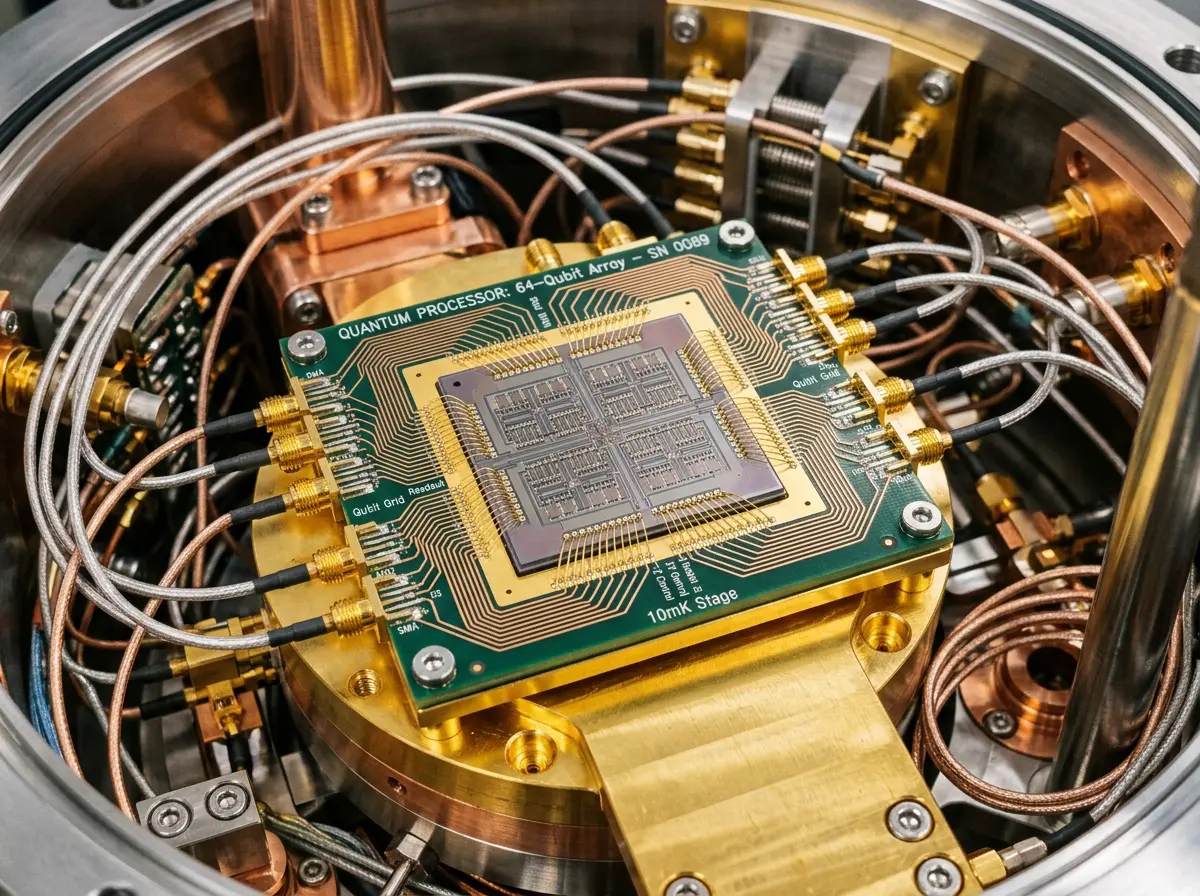
SuperconductingA superconducting qubit is a tiny circuit that only works when it is held near absolute zero, around 10 millikelvin, inside a dilution refrigerator. Microwave pulses do the controlling. This is the camp with the highest qubit counts in 2026, and with the longest commercial track record of any of them.
IBM Quantum
Hardware: Heron R2 (156 qubits, Dec 2024); Nighthawk (120 qubits, Nov 2025); Condor (1,121 qubits, Dec 2023 scale demo).
IBM runs the largest commercial superconducting fleet there is, and DARPA picked it for Stage B of the QBI programme in November 2025. Heron R2 and the November 2025 Nighthawk processor carry the production roadmap. Condor is still the highest-qubit single chip built. Qiskit 2.3, released in Jan 2026, opened up C API access for HPC integration, so the machines can be driven directly from supercomputing code.
IBM Quantum, one of the top quantum hardware companies →Google Quantum AI
Hardware: Willow (105 qubits, Dec 2024) with below-threshold quantum error correction; new neutral-atom programme led by Adam Kaufman at Boulder (Mar 2026).
Google Quantum AI runs the most influential quantum-error-correction research programme in the industry. Willow gave the first below-threshold QEC demonstration in December 2024, which is the point where adding more qubits starts making a machine better rather than worse. The Quantum Echoes algorithm of October 2025 reported a 13,000x speedup on specific problems. Google also bought the Atlantic Quantum team in October 2025, for its fluxonium expertise.
Google Quantum AI on the top quantum hardware companies leaderboard →Rigetti Computing
Hardware: Cepheus-1-108Q (108 qubits, 2026) multi-chip system with 99.5% 2Q fidelity; Ankaa-3 (84 qubits, 2024) sub-30 ns adiabatic CZ gates.
Rigetti is the listed superconducting pure-play, trading on NASDAQ as RGTI. Its 2026 Cepheus-1-108Q stitches several chips into one machine, and it reached 99.5% two-qubit gate fidelity using adiabatic CZ gates that take under 30 nanoseconds. C-DAC India placed an $8.4M purchase order for a 108-qubit deployment. Rigetti has also wired in NVIDIA NVQLink, so that a GPU and a quantum processor can work on the same job. That pairing is one example of hybrid quantum-classical orchestration, the software layer that schedules classical and quantum processors together in a single run, and it is fast becoming a requirement rather than a nicety.
Visit Rigetti →Oxford Quantum Circuits (OQC)
Hardware: Toshiko Gen-1 (35 qubits, coaxmon, June 2023); Genesis dual-rail Dimon architecture targeted for 2026.
OQC is a British superconducting hardware company, built on a qubit design of its own called the coaxmon, with a dual-rail Dimon roadmap behind it. In 2025 it demonstrated wafer-scale packaging for 500+ qubits. It also co-founded the Quantum Datacenter Alliance with Cisco, Quantinuum and QuEra, and it sells machines into enterprise data centres rather than offering cloud access alone.
Visit OQC →
D-Wave Quantum Inc.
Hardware: Advantage2 (4,400+ annealing qubits, production, 2x coherence improvement); Advantage; gate-based architecture acquired Jan 2026.
D-Wave has been at this longer than anyone. It was founded in 1999 and trades on the NYSE as QBTS. The Advantage2 series is still the dominant commercial quantum-annealing platform, and it is installed at Volkswagen, Lockheed Martin and Forschungszentrum Jülich. A $150M at-the-market equity offering took the company’s cash reserves to $884M.
Visit D-Wave →Trapped-Ion Quantum Computing Companies
Trapped-IonA trapped-ion machine holds single charged atoms still inside an electromagnetic cage called a Paul trap, and speaks to each one with a laser tuned to that single atom. The gates are the most accurate in the industry. The qubit counts are lower than superconducting, and that trade is the whole story of the modality.
Quantinuum
Hardware: Helios (98 barium ions, 99.92% 2Q fidelity, 48 logical qubits, Nov 2025); H2-1 (56 ytterbium ions, production, 2023).
Quantinuum was formed in 2021 out of Honeywell Quantum and Cambridge Quantum, and it holds the highest gate fidelities in the industry. The Helios system of November 2025 reached a quantum volume of 33.5 million. The company listed on Nasdaq under the ticker QNT in June 2026 and raised roughly $1.68 billion doing it. Helios went outside the US for the first time in March 2026, to Singapore.
Visit Quantinuum →IonQ
Hardware: Forte (AQ32) production system; Tempo (AQ64) targeted for late 2025; Forte Enterprise units delivered to AFRL and US national labs.
IonQ (NYSE: IONQ) is the largest publicly listed pure-play quantum company by market cap. It is also the first to clear $100M GAAP revenue, booking $130M in 2025, up 202% YoY. In September 2025 it completed the $1.075B Oxford Ionics acquisition, which brought in Electronic Qubit Control technology. Its barium R&D prototypes have reached 99.99% two-qubit fidelity.
Visit IonQ →Alpine Quantum Technologies (AQT)
Hardware: IBEX Q1 (rack-mount trapped-ion system, on Amazon Braket with EU data residency); PINE legacy system.
AQT is the Austrian academic spinout from Rainer Blatt’s group at Innsbruck, and it sells trapped-ion systems that fit in a standard rack. Its PIAST-Q installation for EuroHPC in Poland went live in June 2025. In October 2025 the company won a European tender worth €12.28M. The IBEX Q1 system now runs on Amazon Braket, with the data held in Europe.
Visit AQT →Neutral-Atom Quantum Computing Companies
Neutral-AtomNeutral-atom machines hold single uncharged atoms in place with tightly focused laser beams, known as optical tweezers, which grip an atom much as a pair of fingers would. To entangle two of them a pulse lifts the pair into a bloated, highly excited Rydberg state, in which each atom can feel the other. This is the fastest-scaling camp, and systems of more than 1000 atoms were demonstrated in 2024.
QuEra Computing
Hardware: Gemini (digital, 256 atoms, 2025); Aquila (analog, 256 atoms); 448-physical / 96-logical qubit demonstration.
QuEra is the Boston spinout from Harvard and MIT that turned neutral-atom quantum computing into a business. Its January 2026 Nature paper used [[16,6,4]] high-rate codes to reach 96 logical qubits. That is the largest verified logical-qubit count to date. The company raised a $230M convertible note in February 2025, led by Google Quantum AI and SoftBank.
Visit QuEra →Atom Computing
Hardware: Phoenix (1,200 atoms, optical-tweezer); Magne (Atom + Microsoft + QuNorth, late 2026 target with 50 logical qubits).
Atom Computing holds its atoms in optical tweezers, an arrangement that lets the atom count grow quickly without rewriting the machine around it. QuNorth put the Atom and Microsoft Magne system into commercial service in Denmark in January 2026. It ran Bernstein-Vazirani on 28 logical qubits. Fast Company named Atom Computing its #10 Most Innovative Company in 2025.
Visit Atom Computing →Pasqal
Hardware: Fresnel 2 (324 atoms, analog and digital); Vela next-generation system; QPUs available on Scaleway and OVHcloud sovereign clouds.
Pasqal is the French neutral-atom champion, founded by Antoine Browaeys with Alain Aspect, who took the Nobel prize in 2022. It installed a 200-qubit system at Saudi Aramco’s Dhahran data centre in November 2025. In March 2026 it raised €340M at a $2B valuation. LG Electronics took an equity stake as part of a deal to develop optical and electronic modules together.
Visit Pasqal →Infleqtion
Hardware: Sqale (1,600 atoms, 99.73% 2Q fidelity on a 114-qubit array, 2025); Sqorpius commercial system; Tiqker optical atomic clock.
Infleqtion, which used to be called ColdQuanta, works across quantum computing, sensing and timing, all of it on neutral-atom technology. In December 2025 its Sqale system reached 99.73% two-qubit gate fidelity on a 114-qubit array. Its Tiqker optical atomic clock keeps time 40x more precisely than GPS. In April 2026 the company took an $11M US Department of Defense contract for navigation where GPS cannot reach.
Visit Infleqtion →Photonic Quantum Computing Companies
PhotonicA photonic qubit is a single particle of light travelling down a channel etched into a chip. Machines built this way either measure their way through a calculation, step by step, or encode the information in the continuous properties of a light beam rather than in discrete states. The route to fault-tolerant scale runs through silicon photonics made in ordinary CMOS chip factories, and that is the modality’s main argument for itself.
PsiQuantum
Hardware: Omega photonic-chip platform pursuing fusion-based quantum computation at fault-tolerant scale; 99.22% two-qubit fidelity on integrated photonics.
No private quantum-computing company has raised more money than PsiQuantum. Its target is a Saudi-tolerant million-qubit machine, and the plan is to print the chips the way silicon photonics is printed in an ordinary chip fab rather than to build them by hand. A $1B Series E in September 2025 valued it at $7B. It reached DARPA QBI Stage C in February 2025. It broke ground on its Chicago facility in October 2025.
Visit PsiQuantum →Xanadu
Hardware: Aurora (35-chip photonic processor, 13 km fiber-connected, published in Nature); Borealis (Gaussian boson sampling).
Xanadu is the Toronto photonic-quantum company that demonstrated quantum advantage on its Borealis machine. It is now after fault tolerance at room temperature, using an approach that computes by measuring rather than by applying gates. In June 2025 it published a GKP error-correction breakthrough in Physical Review Letters. Canada’s Quantum Champions Programme gave it CA$23M.
Visit Xanadu →ORCA Computing
Hardware: PT-1, PT-2, PT-3 photonic systems (room temperature, telecom wavelength); PT-2 deployed at UK MoD and Oak Ridge National Laboratory.
ORCA is a UK photonic quantum-hardware company, working with Shyperse Coltrap approaches. Its PT-1 system has gone to the UK Ministry of Defence and to Oak Ridge National Laboratory. It runs at room temperature. That makes it far simpler to install than anything that has to be kept cold.
Visit ORCA →Silicon-Spin Quantum Computing Companies
Silicon-SpinA silicon-spin qubit stores its information in the spin of a single electron, inside a device made the same way ordinary silicon chips are made. The qubit counts trail every other camp. The manufacturing argument is the strongest of any of them, because the factories already exist.
Diraq
Hardware: CMOS-compatible silicon-spin qubit chips manufactured on 300mm wafers at GlobalFoundries and IMEC; 99.85% single-qubit and 98.92% two-qubit fidelity at 1 K.
Diraq came out of UNSW. It is built around Andrew Dzurak‘s silicon-MOS quantum-dot architecture, which pins single electrons inside the same kind of transistor structure an ordinary chip is made of. Because the platform is CMOS-compatible, it could in principle be made in the semiconductor factories that already exist. In October 2025 Diraq demonstrated a low-latency link between classical and quantum hardware, through NVIDIA’s NVQLink.
Visit Diraq →Quantum Motion
Hardware: 1,024 quantum-dot array on a 300mm CMOS wafer; 384-qubit silicon quantum-dot chip; world’s fastest dispersive readout (~8 microseconds, Nature Electronics).
Quantum Motion is the UK silicon-spin company, spun out of UCL and Oxford. Its 2025 commercial-foundry demonstration matters because those chips came off a production line rather than out of a laboratory. Silicon-spin has lagged superconducting and trapped-ion on qubit count. What it offers in exchange is the best chance of being made in bulk.
Visit Quantum Motion →Specialty Quantum Computing Companies
SpecialtyThree approaches sit outside the mainstream camps altogether. They are topological (Microsoft), cat-qubit (Alice & Bob) and NV-diamond (Quantum Brilliance). Each has its own card below.
Microsoft Quantum
Hardware: Majorana 1 (Feb 2025) topological-core processor with Majorana zero modes; 24 entangled logical qubits via Atom Computing partnership.
Microsoft is chasing topological quantum computing, which is the most ambitious approach on this page and the longest shot on it. The 2025 Majorana 1 announcement was the most distinct signature of that year. It is also contested. Critics including some at Bell Labs and KITP argue that the topological-qubit signatures are incomplete.
Visit Microsoft Quantum →Alice & Bob
Hardware: Boson 4 (16 cat qubits, bosonic encoding, Sept 2025) with bit-flip lifetime exceeding one hour; Elevator Codes demonstrating ~10,000x lower error rates.
Alice & Bob is the French startup commercialising cat qubits. The information is held in an oscillation rather than in a simple two-state system. That arrangement lets the hardware itself crush one of the two kinds of error, the bit flip, instead of leaving the job to software. The Heart Code magic-state preparation protocol of Aug 2025 needs only 53 qubits, against 463 in a comparable Google proposal. That is the cat-qubit bargain in one number. Far fewer qubits, in exchange for much harder control.
Visit Alice & Bob →Quantum Brilliance
Hardware: QB-QDK2.0 (5 qubits, room-temperature NV-centre quantum accelerator); roadmap targets 25-100 qubit systems by 2026-2027.
Quantum Brilliance builds its quantum computers out of diamond. The company is Australian-German, and its qubits are nitrogen-vacancy centres, which are single flaws in the crystal where one carbon atom is missing and a nitrogen atom sits beside the gap. NV-diamond runs at room temperature, so the machines can go where anything needing a refrigerator cannot. The qubit counts remain modest. That is the trade. Three QB-QDK2.0 units went into Oak Ridge National Laboratory in 2025.
Visit Quantum Brilliance →Comparison Table
| Modality | Leading vendor | Qubit count (2026) | Strength | Limitation |
|---|---|---|---|---|
| Superconducting | IBM, Google | 105-1121 | Highest qubit count, mature stack | Cryogenic, fab-intensive |
| Trapped-Ion | Quantinuum, IonQ | 12-98 | Highest gate fidelity (Quantinuum Helios 99.92%) | Slow gates, scaling challenge |
| Neutral-Atom | QuEra, Atom Computing, Infleqtion | 324-1600 | Fastest-scaling, room-temperature optics, 96 logical qubits (QuEra) | Coherence times, gate fidelity catching up |
| Photonic | PsiQuantum, Xanadu | Modes, not qubits | Fault-tolerant target, CMOS-fab compatible | Loss-rate engineering |
| Silicon-Spin | Diraq, Quantum Motion | 10s | Manufacturing scalability | Years behind on qubit count |
| Topological | Microsoft (Majorana 1) | 8 hardware + 24 logical via Atom partnership | Lower error-correction overhead if it works | Disputed physics, longest-shot |
2024 to 2029 roadmap of the top quantum hardware companies
- December 2024Google Willow demonstrates below-threshold quantum error correction, the first time a logical-qubit error rate dropped as code distance grew.
- February 2025Microsoft Majorana 1, the first topological-core processor using indium-arsenide and aluminium heterostructure, claims a hardware path to one million qubits.
- November 2025Quantinuum Helios launches with 98 barium ions, 99.92 percent two-qubit fidelity, and 48 fully error-corrected logical qubits. Quantinuum closes a $600M Series C at $10B pre-money.
- January 2026QuEra Computing publishes 96 verified logical qubits from 448 atoms in Nature. IonQ announces a $1.8B SkyWater acquisition. D-Wave acquires Quantum Circuits Inc. for $550M to add gate-based hardware.
- February 2026Infleqtion lists on NYSE as INFQ via SPAC, the first publicly traded neutral-atom quantum company.
- March 2026Xanadu begins trading on Nasdaq and TSX as XNDU. Pasqal raises EUR 340M at $2B valuation. Rigetti announces a $100M UK investment with a 1,000+ qubit deployment target.
- Late 2026 (target)Atom Computing + Microsoft + QuNorth Magne system targets 50 logical qubits and 1,200+ physical qubits.
- 2027 (target)Pasqal and Quantinuum both target 100+ logical qubits on next-generation systems.
- 2028 (target)IonQ Tempo at 200,000-physical-qubit scale (post SkyWater integration), enabling thousands of logical qubits.
- 2029 (target)IBM Quantum public roadmap: 200 logical qubits.
Top quantum hardware companies 2026 Outlook
The 1,000-qubit mark stopped being the contest in 2025, because the leaders all cleared it. Superconducting got there with IBM Condor at 1,121 and the 120-qubit Nighthawk in production, and neutral-atom followed with Atom Phoenix at 1,200 and Infleqtion Sqale at 1,600. The race now is for logical qubits, the error-corrected kind that several physical qubits are pooled together to make. QuEra has demonstrated 96 verified logical qubits, and Quantinuum Helios delivered 48 in November 2025.
Three things are still open for 2026. One is a logical qubit that does something useful inside a commercial product. Another is sustained 99.99% two-qubit fidelity in production, which IonQ and Quantinuum are both closing on. The third is a credible scalability proof from the long shots, meaning topological, photonic and silicon-spin.
For benchmarks that do not come from the vendors themselves, see the NIST Quantum Information Science programme, which tracks the top quantum hardware companies independently and company by company. It is the obvious cross-check on any number a company publishes about its own machine.
Investor money in 2024-2025 went mostly to two places, PsiQuantum’s $1B Series E and Quantinuum’s preparations to list. Both point the same way. The top quantum hardware companies are moving into a public-markets phase. Expect between two and four pure-play hardware flotations by the end of 2027, and expect the smaller modality specialists to keep being folded into larger platforms while it happens.
Two other pages here go wider than this one. Our mega list of quantum companies covers the full field company by company, and our 2026 quantum companies overview takes the year in the round.
Top quantum hardware companies FAQ
Who are the top quantum hardware companies in 2026?
The leading vendors split by modality: IBM, Google, and D-Wave (annealing) for superconducting; Quantinuum and IonQ for trapped-ion; QuEra, Atom Computing, Pasqal, and Infleqtion for neutral-atom; PsiQuantum and Xanadu for photonic; Diraq and Quantum Motion for silicon-spin; Microsoft, Alice & Bob, and Quantum Brilliance for specialty platforms.
Which quantum hardware modality leads in 2026?
Superconducting holds the highest qubit count, with IBM Condor at 1121 physical qubits. Trapped-ion (Quantinuum, IonQ) holds the highest gate fidelities. Neutral-atom (Atom Computing Phoenix at 1200 atoms (Infleqtion Sqale at 1600 atoms is the largest neutral-atom system)) is the fastest-scaling. No single modality leads on all metrics; the right answer depends on the workload.
Which top quantum hardware companies are publicly traded?
IonQ (NYSE: IONQ), Rigetti (NASDAQ: RGTI), and D-Wave (NYSE: QBTS) are the long-running public quantum-hardware pure-plays. The 2026 cohort added Infleqtion (NYSE: INFQ, February 2026 SPAC merger and the first publicly traded neutral-atom company) and Xanadu (Nasdaq/TSX: XNDU, March 2026 SPAC merger). IBM (NYSE: IBM) and Google (Alphabet, NASDAQ: GOOG) operate quantum hardware as part of much larger businesses. Quantinuum listed on Nasdaq under the ticker QNT in June 2026.
Should I follow all the top quantum hardware companies, or focus?
Follow modality leaders rather than tracking every vendor. The top quantum hardware companies concentrate around six modalities, each with one to three serious commercial competitors. Focusing on IBM (superconducting), Quantinuum (trapped-ion), QuEra or Atom Computing (neutral-atom), PsiQuantum (photonic), and Microsoft (topological) gives full coverage of the modality space without listicle fatigue.
Disclaimer. This article is for informational purposes only and does not constitute investment, financial or professional advice. The quantum technology industry evolves rapidly and information may become outdated. Always conduct your own research and consult qualified advisers before making investment decisions. Investing in quantum computing companies involves significant risk, including the potential loss of your entire investment, and past performance is not indicative of future results.



See today’s quantum computing news on Quantum Zeitgeist for the latest breakthroughs in qubits, hardware, algorithms, and industry deals.