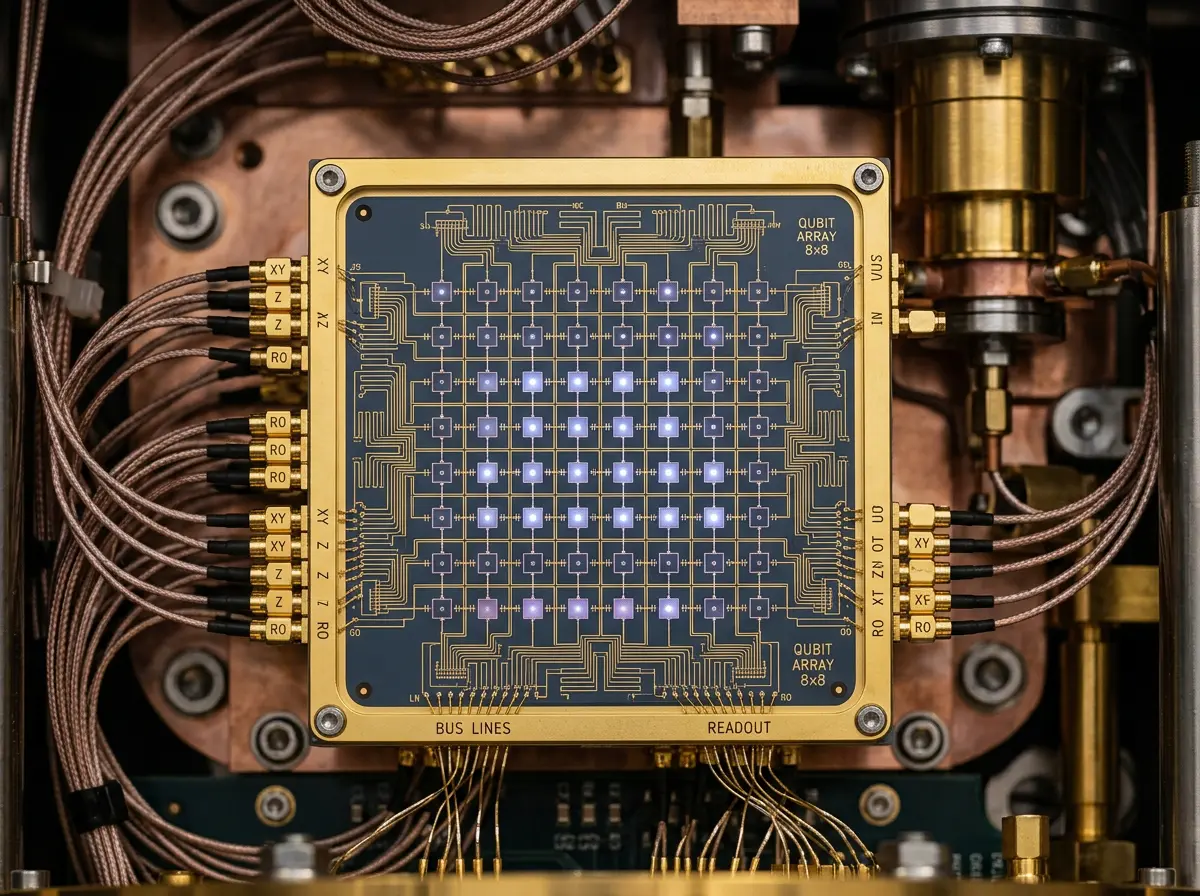
This quantum logical qubit leaderboard tracks the verified, publicly demonstrated logical-qubit counts across every major quantum-hardware platform. A logical qubit is a single fault-tolerant qubit assembled from many physical qubits using quantum error correction; logical-qubit count, not physical-qubit count, is the metric that governs whether a quantum computer can run useful algorithms at scale. The 2026 this leaderboard is led by QuEra Computing with 96 verified logical qubits, followed by Quantinuum at 48 and Atom Computing plus Microsoft at 24.
The state of the leaderboard at a glance. Sources: peer-reviewed publications, official company announcements, and the entangledfuture.com Quantum Navigator.
Verified logical qubit leaderboard
| # | Company | Logical | Physical | Ratio | QEC Method | Modality | Achieved |
|---|---|---|---|---|---|---|---|
| Rank1 | CompanyQuEra Computing [[16,6,4]] high-rate code |
Logical96 | Physical448 | Ratio4.7:1 | QEC[[16,6,4]] high-rate code | ModalityNeutral-Atom | AchievedJanuary 2026 |
| Rank2 | CompanyQuantinuum Color code with Iceberg concatenation |
Logical48 | Physical98 | Ratio2.0:1 | QECColor code with Iceberg concatenation | ModalityTrapped-Ion | AchievedNovember 2025 |
| Rank3 | CompanyAtom Computing + Microsoft Bacon-Shor |
Logical24 | Physical1,180 | Ratio49.2:1 | QECBacon-Shor | ModalityNeutral-Atom | AchievedNovember 2024 |
| Rank4 | CompanyGoogle Quantum AI Surface code, below threshold |
Logical1 | Physical105 | Ratio105:1 | QECSurface code, below threshold | ModalitySuperconducting | AchievedDecember 2024 |
| Rank5 | CompanyInfleqtion Surface code |
Logical12 | Physical1,600 | Ratio133:1 | QECSurface code | ModalityNeutral-Atom | AchievedDecember 2025 |
| Rank6 | CompanyNord Quantique GKP bosonic |
Logical1 | Physical1 | Ratio1:1 | QECGKP bosonic | ModalityBosonic | AchievedFebruary 2024 |
Encoding ratio is physical qubits per logical qubit, lower is better. Methodology note: results are limited to verified demonstrations published in peer-reviewed journals or pre-registered open documentation, not roadmap targets. The leaderboard updates each quarter as new results are announced.
Per-modality standing on the quantum logical qubit leaderboard
Neutral-atom platforms hold positions 1, 3, and 5 on the leaderboard. QuEra reaches 96 logical qubits using high-rate [[16,6,4]] codes at a 4.7-to-1 ratio. Atom Computing and Microsoft jointly demonstrated 24 logical qubits in November 2024 using Bacon-Shor codes on Atom’s Phoenix system at a 49-to-1 ratio. Infleqtion delivered 12 logical qubits on the Sqale platform in December 2025. Neutral-atom systems have the fastest path to large physical-qubit counts because optical-tweezer arrays scale to 1,000-plus atoms without major architectural rewrites.
Trapped-ion platforms have the best encoding efficiency. Quantinuum’s Helios system reached 48 logical qubits from 98 physical barium ions in November 2025, a 2-to-1 ratio that no other modality has matched. The high single-qubit and two-qubit gate fidelities of trapped ions (99.92 percent two-qubit fidelity on Helios) lower the physical-qubit overhead needed for surface-code or concatenated-code operation. The drawback is that trapped-ion systems scale slowly: getting from 100 to 1,000 ions per chain is a much harder problem than scaling neutral-atom arrays.
Superconducting platforms hold one logical-qubit position so far. Google’s Willow processor demonstrated below-threshold quantum error correction with 1 logical qubit from 105 physical qubits in December 2024. The achievement was historic because it was the first time a logical-qubit error rate dropped as the surface-code distance grew, validating the entire fault-tolerance theory experimentally. IBM’s roadmap targets 200 logical qubits by 2029. Rigetti and OQC have not yet entered the leaderboard but both have public roadmaps targeting logical-qubit demonstrations in 2027.
Bosonic platforms occupy a separate column. Nord Quantique demonstrated a single logical qubit using GKP bosonic encoding in February 2024, a continuous-variable scheme where each logical qubit is a single mode rather than many discrete qubits. Bosonic codes have a different scaling story: the physical-qubit overhead is replaced by a per-mode overhead in modes per logical qubit. This makes head-to-head comparison with discrete-qubit codes apples-to-oranges, but bosonic codes remain a credible long-shot path to fault tolerance.
Photonic platforms have not yet entered the verified leaderboard. Xanadu, ORCA, and PsiQuantum all have logical-qubit demonstrations on their public roadmaps. Xanadu’s June 2025 GKP error-correction breakthrough in Physical Review Letters is a precursor result. PsiQuantum’s $1B Series E funding (September 2025) targets a million-physical-qubit fault-tolerant photonic computer; the logical-qubit count for that system has not been publicly disclosed but is expected to be in the thousands.
Silicon-spin platforms are a year or two behind. Diraq and Quantum Motion both demonstrated high-fidelity 1- and 2-qubit operations on 300mm CMOS wafers in 2025, but neither has yet entered the logical-qubit leaderboard. Diraq’s 99.85 percent single-qubit and 98.92 percent two-qubit fidelity at 1 Kelvin is the prerequisite for fault-tolerant operation; the next demonstration step is logical-qubit encoding.
Why logical qubits matter
Physical qubits are noisy. Even the best superconducting and trapped-ion qubits make a small mistake about once every 100 to 10,000 operations, and any algorithm with thousands of gates will accumulate errors faster than the algorithm produces useful output. Quantum error correction (QEC) solves this by encoding the state of a single logical qubit across many physical qubits in such a way that errors on individual physical qubits can be detected and corrected without disturbing the encoded logical state.
The fundamental theorem behind QEC is the threshold theorem, which says that if the physical-qubit error rate is below a critical threshold, then the logical-qubit error rate can be made arbitrarily small by increasing the number of physical qubits in the code. Different codes have different thresholds: surface codes require physical-qubit error rates around 1 percent, while concatenated codes can tolerate higher rates at the cost of much larger encoding overhead.
The encoding overhead, the ratio of physical qubits per logical qubit, is the next key metric on this ranking after raw count. Surface codes typically need 1,000 or more physical qubits per logical qubit at fault-tolerant operating points. The new high-rate codes used by QuEra in January 2026 reduced this ratio dramatically, packing six logical qubits into 16 physical atoms, a 4.7-to-1 ratio that makes large logical-qubit counts feasible on near-term hardware.
Methodology: what counts as a logical qubit on this leaderboard
The quantum logical qubit leaderboard has strict inclusion rules. A demonstration must satisfy three criteria to qualify: it must be published in a peer-reviewed journal, a verifiable preprint with public code, or a pre-registered hardware announcement; the logical qubits must be operated as logical qubits (not merely encoded passively); and the experiment must include at least one logical-state preparation, gate, or measurement that demonstrates the encoded behaviour.
The leaderboard does not include roadmap targets, simulation-only results, single-shot demonstrations without verification, or proposals. Companies that have announced plans for logical-qubit counts but not delivered are tracked separately in the outlook section. The leaderboard is updated quarterly to incorporate new published results.
Encoding ratio (physical-qubits-per-logical-qubit) is reported alongside count because a system with 1 logical qubit from 1,000 physical qubits is a less promising scale-up path than a system with 48 logical qubits from 98 physical qubits, even though both are nominally above the threshold. The ratio reveals how efficiently the underlying QEC code is using the available physical resource.
Key takeaways
- QuEra holds the lead with 96 verified logical qubits from 448 neutral atoms, published in Nature in January 2026.
- Quantinuum has the best encoding efficiency: 48 logical from 98 physical (about 2:1) using Helios trapped ions and Color code with Iceberg concatenation.
- Atom Computing and Microsoft jointly demonstrated 24 logical qubits in November 2024, the first beyond-toy multi-logical qubit result.
- Google’s Willow showed below-threshold quantum error correction in December 2024: a logical qubit whose error rate decreased as the surface-code distance grew. The number to watch in 2026 is 50 logical (Atom + Microsoft Magne, late 2026 target) and 100+ (Quantinuum, Pasqal).
- Nord Quantique uses bosonic GKP encoding, a different approach where each logical qubit is one continuous-variable mode rather than many discrete qubits.
Historical milestones on the quantum logical qubit leaderboard
The quantum logical qubit leaderboard has accelerated dramatically in 2024 and 2025. Before 2024, single-shot logical-qubit encodings without sustained operation were the norm; today, dozens of logical qubits are operated routinely.
- February 2024Nord Quantique demonstrates the first single-mode bosonic GKP logical qubit.
- April 2024Quantinuum H2 demonstrates 4 logical qubits with logical-qubit error correction below physical-qubit error rate, the first below-threshold result on a discrete-qubit platform.
- November 2024Atom Computing and Microsoft jointly demonstrate 24 entangled logical qubits using Bacon-Shor codes, the first multi-logical-qubit gate demonstration.
- December 2024Google Willow demonstrates below-threshold quantum error correction on the surface code, the first time a logical error rate decreased as code distance grew on superconducting hardware.
- November 2025Quantinuum Helios launches with 98 barium ions, achieving 48 logical qubits and 99.92 percent two-qubit gate fidelity.
- December 2025Infleqtion Sqale demonstrates 12 logical qubits during the run-up to its February 2026 NYSE listing.
- January 2026QuEra publishes 96 logical qubits from 448 atoms in Nature using [[16,6,4]] high-rate codes, the largest verified count to date.
- April 2026Riverlane demonstrates real-time QEC decoding 10 times faster than Google’s surface-code approach, addressing the decoder-latency bottleneck.
2026 to 2029 outlook
The quantum logical qubit leaderboard will look very different by the end of 2026. The Atom Computing, Microsoft, and QuNorth Magne system targets 50 logical qubits in late 2026, which would push Atom Computing into a tie with Quantinuum for the second position. Pasqal and Quantinuum both target 100-plus logical qubits in 2027 on next-generation systems; QuEra is expected to push past 200 logical qubits as new physics-tweezer arrays come online.
By 2029, IBM’s public roadmap targets 200 logical qubits on superconducting hardware, IonQ targets 200,000-physical-qubit systems following its January 2026 SkyWater acquisition (enabling thousands of logical qubits at expected encoding ratios), and PsiQuantum targets million-physical-qubit photonic systems with logical-qubit counts in the thousands. The 2029 leaderboard will likely be the first year where any single platform crosses 1,000 verified logical qubits.
The strategic question for enterprises tracking the quantum logical qubit leaderboard is when 100 logical qubits with sustained operation becomes available, the threshold at which several practically useful algorithms in chemistry simulation, optimisation, and cryptography become tractable. Current trajectories suggest 100 logical qubits will be a verified result by Q2 2027, with Quantinuum, Pasqal, and QuEra all racing for that milestone.
How to use the quantum logical qubit leaderboard
Different audiences should read the quantum logical qubit leaderboard differently. Researchers should focus on the encoding ratio and QEC method columns, since those are the metrics that determine whether a result is reproducible on adjacent hardware platforms and whether it points to a scalable architecture or a one-off achievement. The QuEra 4.7-to-1 ratio achieved with [[16,6,4]] codes is more interesting than the absolute count of 96 because the ratio implies that 1,000 logical qubits could be reached with 4,700 atoms.
Enterprises evaluating quantum software contracts should focus on the achieved date and the platform behind each entry. A 2-to-1 encoding ratio on a trapped-ion system that ships in production today (Quantinuum Helios) supports different procurement decisions than a higher logical-qubit count on a research-only platform. Buying decisions should also consider whether the platform is integrated with the major SDKs (Qiskit, Cirq, PennyLane, tket) the buyer’s team is already trained on, and whether the cloud platform (IBM Quantum, Azure Quantum, Amazon Braket) is the same one the buyer uses for classical workloads.
Investors should look at the trajectory rather than the snapshot. The fact that the quantum logical qubit leaderboard has gone from one verified logical qubit (Nord Quantique, February 2024) to 96 (QuEra, January 2026) in two years is a stronger signal than any single ranking position. Companies whose roadmaps extrapolate the 2024-2026 trajectory credibly are more likely to capture the bulk of the 2027-2029 enterprise quantum-software spend.
References and external sources
Verified demonstrations on the quantum logical qubit leaderboard are sourced from peer-reviewed publications and official company announcements. Each entry below links to the primary source so every number can be checked independently. Key references for the 2026 leaderboard:
- Bluvstein et al., logical processor with reconfigurable atom arrays, Nature (2023) , foundation paper for QuEra’s neutral-atom logical-qubit approach.
- Google AI Quantum, below-threshold quantum error correction with surface codes (Willow), Nature (December 2024) , the historic first demonstration of below-threshold QEC.
- Quantinuum Helios system announcement (November 2025) , official announcement of the 48-logical-qubit Helios system.
- independent quantum logical qubit leaderboard updated quarterly at Quantum Navigator , quarterly directory of verified logical-qubit demonstrations.
- Riverlane Deltaflow real-time QEC decoder press releases (2025-2026) , context on decoder-latency progress, the bottleneck for scaling logical qubits beyond a few dozen.
Quantum logical qubit leaderboard FAQ
What is a logical qubit?
A logical qubit is one fault-tolerant qubit assembled from many physical qubits via quantum error correction. The physical qubits suffer from noise individually but their collective state encodes a logical qubit whose error rate is lower than any single physical qubit. The ratio of physical to logical qubits is called the encoding overhead.Why does logical qubit count matter more than physical-qubit count?
Useful quantum algorithms (Shor, Grover, quantum chemistry, fault-tolerant simulation) need fault-tolerant operations. A million noisy physical qubits cannot run Shor’s algorithm; a few thousand high-quality logical qubits can. Physical qubits are an input; logical qubits are the output that matters.Why does QuEra lead with 96 logical qubits?
QuEra’s January 2026 Nature paper introduced [[16,6,4]] high-rate codes that pack six logical qubits into 16 physical atoms, dramatically improving encoding efficiency over traditional surface codes. Combined with neutral-atom platforms’ fast scaling, this gave QuEra the largest verified count.Why does Quantinuum have the best encoding ratio?
Quantinuum’s Iceberg-concatenated codes on the Helios trapped-ion system require only about 2 physical qubits per logical qubit at current operating fidelity (99.92 percent). Trapped-ion systems achieve higher single-qubit fidelities than other platforms, which lowers the physical-qubit overhead needed for error correction.What’s coming next?
Atom Computing, Microsoft, and QuNorth’s Magne system targets 50 logical qubits in late 2026. Pasqal and Quantinuum both target the 100-logical qubit threshold in 2027. IBM’s public roadmap targets 200 logical qubits by 2029. PsiQuantum aims for million-qubit fault-tolerant photonic computation.



See today’s quantum computing news on Quantum Zeitgeist for the latest breakthroughs in qubits, hardware, algorithms, and industry deals.