IBM and its partners report the first clear demonstrations of quantum advantage through three separate experiments, a milestone years in the making. While recent quantum advantage demonstrations did not focus on this area, optimization is now emerging as a key application for these capabilities.
Recent research has yielded promising algorithmic candidates, and a foundational publication in Nature Computational Science details the collaborative effort behind the Quantum Optimization Benchmarking Library, or QOBLIB. Researchers state that proving quantum advantage is possible was one challenge, and discovering where it will deliver real-world value is another, highlighting the need for open collaboration to identify practical applications.
IBM and Partners Demonstrate Quantum Advantage in Optimization
Developed by the Quantum Optimization Working Group with contributions from organizations including Zuse Institute Berlin and Purdue University, QOBLIB provides a shared platform for evaluating both quantum and classical methods on a level playing field. First shared as an arXiv preprint and open-source GitHub repository in 2025, the library was specifically designed to track advancement toward quantum advantage in optimization, focusing on problem classes that quickly become intractable for even the most powerful classical solvers.
The emergence of optimization as a key area for quantum advantage is noteworthy, as it wasn’t the primary focus of demonstrations reported last week, yet it now stands as a high-priority domain for near-term breakthroughs. This publication, alongside a newly launched QOBLIB website, signals a concerted effort to foster open collaboration and rigorous evaluation within the quantum community.
QOBLIB’s design addresses a critical need for credible benchmarking in optimization, where most algorithms are heuristics, methods that offer good solutions but lack guaranteed performance. Unlike theoretical proofs, demonstrating quantum advantage in this domain requires empirical evidence, specifically outperforming the strongest available classical methods. This necessitates a collaborative approach, as no single research group can independently assess classical optimization techniques. The library brings together classical and quantum researchers, providing a common set of problem classes, evaluation standards, and transparent baselines.
With over 2,000 results already submitted, QOBLIB has evolved into a dynamic resource reflecting the latest advancements, with new contributions from organizations like E.ON, Forschungszentrum Jülich, and the STFC Hartree Centre. The library also tracks improvements in classical methods alongside quantum progress, raising the bar for any quantum advantage claim. The team welcomes suggestions for new problem classes, emphasizing that the selection process should be a community-driven conversation, with their ultimate goal being a demonstration of quantum advantage in optimization that earns the confidence of both the quantum and classical research communities.
QOBLIB Framework Benchmarks Intractable Optimization Problem Classes
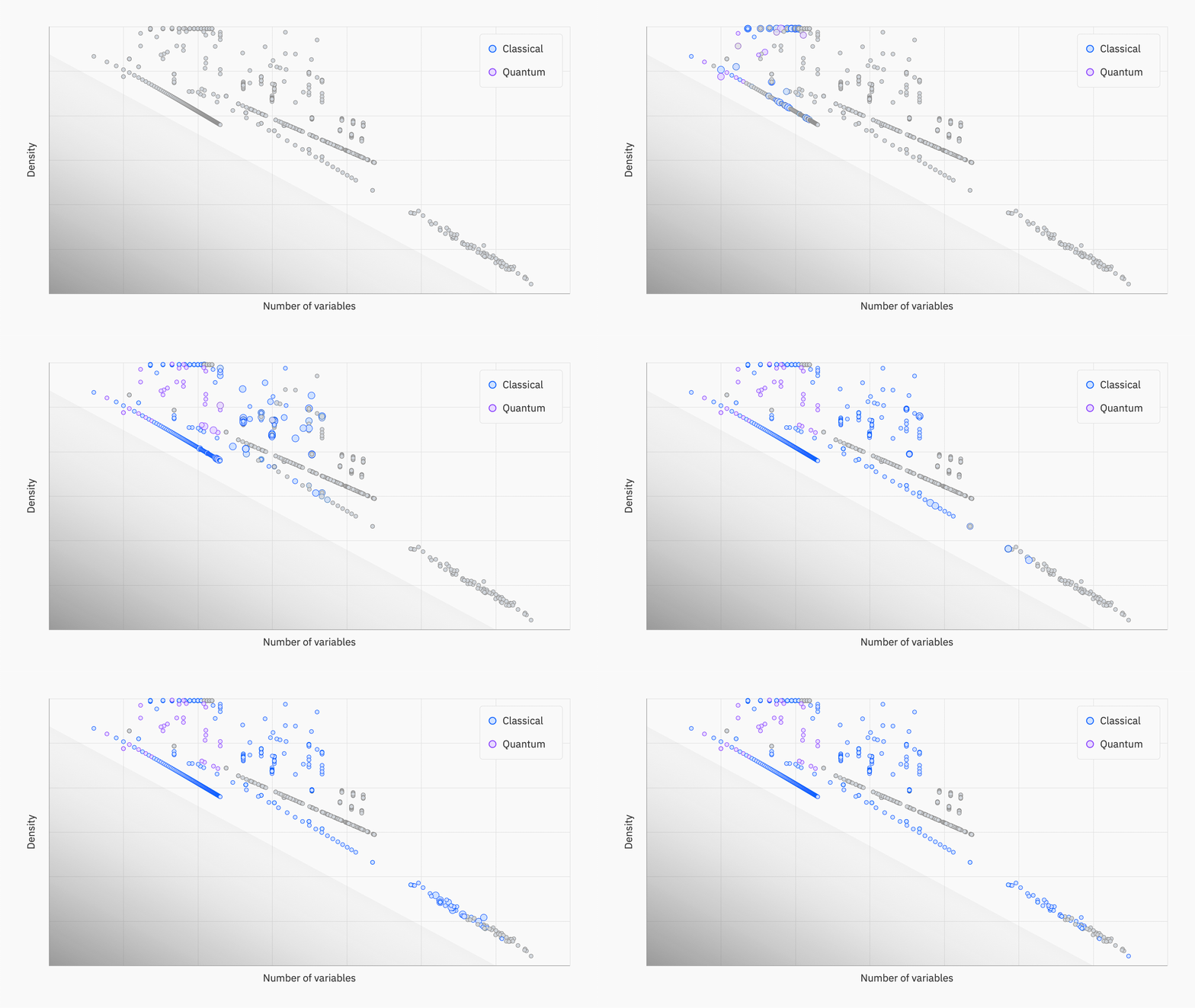
A foundational publication detailing QOBLIB’s design and implementation recently appeared in Nature Computational Science, coinciding with the launch of a dedicated website intended to streamline contributions and showcase results. The site currently hosts over 1,200 problem instances, with more than 500 solved to optimality, and features a complexity-landscape visualization allowing researchers to pinpoint the most challenging problems.
This public accounting of the state of the art includes a live page tracking best-known results and the affiliations of those who achieved them, providing visible credit for every contributor. A guided Submission Builder further lowers the barrier to entry for researchers wishing to participate.
QOBLIB Website Tracks Progress with 1,200+ Problem Instances
Launched initially as an open-source project and arXiv preprint in 2025, QOBLIB’s evolution is now formalized with a dedicated website designed to enhance exploration, contribution, and transparency within the quantum computing community. This allows for focused efforts on problems that truly push the boundaries of both classical and quantum algorithms.
The site also maintains a live, publicly accessible page that records the best-known solution for each instance, alongside the responsible researcher and their affiliation, ensuring full credit for contributions. The development of QOBLIB reflects a shift toward open, collaborative benchmarking as essential for validating claims of quantum advantage.




See today’s quantum computing news on Quantum Zeitgeist for the latest breakthroughs in qubits, hardware, algorithms, and industry deals.