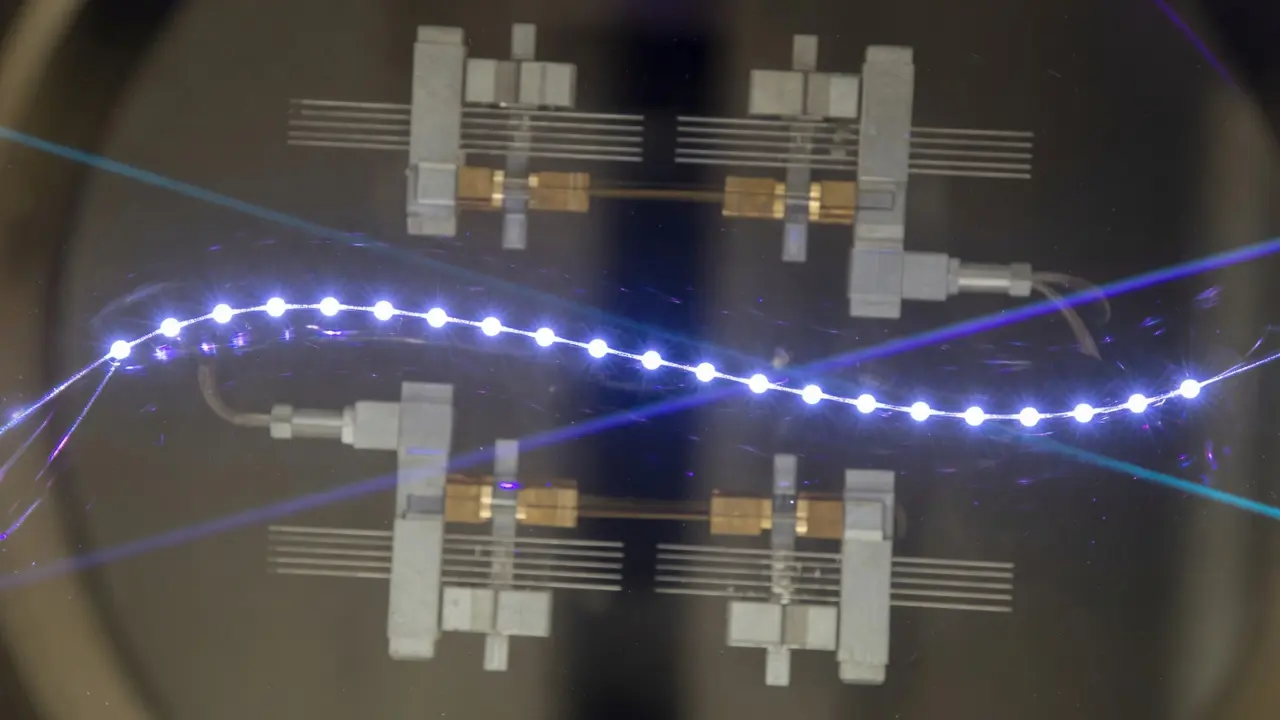
Stephan Roschinski, Johannes Schabbauer, Franz von Silva-Tarouca, Marvin Holten, Damien Bloch, and Julian Léonard Austria and the Vienna Center for Quantum Science and Technology have integrated a twelve-site 87Rb optical tweezer array with a high-cooperativity fiber Fabry-Pérot microcavity. This combination addresses a key challenge in quantum networking: uniting scalable atomic arrays with high-quality cavity systems.
The researchers measured collectively enhanced vacuum Rabi splitting with up to five atoms demonstrating a scalable architecture for entanglement generation and laying the foundation for fiber-integrated quantum network nodes. This work establishes a pathway toward quantum network nodes with local processing power.
Fiber Fabry-Pérot Cavity Integrates with 87Rb Tweezer Array
A twelve-site array of rubidium atoms has been successfully positioned within a high-cooperativity fiber Fabry-Pérot microcavity, a configuration that overcomes a longstanding challenge in scaling quantum systems. This integration allows for precise, subwavelength control over individual atoms and continuous tuning of their interaction strength with the cavity’s light field, achieved through deterministic displacement within the standing-wave pattern. The cavity itself, constructed from fiber mirrors, offers a native fiber-coupled interface between the controlled atoms and emitted photons, a feature not commonly found in high-cooperativity cavity quantum electrodynamics systems.
The fiber-based design distinguishes this work from previous experiments coupling atomic ensembles or single atoms to similar cavities, extending those capabilities to a multi-site tweezer array. The cavity’s geometry, a length of and mirrors with radii of curvature of, yields a geometric single-atom cooperativity of 173, a key metric indicating the strength of the light-matter interaction.
This high cooperativity is important for observing collective effects and implementing advanced quantum protocols, and is calculated using the formula η = 24F/(π k^2w_0^2), where k represents the wavenumber at the resonant cavity wavelength and is the 1/e^2 mode waist. The system’s ability to precisely control atomic positioning enables researchers to manipulate the coupling strength, opening avenues for exploring novel quantum phenomena. Beyond strong coupling, the platform facilitates nondestructive measurements of the number of coupled atoms, a capability essential for many cavity-mediated entanglement protocols.
By probing the cavity at the empty-cavity resonance, the system can distinguish between an empty array and one containing a single atom. This polariton-resolved readout is particularly well-suited for high-cooperativity microscopic cavities, where the normal modes are clearly separated. Such measurements form the basis for projecting onto specific subspaces, generating entanglement between atoms and enabling complex quantum operations.
The researchers demonstrated key capabilities, including programmable single-atom coupling, collectively enhanced atom-photon interactions, and nondestructive atom-number measurements. Fiber integration, they note, provides a route toward multiple photonic interfaces within a single atom-array platform, allowing different regions of an atomic array to couple to independent optical modes. The experimental process begins with loading the optical tweezers and acquiring a fluorescence image to identify occupied atomic traps.
Following optical pumping, the optical power in each tweezer is increased to reduce the atomic wavefunction spread before probing the cavity transmission. A second fluorescence image then verifies that the traps remain occupied throughout the process. This careful control over atomic positioning and state is fundamental to achieving the observed strong coupling and nondestructive readout.
While finalizing the manuscript, the researchers became aware of two independent preprints reporting similar progress in coupling optical tweezer arrays to high-cooperativity Fabry-Pérot cavities, indicating a growing interest in this promising architecture. The combination of strong, controllable coupling, nondestructive readout, scalable atom number and fiber integration, they conclude, provides a versatile foundation for future studies in quantum optics and technological applications.
Atomic Array Control: Subwavelength Precision and Displacement Tuning
This combination represents a departure from traditional cavity QED systems, where atom placement is often fixed, and allows for continuous tuning of atom-cavity coupling through deterministic displacement within the cavity’s standing-wave field. The precision achieved, with inferred relative displacement standard deviations of 1.1% of the light’s wavelength, establishes optical tweezers as a viable alternative to intracavity lattices for controlling these interactions. The architecture detailed in the work moves beyond previous limitations of one or two trapped atoms in such experiments, enabling the study of collective atomic behavior.
This enhancement is not merely additive; the observed coupling strength scales with the square root of the number of atoms, a relationship predicted by the Tavis-Cummings model and confirming the collective nature of the interaction. The ability to control and measure this collective coupling is fundamental to realizing more complex quantum phenomena.
Beyond enhancing interactions, the system facilitates cavity-based, nondestructive readout of the number of coupled atoms. By exploiting the dependence of the cavity response on the number of atoms, researchers extracted fidelities for distinguishing between different atom numbers. This capability is not simply a diagnostic tool; it is an important element for implementing measurement-based quantum computing and generating scalable entangled states.
“Combining this control with Rydberg excitations would create a hybrid architecture in which local Rydberg gates are complemented by non-local cavity-mediated gates,” the researchers write, outlining a path toward more versatile quantum information processing. The use of a fiber Fabry-Pérot microcavity is a key innovation, offering a pathway toward scalable quantum networks.
Vacuum Rabi Splitting Demonstrates Collective Atom-Cavity Coupling
Measurements of cavity transmission spectra reveal a continuous tuning of atom-cavity coupling strength achieved by translating single rubidium atoms through the standing-wave field of a fiber Fabry-Pérot microcavity. By positioning an atom from an antinode toward a node, researchers observed a corresponding decrease in vacuum Rabi splitting, with the spectrum evolving toward that of an empty cavity, demonstrating direct and robust control over the interaction.
The residual splitting observed even near the node is explained by the finite spatial extent of the atomic wavepacket, which samples regions of nonzero cavity field, a detail elaborated in the supplementary material. This level of control extends to collective behavior. The team projected a five-site tweezer array, positioning all sites near antinodes and confirming homogeneous coupling strengths across the array.
As additional tweezers were occupied, cavity transmission spectra exhibited a growing vacuum Rabi doublet, indicating collective enhancement of the atom-cavity coupling, a phenomenon quantified by fitting the spectra to a cavity-QED model. The extracted collective couplings followed the characteristic square root of N scaling predicted by the Tavis-Cummings model, demonstrating that the programmed, site-resolved couplings dictate the collective strong-coupling response of the array.
Beyond simply observing this enhancement, the platform enables non-destructive atom-number readout. When the cavity is resonant, a zero-atom state transmits strongly, while a single atom suppresses resonant transmission, creating a markedly lower photon count.
A threshold on detected photon count successfully discriminated between zero and one atom with 97.4(6)% fidelity, and further extended to pairwise discrimination of larger atom numbers. “For N = 0, the cavity is resonant with the probe and transmits strongly. For N = 1, the strong coupling suppresses resonant transmission, producing a markedly lower photon count,” the researchers report, detailing the basis of their readout protocol. This capability allows for the determination of atom number without disturbing the quantum state, an important step toward scalable quantum computation and networking.
Non-Destructive Atom Number Readout via Cavity Transmission
This architecture allows for the quantification of collective coupling strength as the number of atoms within the cavity increases, revealing a predictable relationship with the number of coupled atoms. Measurements demonstrate a growing vacuum Rabi doublet as more tweezers are occupied, a direct signal of enhanced light-matter interaction. This non-destructive readout relies on detecting the suppression of resonant probe light when atoms are present, a phenomenon stemming from cavity blockade effects.
4(6)% fidelity, and further refined to 99.0(4)% fidelity. The method uses the unique spectral properties of collective polariton resonances, which shift with the square root of the atom number.
By tuning the probe frequency to a resonance specific to one atom number, the system achieves high transmission for that number and low transmission for others. This approach, operating in the resonant strong-coupling regime, offers a distinct advantage over traditional dispersive measurements used in cavity QED. The observed performance is consistent with the limitations imposed by photon shot noise, suggesting that increasing the detected photon count could further improve discrimination fidelity.
This resonant readout is complementary to dispersive measurements, providing an alternative means of inferring atom number. By operating near collective resonances, the system amplifies the transmission contrast between different atom numbers, enabling more accurate and efficient readout. The ability to perform collective, nondestructive measurements of excitation number forms a foundation for cavity-mediated entanglement protocols, where projecting onto a subspace can generate entanglement between atoms.
Fiber Integration Enables Scalable Quantum Network Nodes
The resulting system demonstrates a pathway toward building quantum network nodes with integrated local processing capabilities, a critical step for distributed quantum computing and secure communication. This design choice is significant, as it facilitates the transmission of quantum information over fiber-optic interconnects, the backbone of any practical quantum network. Researchers demonstrated the ability to program the coupling of single atoms to the cavity, opening possibilities for engineered collective atom-photon interfaces with broad applications.
Homogeneous coupling generates an atom-number-dependent polariton spectrum for nondestructive readout, while deliberately inhomogeneous coupling patterns could address selected subsets of atoms, tailoring collective modes or realizing weighted spin models. Such capabilities are relevant for measurement-based quantum computing, dissipative entanglement generation and quantum error correction, offering a versatile platform for exploring advanced quantum protocols.
The system’s design also allows for the potential integration of multiple fiber Fabry-Pérot resonators within the field of view of a single microscope objective, enabling parallel readout and photon-mediated links between neighboring registers. This is a departure from macroscopic Fabry-Pérot resonators, which often present geometric limitations due to the conflict between optical access for tweezer control and the need for small mode diameters to achieve high single-atom cooperativity.
The ability to program atom-light coupling also enables non-local cavity-mediated quantum gates, a feature that expands the possibilities for quantum computation and communication. The researchers acknowledge concurrent work in the field, noting that two independent preprints on optical tweezer arrays coupled to high-cooperativity Fabry-Pérot cavities were finalized around the same time as their own findings.
👉 More information
🗞 Programmable cavity QED with a fiber-integrated atomic array
✍️ Stephan Roschinski, Johannes Schabbauer, Franz von Silva-Tarouca, Marvin Holten, Damien Bloch and Julian Léonard
🧠 DOI: http://link.aps.org/doi/10.1103/k3g2-3q1n



See today’s quantum computing news on Quantum Zeitgeist for the latest breakthroughs in qubits, hardware, algorithms, and industry deals.