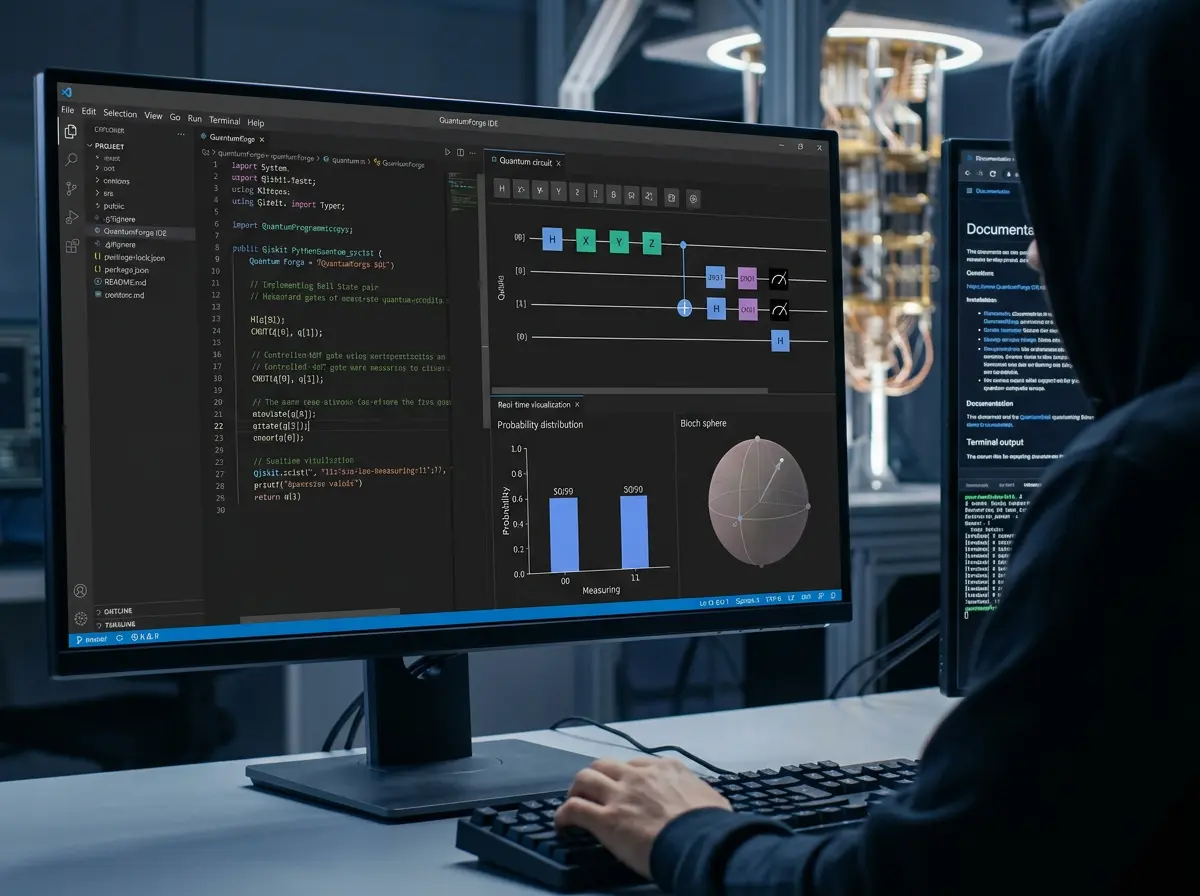
Reference data sourced from the top quantum software companies and quantum-vendor directory at Entangled Future and updated quarterly.
Key takeaways
- The four canonical SDKs are Qiskit (IBM), Cirq (Google), PennyLane (Xanadu), and tket (Quantinuum). Each is the canonical compilation layer for its parent hardware company.
- Three cloud platforms aggregate the bulk of commercial quantum-hardware access: IBM Quantum Platform, AWS Amazon Braket, and Microsoft Azure Quantum.
- Compilers, middleware, and control are the next-most-funded category. Classiq ($200M+), Quantum Machines ($280M+), Riverlane ($195M+), and Q-CTRL ($190M+) lead by capital raised.
- Application software is consolidating around chemistry (Algorithmiq, Phasecraft, Quantistry), finance (Multiverse, QC Ware), and materials science.
- Multi-vendor abstraction layers like Strangeworks let enterprises mix hardware providers without committing to a single stack.
SDKs and Frameworks SDK
Open-source quantum software development kits and frameworks. Each entry below is identified by its package name and the language ecosystem it targets, not by its parent company. The packages cover circuit construction, simulation, hardware execution, and domain libraries for chemistry, finance, machine learning, and optimisation.Qiskit
Packages and features: qiskit (core), qiskit-aer (simulator), qiskit-ibm-runtime (cloud), qiskit-optimization, qiskit-machine-learning, qiskit-nature, qiskit-finance. OpenQASM 3.0 compatible. C API for HPC since 2.3.
The most-installed quantum SDK, the de facto teaching tool in university quantum-computing courses, and the canonical compilation layer for IBM hardware. Sampler and Estimator primitives are the production interface for circuit execution at scale.
Qiskit on PyPI →Cirq
Packages and features: cirq-core, cirq-google (Sycamore + Willow), cirq-aqt, cirq-ionq, cirq-pasqal, cirq-rigetti, cirq-ft. Includes the Quirk circuit visualiser and TensorFlow Quantum integration for hybrid QC-ML.
Research-first SDK built around the surface-code stack and the Willow processor architecture. The canonical framework for surface-code research, AlphaQubit decoder integration, and quantum-machine-learning pipelines via TensorFlow Quantum.
Cirq on GitHub →PennyLane
Packages and features: pennylane (core), pennylane-lightning (high-performance state-vector simulator), pennylane-cirq, pennylane-qiskit, pennylane-aqt, pennylane-amazon-braket, pennylane-strawberryfields. Hardware-agnostic differentiable interface.
Standard SDK for quantum machine learning. Treats quantum circuits as differentiable functions, allowing gradient-based training of variational quantum models alongside classical neural networks. Catalyst extends the differentiable model to MLIR-compiled GPU pipelines.
PennyLane on PyPI →tket
Packages and features: pytket (Python interface), pytket-qiskit, pytket-cirq, pytket-quantinuum, pytket-pennylane, pytket-aqt, pytket-extensions. C++ compiler core wrapped via pytket on PyPI.
Compiler-first SDK originally built at Cambridge Quantum and rewritten in C++ for production performance. Canonical compiler for Quantinuum Nexus and routinely produces shorter circuit depths than competing transpilers on benchmark tasks.
tket on PyPI →Q# and the QDK
Packages and features: Microsoft.Quantum.Development.Kit (Q# compiler + libraries), Microsoft.Quantum.Numerics, Microsoft.Quantum.Chemistry, Microsoft.Quantum.MachineLearning. Q# language tooling in VS Code, Visual Studio, and Jupyter.
Domain-specific language for quantum programming, combined with the QDK libraries for chemistry, machine learning, and numerics. Integrates tightly with Azure Quantum and the .NET runtime, the natural choice for enterprise teams whose existing stack is C#-based.
Q# on Microsoft Learn →Strawberry Fields
Packages and features: strawberryfields (core CV simulator + Borealis/Aurora hardware backend), strawberryfields.tf (TensorFlow integration), strawberryfields.apps (Gaussian boson sampling and graph-similarity applications).
Continuous-variable quantum-computing framework, distinct from the gate-model SDKs. Canonical interface to Xanadu’s Borealis and Aurora photonic processors and the standard tool for Gaussian boson sampling research.
Strawberry Fields on PyPI →Cloud Platforms CLOUD
Managed cloud entry points that expose quantum processors through a single API and SDK. Cloud platforms abstract away hardware-vendor differences and offer pay-as-you-go access to production quantum processors.IBM Quantum Platform
Packages and features: Cloud entry point to IBM’s Heron R2 (156q), Nighthawk (120q, Nov 2025), and Condor (1,121q). Free tier and pay-as-you-go. Qiskit Runtime primitives optimise circuit execution.
The most-used cloud entry point to real quantum hardware, with the largest commercial superconducting fleet behind it. Qiskit Runtime layer optimises circuit execution and integrates with HPC clusters via the Qiskit C API.
Run on IBM Quantum Platform →
Amazon Braket
Packages and features: Managed quantum-computing service offering access to IonQ Forte and Tempo, Rigetti Cepheus, QuEra Aquila and Gemini, IQM Garnet, and AQT IBEX Q1 (added Nov 2025 with EU data residency) through a single API and SDK.
The most diverse multi-vendor cloud, with the broadest hardware-partner roster spanning trapped-ion, neutral-atom, and superconducting platforms. Integrates with AWS analytics, security, and machine-learning tooling.
Run on Amazon Braket →Azure Quantum
Packages and features: Microsoft’s quantum-computing cloud, hosting Majorana 1 plus partner hardware from Quantinuum, IonQ, and PASQAL. Integrates Q# and Qiskit, plus the QDK chemistry libraries.
Distinguishing feature is the topological-qubit research path led by Microsoft’s hardware team. The Quantinuum partnership delivered 12 logical qubits with an 800x error-rate improvement, and the Magne collaboration targets 50 logical qubits by late 2026.
Run on Azure Quantum →Quantinuum Nexus
Packages and features: Cloud entry point to Helios (98 barium ions, 99.92 percent two-qubit fidelity, 48 logical qubits, Nov 2025). tket-native compiler. Subscription and per-usage billing.
Direct access to the highest-fidelity gate operations in industry. The first cloud to ship logical-qubit-native APIs as Quantinuum scales toward 100+ logical qubits, with Color code plus Iceberg concatenation under the hood.
Visit Quantinuum Nexus →Strangeworks
Packages and features: Unified multi-vendor quantum-computing platform that aggregates access to IBM, Google, Rigetti, IonQ, D-Wave, and Infleqtion behind a single workflow with cumulative funding. Quantinuum partnership for cryptographic key services.
The canonical multi-vendor abstraction layer for enterprises that want hardware-agnostic quantum access without committing to a single vendor’s stack. Serves clients across financial services, defence, and pharma.
Visit Strangeworks →Compilers, Control, and Middleware COMPILER
Software that turns high-level algorithm descriptions into optimised quantum-hardware operations, plus the real-time control and quantum-error-correction systems that make fault-tolerant operation possible. Coordinating these control layers with the surrounding CPUs and GPUs is the domain of quantum-classical orchestration, the software that schedules a single workload across classical and quantum processors. Several tools in this section sit squarely in that orchestration layer.Classiq Quantum Platform
Packages and features: AI-powered algorithm-design platform that automatically generates optimised quantum circuits from high-level functional specifications. Correct-by-construction enforcement, automatic uncomputation, GPU-based simulation. Integrates with NVIDIA CUDA-Q and C12 carbon-nanotube qubits.
Algorithm-design platform that lets engineers describe what they want a quantum circuit to do at a high level, and the compiler synthesises the optimised circuit. Removes the need to hand-write quantum gate sequences.
Visit Classiq →Deltaflow 2
Packages and features: Real-time quantum-error-correction decoder running at sub-microsecond latency. Deployed at Oak Ridge National Laboratory in September 2025 (first dedicated real-time QEC at a US national lab) and at OQC’s UK commercial data centre in July 2025.
Real-time error-correction decoder that addresses the bottleneck for scaling logical-qubit counts beyond a few dozen. Drives the practical limits of fault-tolerant operation: faster decoders enable deeper circuits and more logical qubits.
Visit Riverlane →OPX1000
Packages and features: Quantum control system supporting nanosecond-to-millisecond operations on superconducting, trapped-ion, and neutral-atom processors. Integrates with NVIDIA DGX Quantum at Julich Supercomputing Centre. The QBridge layer enables quantum computers to act as HPC resources.
Quantum-control hardware-software platform that handles real-time pulse generation, classical feedback, and orchestration across multiple qubit modalities. The integration with NVIDIA DGX Quantum is the canonical example of HPC-quantum coupling in 2026.
Visit Quantum Machines →Triple Alpha
Packages and features: Quantum software development environment that translates classical code into quantum circuits. Integrates with Maybell cryostat, Quantum Machines control systems, and a Rigetti processor at the Singapore HQ. Strategic collaboration with Alice & Bob for fault-tolerant cat-qubit software in 2026.
Compiler that translates classical code into quantum circuits, removing the need to hand-write quantum algorithms. The first quantum-software stack to integrate with a wholly-owned in-house quantum computer.
Visit Horizon Quantum →Fire Opal
Packages and features: Quantum control infrastructure software for error suppression. Drops in beneath any SDK to apply pulse-level optimisation that boosts circuit fidelity without changing the application code. The Ironstone Opal sister product (Feb 2026) extends to quantum navigation for defence and aerospace.
Pulse-level error-suppression middleware that boosts circuit fidelity on existing quantum hardware. Achieved a 4x optimisation boost on IBM utility-scale quantum computers and won the TIME Magazine Best Innovation of the Year award in December 2025.
Visit Q-CTRL →Algorithm Libraries and Applications ALGORITHM
Quantum-algorithm libraries targeting specific industries: financial optimisation, machine-learning compression, drug-discovery chemistry, and materials simulation.Forge
Packages and features: Enterprise quantum-computing platform with platform-agnostic access to quantum hardware. Abstracts vendor-specific APIs and lets enterprise data-science teams run optimisation, ML, and Monte Carlo simulations across IBM, IonQ, and partner hardware.
Enterprise access layer for Fortune 100 quantum proof-of-concepts in finance, aerospace, and industrial optimisation. The longest-running enterprise quantum-software platform, founded in 2014, with deep partnerships at Goldman Sachs and Airbus.
Visit Forge →CompactifAI
Packages and features: Quantum-inspired large-language-model compression platform. The HyperNova 60B model (Feb 2026) achieves 50 percent compression from a 120B-parameter base model. Available via the CompactifAI API on AWS Marketplace.
Quantum-inspired model-compression engine that shrinks LLMs by up to 95 percent with 2 to 3 percent accuracy loss. Sister product Singularity targets quantum portfolio optimisation for asset managers.
Visit CompactifAI →Algorithmiq
Packages and features: Quantum-enhanced molecular simulation algorithms targeting pharmaceutical research and drug discovery. Hardware-portable across IBM Quantum, Microsoft Quantum Development Kit, Quantum Circuits Aqumen Seeker (dual-rail qubits), and Rigetti.
Pharma-focused quantum-algorithm company specialising in molecular simulation and quantum-enhanced optimisation for drug discovery. Distinct from horizontal SDKs by its chemistry-vertical focus and hardware-agnostic algorithm portfolio. Recent partnerships span IBM (chemistry benchmarks), Microsoft (fault-tolerant chemistry workflows), and Rigetti (quantum-ML fraud detection in payments).
Visit Algorithmiq →THRIFT and Mondrian
Packages and features: Mondrian quantum-optimisation platform plus the THRIFT algorithm for quantum simulation. THRIFT, published in Nature Communications, achieved 10x simulation efficiency gains; Mondrian extends to broader optimisation and chemistry workloads.
Materials-focused quantum-algorithm platform with collaborations across Johnson Matthey, Oxford PV, UK NESO, and BT. Achieved DARPA QBI collaborator status and was named XPRIZE Quantum Applications finalist.
Visit Phasecraft →Top quantum software companies FAQ
Who are the top quantum software companies in 2026?
The leaders by stack layer: SDKs are Qiskit (IBM), Cirq (Google), PennyLane (Xanadu), and tket (Quantinuum). Cloud platforms are IBM Quantum, Microsoft Azure Quantum, and AWS Amazon Braket. Compilers and middleware are Classiq, Quantum Machines, and Horizon Quantum. Real-time error correction is Riverlane. Algorithm libraries span finance (QC Ware, Multiverse, 1QBit), chemistry (Algorithmiq), and materials (Phasecraft). Multi-vendor and control specialty: Q-CTRL and Strangeworks.Which quantum SDK should I learn?
Qiskit is the most widely used and has the deepest tutorial library, especially for beginners. PennyLane is best if you are doing quantum machine learning or differentiable quantum programming. tket is best for compilation and circuit-depth optimisation. Cirq is most useful if you are doing surface-code or Google-hardware-specific research. Q# (Microsoft) integrates well with classical .NET workflows.Which top quantum software companies are publicly traded?
Horizon Quantum Computing (Nasdaq: HQ) listed via SPAC in March 2026 and is the first software-first quantum company on a major US exchange. Most other top quantum-software companies are privately held but venture-backed at $100M+ valuations.What is the difference between a quantum SDK, a compiler, and a cloud platform?
A quantum SDK (Qiskit, Cirq, PennyLane, tket) is the developer-facing API for writing quantum circuits. A compiler (Classiq, tket transpiler) translates that high-level circuit into hardware-specific instructions optimised for a target processor. A cloud platform (IBM Quantum, Azure Quantum, Braket) hosts the hardware and the SDK runtime, providing scheduling, billing, and authentication.Should I follow all the top quantum software companies, or focus?
Follow stack-layer leaders rather than tracking every vendor. The top quantum software companies cluster around five layers, with one to four serious commercial competitors per layer. Focusing on Qiskit (SDK), Azure Quantum or Braket (cloud), Classiq (compiler), Multiverse or Algorithmiq (vertical algorithms), and Q-CTRL (control) gives full coverage of the software stack.


See today’s quantum computing news on Quantum Zeitgeist for the latest breakthroughs in qubits, hardware, algorithms, and industry deals.