Key relay protocols, used in quantum networks to establish shared secrets, were compared with secure network coding techniques on undirected graphs; this investigation determines if these methods are interchangeable when multiple terminals need a common key. The analysis found that while these techniques perform equivalently in simple scenarios, key relay outperforms standard network coding as networks become more complex; specific graph structures demonstrate this difference.
This suggests potential improvements to security in networked communications through combining the strengths of both approaches.
A key concept is the ‘finite field’, which represents a limited set of numbers used in calculations, consider restricting yourself to only using the digits 0, 1, and 2 instead of all possible numbers. Researchers have now identified specific conditions where one method decisively outperforms the other, raising an important statement: will future network designs prioritize efficiency or absolute security when establishing shared keys?
Ternary Field Relay Achieves Enhanced Security Against Simultaneous Eavesdroppers
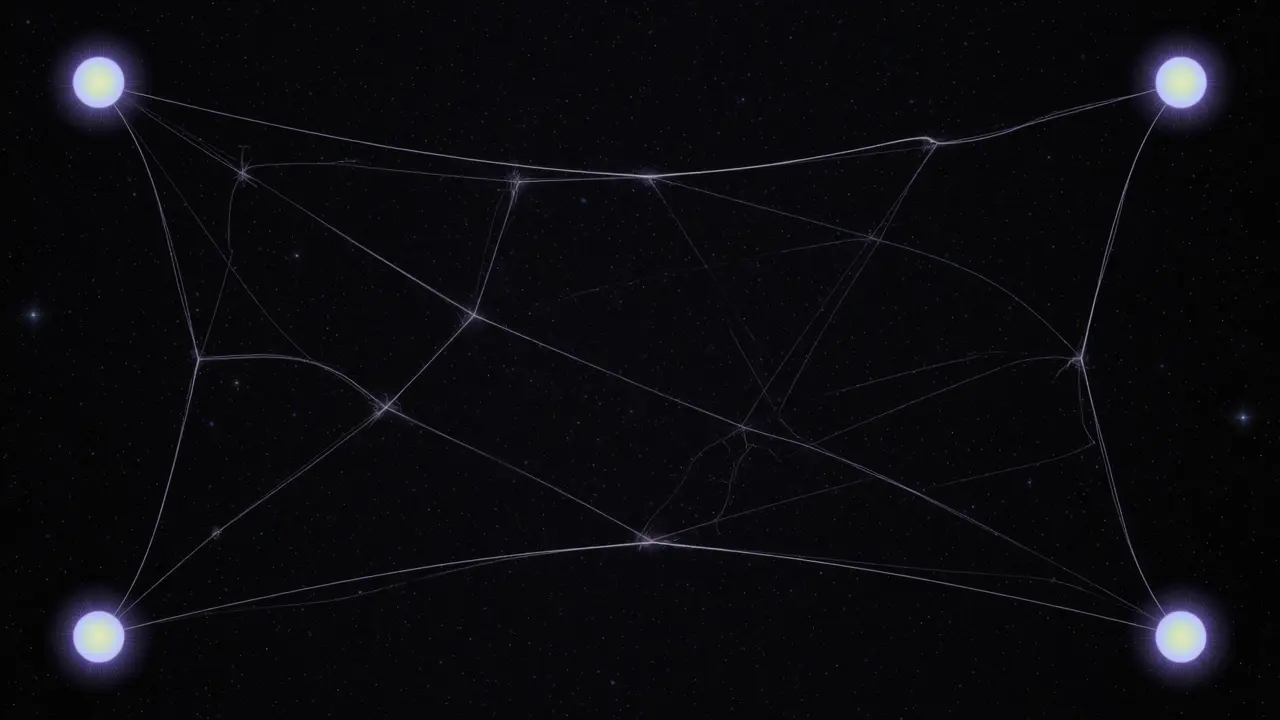
A ternary field enables a linear key relay protocol capable of resisting three perfect-matching wiretap sets, attempts to intercept communications impossible for any comparable linear causal network code on the same four-terminal complete graph. Standard network coding cannot distribute an equally sized source symbol even with private randomness at each vertex and used during decoding. This represents an improvement in security by demonstrating durability against multiple simultaneous eavesdropping attempts, previously unattainable protection.
The findings establish fundamental limits concerning one-shot communication feasibility regarding exact agreement and perfect secrecy while also providing a blueprint for efficient linear key relays that minimise public discussion needed to share keys securely. Researchers from Tohoku University have developed a ‘normal form’ which streamlines communication overheads; however, these results currently focus solely on single instances of communication with perfect secrecy and exact agreement, performance across multiple rounds or practical error correction implementation remains unexplored.
Linear Network Codes Exhibit Performance Limits at Scale
Key relay protocols and secure network coding both aim to establish shared secrets within communications networks, but researchers demonstrated they aren’t universally interchangeable as complexity increases. This divergence in performance raises an important tension: the current findings assess feasibility only with *linear* causal network codes, leaving open the possibility that more complex non-linear schemes could potentially match or even surpass this approach under similar conditions. Acknowledging potential rivals doesn’t diminish the value of this work; it clarifies a fundamental trade-off between these methods as complexity grows.
The team clearly separated secret distribution among multiple parties when using one symbol for simple two-terminal scenarios, this equivalence does not extend to larger networks requiring shared information across several terminals. Their four-terminal complete graph research utilising a ternary field revealed resistance against up to three simultaneous eavesdroppers, an ability beyond current linear causal network codes even with added private randomness at each node. This rigorously demonstrates limitations within specific data transmission schemes and highlights that simpler key relay methods currently outperform them in secure communication networks.
Specifically, they showed that while a one-symbol key can be established between two terminals using either method, this equivalence does not hold when multiple terminals need a shared key. This work establishes fundamental limits concerning secret sharing and provides an efficient blueprint for linear key relays minimizing public communication needed for secure keys.
👉 More information
🗞 Key Relay and Secure Network Coding: One-Shot Equivalence and Separation on Undirected Networks
✍️ Yuji Ando, Edmund Chen, Toyohiro Tsurumaru, Derek Zhang and Donald Zvada (Tohoku University); Go Kato (Affiliation: Toyohiro Tsurumaru)
🧠 ArXiv: https://arxiv.org/abs/2611.16776



See today’s quantum computing news on Quantum Zeitgeist for the latest breakthroughs in qubits, hardware, algorithms, and industry deals.