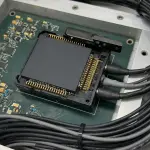
FirstQFM’s quantum reservoir computing system achieved top performance in a pilot program with SW7 Group, forecasting market data across 43 assets for a period of 600 out-of-sample dates, the company says. The system ran on Rigetti’s Cepheus-1-108Q, a gate-based superconducting quantum processor, and was evaluated using metrics including accuracy, macro-F1, portfolio PnL and Sharpe ratio.
FirstQFM extends standard QRC with a proprietary foundation model trained on the Leonardo supercomputer and fine-tuned on the quantum processor, constructing problem-aware reservoirs adapted to the hardware. The company reports that classical simulation was not used to generate the quantum features or forecasts.
FirstQFM’s QRC System Achieves Top Financial Forecast Accuracy
FirstQFM’s quantum reservoir computing system achieved 52.02% accuracy in forecasting the direction of 43 anonymized assets, a figure the company reports is the highest observed among evaluated models during a 600-date out-of-sample test. This performance, measured using a regression-to-sign approach, also translated to a macro-F1 score of 0.5176 and a cumulative gross portfolio PnL of 513,473. The annualized Sharpe ratio reached 1.22. FirstQFM balanced shallow circuit depth with the necessary entangling structure for a useful feature map, ensuring the system could construct representations suitable for financial forecasting.
Beyond aggregate performance, the system demonstrated consistent results across individual assets, achieving positive PnL and Sharpe ratios for 41 of the assets evaluated, according to FirstQFM. This broad applicability contrasts with the performance of a pooled multi-layer perceptron (MLP), which generated positive PnL for 28 assets, and a random forest (RF) model, which achieved this for only 25.
The median asset Sharpe ratio was 0.77 for the QRC system, significantly higher than the 0.35 recorded for the pooled MLP and the 0.10 for the individual RF. The system’s ability to frequently disagree with benchmark consensus suggests it identifies opportunities overlooked by conventional models. FirstQFM emphasizes that generalization beyond the examined period is not claimed, but the findings demonstrate the potential of quantum reservoir computing for financial forecasting. The company reports that the QRC system achieved macro-F1 above 50% for 35 assets, and accuracy above 50% for 36, further solidifying its performance.
Foundation-Model QRC for Enterprise Forecasting.
Cepheus-1-108Q Hardware and QRC Implementation Details
Rigetti’s Cepheus-1-108Q processor executed the quantum component of FirstQFM’s reservoir computing system during a pilot program, requiring between 61 and 84 physical qubits for each of the 600 forecast-date reservoir evaluations. This hardware choice was critical, as the system needed both the qubit count and the fast-executing superconducting gates to support the repeated circuit executions inherent in quantum reservoir computing. The pilot, conducted in collaboration with SW7 Group, assessed the system’s ability to forecast across 43 different assets, providing a broad test of its capabilities beyond a single market indicator.
The evaluation design incorporated six chronological test blocks, allowing for a time-series analysis of the QRC system’s performance over the 600-day out-of-sample period. Primary performance metrics included accuracy, macro-F1, equal-weight portfolio PnL and annualized Sharpe ratio, all of which were used to compare the QRC system against classical statistical and machine-learning models.
FirstQFM reports that QRC achieved the highest observed values for each of these metrics, exceeding the performance of the comparison set. The system encodes input sequences into a quantum reservoir, then uses measurements to generate features for a classically fitted readout that produces the forecast. This approach minimizes the need for extensive quantum circuit optimization, making it suitable for NISQ devices. Researchers acknowledge that no broader claim of “quantum advantage” or generalization of performance beyond the evaluated models and periods is made.
However, the results demonstrate the potential of combining quantum reservoir computing with foundation models to improve financial forecasting. FirstQFM’s work builds on prior investigations into quantum machine learning, including studies by Fujii and Nakajima on harnessing disordered quantum dynamics for machine learning, and Mujal et al.
Quantum Reservoir Computing: A Reservoir Approach Toward Quantum Machine Learning on Near-Term Quantum Devices.
SW7 Group Pilot: Forecasting Task and Evaluation Metrics
This extended testing period, using six chronological test blocks, allowed for a robust evaluation of the system’s predictive capabilities across a diverse range of financial instruments. The evaluation design ensured a consistent comparison between the quantum system and classical benchmarks by using the same supplied features, dates, targets, chronological training, validation and test folds, and evaluation formulas. Each observation within the dataset included a binary target indicating the direction of the next-day asset return, alongside a second target representing its signed magnitude.
FirstQFM’s proprietary approach to reservoir construction, data embedding, and stabilization played an important role in determining the quantum feature representation, while a separately estimated prediction head mapped that representation into the forecast target units. A pretrained head, capable of zero-shot forecasting, was deliberately excluded from the evaluation to prevent potential data leakage.
Among the fitted forecasting models, FirstQFM’s QRC system recorded the highest observed accuracy, macro-F1, cumulative gross portfolio PnL and annualized Sharpe ratio. The system generated positive PnL for 41 assets, and frequently produced predictions that diverged from the consensus of benchmark models.
These results were derived from measurements executed on Rigetti’s Cepheus-1-108Q, with prediction heads fitted and validated chronologically using SW7’s data. Because the asset identities and dates were anonymized, determining whether the underlying time series appeared in the pretraining corpus of the QRC system or any of the time series foundation models was not possible.
A new QRC head was fitted using the training observations within each fold, with settings chosen on validation data under the same chronological scheme used for the fitted classical benchmarks. This rigorous methodology aimed to ensure a fair and reliable comparison of performance. The company stated, indicating plans to expand access to the technology and gather further real-world validation.
Exact Simulation of Quantum Enhanced Signature Kernels for Financial Data Streams Prediction Using Amazon Braket.
Foundation Model Adapts QRC Reservoirs for NISQ Devices
FirstQFM’s system uses a proprietary foundation model, containing over one billion parameters, to adapt quantum reservoir computing (QRC) for use on noisy intermediate-scale quantum (NISQ) devices, a strategy designed to overcome limitations imposed by current quantum hardware. The model, trained on the Leonardo supercomputer, constructs problem-aware reservoirs tailored to both the forecast target and related variables, effectively preparing the quantum system for specific predictive tasks.
This adaptation process accounts for the topology and operating conditions of the quantum processor, and applies learned stabilization techniques to the measured quantum embeddings, enhancing signal clarity. The system’s performance was evaluated across data over a 600-day out-of-sample period, demonstrating its ability to handle a substantial volume of data and a diverse range of financial instruments.
No other evaluated model, including the Chronos-2 time series foundation model, exceeded the QRC system’s performance on the four targeted measures: accuracy, macro-F1 score, portfolio profit and loss and the Sharpe ratio, the company says. The company reports, highlighting the system’s unique capabilities. Rigetti’s Cepheus-1-108Q quantum processor played a large part in the pilot program, providing the necessary scale and performance to execute the 61 to 84-qubit reservoirs required for QRC.
The processor’s fast-executing superconducting gates also facilitated the repeated circuit executions essential for the QRC process, making it a particularly suitable platform for latency-sensitive applications. “Foundation-Model QRC for Enterprise Forecasting,” a recent publication by FirstQFM, details the methodology and findings of this research.
The company’s approach differs from traditional QRC by incorporating a foundation model, a technique borrowed from the field of artificial intelligence, to pre-process and optimize the quantum computations, the company states. This allows the system to adapt to the inherent limitations of NISQ hardware, such as circuit depth, connectivity and noise, which often hinder the construction of complex quantum representations, the company’s account states.
The model was trained on the Leonardo supercomputer and fine-tuned on Cepheus-1-108Q. The success of this pilot program has prompted FirstQFM to announce a broader beta system release to select partners.
Opportunities in Quantum Reservoir Computing and Extreme Learning Machines.
Fujii-Nakajima Framework Underpins Quantum Reservoir Computing
This extended forecasting period demonstrates the system’s capacity for sustained performance beyond immediate predictions, a requirement for practical financial applications. Their subsequent research further refined the connections between quantum reservoir computing and the challenges of temporal information processing on near-term quantum devices. The system uses a reservoir state, accessed through measurements, to preserve relevant information from recent inputs while distinguishing between input histories that would lead to different predictions.
Expectation values, derived from repeated circuit executions, are then used as classical features for a prediction head, effectively translating quantum information into actionable financial forecasts. This approach allows the system to function with shallow circuits and without the need for full quantum error correction, making it particularly well-suited for implementation on noisy intermediate-scale quantum devices.
The evaluation included comparisons against a range of classical models, including neural networks, echo state networks and other time series foundation models such as Chronos-2 and Granite TTM-R2, FirstQFM claims. While some models achieved comparable accuracy, the QRC system consistently demonstrated stronger aggregate results and often produced predictions that diverged from the benchmarks, suggesting its potential to identify unique market signals, FirstQFM says.
“Natural Quantum Reservoir Computing for Temporal Information Processing” and “Large-Scale Quantum Reservoir Learning with an Analog Quantum Computer” represent earlier investigations into the potential of this approach, but FirstQFM’s work demonstrates a practical application on a commercially available quantum processor. The company’s long-term vision, as articulated in a recent perspective, centers on the role of AI in guiding quantum technology and defining what constitutes genuine quantum utility.
Optimal Quantum Reservoir Computing for Market Forecasting: An Application to Fight Food Price Crises.




See today’s quantum computing news on Quantum Zeitgeist for the latest breakthroughs in qubits, hardware, algorithms, and industry deals.