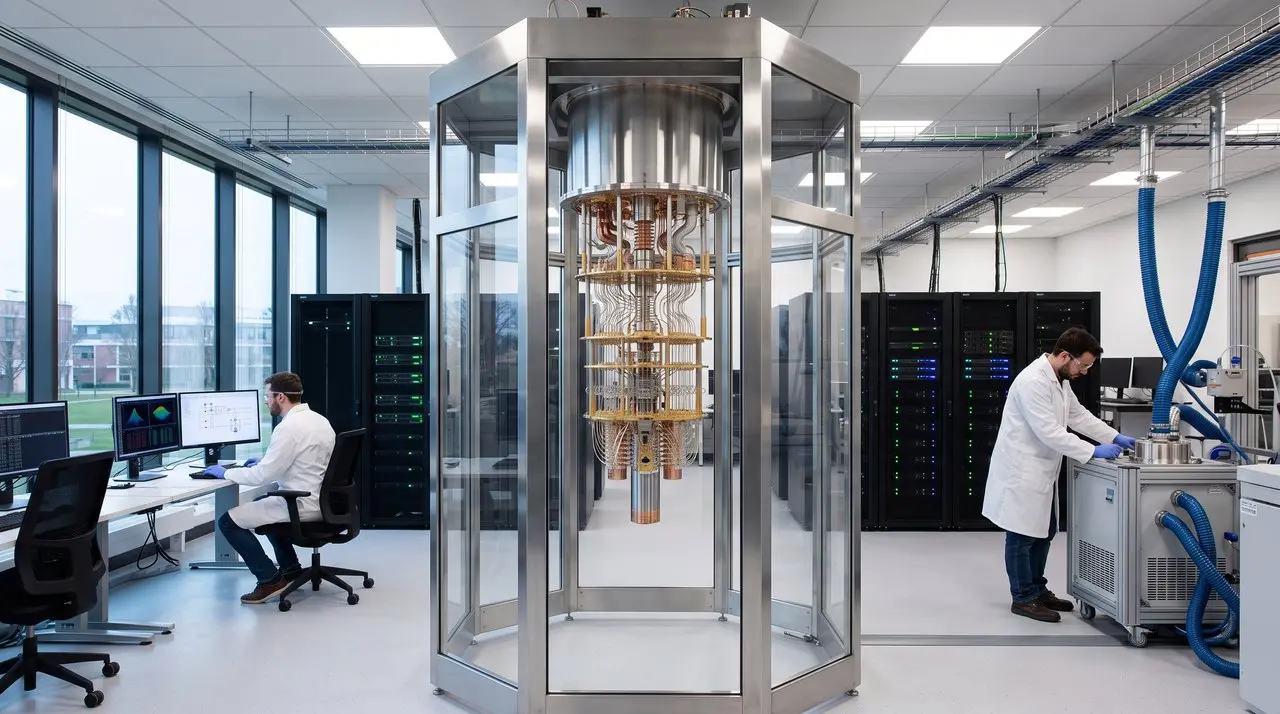
IBM, Cleveland Clinic, and RIKEN are finalists for the 2026 ACM Gordon Bell Prize after successfully simulating protein-ligand complexes containing 12,635 atoms, the largest molecules yet modeled using quantum computers. This achievement exemplifies a growing integration of quantum computing with high-performance computing, where each system tackles the portions of a problem it handles best.
“We are on that path, which runs through high-performance computing (HPC) centers,” IBM states, unveiling new open-source tools at SC26 to support quantum processing unit and graphics processing unit integrations across various classical hardware vendors. This collaboration with AMD and NVIDIA aims to accelerate practical applications of quantum computing within existing HPC workflows.
Quantum-HPC Integration Simulates Protein-Ligand Complexes
Classical computers initially processed clusters within these complexes, focusing on less entangled segments while reserving more complex, entangled portions for IBM Quantum Heron processors coupled with classical high-performance computing resources. This workflow, using a method called sample-based quantum diagonalization (SQD), has been automated through ROQUO, RIKEN’s new supercomputer built on NVIDIA GB200 NVL4 systems. Researchers extended this approach to study Fe₄S₄, an iron-sulfur cluster found in proteins within living cells, acknowledging its strongly interacting electrons present a significant simulation challenge.
By initiating SQD from a broken-symmetry reference state, an approximation designed to better capture magnetic interactions, the team achieved results within 4.3 millihartree of the accuracy attained by the density-matrix renormalization group (DMRG), a highly accurate classical simulation method. This represents a 79× improvement over their previous closed-loop SQD result on the same cluster, demonstrating the increasing precision of combined quantum-classical methods.
Further integration efforts focus on streamlining error correction, a critical hurdle for practical quantum computation. IBM, ORNL, and AMD recently launched a co-design platform for quantum error correction, physically connecting AMD Instinct MI355X GPUs and 5th Gen AMD EPYC CPUs with IBM Quantum Nighthawk r2 processors. This platform allows researchers to develop and test decoders and error correction workflows on real quantum hardware without independently constructing the necessary infrastructure.
Complementing hardware advancements, new software tools like Pelagos, built using the Triton framework, accelerate decoder testing on both AMD and NVIDIA GPUs, achieving up to 97× faster runtimes compared to single-CPU core execution. “OpenQSE: Building an open quantum-HPC software ecosystem” is also a key focus for the collaboration, alongside “Workload-manager-agnostic QPU integration with QRMI.”
Sample-Based Quantum Diagonalization Advances Fe₄S₄ Research
The team will detail these findings at the SC26 conference, showing a practical application of hybrid quantum-classical computing. Classical hardware is essential to enabling these advancements, particularly in error correction research where rapid processing is essential. Error-correcting codes require constant monitoring of qubits to identify and correct errors, demanding decoders that can keep pace with quantum processors. AMD’s contributions extend to optimizing the classical components of the workflow. A study with an AMD co-author demonstrated a roughly 100-fold speedup per node by moving the classical diagonalization step of SQD onto GPUs.
IBM is also streamlining workflow management with the introduction of managed workflows in IBM Quantum Functions, allowing teams to run and reuse quantum-classical workflows on high-performance infrastructure. “You can start today with the free IBM Quantum Open Plan on the IBM Quantum Platform,” the company states, indicating immediate accessibility for those interested in exploring these tools.
Pelagos Tool Accelerates Quantum Decoder Testing on GPUs
Pelagos, a new open-source tool developed by IBM and AMD, accelerates quantum decoder testing by using the parallel processing capabilities of graphics processing units. The tool uses the Triton framework, enabling compatibility with both AMD and NVIDIA GPUs, and represents a step toward integrating quantum computing with existing high-performance computing infrastructure. Initial tests demonstrate Pelagos can run decoder tests up to 97 times faster than equivalent simulations on a single CPU core, dramatically reducing the time required to evaluate error correction strategies.
This scalability is important, as simulating the billions of error patterns necessary to validate quantum decoders demands substantial computational resources. “But maturing these integrations requires software that fits into existing HPC workflows,” the team notes, highlighting the importance of tools like Pelagos for practical implementation. They tested Pelagos on Lux, an AMD-powered system at Oak Ridge National Laboratory, further demonstrating its real-world applicability.
Beyond raw speed, Pelagos also simplifies the orchestration of complex workloads across multiple GPUs, a traditionally challenging aspect of distributed computing. This ease of use is intended to broaden access to advanced decoder testing for researchers, allowing them to explore the impact of varying error rates and hardware configurations on decoder performance. This work contributes to the Quantum Genesis initiative, which aims to establish a fault-tolerant quantum computing capability by 2028.
QRMI Integrates QPUs into Existing HPC Schedulers
QRMI addresses a core challenge in hybrid quantum-classical computing by enabling existing high-performance computing schedulers to directly manage quantum processing units. The open-source middleware functions as a bridge, allowing systems like Slurm to treat a QPU as another resource alongside CPUs and GPUs, eliminating the need for manual orchestration of hybrid jobs. This integration means researchers familiar with HPC workflows can use quantum hardware without learning entirely new systems.
NVIDIA’s acquisition of Slurm’s lead developer, SchedMD, in December 2025, is now directly contributing to this integration. The company is collaborating with IBM to incorporate QRMI with Slurm’s Hierarchical Resources feature, further streamlining access to quantum resources. This partnership aims to ensure that the tools and expertise already present in HPC centers are readily applicable to quantum workloads, reducing the barrier to entry for researchers.
IBM researchers are demonstrating QRMI and related tools at SC26, the International Conference for High Performance Computing, Networking, Storage and Analysis. This focus on open-source tools and standardized interfaces is intended to broaden participation and accelerate the development of practical quantum applications.


See today’s quantum computing news on Quantum Zeitgeist for the latest breakthroughs in qubits, hardware, algorithms, and industry deals.