
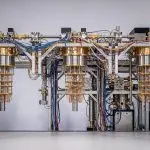
Oak Ridge National Laboratory identifies shifts in quantum computing capabilities, with access to IBM Quantum superconducting transmon systems offering up to 156 qubits through the Quantum Computing User Program. This represents the highest qubit count resource currently available within the program, alongside alternative architectures from Quantinuum, which provides superconducting transmon systems with up to 54 qubits. Beyond simply offering hardware, the QCUP Operations model proactively supports users through its User Assistance Group, providing technical support, training, documentation, and tools. Researchers at ORNL expect these resources and support structures will enable evaluation of emerging technologies and engagement with a growing quantum ecosystem.
This year will see a significant push toward practical quantum algorithm implementation, moving beyond theoretical designs to executable code on available hardware. The crucial step of compilation, translating a high-level quantum algorithm into a sequence of standard quantum gates, is receiving focused attention as researchers strive to bridge the gap between algorithmic intent and physical realization. This process is not merely a technical detail; it’s the equivalent of writing out the precise steps of a recipe for a quantum processor to follow, demanding optimization to minimize errors and maximize computational efficiency. Experts anticipate that advancements in compilation techniques will be a key determinant of near-term quantum advantage, allowing complex algorithms to run effectively on increasingly powerful quantum systems. Simply having qubits is not enough; the ability to effectively program them is paramount.
Quantinuum also contributes to the QCUP landscape with its own superconducting transmon systems, reaching 54 qubits, demonstrating that Oak Ridge National Laboratory is actively diversifying its access to different quantum architectures. This multi-platform approach is vital because compilation strategies often need to be tailored to the specific characteristics of each quantum processor, including its connectivity, gate fidelity, and error rates. The Software Services Development (SSD) Group within QCUP Operations plays a critical role in this process, providing technical support and training, and also designing and building custom software to facilitate algorithm compilation and execution. The SSD Group is focused on developing techniques to handle the limitations of qubit connectivity, effectively routing quantum information between qubits that are not directly connected.
The goal is to create a seamless workflow where researchers can define their algorithms at a high level and the compilation process automatically generates an optimized quantum circuit ready for execution on systems with up to 156 qubits, and beyond as hardware continues to evolve. This level of automation will be essential for scaling quantum algorithms and unlocking the full potential of quantum computing.
At the end of the day, the power of quantum computing is that a qubit can be both a 0 and 1 at the same time.
Industry leaders predict a significant shift in quantum computing workflows, moving beyond simply accessing qubits to actively tailoring algorithms for specific hardware. The process, known as transpilation, adapts a standard quantum circuit, a series of idealised operations, to the limitations of real-world quantum processors. This is not merely a technical detail; it’s becoming a central bottleneck as researchers strive to extract meaningful results from increasingly complex quantum systems. Transpilation accounts for constraints like the allowed set of quantum gates a processor can natively execute, the physical connectivity between qubits determining which can directly interact, and the precise timing and measurement protocols of each device. The analogy of adapting a recipe to a particular kitchen’s equipment perfectly encapsulates the challenge; a theoretically perfect algorithm must be reshaped to function within the confines of available resources.
However, simply having a large number of qubits does not guarantee success; the efficiency of transpilation directly impacts the fidelity and speed of calculations. Experts anticipate that automated transpilation tools will become increasingly sophisticated, reducing the burden on users and enabling them to focus on algorithm design rather than low-level hardware optimisation.
Simulating quantum systems (many body systems and entangled particles) is exponentially hard classically but naturally suited for quantum computers, in fields such as Materials Science, Chemistry & Quantum Chemistry, and Nuclear Physics • Pathway to Breakthroughs in Materials and Drug Discovery • QC enables accurate modeling of molecular systems (e.
Industry leaders predict a significant focus on streamlining quantum circuits to maximize performance on existing, imperfect hardware. The core principle guiding this effort, as articulated by researchers at Oak Ridge National Laboratory, is to reduce circuit complexity; “Same dish, fewer steps and fewer chances to mess up” encapsulates the drive to achieve computational goals with minimal quantum gates and reduced circuit depth. This is not merely about theoretical efficiency, but a pragmatic response to the realities of current qubit technology, where errors accumulate with each operation. The emphasis on optimization stems from a fundamental shift in evaluation metrics for quantum computers. Traditional measures like FLOPS, commonly used in high-performance computing, are becoming less relevant; instead, the focus is shifting towards fidelity, the reliability of the answer, scale, the resources required, and speed, the rate of circuit execution.
Quantifying these aspects requires new benchmarks, such as Quantum Volume, which assesses a computer’s ability to execute complex, random circuits of increasing size, and CLOPs, or “circuit layer operations per second,” which measures the speed of executing circuit layers. Researchers are actively working to improve these metrics, recognizing that simply increasing qubit count is not sufficient for practical quantum computation. The Software Services Development Group within the Quantum Computing User Program Operations is designing and building custom software and integrating vendor APIs to automate these processes. Experts anticipate that these advancements in circuit optimization will be crucial for unlocking the full potential of near-term quantum computers and tackling increasingly complex computational challenges, even with the limitations of current hardware.
Quantum computing is increasingly viewed as a critical technology, necessary for global competitiveness Quantum Simulation for Scientific Discovery • Simulating quantum systems (many body systems and entangled particles) is exponentially hard classically but naturally suited for quantum computers, in fields such as Materials Science, Chemistry & Quantum Chemistry, and Nuclear Physics • Pathway to Breakthroughs in Materials and Drug Discovery • QC enables accurate modeling of molecular systems (e.
The pursuit of practical quantum computation is rapidly shifting focus from simply increasing qubit counts to ensuring those qubits are reliably controllable and well-characterized. The challenge lies in scaling these systems without sacrificing the precision needed for complex calculations, as adding more qubits invariably introduces greater calibration difficulties and increased variability. A crucial aspect of this refinement is the ability to consistently initialize and reset qubits to the ground state, denoted as ⟩|𝟎. This standardized starting point is not merely a convenience; it is essential for both reproducible experimentation and the implementation of error correction cycles. However, achieving faster reset times presents a trade-off, potentially introducing additional errors or necessitating more sophisticated control hardware and calibration routines. Maintaining qubit coherence, the duration for which a qubit can reliably hold quantum information, remains a significant hurdle.
Ideally, coherence times must significantly exceed the duration of any gate operation performed on the qubit. This requirement dictates a constant push for materials and architectures that minimize environmental interactions, as any disturbance can lead to decoherence and computational errors. Faster gate speeds, while desirable, can paradoxically increase error rates, and deeper computational circuits inherently amplify the effects of noise. Faster qubit readout, necessary for extracting computational results, can also reduce fidelity or inadvertently disturb neighboring qubits, creating a complex interplay of competing factors. Addressing these sources of “noise,” or error, is paramount. The source lists error suppression, which proactively accounts for known hardware limitations; error mitigation, which adjusts results based on observed inaccuracies; and error correction, which employs redundancy to create “logical” qubits from multiple physical qubits, effectively masking errors.
Nifty trick, but introduces “noise” (will talk about this more later) • Physical representation depends on the technology • Classical computers can only simulate so many qubits before running out of memory… Many Types of Technology “Trapped” Atoms & Ions Superconducting Material Neutral Atoms Topological Materials Quantinuum ColdQuanta Delft IonQ QuEra Copenhagen Credit Steane & Rieffel Credit Dickel Credit DiVincenzo Credit Stern & Linder So Many Technologies: How Do We Evaluate Them?



See today’s quantum computing news on Quantum Zeitgeist for the latest breakthroughs in qubits, hardware, algorithms, and industry deals.