Quantum Stocks · Updated July 2026
Public Quantum Computing Companies You Can Track In 2026
The public quantum computing companies below trade on the New York Stock Exchange, the Nasdaq, and exchanges in Europe and Asia. This guide lists their tickers, home markets, and quantum approach, and it is reporting rather than investment advice.
Public quantum computing companies are businesses whose shares trade on a stock exchange and whose work centres on quantum hardware, quantum software, or both. A few years ago this was a very short list, yet the picture in 2026 looks completely different.
Across 2026 the sector saw the busiest run of quantum listings on record. The roster of public quantum computing companies expanded well past two dozen names, spanning the New York Stock Exchange, the Nasdaq, and several venues in Europe and Asia. Our live Quantum Navigator follows 27 public quantum stocks and refreshes as prices move.
This page tracks the companies you can research as of July 2026, with tickers, home exchanges, and the quantum approach each one takes. It is descriptive reporting rather than investment advice, and every valuation here is a point in time figure that moves with the market. For a broader view of the field, see our guide to quantum computing companies of every size.
On this page
- The 2026 listing wave
- Quantum stock tickers at a glance
- Pure play quantum computing stocks
- Smaller quantum listings that get overlooked
- Big technology companies with quantum programmes
- How to read this list
- Frequently asked questions



The 2026 listing wave
The most important shift for public quantum computing companies came from a wave of initial public offerings and SPAC mergers. Four names in particular changed the shape of the sector, because they brought large, dedicated quantum businesses onto public markets for the first time.
Quantinuum (Nasdaq QNT)
Quantinuum began trading on the Nasdaq under the ticker QNT on 4 June 2026, after an upsized initial public offering that raised about 1.68 billion dollars. The debut implied a valuation in the region of 15 billion dollars, which made it one of the largest quantum listings to date.
The company was formed from Honeywell’s quantum division and the British firm Cambridge Quantum, and it runs a full stack of trapped ion hardware and software. Honeywell remains its largest shareholder after the offering, so the listing gave public investors direct exposure to one of the field’s leading hardware makers.

IQM (Nasdaq IQMX)
IQM started trading on the Nasdaq Global Select Market under the ticker IQMX on 2 July 2026, through a business combination with the Real Asset Acquisition Corp. The deal valued the Finnish superconducting specialist at roughly 1.8 billion dollars and dual listed its shares on Nasdaq Helsinki the following day.
IQM describes itself as the first European quantum computing company to reach a major United States exchange. It had sold more than twenty quantum computers worldwide before the listing, which the company says is one of the largest installed bases among gate-model hardware makers, giving it unusual deployed field experience for a young company.
Xanadu (Nasdaq XNDU)
Xanadu completed a SPAC merger with Crane Harbor Acquisition Corp in March 2026 and now trades as XNDU on both the Nasdaq and the Toronto Stock Exchange. The Canadian company describes itself as the first publicly listed pure play photonic quantum business, and the transaction valued it at roughly 3 billion dollars.
Its approach uses light rather than superconducting circuits or trapped ions to carry quantum information. The Canadian and Ontario governments committed substantial funding alongside the deal, which points to how closely public money now sits behind several quantum listings.
Infleqtion (NYSE INFQ)
Infleqtion began trading on the New York Stock Exchange under the ticker INFQ on 17 February 2026, following a merger with Churchill Capital Corp X. The combination brought in about 550 million dollars of gross proceeds, and the company is led by chief executive Matthew Kinsella.
Infleqtion is, by its own account, the first publicly listed neutral atom quantum business, and its work spans both quantum computers and precision sensing. The company grew out of the group formerly known as ColdQuanta, and it now sits alongside the superconducting, trapped ion, and photonic names on this list.
Quantum stock tickers at a glance
The table below gathers the main tickers for public quantum computing companies, along with each firm’s home exchange and quantum approach. Listings and modalities are current as of July 2026 and are provided for reference only, not as a recommendation.
| Ticker | Company | Exchange | Quantum approach |
|---|---|---|---|
| QNT | Quantinuum | Nasdaq | Trapped ion, full stack |
| IONQ | IonQ | NYSE | Trapped ion |
| IQMX | IQM | Nasdaq, Nasdaq Helsinki | Superconducting |
| XNDU | Xanadu | Nasdaq, TSX | Photonic |
| INFQ | Infleqtion | NYSE | Neutral atom, sensing |
| RGTI | Rigetti Computing | Nasdaq | Superconducting |
| QBTS | D-Wave Quantum | Nasdaq | Quantum annealing |
| QUBT | Quantum Computing Inc | Nasdaq | Photonic, entropy based |
| ARQQ | Arqit Quantum | Nasdaq | Quantum safe encryption |
| LAES | SEALSQ | Nasdaq | Post quantum security chips |
| BTQ | BTQ Technologies | Nasdaq | Post quantum security infrastructure |
| HQ | Horizon Quantum | Nasdaq | Quantum software tools |
| QNC | Quantum eMotion | NYSE | Quantum random numbers |
| ZPTA | Zapata Quantum | OTC | Quantum application software |
| IBM | IBM | NYSE | Superconducting |
| GOOGL | Alphabet (Google) | Nasdaq | Superconducting |
| MSFT | Microsoft | Nasdaq | Topological, cloud |
| AMZN | Amazon | Nasdaq | Cloud access, hardware research |
| INTC | Intel | Nasdaq | Silicon spin qubits |
| NVDA | NVIDIA | Nasdaq | GPU simulation, CUDA-Q |
| HON | Honeywell | Nasdaq | Quantinuum shareholder |
| FJTSY | Fujitsu | Tokyo, OTC | Superconducting, annealing |
| 6701 | NEC | Tokyo | Quantum annealing |
Pure play quantum computing stocks
Beyond the new arrivals, a group of established pure play public quantum computing companies has traded for several years. These firms draw most of their revenue and their identity from quantum technology rather than from a larger corporate parent, so their share prices react sharply to quantum news.
IonQ (NYSE IONQ)
IonQ trades on the New York Stock Exchange under the ticker IONQ and builds trapped ion quantum computers. In September 2025 it completed the acquisition of the British firm Oxford Ionics for around 1.075 billion dollars, a deal that added a respected trapped ion engineering team to its roadmap.
The company is led by chief executive Niccolo de Masi, who took the role after co-founder Peter Chapman stepped back in 2025. IonQ offers its systems through the major cloud platforms and has built its own quantum data centre in Europe, part of a steady push into markets outside the United States.
D-Wave Quantum (Nasdaq QBTS)
D-Wave Quantum moved from the New York Stock Exchange to the Nasdaq in July 2026 and trades as QBTS. It is best known for quantum annealing, an approach aimed at optimisation problems rather than universal computation. In March 2025 the company published a Science paper claiming a form of quantum advantage on a materials simulation task.
That claim is contested and should be read as a company statement rather than a settled result. Independent groups at the Flatiron Institute and at EPFL reported classical methods that reproduced comparable results, so the significance of the advantage remains an open scientific debate.
Rigetti Computing (Nasdaq RGTI)
Rigetti Computing trades on the Nasdaq under the ticker RGTI and develops superconducting quantum processors. Its modular architecture and the Novera QPU aim to make on premises quantum hardware available to research groups and companies.
The company has worked with government programmes including DARPA and has pursued multi chip designs as a route to higher qubit counts. Founder Chad Rigetti left the chief executive role in 2022, and the firm has since focused on scaling and system performance.
Quantum Computing Inc (Nasdaq QUBT)
Quantum Computing Inc trades on the Nasdaq as QUBT and focuses on photonic and entropy based systems rather than superconducting qubits. Its Dirac line targets optimisation problems, and the company has emphasised room temperature operation as a practical selling point.
The firm has expanded into photonic chip manufacturing at a facility in Arizona, which sets it apart from software led rivals. Like several small quantum names, its share price has been highly volatile, so its market value can shift quickly on company news.
Arqit Quantum (Nasdaq ARQQ)
Arqit Quantum trades on the Nasdaq under the ticker ARQQ and works on quantum safe encryption rather than quantum hardware. Its symmetric key technology is designed to protect data against future quantum attacks, which places the firm in the cybersecurity corner of this list.
The company sits closer to the post quantum security market than to quantum computing itself. It appears here because it is frequently grouped with quantum stocks, and because its fortunes are tied to the same expectation that powerful quantum machines are coming.
Smaller quantum listings that get overlooked
The names above take almost all the attention. They are not the whole list, though, and six more quantum businesses now file with the Securities and Exchange Commission, several of them selling quantum security rather than quantum computers. All are small and thinly traded. All are easy to miss.
SEALSQ (Nasdaq LAES)
SEALSQ makes security chips. It is moving its range onto the new codes built to survive a quantum computer, which is where the quantum label comes from. The Swiss group WISeKey owns most of it, so buying the shares means buying into a listed subsidiary rather than a company that stands on its own.
The chips go into payment cards, identity documents and connected devices. That places the business much closer to the ordinary chip trade than to quantum computing, which is worth knowing before anyone treats the shares as a bet on quantum hardware. The quantum part is the code running on the silicon.
BTQ Technologies (Nasdaq BTQ)
BTQ Technologies sits in Vancouver. It builds the plumbing that keeps systems safe once a quantum computer can break the codes we use today. That covers trusted hardware, tools for moving digital assets onto the new codes, and kit for testing quantum systems.
It backs the two codes America’s standards body picked, ML-KEM and ML-DSA. BTQ is Canadian, so it counts as a foreign issuer, files on Form 6-K, and does not publish the quarterly reports an American company has to. That makes it harder to follow.
Horizon Quantum (Nasdaq HQ)
Horizon Quantum is based in Singapore and sells software, not machines. Its product is called Triple Alpha. It pairs its own programming languages with a compiler, the tool that turns written code into something a given machine can actually run, and it aims at more than one kind of quantum chip.
The pitch is that writing quantum programs is still too hard and too tied to one machine. Horizon also runs its own quantum computer as a testbed, though it sells the tools rather than the hardware.
Quantum eMotion (NYSE QNC)
Quantum eMotion is a Montreal firm that sells one thing. It makes a chip that produces truly random numbers. The randomness comes from electron tunnelling rather than from light, which the company says lets it shrink the part small enough to sit inside ordinary electronics.
Random numbers matter more than they sound. A code is only as strong as the guesswork behind its keys, so a weak source of randomness undoes everything built on top of it. The company claims 1.8 gigabits a second, and says its US federal approval is still in progress rather than granted.
Zapata Quantum (OTC ZPTA)
Zapata is the survivor on this list. The Boston company wound down its earlier operations, fell behind on its filings, then caught up four overdue reports in December 2025 and registered its shares again in May 2026.
It now sells quantum application software and trades over the counter rather than on an exchange. Its accounts carry going concern language, it lost about 3.1 million dollars in the first half of 2026, and it held about 12.1 million dollars in cash at the start of August.
Pasqal, the next one to watch
Pasqal is French, it builds machines from neutral atoms, and it is merging with a listed shell called Bleichroeder Acquisition Corp II. The ticker PSQL is reserved but not yet in use. Its registration went effective on 5 August 2026 and shareholders were called to vote on the deal on 25 August.
It has not closed yet, and a deal that is cleared is not the same as a deal that is done. Until the shares actually change hands, Pasqal belongs on a watchlist rather than on this table.
Big technology companies with quantum programmes
Several of the largest technology companies in the world run substantial quantum programmes, even though quantum is a small part of their overall business. Investors cannot buy these efforts on their own, yet these firms belong on any serious list of quantum stocks.
IBM (NYSE IBM)
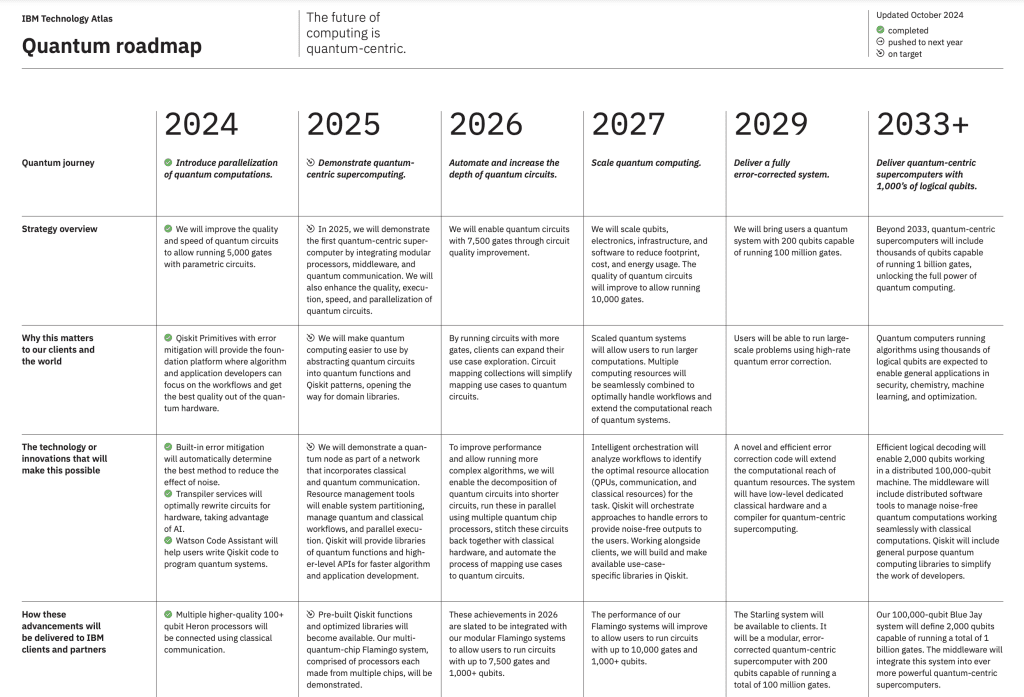
IBM trades on the New York Stock Exchange as IBM and runs one of the oldest and deepest quantum programmes in the industry. It operates a fleet of superconducting systems on the cloud through Qiskit and publishes a detailed multi year hardware roadmap.
The roadmap targets error corrected machines later this decade, built on processors such as Heron and the planned Starling generation. IBM has also installed Quantum System One machines at partner sites around the world, from universities to national laboratories.
Google (Nasdaq GOOGL)
Google, part of Alphabet, trades on the Nasdaq under GOOGL and pursues superconducting quantum computing through its Quantum AI group. Its 2024 Willow chip focused on quantum error correction and reported error rates that fell as the code grew.
Google claimed a computational milestone in 2019 with its Sycamore processor, a result the team framed as quantum supremacy. The group continues to work toward a large error corrected machine that could run useful algorithms.
Microsoft (Nasdaq MSFT)
Microsoft trades on the Nasdaq as MSFT and approaches quantum through its Azure Quantum cloud and its long running topological qubit research. In 2025 it presented Majorana based devices, a path that remains scientifically debated and far from a working machine.
The company also partners with hardware makers to offer their systems on Azure, so customers can reach several kinds of quantum processor in one place. Microsoft created the Q sharp programming language to give developers a dedicated quantum toolset.
Amazon (Nasdaq AMZN)
Amazon trades on the Nasdaq as AMZN and reaches quantum mainly through Amazon Web Services and its Braket platform. Braket gives developers on demand access to hardware from several providers, including superconducting, trapped ion, and neutral atom machines.
Amazon has also funded its own hardware research, including work on error corrected architectures using novel qubit designs. Its main strength in this field is delivering quantum access as a managed cloud service rather than selling a machine outright.
Intel and NVIDIA (Nasdaq INTC and NVDA)
Intel trades on the Nasdaq as INTC and pursues silicon spin qubits that borrow directly from its semiconductor manufacturing base. NVIDIA trades on the Nasdaq as NVDA and, rather than building qubits, supplies the GPUs and the CUDA-Q software that many groups use to simulate and orchestrate quantum workloads.
Both companies sit at the edges of this list, since neither sells a general purpose quantum computer today. Their tools nonetheless shape how the wider field develops, which is why they appear on most quantum stock screens.
Honeywell and the Japanese majors
Honeywell trades on the Nasdaq as HON and remains the largest shareholder in Quantinuum after that company’s 2026 listing. In Japan, Fujitsu and NEC continue to trade in Tokyo and run superconducting and annealing programmes.
Fujitsu has built joint systems with the research institute RIKEN, while NEC has a long history in quantum annealing. These names give investors indirect exposure to quantum through much larger parent businesses, so their share prices tend to move less on individual quantum announcements than the pure plays.
Companies that stepped back
Not every name from earlier lists still belongs here. Alibaba and Baidu both closed their quantum laboratories in 2023 and 2024, donating equipment to universities and state institutes, and the quantum software firm Zapata AI ceased operations in late 2024.
Toshiba, once a fixture on quantum stock lists for its quantum key distribution work, was taken private in December 2023 and no longer trades publicly. These exits are a reminder that a quantum programme can be wound down as quickly as it was launched.
Get our reporting on quantum listings, hardware milestones, and the companies behind them, straight to your inbox.
Free to join, and you can unsubscribe at any time. Emails are handled by Substack; see our privacy policy.
How to read this list
Public quantum computing companies attract attention that is out of proportion to their current revenue, which makes careful reading essential. Share prices in this sector swing sharply on individual announcements, and the underlying technology remains years away from broad commercial payback.
Government money is now a meaningful part of the story. Under the CHIPS programme in May 2026, the United States committed about 2.013 billion dollars across nine quantum companies in the form of equity stakes, a move that ties several of these firms more closely to public policy.
Technical claims deserve the same scrutiny as financial ones. When a company reports a breakthrough, it is worth checking whether independent researchers have reproduced it, as the debate over D-Wave’s 2025 advantage claim shows. You can track many of these public quantum computing companies on the Nasdaq screener, where they appear alongside conventional technology stocks.
All figures on this page are current as of August 2026 and are offered for information only. Valuations, tickers, and listings can change, so treat this guide as a starting point for your own research rather than a live quote.
Frequently asked questions
How many public quantum computing companies are there
There is no single fixed number, because the total depends on how strictly you define a quantum business. The table on this page lists 23 tickers, from dedicated pure plays to large technology firms with quantum divisions, and six of them are quantum security companies rather than quantum computer makers.
Which quantum companies went public in 2026
The busiest stretch brought Infleqtion, Xanadu, Quantinuum and IQM to public markets, alongside earlier arrivals IonQ, D-Wave, Rigetti and Quantum Computing Inc. Quantinuum raised about 1.68 billion dollars in its June 2026 Nasdaq listing, the largest of them. Pasqal has cleared its registration but had not closed its merger as of August 2026.
Are quantum stocks a good investment
This page does not offer investment advice and cannot tell you what to buy. Quantum stocks are volatile and speculative, and any decision should follow your own research and, where appropriate, a licensed financial adviser.
What is the difference between pure play and big tech quantum stocks
Pure play names such as IonQ and Rigetti earn most of their identity from quantum technology, so their share prices track quantum news closely. Large firms such as IBM, Google, and Microsoft run major quantum programmes, yet quantum is a tiny part of their overall value.
Legal disclaimer
Quantum Zeitgeist does not provide personal investment or financial advice, and does not act as a personal financial, legal, or institutional investment adviser. We do not individually advocate the purchase or sale of any security or investment, or the use of any particular financial strategy, and all investment strategies carry the risk of loss for some or even all of your capital.
Before pursuing any financial strategy discussed here, or relying on information within this website, you should always consult a licensed financial adviser. Any analysis we provide is for informational purposes only, does not take your circumstances into account, and should not be treated as an individualised recommendation, since the securities mentioned may not be suitable for all investors.




See today’s quantum computing news on Quantum Zeitgeist for the latest breakthroughs in qubits, hardware, algorithms, and industry deals.