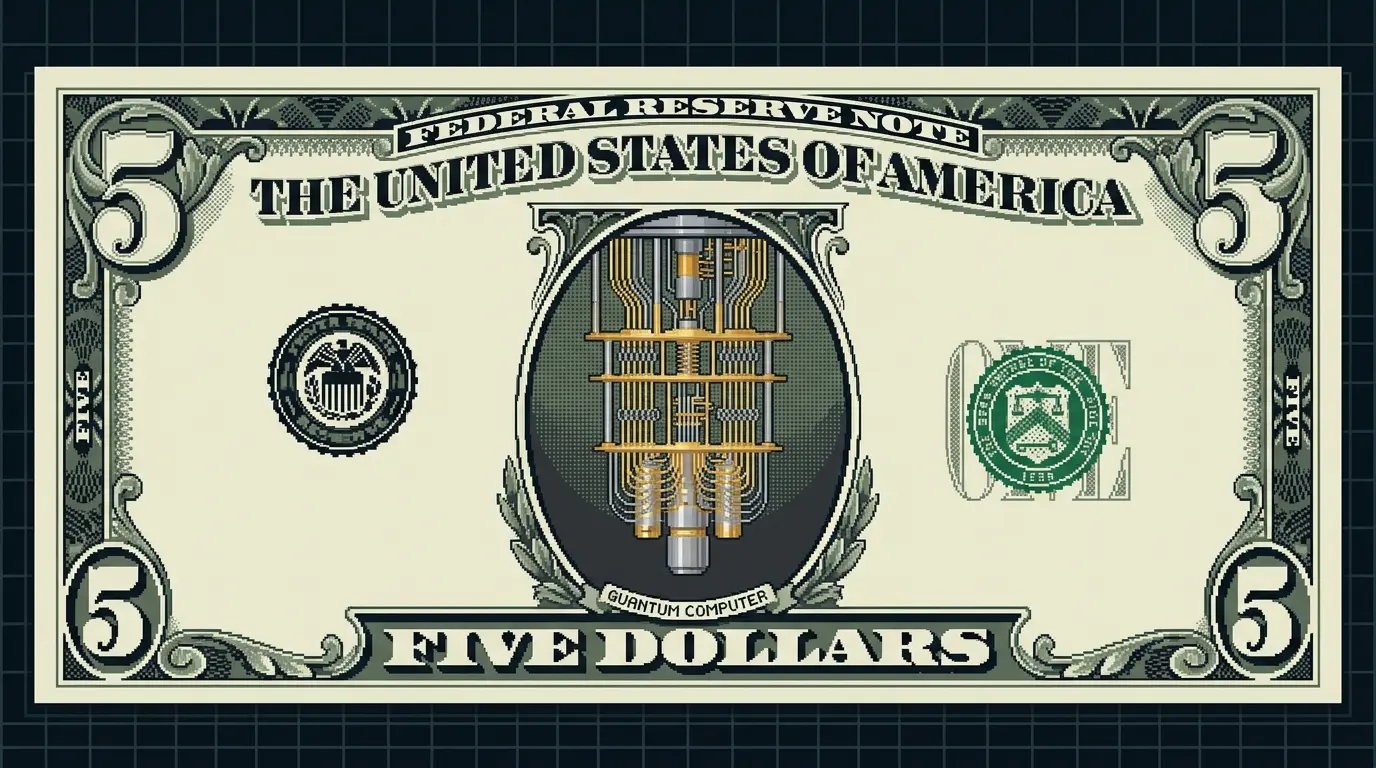
Governments have announced or budgeted about $3.3 billion a year of public money for quantum technology, counted under one rule and traced to their own documents. The United States, Germany and the United Kingdom lead. China, which may spend more than any of them, publishes nothing that can be checked.
Government spending on quantum technology is easy to announce and hard to add up. Ministers quote envelopes that run for four, eight or ten years, and some of them quietly include private money, European money or sums never confirmed outside a press release. We gathered 68 programme lines from budget papers, ministry releases and laws. Then we kept only the money a reader can trace to a government source. The answer is about $3.3 billion a year, most of it announced or budgeted rather than proven spent.
That is consistent with the best-known global count, if that count is spread over time. McKinsey found about $42 billion of public quantum money announced by April 2024. Take out China’s estimated $15.3 billion and spread the rest over eight to ten years, and it comes to about $2.7 billion to $3.3 billion a year. That span runs back to Britain’s 2014 programme, the oldest in our ledger. The difference is in method. Our figure is a current yearly rate built from named lines, while McKinsey’s is a running total whose country list is not published.
The figure is a floor on coverage and a ceiling on spending. China, classified work and defence lines that nobody reports as quantum all sit outside it, so a published Chinese budget or a defence line of known size would raise it. Most of what it counts is plans. The money actually paid out so far is lower.
- One rule puts announced and budgeted public quantum money at about $3.3 billion a year
- The US, Germany and the UK lead on yearly public money, and China cannot be ranked
- America’s quantum research budget has stayed near $1 billion a year since 2022
- Germany spends the most in Europe each year, and France’s headline counts other people’s money
- Japan and Korea publish budget years that can be counted, while Korea’s target and Australia’s PsiQuantum deal mix in private money and loans
- China publishes no quantum budget, so its spending cannot be ranked
- Illinois put $500 million into one quantum campus, and few other state figures can be traced
- New announcements since 2024 add about $9.3 billion at face value and about $240 million on a strict count
- Gulf states, Israel and several EU members publish no quantum budget that can be checked
- A late US report, a German sequel and the next EU budget would change the picture most
- Frequently asked questions
World rate. Governments have announced or budgeted about $3.3 billion a year of public quantum money that can be traced to their own documents. The figure comes from 14 programmes that state an amount and a window and run into 2025 or 2026.
Leaders. The United States leads at about $1.01 billion a year, ahead of Germany at about $848 million and the United Kingdom at about $330 million. The American figure is one enacted budget year, while the German and British figures are averages of announced multi-year plans.
China. China publishes no quantum budget. The usual figure is McKinsey’s 2022 estimate of $15.3 billion announced, and a leading Chinese physicist has said a rumour of $15 billion spent on quantum computing was inflated.
Growth. New announcements since April 2024 that we found come to about $9.3 billion at face value, but only about $240 million passes a strict test for new national public money. America’s research budget has been flat at about $1 billion a year since 2022.
One rule puts announced and budgeted public quantum money at about $3.3 billion a year
The rule has four tests. A programme counts only if it states an amount and a time window, if a government source confirms it, and if the money is public or has a stated public share. Its window must also cover 2025 or 2026, so the figure describes money now rather than in 2019. Each programme that passes becomes a yearly rate, its amount divided by the years it runs.
14 programmes pass, and together they come to about $3.3 billion a year. That total still mixes bases. The American, Japanese and Korean figures are single budget years, while the British, French and German figures are averages of plans that were announced but never voted on line by line. Japan counts only the budget lines its Cabinet Office can separate as quantum, so its figure is a floor.
The rule leaves out more than it keeps. China is out because it publishes no budget, and South Korea’s strategy target is out because it mixes in private money, though Korea’s 2025 ministry budget passes on the same basis as Japan’s. Australia’s deal with PsiQuantum is out too, because it is mostly loans and shares with no window, and so are US state money, equity deals, prize ceilings and private foundations.
Every dollar figure uses the 2025 annual average exchange rate for its currency, so some figures differ from those quoted when each plan was announced. The rates and their sources are listed in the method note at the end.
The US, Germany and the UK lead on yearly public money, and China cannot be ranked
Ranked by headline totals, the list rewards long windows and loose definitions. China tops it with an analyst’s estimate. Korea’s total includes private money and Australia’s is mostly loans and shares, so the first table ranks what governments have said, at face value, with the status of each figure beside it. It is a ranking of claims and must not be added up.
| Country | Headline programme | Total in US dollars | Window | Status |
|---|---|---|---|---|
| China | Public funds announced, McKinsey count (2022) | $15.30 billion | Not stated | Estimate by an analyst |
| United States | Federal quantum research budget, sum of six years | $5.08 billion | FY2019 to FY2024 | Actual to FY2023, enacted FY2024 |
| Germany | Federal quantum action plan | $3.39 billion | 2023 to 2026 | Announced |
| United Kingdom | National Quantum Strategy | $3.30 billion | Ten years from 2024 | Announced |
| South Korea | Quantum strategy target, public and private | $2.11 billion | 2023 to 2035 | Target, includes private money |
| France | National quantum strategy (2021) | $2.04 billion | 2021 to 2025 | Announced, includes EU and industry money |
| European Union | Quantum Flagship | $1.13 billion | Ten years from 2018 | Announced |
| Spain | Quantum technologies strategy | $914 million | 2025 to 2030 | Announced, paid from EU funds |
| Japan | Cabinet Office quantum budgets | $912 million | FY2024 and FY2025 | Enacted |
| Netherlands | Quantum Delta NL, national growth fund | $695 million | Not stated | Awarded in phases, not confirmed at a ministry |
| India | National Quantum Mission | $689 million | 2023-24 to 2030-31 | Approved by Cabinet |
| Australia | Federal and Queensland package for PsiQuantum | $606 million | Not stated | Announced, mostly loans and shares |
| Canada | Two budgeted quantum programmes | $497 million | From 2021-22 | Budgeted |
| Israel | National quantum programme | $363 million | Not stated | Press only |
| Taiwan | Quantum national team programme | $257 million | Five years from December 2020 | Press only |
Fifteen largest public quantum programmes by headline total, one headline programme per country plus the European Union, in US dollars at 2025 average exchange rates. Status, window and what the money includes all differ, so the column must not be summed. The US row adds six published budget years because America has no multi-year envelope. Japan adds its FY2024 initial and supplementary budgets and its FY2025 initial budget. Canada adds C$360 million from 2021 and C$334.3 million from Budget 2025. Israel’s and Taiwan’s figures appear only in the press. State money such as Illinois’s is covered in the US states section.
Ranked by yearly rate, the order changes and the figures firm up. The US spends about $1.01 billion a year on unclassified quantum research, ahead of Germany’s plan at about $848 million a year and Britain’s at about $330 million. Japan comes fourth on budgets it has enacted. Only 14 countries and the EU have enough on record to compute a rate.
| Country | Yearly rate in US dollars | What the rate rests on | Status |
|---|---|---|---|
| United States | $1.01 billion | One year of the federal research budget, FY2024 | Enacted |
| Germany | $848 million | €3 billion plan averaged over 2023 to 2026 | Announced |
| United Kingdom | $330 million | £2.5 billion strategy averaged over ten years | Announced |
| Japan | $241 million | FY2025 initial budget, separable lines only | Enacted |
| France | $226 million | State share of about €1 billion averaged over 2021 to 2025 | Announced |
| Spain | $152 million | €808 million averaged over 2025 to 2030 | Announced, EU funds |
| South Korea | $139 million | Science ministry’s dedicated quantum budget, 2025 | Enacted |
| European Union | $113 million | Quantum Flagship averaged over ten years | Announced |
| India | $86 million | National Quantum Mission averaged over eight years | Approved |
| Canada | $85 million | Two programmes, seven and five years | Budgeted |
| Taiwan | $51 million | NT$8 billion over five years | Press only |
| Singapore | $45 million | S$295 million over 2021 to 2025 | Budgeted |
| Denmark | $30 million | At least DKK 1 billion over 2023 to 2027 | Announced |
| Austria | $20 million | €107 million over 2021 to 2026 | Announced, EU funds |
| Switzerland | $6 million | CHF 10 million over 2023 and 2024 | Press only |
Public quantum money as a yearly rate in US dollars at 2025 average exchange rates, one rate per country plus the European Union, computed only where the source states a window. Rates are averages of multi-year plans except the US, Japan and South Korea, which are single budget years. Taiwan and Switzerland rest on the press. Korea’s strategy target is not used because it includes private money.
The gap between Germany and Britain shows why the second table matters more. They announced almost the same totals, about $3.4 billion and $3.3 billion, but Germany spreads its money over four years while Britain spreads its money over ten. So Germany spends more than two and a half times as much each year.
America’s quantum research budget has stayed near $1 billion a year since 2022
The United States publishes the best series of any country. Each year the National Quantum Initiative office asks federal agencies what they spent on quantum research, then prints the total in a report that also covers the coming year. Its latest report, from December 2024, shows $456 million for 2019 and about $1.04 billion for 2022. Since then the figure has stayed close to $1 billion. The report gives about $1.01 billion of enacted budget for 2024 and a request of $998 million for 2025.
| Fiscal year | Amount | Status | Earlier figure for the same year |
|---|---|---|---|
| FY2019 | $456 million | Actual | $449 million to $450 million in earlier reports |
| FY2020 | $690 million | Actual | $672 million spent, in earlier reports |
| FY2021 | $851 million | Actual | Not recorded |
| FY2022 | $1,041 million | Actual | $877 million requested, $918 million enacted, $1,031 million spent |
| FY2023 | $1,036 million | Actual | $844 million requested, $932 million enacted |
| FY2024 | $1,006 million | Enacted | $968 million requested |
| FY2025 | $998 million | Requested | First appears in this report |
| FY2026 | Not published | No report yet | Not applicable |
US federal spending on quantum information science research by fiscal year (October to September), in US dollars, from the National Quantum Initiative supplement of December 2024. Unclassified research only. The report calls FY2024 enacted budget authority in its text and estimated expenditures in its figure caption. Earlier reports gave different figures for the same years.
Two warnings come with the series. Every new report revises earlier years, and the 2022 figure began as an $877 million request, became $918 million enacted and about $1.03 billion spent, and now stands at about $1.04 billion. The report also calls 2024 enacted budget authority
in its text and estimated expenditures
in its figure caption. So even the latest year is not settled.
The series is also late. The quantum.gov list runs only to the report published in December 2024, more than 21 months ago, and nothing yet covers 2025 spending or the 2026 request. The figures count only research that is not secret, so classified work is left out.
Washington’s newer money sits outside the series and on weaker footing. In May 2026 the Commerce Department signed letters of intent with nine quantum firms in return for minority stakes, worth about $2.01 billion by a trade-press count rather than a government release. D-Wave’s filing confirms its own $100 million share. The Energy Department’s quantum contest offers up to $215 million, but only $2.5 million comes from the 2026 budget year. The rest depends on Congress.
Our Manhattan Project analysis counts all of that at face value and reaches about $3.4 billion for 2026. That is a measure of what was signed or announced in one year, not a yearly spending rate.
North of the border, Canada has budgeted C$360 million over seven years from 2021 and a newer C$334 million over five years from Budget 2025. Together they come to about $85 million a year.
Germany spends the most in Europe each year, and France’s headline counts other people’s money
Germany’s 2023 action plan promised rund drei Milliarden Euro
, around three billion euros, for 2023 to 2026. Of that, €2.18 billion comes from federal ministries and €850 million from research organisations that the state funds. At about $848 million a year it is the largest rate in Europe by a wide margin, but the plan ends in 2026 and no successor amount has been published.
Britain’s National Quantum Strategy commits £2.5 billion over the ten years from 2024, about $330 million a year. Two later packages sit beside it. In June 2025 the government said £670 million would go to quantum computing, though it gave no window for that sum and did not say whether it was new money.
On 17 March 2026 it announced support worth up to £2 billion
. The notes to editors list the £1 billion for procuring large scale quantum computers
and, separately, over £1 billion over the next 4 years
for companies and researchers. Neither release says whether this money is new or part of the £2.5 billion, so this page does not add it to the strategy total.
France’s headline needs the most care. The 2021 strategy dossier described un engagement global de 1,8 Mds€, nécessitera un effort cumulé de l’Etat de près de 1 Md€ à l’horizon 2025, et comprend des financements européens et industriels
. In English, the €1.8 billion is an overall commitment needing a state effort of nearly €1 billion by 2025, and it includes European and industry money. So the state’s own share was about €1 billion over five years, or $226 million a year.
In May 2026 President Macron announced a €1 billion top-up through the France 2030 plan. The money was moved from other France 2030 priorities rather than newly raised. He put the total at près de 3 milliards d’euros qui seront mobilisés sur 5 ans
, meaning nearly €3 billion to be mobilised over five years. That sum counts research and armed forces budgets, money returned from the EU and private money drawn in alongside, so it is not €3 billion of new state spending.
France also runs PROQCIMA, a defence programme to buy quantum computers. Its official page sets a ceiling of un montant maximal de 500 millions d’euros
, a maximum of €500 million over at least ten years. Its first phase, from 2024 to 2026, is worth €60 million, and a second phase from 2026 to 2028 is capped at €150 million, so most of the ceiling lies years ahead.
The European Union’s Quantum Flagship was set up in 2018 at the 1b € level
over ten years, about $113 million a year. The EU and 17 countries also bought six quantum computers for over €100 million, half from each side. A Quantum Act is still being drafted. Its consultation runs to 16 October 2026, so the EU’s next budget for quantum, which the research community wants set aside in its own line, is not yet known.
Spain’s 2025 strategy sets an estimated budget of 808 millones de euros
, which is €808 million, for 2025 to 2030. The ministry says the money comes from EU regional funds and from Spain’s recovery plan, which the EU pays for, so it is largely EU money spent by Spain. Austria’s €107 million to 2026 also comes from the recovery fund.
Denmark promised mindst en milliard kroner
, at least DKK 1 billion, over 2023 to 2027. The Netherlands’ often quoted €615 million for Quantum Delta NL appears on a partner institute’s page rather than at a ministry, so it stays out of the yearly rate.
Japan and Korea publish budget years that can be counted, while Korea’s target and Australia’s PsiQuantum deal mix in private money and loans
Japan’s Cabinet Office adds up every ministry’s quantum lines each year, and for 2025 it reports 予算額(含基金) 約361億円
, a budget of about ¥36.1 billion including funds, or $241 million. A supplementary budget in 2024 added ¥63.5 billion to a first budget of ¥36.8 billion. The 2026 request is ¥43.4 billion. Lines whose quantum share cannot be split out are left out, so every figure is a floor.
South Korea’s headline is a target. Its 2023 strategy calls for 민•관 합동 최소 3조원 투자
, at least ₩3 trillion of public and private investment combined, from 2023 to 2035. The same release puts the government’s share at ₩2.4 trillion, about $1.69 billion or $130 million a year, while the science ministry’s dedicated quantum budget for 2025 was ₩198 billion. That is about $139 million at this page’s 2025 average of ₩1,421 to the dollar, up about 54 per cent on 2024, so the two measures agree on scale.
India’s Union Cabinet approved the National Quantum Mission in April 2023 at Rs 6,003.65 crore from 2023-24 to 2030-31. That is about $689 million, or $86 million a year over eight years, although we found no published figure for what has been spent in each year so far.
Australia’s largest quantum outlay is a single deal. In April 2024 the federal and Queensland governments agreed about A$940 million, roughly A$470 million each, for PsiQuantum to build a machine in Brisbane, which is about $606 million. The Queensland Audit Office shows the state’s half split into convertible notes, a A$200 million loan and a A$75 million grant, both with conditions. At 30 June 2024 the notes were valued at A$188 million, and the loan and grant had not been used.
Singapore set aside S$295 million for quantum research under its 2021 to 2025 research plan, about $45 million a year. Because it sits in the national research plan, it is a budget rather than an announcement.
China publishes no quantum budget, so its spending cannot be ranked
The figure most often quoted for China is $15.3 billion. It comes from McKinsey’s 2022 count of announced public funds, has no time window and has never been confirmed by the Chinese government. Chao-Yang Lu is a leading quantum physicist at the University of Science and Technology of China. In 2023 Foreign Policy reported that he had no idea
how a rumour of China spending $15 billion on quantum computing began. He said the actual money is maybe 25 percent of that
. By our arithmetic that is under $4 billion, but it was a passing remark about computing alone, not a count of all quantum spending.
Neither number can be checked. China does not publish a quantum line in its budget, and part of its work is military, so the first table shows China’s total but the second gives it no yearly rate. The world rate leaves China out too, which may be its largest omission.
In March 2025 China set up a national fund for young tech firms, expected to draw nearly 1 trillion yuan, about $139 billion, from local governments and private investors. It is not a quantum fund. It backs hard tech in general and names quantum as one of several future fields, so its share for quantum is not known.
Illinois put $500 million into one quantum campus, and few other state figures can be traced
Below the federal level, one figure checks out cleanly. The Illinois governor’s office says the state is investing $500 million to build out a quantum campus in Chicago, with PsiQuantum signed up as the anchor tenant. The same release says Illinois earlier put $200 million into the Chicago Quantum Exchange. The $500 million pays for the park, not the company.
New Mexico’s economic development office says the state put $25 million into a quantum start-up studio. The same release calls Elevate Quantum, the hub shared by Colorado and New Mexico, a $127 million grant-funded program
but does not split federal from state money. We found no state sum for Maryland’s Capital of Quantum effort, and a widely cited New Mexico package of $315 million could not be traced to any state source either. No state money enters the world rate.
New announcements since 2024 add about $9.3 billion at face value and about $240 million on a strict count
McKinsey counted about $42 billion of public quantum money announced around the world by April 2024. That figure adds up announcements over many years rather than spending, it includes China’s estimated $15.3 billion, and McKinsey does not publish its country list or its method. So it cannot be checked line by line.
Since then, the new announcements we found come to about $9.3 billion at face value, and two of them rest only on the press or a company release. That includes the Commerce equity letters, Australia’s loans and shares, France’s moved €1 billion, Spain’s EU-funded plan and two British packages that may overlap the £2.5 billion strategy. A strict count keeps only new national public money with no stated overlap. It drops money moved from other plans, EU funds, loans, shares and years that hang on a future vote. Only Canada’s C$334 million programme passes, about $240 million.
Neither figure can be added to McKinsey’s $42 billion. The bases differ, and some of the new packages may sit inside envelopes McKinsey already counted. What does stand out is the change in tools, since much of the new money comes as shares, loans and prize ceilings rather than as grants that are simply paid out. McKinsey’s 2026 monitor found that public sources supplied about a third of start-up investment in 2024 and only 3 per cent in 2025.
Gulf states, Israel and several EU members publish no quantum budget that can be checked
Several governments with quantum plans publish no budget for them. We found none for Saudi Arabia or the UAE. One industry tracker credits Qatar with $1 billion over a decade but gives no source for it, and we could find no Qatari government document that states it. Israel’s figure of NIS 1.25 billion appears only in the press.
Europe has its own gaps. Ireland’s Quantum 2030 strategy states no amount, Italy has a strategy but no budget we could confirm, and Brazil funds quantum through agency calls rather than a national line. Poland and Czechia host EU quantum computers but publish no national quantum budget. In the United States, Maryland is the clearest case of a state programme with no stated sum.
A late US report, a German sequel and the next EU budget would change the picture most
Three publications would move the world rate most. The first is America’s overdue report on 2025 spending and the 2026 request, since the US makes up nearly a third of the total. The second is Germany’s plan for 2027 onwards, because the current one ends this year, and the third is the EU’s next long-term budget, where researchers want money set aside for quantum.
Smaller changes would sharpen it. Britain could say whether its March 2026 package sits inside the £2.5 billion strategy, and Korea could publish its yearly budgets on one consistent basis. A quantum line in China’s budget would change the ranking itself, though nothing suggests one is coming. Until then, the yearly rates in the second table are the safest numbers to compare, because each one rests on a published amount and a published window.
Is quantum the new Manhattan Project?
US quantum companies
German quantum companies
UK quantum companies
French quantum companies
Japanese quantum companies
South Korean quantum companies
Chinese quantum companies
Canadian quantum companies
Australian quantum companies
Spanish quantum companies
Dutch quantum companies
Israeli quantum companies
Frequently asked questions
Which country spends the most on quantum technology?
Among countries that publish their budgets, the United States spends the most, about $1.01 billion a year on federal quantum research in its enacted 2024 budget. Germany comes next at about $848 million a year under its announced 2023 to 2026 plan, then the United Kingdom at about $330 million. China may spend more, but it publishes no quantum budget, so it cannot be ranked.
How much does the US government spend on quantum?
The National Quantum Initiative report puts federal quantum research at about $1.01 billion of enacted budget for 2024 and a request of $998 million for 2025. The figure has been close to $1 billion a year since 2022. Newer deals, such as about $2 billion of Commerce Department equity letters by a trade-press count, sit outside that figure and are not yearly spending.
How much does China spend on quantum?
No one outside the Chinese government knows. McKinsey estimated $15.3 billion of announced public funds in 2022, with no time window. In 2023 Foreign Policy reported the physicist Chao-Yang Lu saying that a rumour of $15 billion spent on quantum computing was inflated and that the actual money was maybe 25 per cent of that. China’s 1 trillion yuan guidance fund is not a quantum fund.
What is the UK’s quantum budget?
The National Quantum Strategy commits £2.5 billion over the ten years from 2024, about $330 million a year. In March 2026 the government announced support worth up to £2 billion, including £1 billion for buying large quantum computers and over £1 billion over four years for research and companies. It has not said how much of that sits inside the £2.5 billion.
How much does the EU spend on quantum?
The EU’s Quantum Flagship was set up in 2018 at about €1 billion over ten years, roughly $113 million a year. The EU and member states also bought six quantum computers for over €100 million, half from each side. Member states put in far more than the EU itself, led by Germany and France.
Is government spending on quantum growing?
Announcements are growing faster than budgets. The new announcements since April 2024 that we found come to about $9.3 billion at face value, but only about $240 million passes a strict test for new national public money. The US research budget has been flat at about $1 billion a year since 2022.
How much do governments spend on quantum in total?
Governments have announced or budgeted about $3.3 billion a year of public quantum money that can be traced to their own documents. The count covers 14 programmes that state an amount and a window and run into 2025 or 2026. McKinsey’s figure of about $42 billion adds up announcements over many years and includes an estimate for China. Without China, and if spread over eight to ten years, roughly back to Britain’s 2014 programme, it is consistent with this page’s yearly figure.
Figures come from the programme ledger behind this page, 68 lines built from budget documents, ministry releases, legislation and official strategies, read on 11 October 2026. A yearly rate is the stated amount divided by the years in the stated window, and is computed only where a window is given. France’s 2021 rate uses the stated state share, not the bundled headline.
The world rate counts 14 programmes and comes to $3.32 billion a year. It leaves out China, South Korea’s strategy target, Australia’s PsiQuantum package, the Netherlands, press-only figures, US state money, equity letters, prize ceilings, defence authorisations and private foundations. New announcements since April 2024 come to $9.28 billion at face value. The strict count of new national public money is $239 million, Canada’s Champions Program only. The McKinsey comparison is our arithmetic, $42 billion less China’s $15.3 billion spread over eight to ten years.
Exchange rates are 2025 annual averages.
| Currency | 2025 average | Source |
|---|---|---|
| GBP | 1.3192 US dollars per unit | FRED AEXUSUK |
| EUR | 1.1306 US dollars per unit | FRED AEXUSEU |
| CAD | 1.3973 per US dollar | FRED AEXCAUS |
| AUD | 0.645 US dollars per unit | FRED AEXUSAL |
| SGD | 1.3065 per US dollar | FRED AEXSIUS |
| JPY | 149.5686 per US dollar | FRED AEXJPUS |
| KRW | 1,421.3963 per US dollar | FRED AEXKOUS |
| INR | 87.1468 per US dollar | FRED AEXINUS |
| CNY | 7.1875 per US dollar | FRED AEXCHUS |
| DKK | 6.6137 per US dollar | FRED AEXDNUS |
| CHF | 0.8305 per US dollar | FRED AEXSZUS |
| TWD | 31.1663 per US dollar | FRED AEXTAUS |
| ILS | 3.4449 per US dollar | ECB EXR A.ILS.EUR / A.USD.EUR 2025 annual (3.8927 / 1.1300) |
The shekel has no Federal Reserve series, so it is derived from European Central Bank annual reference rates.
Statuses follow the source’s own words, namely announced, budgeted, enacted, actual, requested, target, estimate or press only. Nothing on this page is investment advice.


See today’s quantum computing news on Quantum Zeitgeist for the latest breakthroughs in qubits, hardware, algorithms, and industry deals.