Researchers developing quantum algorithms face a growing bottleneck as simulations scale from seconds to hours, even days. Qoro Quantum addresses this challenge with Divi, a managed cloud platform providing CPU and GPU resources designed to accelerate simulations. Two 64-qubit examples demonstrate Qoro’s Divi platform can deliver enough GPU capacity to improve simulation accuracy and enough CPU parallelism to complete a large noise sweep in minutes. Quantum algorithm researchers “should not have to become cluster administrators to keep making progress,” according to the company, and Divi aims to free them from that burden.
Divi Simplifies Quantum Circuit Execution on Cloud Infrastructure
Qoro Quantum’s Divi platform delivers substantial speed increases for complex quantum circuit simulations, completing a large noise sweep in 43 minutes that would previously require approximately 15.6 hours of compute time on a single node. This acceleration stems from Divi’s ability to harness parallel cloud-based CPUs, a capability demonstrated with a simulation involving roughly 15.6 hours of compute, achieving a 22-fold improvement in processing time.
The platform’s architecture allows researchers to access this capacity from their existing Python workflows, minimizing the time spent on infrastructure management and maximizing exploration of increasingly demanding workloads, Qoro Quantum says. The platform’s impact extends beyond speed, also improving simulation accuracy. A 64-qubit Ising quench simulation, tracking a quantum system over time with 100 circuits each containing roughly 60,000 gates, completed each circuit in under nine minutes using GPUs.
This contrasts with a predicted runtime exceeding one day on a single CPU node, even with unlimited nodes, and highlights Divi’s ability to provide the necessary GPU capacity for more precise results. The simulation deliberately avoided classical shortcuts like free-fermion mapping, using fields from Kim & Huse (PRL 111, 127205, 2013) to model a non-integrable system with ballistic entanglement spread. Divi’s flexibility allows researchers to target either GPU or CPU resources through the same script, eliminating the need for separate cluster configurations.
The platform’s TimeEvolutionTrajectory feature constructs gate sequences mirroring those executed on a quantum processor, and the addition of a noise model enables comprehensive error analysis. “Cloud compute gives quantum algorithm teams room to ask harder questions,” according to Qoro Quantum, as the increased computational power allows for more accurate simulations and faster feedback loops across larger experiments.
In the Ising simulation, the GPU’s speed enabled the team to increase the bond dimension, improving late-time results while some CPU runs reached their time limits. The platform’s design addresses a critical bottleneck in quantum algorithm development: the transition from small-scale simulations on personal computers to larger, more demanding calculations.
While initial development often begins with a Python script using Qiskit or Cirq, researchers quickly encounter scaling limitations as simulations grow from seconds to hours, or even consume an entire machine for a day. Qoro Quantum aims to resolve this issue by managing the underlying compute infrastructure, including CUDA drivers, containers, job schedulers and memory limits.
This allows researchers to focus on algorithm design and analysis, rather than becoming “cluster administrators to keep making progress.” By providing a managed cloud environment, Qoro Quantum intends to empower quantum algorithm researchers to explore more complex systems and accelerate the pace of discovery. Qoro’s cloud infrastructure is currently available, offering researchers a pathway to access increased computational resources and streamline their workflows.
Bond Dimension Scaling Impacts Accuracy in Time Evolution
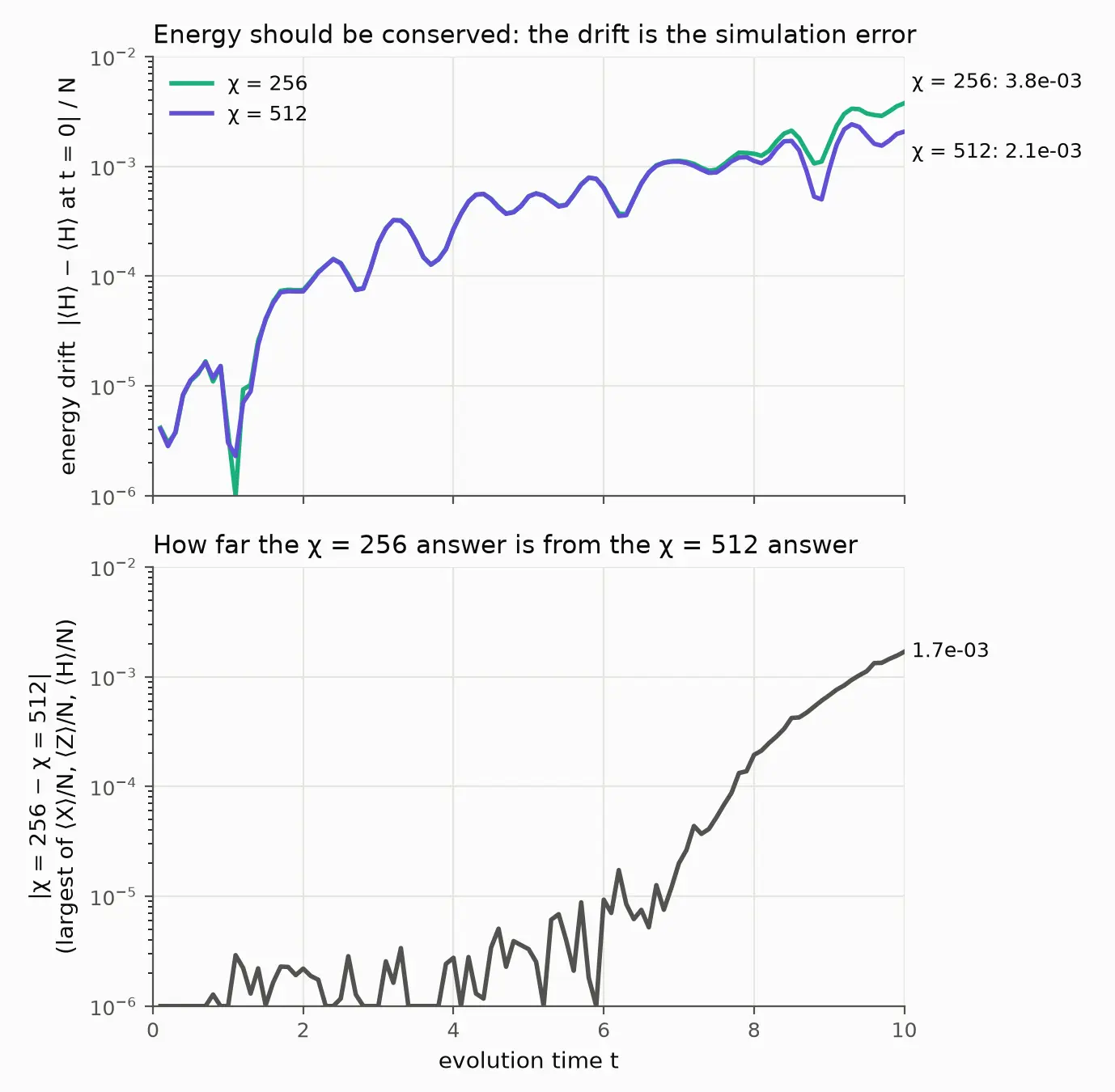
Increasing the bond dimension in time evolution simulations demonstrably improves accuracy, as Qoro Quantum’s recent 64-qubit Ising quench simulation revealed a roughly 50% reduction in energy drift at the final time point when the bond dimension was increased from 256 to 512. This improvement wasn’t simply theoretical; the team successfully completed the full 100-circuit batch at the higher dimension using the Divi platform, a feat that would have been impossible on the same CPU infrastructure due to time constraints.
The ability to explore higher bond dimensions directly impacts the fidelity of results, particularly in systems exhibiting fast entanglement growth where the necessary bond dimension scales exponentially with simulation time. The computational demands of accurately simulating quantum systems quickly become prohibitive, even before considering the complexities of noise. A 64-qubit system requires representing amplitudes, a figure exceeding 295 exabytes at double precision, making direct statevector simulation impractical.
Qoro Quantum circumvented this limitation by employing a matrix product state (MPS) representation, but even with MPS, the bond dimension, a measure of entanglement, becomes a critical parameter, according to the company. The team observed that simulations initialized in the ground state, |0…0⟩, required a lower bond dimension than those starting from a more entangled state, highlighting the sensitivity of simulation accuracy to initial conditions and the need for adaptable resources.
The platform’s GPU resources proved instrumental in achieving these results, completing all 100 circuits at a bond dimension of 512 in under nine minutes each, and using approximately four GPU-hours of compute for the entire batch. This contrasts sharply with the CPU runs, which encountered time limits even at the lower bond dimension of 256. This speed advantage isn’t merely about faster completion. It’s about enabling researchers to explore a wider parameter space and achieve more reliable results.
Parallel CPU Simulation Speeds Large-Scale Noise Analysis
The ability to rapidly complete large noise sweeps in quantum algorithm research is now achievable in minutes, according to Qoro Quantum, using parallel CPU processing on its Divi platform. While graphics processing units (GPUs) excel at simulating highly entangled circuits, the company demonstrates that CPUs, when scaled appropriately, significantly accelerate noise analysis, an important step in assessing a quantum algorithm’s resilience to real-world hardware imperfections, the company says.
A 2,560-circuit noise sweep, designed to evaluate error tolerance in a 64-qubit system, completed in 43 minutes using parallel CPUs, a roughly 22-fold increase in speed compared to sequential processing. This speedup stems from the platform’s architecture, which allows researchers to distribute thousands of smaller simulations across multiple CPU cores simultaneously. Qoro Quantum ran the circuits to track the magnetization of a central qubit over time, beginning with all qubits in the |0⟩ state.
The total compute time for the sweep was approximately 15.6 hours, but the parallel execution on the cloud infrastructure reduced the wait time. Qoro Quantum’s Divi platform aims to abstract away these complexities, allowing researchers to focus on algorithm design rather than cluster administration.
The two 64-qubit examples, the Ising quench simulation and the noise sweep, highlight the platform’s versatility, offering both GPU acceleration for demanding circuits and CPU parallelism for large-scale analyses. The Ising quench simulation, tracking a 64-qubit chain over time, required approximately 2 hours on a GPU, compared to over 8 hours on a CPU, demonstrating the GPU’s advantage in handling entanglement.
Source: https://qoroquantum.net/?news=scaling-simulation-infrastructure-for-quantum-algorithm-research



See today’s quantum computing news on Quantum Zeitgeist for the latest breakthroughs in qubits, hardware, algorithms, and industry deals.