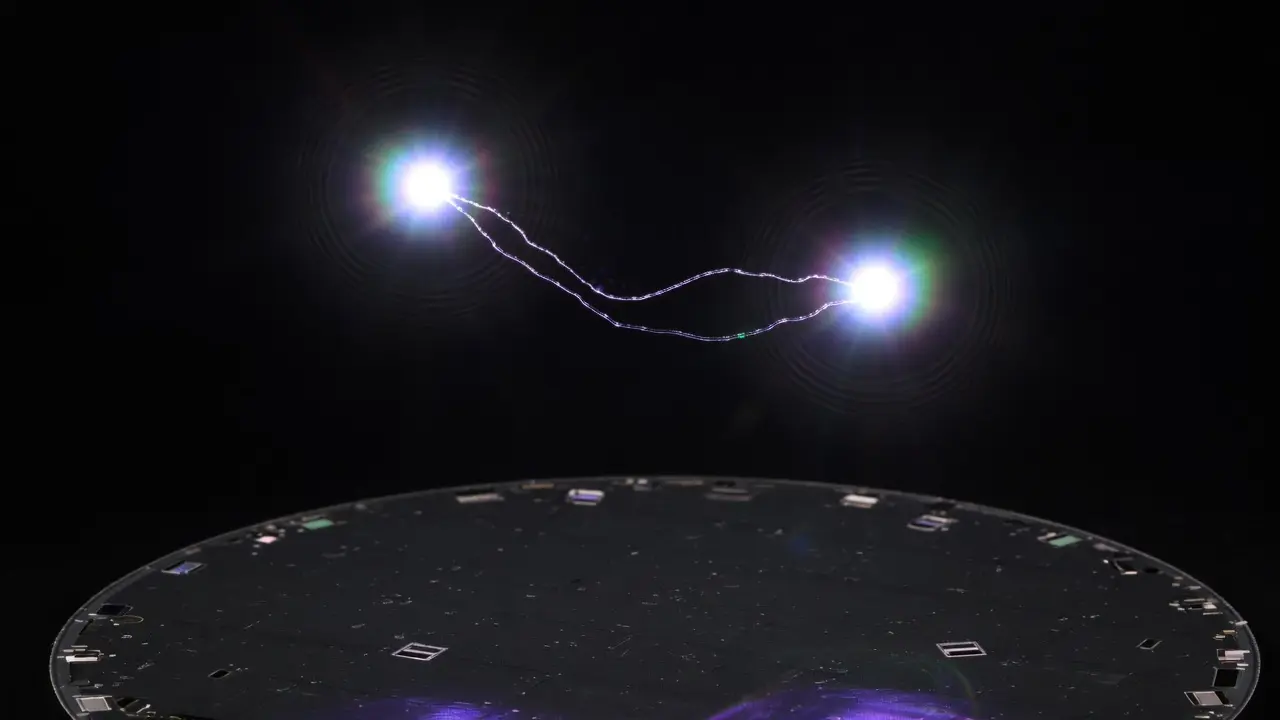
The Weyl semimetal PtBi₂ exhibits a surprising phenomenon: superconductivity confined to its Fermi arcs while the bulk material remains non-superconducting. Researchers at the Leibniz Institute for Solid State and Materials Research and the University of London have now demonstrated that this arises from interactions between electrons on these arcs and phonons within the material.
They identified two competing mechanisms governing the strength of this superconductivity, influenced by how effectively the surface screens electrical charges. Recent photoelectron spectroscopy experiments confirm the presence of nodes within the superconducting gap of PtBi₂, suggesting that surface coatings could be used to manipulate the material’s superconducting properties.
Phonon-Driven Superconductivity Emerges on PtBi₂ Fermi Arcs
Angle-resolved photoemission spectroscopy experiments on PtBi₂ reveal nodes within its superconducting gap, indicating an unconventional superconducting state with i-wave pairing symmetry. These nodes belong to a manifold of Majorana modes located at the center of the Fermi arcs. The material exhibits a superconducting gap opening on its Fermi arcs below approximately 14 Kelvin, while remaining non-superconducting in the bulk. PtBi₂’s layered, non-centrosymmetric structure hosts multiple Weyl points connected by surface Fermi arcs, creating a sizable surface density of states even when the bulk density is suppressed.
This electronic structure suggests a superconducting instability predominantly occurring on the surface, as confirmed by scanning tunneling experiments that demonstrate robust superconducting gaps consistent with Fermi arc-carried superconductivity. This interaction establishes two competing pairing channels, intra-arc and inter-arc, whose relative strength is governed by the efficiency of Coulomb screening at the surface.
Manipulating Coulomb screening at the surface of PtBi₂ presents a pathway to engineer the critical temperature and the size and symmetry of the surface superconducting gap. The unusual robustness of the surface superconducting state and its vortex phenomenology currently position PtBi₂ to realize and control intrinsic topological superconductivity.
PtBi₂ as a Topological Surface Superconductor: Experimental Findings
Angle-resolved photoemission spectroscopy measurements reveal a superconducting gap forming within the Fermi arcs of PtBi₂ below approximately 14 Kelvin, while the bulk of the material remains non-superconducting. This decoupling of surface and bulk superconductivity distinguishes PtBi₂ from conventional superconductors where the bulk typically transitions first, and suggests a unique mechanism is at play. Scanning tunneling experiments corroborate these findings demonstrating robust superconducting gaps localized to the surface and consistent with the Fermi arcs as the primary carriers of this state.
Recent ARPES measurements have identified nodes within the superconducting gap, a characteristic feature indicating unconventional pairing. The electronic structure of PtBi₂ exhibits a suppressed bulk density of states when the chemical potential nears the Weyl nodes, while the surface density of states remains substantial.
Competing Intra- and Inter-Arc Pairing Channels
The interplay between two distinct pairing mechanisms governs the strength of superconductivity within the Fermi arcs of PtBi₂, with the dominance of each channel dictated by how effectively surface charges are shielded from one another. Researchers found that intra-arc processes, where electrons remain within the same Fermi arc, naturally lead to a conventional superconducting state lacking nodes, while inter-arc processes, involving electrons switching arcs, support momentum-odd pairing.
A weak screening of Coulomb repulsion selectively suppresses small-momentum scattering, effectively eliminating the nodeless solutions generated by intra-arc processes and leaving the momentum-odd channel as the dominant pairing instability. This is modeled using a phenomenological Thomas-Fermi wavevector, capturing the combined response of low-energy screening channels, and considers electrons labeled by energy, arc identity and momentum. The distinction between intra- and inter-arc scattering is important because the former keeps electrons on the same arc while the latter involves a transfer between arcs.
This difference in momentum transfer significantly impacts the resulting superconducting gap. Critical temperatures in the intra- and inter-arc channels can diverge substantially, as the intra-arc channel is highly sensitive to Coulomb interactions and can be suppressed by inefficient screening, particularly when the surface density of states is low. Conversely, the inter-arc potential remains largely unaffected by Coulomb repulsion due to the large momentum transfer involved. The paper explains, detailing the labeling scheme used to differentiate between the arcs.
Coulomb Screening Impacts Superconducting Gap Symmetry
Calculations reveal that weak screening selectively suppresses small-momentum scattering, effectively eliminating nodeless superconducting solutions and favoring the formation of nodes within the gap, a phenomenon recently observed through photoelectron spectroscopy. This suppression arises because the disconnected nature of the Fermi arcs, combined with weak screening, alters the conditions for pairing. This suggests manipulation of the Coulomb screening, for example by a surface layer coating, as a pathway to engineer the critical temperature, as well as size and symmetry of the surface superconducting gap.
Nodal Superconductivity Originates from Disconnected Fermi Arcs
The efficiency of electron-phonon coupling on Weyl-semimetal surfaces, combined with screened Coulomb repulsion can stabilize nodal pairing on the arcs of materials like PtBi₂, a finding that challenges conventional understandings of superconductivity. This pairing mechanism is not a consequence of the material’s lattice structure, but rather a universal effect of pairing on disconnected Fermi-arc segments, according to recent theoretical work. The research highlights the role of bulk degrees of freedom in establishing surface superconductivity, which can be either nodeless or nodal depending on the origin of scattering processes.
Nodal superconductivity arises as a natural outcome when pairing occurs on disconnected surface Fermi arcs, with both electron-phonon interactions and weakly-screened Coulomb interactions present. This suggests manipulation of the Coulomb screening, for example by a surface layer coating, as a pathway to engineer the critical temperature, as well as size and symmetry of the surface superconducting gap.
Momentum-Odd Pairing Favored by Weakly Screened Repulsion
The emergence of superconductivity confined to surface Fermi arcs in Weyl semimetals like PtBi₂ hinges on a competition between two distinct pairing channels, intra-arc and inter-arc, according to recent theoretical work. Intra-arc processes favor conventional nodeless pairing, while inter-arc scattering generates momentum-odd pairing, effectively establishing an internal degree of freedom within the superconducting state.
Numerical modeling demonstrates that as the Thomas-Fermi wavevector decreases, indicating weaker screening, the critical temperature for intra-arc pairing sharply drops, leaving the inter-arc state as the dominant instability. This effect is visualized in the relationship between critical temperature and the Thomas-Fermi screening momentum, where inter-arc pairing prevails under weak screening conditions.
The findings provide a material-independent mechanism for the emergence of nodes in the superconducting gap on Fermi arcs, aligning with observations made in PtBi₂. “This feature of the Fermi surface opens up the possibility of two different channels,” the study notes, associated with momentum-conserving scattering processes. This understanding offers a pathway to manipulate the superconducting gap’s size and symmetry through control of surface screening.
Continuum Model Captures Surface Pairing and Node Formation
The model details how electrons interact with both surface and bulk phonons, establishing a pairing mechanism distinct from conventional superconductivity. This approach isolates the essential physics driving the phenomenon, treating lattice details as secondary parameters rather than fundamental requirements for pairing. The resulting framework accounts for disconnected Fermi arcs, treating each arc segment as possessing an internal degree of freedom influencing pairing behavior. The model predicts the formation of nodes, points of zero energy, within the superconducting gap, aligning with recent observations from photoelectron spectroscopy experiments on PtBi₂.
These nodes emerge because strong Coulomb repulsion, localized near the center of each arc, suppresses pairing channels favoring a simple, nodeless gap. Instead, the system favors solutions with sign-changing, higher-angular-momentum pairings. The analysis demonstrates that the spatial profile of surface states directly shapes the superconducting gap along the arc, revealing a connection between electronic structure and superconducting properties.
The researchers found that the chemical potential must be close to the bulk nodes to ensure the surface electron density is dominant, simplifying the analysis and isolating the key physical ingredients.
Bulk Electronic Structure and Fermi Arc Localization in PtBi₂
The layered semimetal PtBi₂ exhibits a surprising interplay between its bulk electronic structure and surface superconductivity, with phonon interactions playing a major role in establishing a superconducting state confined to Fermi arcs. Modeling reveals bulk lattice vibrations contribute significantly to the effective electron-electron interaction, despite superconductivity occurring primarily on the surface, suggesting the phenomenon extends beyond a purely two-dimensional effect.
This anisotropic pairing interaction along the arc gives rise to two distinct channels, distinguished by their symmetry under inversion, and their relative strength is determined by the momentum dependence of electron overlaps. This form factor, expressed as = (2κ_(k + q)κ_k)/((κ_(k + q) + κ_k)(κ_(k + q) + + q)), demonstrates how the effective pairing interaction is intrinsically anisotropic and nonuniform.
👉 More information
🗞 Phonon-driven nodal surface superconductivity of Fermi arcs
✍️ Francesco Buccheri, Alessandro De Martino and Jeroen van den Brink
🧠 DOI: http://link.aps.org/doi/10.1103/qp2j-p4xh




See today’s quantum computing news on Quantum Zeitgeist for the latest breakthroughs in qubits, hardware, algorithms, and industry deals.