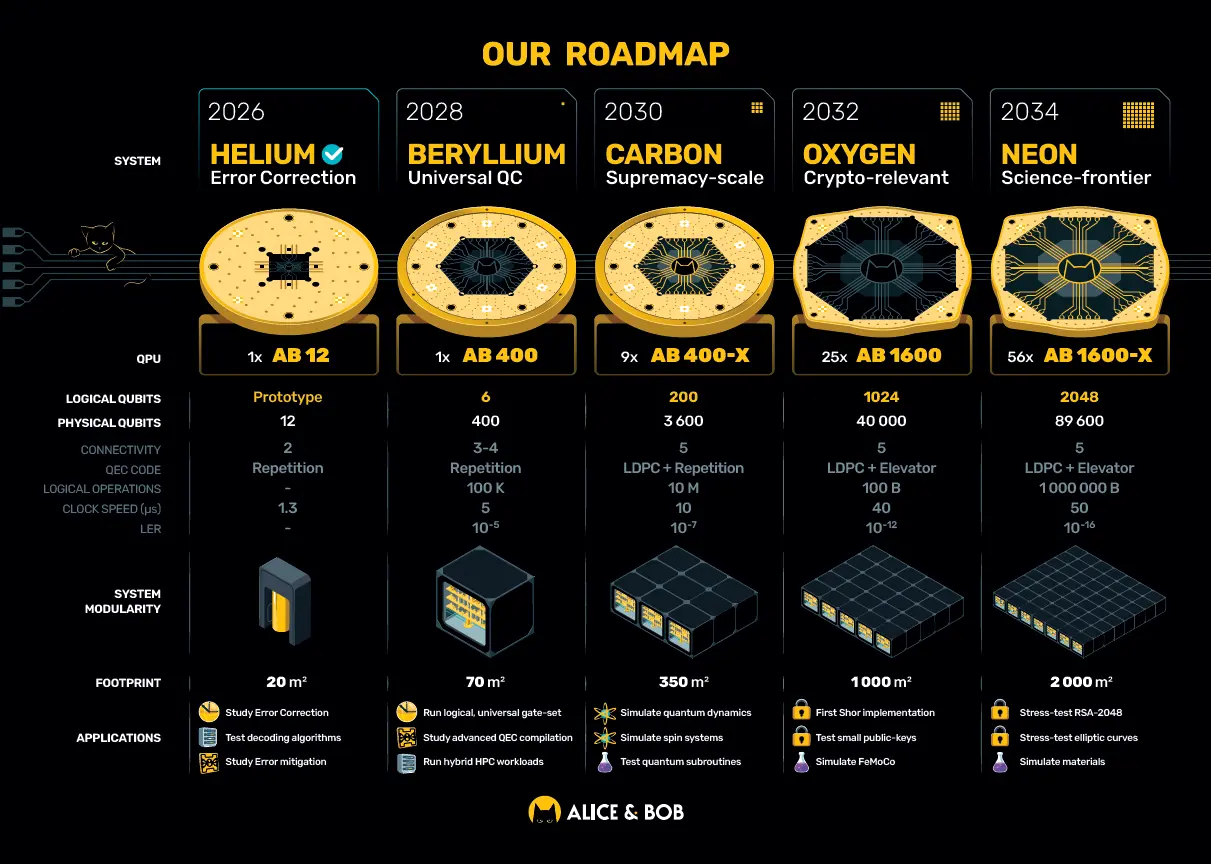
Alice & Bob intends to achieve 200 logical qubits by 2030, doubling its previous target and signaling increased confidence in its quantum computing roadmap, the company says. The company plans to reach this milestone using 3,600 physical “cat qubits,” a design that suppresses bit-flip errors at the hardware level. This accelerated plan relies on a new modular architecture and recent experimental results demonstrating key building blocks of a logical qubit.
Carbon Roadmap Targets 200 Logical Qubits by 2030
Alice & Bob is targeting a utility-scale quantum system capable of surpassing classical capabilities by 2030, with the Carbon processor slated to deliver 200 logical qubits built from 3,600 physical qubits. This accelerated timeline represents a doubling of the company’s previous goal, signaling increased confidence in its approach to fault-tolerant quantum computing and a faster path toward practical applications, according to Alice & Bob. The company’s strategy centers on “cat qubits,” superconducting circuits designed to suppress bit-flip errors directly at the hardware level, reducing the overall qubit count needed for reliable computation.
Raphaël Lescanne, CTO and co-founder of Alice & Bob, explains that “Cat qubits give an efficient path to fault tolerance. They suppress one type of quantum error at the hardware level, giving us an unfair advantage: far fewer qubits for the same logical performance.” This hardware-level error suppression is a key differentiator, allowing Alice & Bob to pursue logical qubit development with a comparatively smaller physical qubit count than many other quantum computing efforts.
The roadmap extends beyond 2030, outlining milestones through 2034 with increasingly powerful systems. The Oxygen processor, due in 2032, aims for 1,024 logical qubits and initial applications in cybersecurity, including an implementation of Shor’s algorithm. The company’s modular architecture is central to achieving this scale, allowing for the interconnection of multiple quantum processing units (QPUs) at cryogenic temperatures.
This approach addresses a critical bottleneck in quantum computing, the physical limits of individual cryostats, and offers end users flexibility in system size, the company says. Jérémie Guillaud, VP of Firmware at Alice & Bob, highlights that the convergence of hardware improvements and algorithmic efficiency is important for progress.
“Useful fault-tolerant quantum computing will come from two trends converging: improving hardware while reducing the resources that real applications need,” he said. “We have already shown that RSA-2048 could be broken with 40 times fewer qubits than previously estimated. And AI is accelerating both trends, helping us design better chips, build better models, run experiments faster and develop more efficient algorithms.” The company’s investment in AI-enabled research and development, coupled with its fully integrated chip design and fabrication facility, is intended to accelerate this convergence.
The Carbon processor is specifically designed to unlock applications in materials science, with a focus on simulating complex spin systems like the Hubbard and Ising models, Alice & Bob reports. Subsequent processors, like Neon due in 2034, will expand the scope to include cryptography and more complex chemical simulations, potentially revolutionizing fields beyond current scientific frontiers. This ambitious roadmap relies on continued innovation in both hardware and software. But Alice & Bob believes its current trajectory positions it to deliver a significant leap forward in the development of practical, fault-tolerant quantum computing.
We have already shown that RSA-2048 could be broken with 40 times fewer qubits than previously estimated.
Jérémie Guillaud, VP of Firmware at Alice & Bob

See today’s quantum computing news on Quantum Zeitgeist for the latest breakthroughs in qubits, hardware, algorithms, and industry deals.