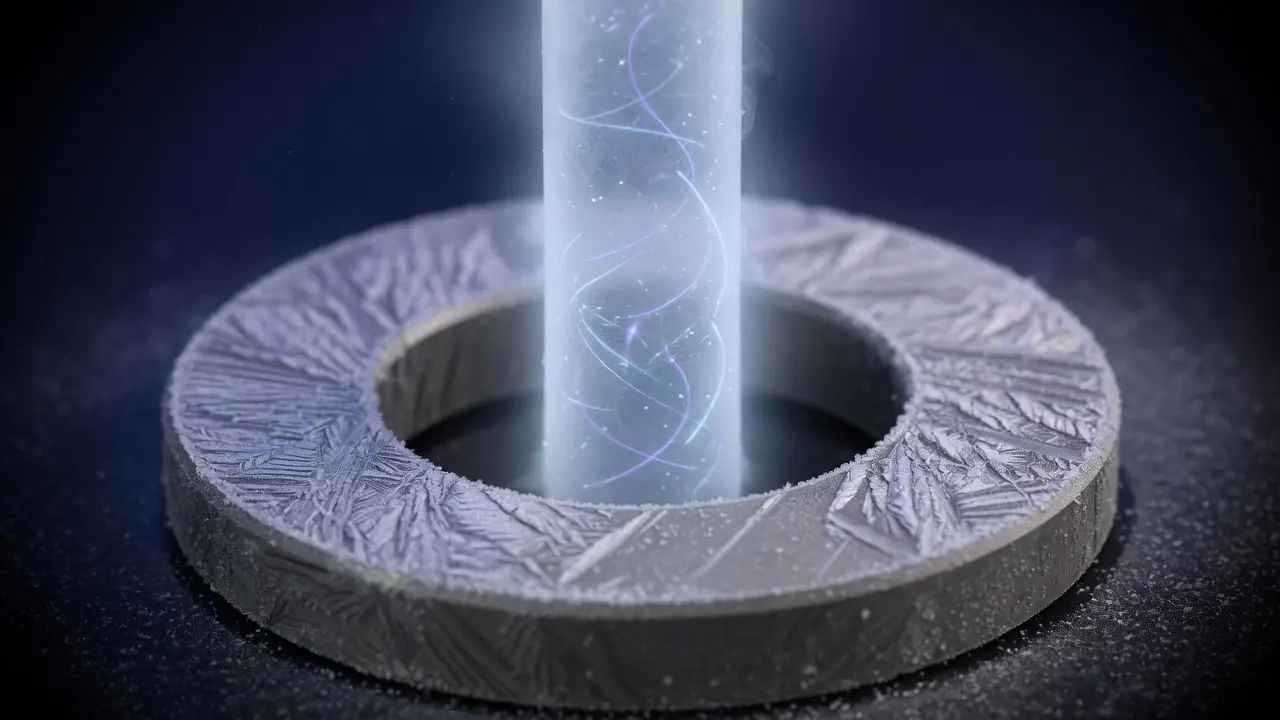
This architecture couples two YIG spheres via a waveguide, harnessing decoherence from electromagnetic fields to enable robust and potentially wireless charging. The work establishes chirality as a useful quantum resource, paving a viable path toward realizing practical quantum batteries.
Yttrium Iron Garnet Spheres Enable Chiral Magnon Coupling
The design uses a continuous-variable approach, using two YIG spheres, one functioning as a charger and the other as the battery itself, to facilitate this improved performance. The core of this advancement lies in the chiral coupling between magnons, quantum excitations in magnetic materials, and the electromagnetic fields guided within the connecting waveguide. This interaction breaks inversion symmetry, inducing nonreciprocal energy flow and coherent interference between the charging and storage components.
Researchers detail that the coupling strength between each magnon and the electromagnetic fields is dependent on the magnetic field strength felt by the YIG sphere, and is further influenced by the sphere’s volume and the frequency of the electromagnetic wave. Specifically, the coupling strength becomes gλ j(ω) = ab))[π/a cos((π sin((π xj)/a)], where ‘a’ and ‘b’ represent the waveguide’s cross-sectional dimensions.
This carefully engineered asymmetry allows the system to harness decoherence, typically a detrimental effect in quantum systems, and transform it into an asset. The resulting quantum coherence, driven by the nonreciprocal dissipation and unbalanced interference, governs the battery’s overall performance, enabling a “wireless-like remote-charging” capability. The team’s analysis reveals that the positioning of the YIG spheres, denoted as x0, allows for tuning of both the coupling strength and the chirality of the magnon-waveguide interaction. This precise control is enabled by the spin-momentum locking effect, an intrinsic property of the chiral coupling mechanism.
Recent experimental progress in chiral magnon-photon coupling within spin-momentum locked waveguides has cleared the way for this development, building upon established platforms featuring high-spin density and low-damping rates in YIG spheres. “Being similar to the chiral coupling of emitters to spin-momentum-locked light fields, the strong coupling between magnons and photons in a microwave waveguide, the negative refractive index effect in photon-magnon hybrid system, and the Kittel mode based on ring cavities or waveguides collectively set a solid foundation for the realizability for our scheme,” the researchers state.
Experimental confirmation of this chiral coupling mechanism in hybrid magnon-altermagnet systems further solidifies the feasibility of the proposed architecture, demonstrating that chirality can indeed is a valuable resource for enhancing quantum battery performance even in the presence of real-world decoherence.
Nonreciprocal Energy Flow in the Chiral Quantum Battery
The proposed quantum battery architecture achieves unidirectional energy transfer through a carefully designed interaction between magnons and electromagnetic fields. This nonreciprocal energy flow, induced by breaking inversion symmetry, is central to the system’s enhanced performance and distinguishes it from traditional quantum battery designs. This design doesn’t merely improve energy storage. It fundamentally alters how decoherence impacts the system. Rather than being a detrimental force causing self-discharging, the researchers demonstrate that decoherence from the electromagnetic fields is harnessed, contributing to the robustness and enabling the “wireless-like remote-charging” features of the quantum battery.
Analysis of the system reveals that quantum coherence, driven by this nonreciprocal dissipation and the resulting interference, is the governing factor in its exceptional capabilities. The interplay between these elements allows for a 34-fold increase in energy capacity and a 55-fold boost in extractable work compared to an achiral counterpart.
The relationship between stored energy and quantum coherence is particularly noteworthy. Results demonstrate a synchronization between the ratio of steady-state quantum battery energy and quantum coherence, indicating that quantum coherence plays a dominant role in the chiral quantum battery’s operation. Destructive interference at specific distances hinders energy conversion, while constructive interference maximizes both coherence and ergotropy, the measure of useful work obtainable from the battery. The nonreciprocity also functions as a switch and amplifier for unidirectional energy flow, enhancing the remote-charging efficiency.
However, the researchers emphasize that achieving optimal ergotropy requires a cooperative effect between nonreciprocity and spatial quantum interference, dictating the quality of stored energy. “The nonreciprocity must cooperate with the spatial quantum interference to determine the quality of stored energy in the QB,” the paper states, offering insight into designing high-performance quantum batteries based on chiral systems. This work establishes that chirality isn’t simply a structural characteristic, but a functional quantum resource.
By demonstrating the ability to harness decoherence and use nonreciprocal energy flow, the researchers have moved beyond mitigating the limitations of quantum batteries and actively incorporated them into the design. The system’s performance is directly linked to the interplay between nonreciprocity and coherent interference, offering a pathway towards realizing practical quantum batteries with improved energy density and efficiency. The team concludes that their continuous-variable chiral quantum battery scheme, based on waveguide magnonics, provides a promising foundation for future development in quantum energy storage.
34-Fold Capacity & 55-Fold Work Boost via Chirality
This performance leap stems from a unique architecture coupling two yttrium iron garnet (YIG) spheres via a waveguide, inducing nonreciprocal dissipation and unbalanced coherent interference. The resulting combination allows the battery to maintain performance even with local magnon dissipation, a common limitation in quantum energy storage systems. The system’s nonreciprocity, quantified by a dimensionless parameter ‘D’ ranging from 0 to 1, directly influences energy transfer.
A value of D = 1 signifies fully nonreciprocal behavior, while D = 0 indicates a reciprocal system. This manipulation, combined with induced phase differences between the charger and the battery, creates coherent interference patterns that dictate energy flow. Analysis reveals a periodic dependence of performance on the distance between the YIG spheres, with constructive interference maximizing ergotropy, the work extractable from the battery, at distances of (n + 1/2)π/k₀, where n is an integer.
At maximum nonreciprocity (D = 1), the chirality-enhanced gain of steady-state ergotropy reaches 55 at constructive interference distances, while diminishing to 1 at destructive interference distances. This effect is directly linked to quantum coherence, with the ratio of quantum coherence between D = 1 and D = 0 demonstrating the mechanism at play. The ergotropy of this chiral quantum battery reaches a gain factor of 55, approaching a theoretical limit of 64, within experimentally accessible ranges.
“It is the quantum coherence that governs the unprecedented capabilities in energy capacity, remote charging, and maximal extractable work of our QB,” the researchers state. The team’s findings suggest that manipulating quantum coherence through chiral interactions offers a promising avenue for advancing the field of quantum batteries.
Waveguide Architecture Enables Remote Quantum Battery Charging
The resulting combination not only enhances energy storage but also facilitates a 55-fold improvement in extractable work within experimentally viable parameters. The system’s ability to harness decoherence, typically a detriment to quantum battery performance, is central to its functionality. Rather than mitigating decoherence, the architecture actively uses it, transforming what is usually a destructive force into an asset that contributes to both robustness and the capacity for remote charging.
This is accomplished through the careful manipulation of electromagnetic fields within the waveguide, which mediate the energy transfer between the charger YIG sphere and the battery YIG sphere. The nonreciprocity, quantified by the parameter D, reaches a value of 1, indicating fully nonreciprocal behavior, and is essential to this process. These interferences, occurring at a distance of k₀d, are facilitated by the electromagnetic fields within the waveguide, creating a specific spatial relationship that maximizes efficiency.
This performance is achieved even with magnon dissipation present, demonstrating the robustness of the chiral magnonic platform. The stored energy is found to be nearly equal to the extractable work , excluding only the vacuum zero-point energy when n equals 0. The realization of this wireless-like remote charging is achieved through the left and right-propagating electromagnetic fields within the waveguide, which couple chirally to both the charger and the quantum battery.
Quantum Coherence Governs Battery Performance in Decoherence
The ability to suppress quantum battery self-discharging through engineering and hyperfine interactions has driven exploration into more stable architectures, particularly those using useful quantum resources in realistic decoherence scenarios. This design relies on chiral coupling rates between the spheres, facilitating energy transfer along the z-axis and establishing a foundation for wireless-like remote charging. Analysis of the chiral quantum battery reveals a stable energy storage capability even with local decoherence rates of κ affecting both the battery and charger.
The synchronization between the ratio of steady-state work and the ratio of steady-state capacitance further highlights the system’s resilience. maxima in chirality-enhanced ergotropy directly correlate with peaks in quantum coherence, confirming that quantum coherence dominates performance within this chiral quantum battery. This connection arises from the interplay between nonreciprocity, which directs energy flow, and coherent interference, governed by the relative phase k₀d accumulated during waveguide propagation. The resulting combination enables both robust operation and the capacity for remote charging, even with magnon dissipation present.
👉 More information
🗞 Chiral quantum batteries
✍️ Rong-Fang Liu, Wan-Lu Song, Wan-Li Yang, Hua Guan and Jun-Hong An
🧠 DOI: http://link.aps.org/doi/10.1103/4rp7-s37c



See today’s quantum computing news on Quantum Zeitgeist for the latest breakthroughs in qubits, hardware, algorithms, and industry deals.