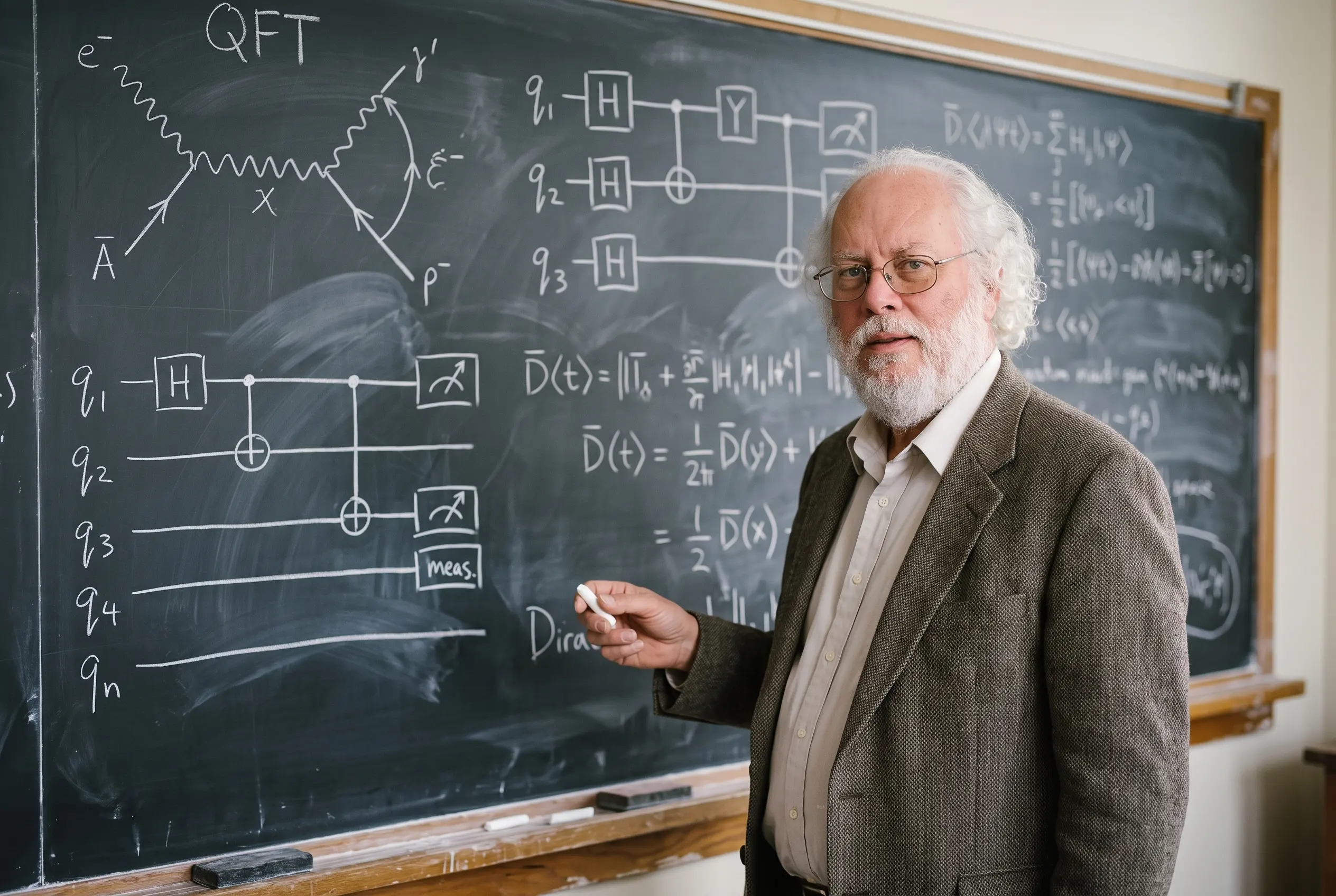
The mathematician whose work launched the modern field of quantum computing is now advising Zapata Quantum. In 1994, Peter Shor published his algorithm demonstrating a quantum computer’s potential to rapidly solve previously intractable problems; now, he joins Zapata’s Scientific Advisory Board to guide the development of practical quantum applications, the company says.
“Quantum computers will only be as useful as the applications we run on them,” says Dr. Shor, emphasizing the need to translate hardware advancements into tangible results. The new advisory board will focus on Zapata’s Quantum Pilot platform, combining decision intelligence and engineering to discover and develop those applications.
Shor’s Algorithm Validates Zapata’s Quantum Application Development
The foundation of modern quantum computing received further validation as Dr. His 1994 algorithm demonstrating the potential for quantum speedup in factorization remains a cornerstone of the field and directly informs Zapata’s focus on application development. Zapata’s emphasis on translating hardware advancements into practical applications aligns with Dr, according to the company.
Shor’s own assessment of the field’s current needs. The company intends to use the board’s collective knowledge to overcome bottlenecks in resource estimation, error correction and algorithm design, critical areas for achieving commercially viable quantum applications. Alexandru Paler of Aalto University, Dr. Simon Devitt, Sydney and Dr. Artur Izmaylov of the University of Toronto, each contributing specialized expertise to address these challenges.
According to Zapata’s CTO, Yudong Cao, “Dr. Paler, Dr. Devitt and Dr. Izmaylov each bring deep expertise in these exact layers of the stack,” reinforcing the company’s commitment to a comprehensive approach to quantum software development. This collaborative effort aims to relieve constraints currently limiting practical quantum computing and position Zapata as a leader in the transition to scalable quantum execution, guided by Dr. Shor’s insights and the board’s combined experience. Dr. Shor himself expressed enthusiasm for the work underway at Zapata, stating, “I’m excited about the work Zapata is doing in this area and look forward to helping guide those efforts.
Dr. Shor’s work is the reason this entire field exists. His discovery of quantum algorithmic advantage is the foundational proof point the industry has been built upon, and having his guidance regarding our scientific direction is strong validation of our approach.
Sumit Kapur, CEO of Zapata Quantum
Paler, Devitt, and Izmaylov Enhance Zapata’s Quantum Software Stack
The addition of Peter Shor to Zapata Quantum’s Scientific Advisory Board extends beyond symbolic weight, directly influencing the company’s methodological approach to quantum software development. According to Sumit Kapur, CEO of Zapata Quantum, “Dr. Shor’s work is the reason this entire field exists.
His discovery of quantum algorithmic advantage is the foundational proof point the industry has been built upon, and having his guidance regarding our scientific direction is strong validation of our approach.” This guidance focuses on bolstering Zapata’s software, specifically for enterprise customers and government partners seeking practical quantum solutions.
The expanded advisory board includes Dr. Alexandru Paler, Dr. Simon Devitt and Dr. Artur Izmaylov, each bringing expertise in some of the most important and technically challenging areas of Zapata’s quantum software platform, including algorithm benchmarking, error correction architectures and quantum resource estimation, key factors that determine when and how quantum applications become commercially viable.
These layers encompass algorithm benchmarking, a process for evaluating quantum algorithm performance, and the development of error correction architectures, essential for mitigating the inherent instability of quantum systems, the firm reports. Equally important is the focus on quantum resource estimation, which determines the computational requirements for running quantum applications, a key factor in achieving commercial viability. The expanded board joins existing members Dr. Alireza Shabani, Dr. Austin G. Fowler and Dr. Jeff Grover, further solidifying Zapata’s position as a leader in quantum software innovation.
The path to large-scale commercially viable quantum applications depends on solving critical bottlenecks in resource estimation, error correction and algorithm design.
Yudong Cao, CTO of Zapata Quantum
Source: https://zapataquantum.com/




See today’s quantum computing news on Quantum Zeitgeist for the latest breakthroughs in qubits, hardware, algorithms, and industry deals.