Shor algorithm is the most consequential quantum algorithm ever discovered: Peter Shor’s 1994 result showing that a quantum computer can factor large integers exponentially faster than any known classical algorithm. This 2026 guide walks the Shor algorithm from the original Bell Labs paper through the quantum Fourier transform that makes it work, the small-N hardware demonstrations, and the cryptography crisis the algorithm precipitated.
nnThe seemingly impenetrable world of modern cryptography, the foundation of secure communication and data protection, rests upon the computational difficulty of certain mathematical problems. For decades, mathematicians and computer scientists have sought problems that are easy to compute in one direction but extraordinarily difficult to reverse, forming the basis for encryption algorithms. The RSA algorithm, widely used for secure internet transactions, relies on the difficulty of factoring large numbers into their prime components. However, in 1994, Peter Shor, a researcher at AT&T Bell Labs, shattered this foundation with a groundbreaking algorithm that demonstrated a quantum computer could efficiently solve this problem, and others like it, rendering many current encryption methods vulnerable. This wasn’t merely a theoretical curiosity; it was a stark warning that the future of cybersecurity hinged on the development of quantum computing, and a testament to the power of harnessing the bizarre principles of quantum mechanics for computational advantage. Shor’s algorithm wasn’t just about breaking codes; it was about proving the potential of quantum computation to fundamentally alter the landscape of information processing.nnThe Mathematical Landscape Before Shor: Classical Computational Limits
nnPrior to Shor’s work, the security of widely used cryptographic systems like RSA was predicated on the assumption that factoring large numbers was computationally intractable for classical computers. The best-known classical algorithm for factoring, the General Number Field Sieve (GNFS), has a runtime that grows exponentially with the number of digits in the number being factored. This means that as the number of digits increases, the time required to factor it grows at an incredibly rapid rate, quickly exceeding the capabilities of even the most powerful supercomputers. The difficulty stems from the lack of a known efficient algorithm to systematically explore the potential prime factors. While probabilistic algorithms exist, they offer only a limited degree of certainty and are still computationally expensive for sufficiently large numbers. This exponential scaling is the cornerstone of RSA’s security; increasing the key size (the number of digits in the number being factored) exponentially increases the computational effort required to break the encryption.nnQuantum Computation: Harnessing Superposition and Entanglement
nnShor’s algorithm doesn’t operate within the constraints of classical computation. It leverages the unique principles of quantum mechanics, specifically superposition and entanglement, to achieve a computational speedup. Superposition allows a quantum bit, or qubit, to exist in a combination of states – both 0 and 1 simultaneously – unlike a classical bit which can only be either 0 or 1. This allows a quantum computer to explore multiple possibilities concurrently. Entanglement, a phenomenon where two or more qubits become linked together, allows for correlated behavior even when separated by vast distances. These entangled qubits can be manipulated to perform calculations in a fundamentally different way than classical computers. The power of quantum computation isn’t simply about performing calculations faster; it’s about performing calculations that are impossible for classical computers to perform within a reasonable timeframe.nnThe Core of Shor’s Algorithm: Quantum Fourier Transform and Period Finding
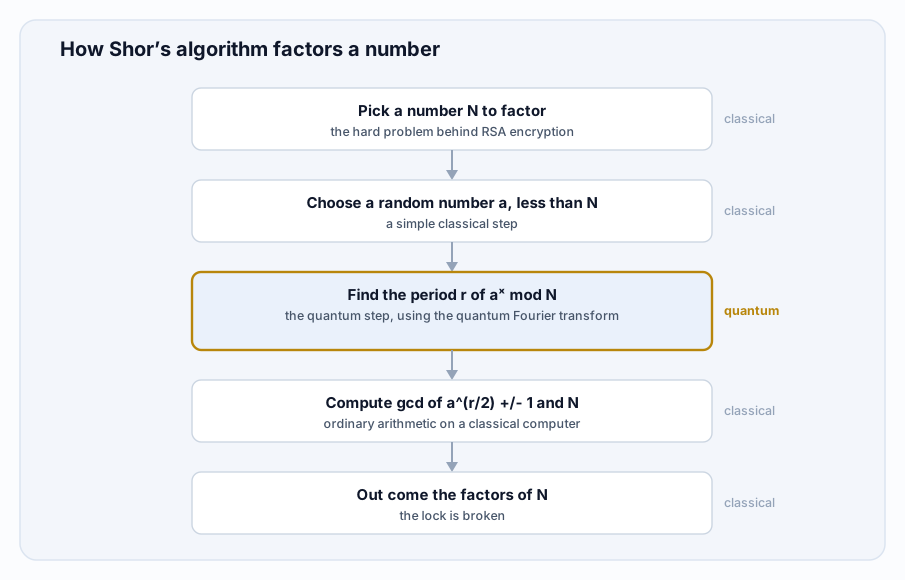
nnThe brilliance of Shor’s algorithm lies in its clever transformation of the factoring problem into a problem of period finding. Instead of directly attempting to find the prime factors of a number N, the algorithm seeks to find the period r of a modular exponential function:Mathematical Formulation: The Quantum Circuit for Period Finding
nnThe quantum circuit implementing Shor’s algorithm is complex, but its core components can be understood. It begins with two registers of qubits: one for representing the input x and another for storing the result. The first register is initialized in a superposition of all possible values of x. The function ![]()
Beyond Factoring: Applications to Discrete Logarithm and Elliptic Curve Cryptography
nnThe impact of Shor’s algorithm extends beyond factoring. It can also efficiently solve the discrete logarithm problem, which underlies many other cryptographic algorithms, including Diffie-Hellman key exchange and the Digital Signature Algorithm (DSA). Furthermore, while not directly applicable in its original form, research is ongoing to adapt Shor’s principles to break elliptic curve cryptography (ECC), which is becoming increasingly prevalent in modern security protocols. ECC relies on the difficulty of solving the elliptic curve discrete logarithm problem, and while a direct quantum algorithm doesn’t yet exist, the potential for future breakthroughs remains a significant concern. This broad applicability underscores the far-reaching implications of Shor’s discovery.nnThe Challenges of Building a Scalable Quantum Computer
nnDespite the theoretical power of Shor’s algorithm, building a quantum computer capable of running it on numbers large enough to break real-world encryption is an immense technological challenge. Maintaining the delicate quantum states of qubits is extremely difficult, as they are highly susceptible to noise and decoherence. Decoherence refers to the loss of quantum information due to interactions with the environment. Building a fault-tolerant quantum computer, one that can correct errors caused by decoherence, requires a significant increase in the number of physical qubits, as well as sophisticated error correction codes. Current quantum computers have only a limited number of qubits, and their coherence times are still relatively short. Scaling up the number of qubits while maintaining their coherence and fidelity remains the primary obstacle to realizing the full potential of Shor’s algorithm.nnCurrent State of Quantum Computing in 2025: Progress and Limitations
nnAs of 2025, quantum computing has made significant strides, but remains in its nascent stages. Several companies, including Google, IBM, and IonQ, have developed quantum processors with increasing numbers of qubits. However, these processors are still far from being able to break RSA encryption with practical key sizes. The focus has shifted towards developing “noisy intermediate-scale quantum” (NISQ) devices, which have a limited number of qubits and are prone to errors. Researchers are exploring algorithms that can be run on NISQ devices, as well as developing improved error mitigation techniques. While a fully fault-tolerant quantum computer capable of running Shor’s algorithm remains years, if not decades, away, the progress made in recent years is encouraging.nnPost-Quantum Cryptography: Preparing for a Quantum Future
nnRecognizing the potential threat posed by Shor’s algorithm, the cryptographic community has been actively developing post-quantum cryptography (PQC) algorithms. PQC algorithms are designed to be resistant to attacks from both classical and quantum computers. These algorithms are based on mathematical problems that are believed to be hard for both types of computers, such as lattice-based cryptography, code-based cryptography, and multivariate cryptography. The National Institute of Standards and Technology (NIST) has been leading an effort to standardize PQC algorithms, and several candidates have been selected for standardization. The transition to PQC is a complex undertaking, requiring significant changes to existing cryptographic infrastructure.nnThe Role of Quantum Key Distribution: A Complementary Approach
nnWhile PQC focuses on developing algorithms that are resistant to quantum attacks, Quantum Key Distribution (QKD) offers a fundamentally different approach to secure communication. QKD uses the principles of quantum mechanics to distribute a secret key between two parties in a way that is provably secure against eavesdropping. Any attempt to intercept the key will inevitably disturb the quantum states, alerting the parties to the presence of an attacker. QKD is not a replacement for PQC, but rather a complementary technology that can provide an additional layer of security. However, QKD has its own limitations, such as limited range and the need for specialized hardware.nnThe Ongoing Race: Quantum Attack vs. Quantum Defense
nnThe development of quantum computing and the emergence of PQC have created an ongoing race between quantum attack and quantum defense. As quantum computers become more powerful, they will pose an increasing threat to current cryptographic systems. At the same time, researchers are working to develop more robust PQC algorithms and improve QKD technology. This race is likely to continue for many years to come, with the outcome determining the future of cybersecurity. The stakes are high, as the security of critical infrastructure, financial systems, and personal data depends on staying ahead of the quantum threat.nnShor’s Legacy: A Catalyst for Quantum Innovation
nnPeter Shor’s algorithm remains a landmark achievement in the field of quantum computation. It not only demonstrated the potential of quantum computers to solve problems that are intractable for classical computers, but also spurred a tremendous amount of research and development in quantum computing and cryptography. Shor’s work has inspired a new generation of scientists and engineers to explore the frontiers of quantum technology, and his legacy will continue to shape the future of information security for decades to come. The algorithm wasn’t just about breaking codes; it was about unlocking the potential of a new paradigm of computation, and forcing us to rethink the very foundations of security in the digital age.Shor’s 1994 paper is the moment quantum computing became geopolitically interesting, placed in context in our long-form history of quantum computing.
Shor algorithm 2026 Outlook
Shor algorithm entered 2026 as the central motivator for the global post-quantum cryptography migration. NIST finalised CRYSTALS-Kyber, CRYSTALS-Dilithium, FALCON, and SPHINCS+ as the first post-quantum standards in August 2024, and major standards bodies including IETF, ISO, and ETSI have followed. The cryptographic threat from Shor algorithm is no longer theoretical: governments and enterprises are migrating now because data harvested today could be decrypted by future quantum machines. The NIST post-quantum cryptography release notes document the new standards.Hardware Status
No quantum computer has yet factored a number larger than 21 using a faithful implementation of Shor algorithm. The reason is the qubit-count and error-rate gap: a useful run requires roughly 4,000 logical qubits with error rates below one in 10 billion, which translates to millions of physical qubits with current error-correction overhead. IBM, Google, Quantinuum, and IonQ have all published roadmaps targeting fault-tolerant Shor algorithm-relevant scale by the early 2030s, but the timeline remains uncertain.Why Shor algorithm Still Matters
Even though no production system runs Shor algorithm today, the algorithm reshapes cryptographic policy. The U.S. National Security Agency CNSA 2.0 timeline mandates post-quantum migration for national-security systems by 2033. EU regulations under the NIS2 Directive require similar migration. Banking, telecom, and cloud providers are deploying hybrid classical-plus-post-quantum schemes already, all driven by the eventual prospect of Shor algorithm on real hardware.What Comes Next
By 2030 the field expects either a credible Shor algorithm demonstration on a logical-qubit machine, or a clear understanding of why fault tolerance has not yet arrived at the required scale. Either result is consequential: the first triggers urgent acceleration of post-quantum migration, the second buys time but does not eliminate the threat. The Shor era of quantum computing is approaching its proving moment.Shor algorithm FAQ
What does Shor algorithm actually do?
Shor algorithm is a quantum algorithm that factors large integers exponentially faster than any known classical method. Given an integer N, the algorithm finds the prime factors of N in time polynomial in the number of digits of N. The classical fastest known algorithm (the general number field sieve) takes sub-exponential time, which means N=2048 bits is intractable classically but would be feasible on a sufficiently large fault-tolerant quantum computer running Shor algorithm.
Has Shor algorithm been run on real quantum hardware?
Yes, but only on tiny instances. The first experimental demonstration factored N=15 on an NMR quantum computer in 2001 by an IBM team. Subsequent improvements have factored 21 (2012) and various larger ‘compiled’ circuits where some of the work is done classically. No experiment has yet performed a full Shor algorithm run on a number that would matter for cryptography. The bottleneck is qubit count and error rate, not the algorithm itself.
Will Shor algorithm break RSA encryption?
Eventually yes, when fault-tolerant quantum computers become large enough. Breaking RSA-2048 with Shor algorithm requires roughly 4,000 logical qubits, each itself protected by hundreds or thousands of physical qubits with strong error correction. Current quantum hardware is far below this scale, and credible estimates put the threshold a decade or more away. But the threat is taken seriously enough that NIST finalised post-quantum cryptography standards in 2024, and global cryptographic migration is now underway.
What is post-quantum cryptography in relation to Shor algorithm?
Post-quantum cryptography is a new generation of encryption schemes designed to resist attack by Shor algorithm and other quantum algorithms. The schemes rely on mathematical problems (lattice problems, hash functions, code-based cryptography) for which no efficient quantum algorithm is known. NIST standardised CRYSTALS-Kyber for key encapsulation and CRYSTALS-Dilithium and FALCON for digital signatures in 2024, and major systems are deploying these now to be ready before Shor algorithm becomes a practical threat.