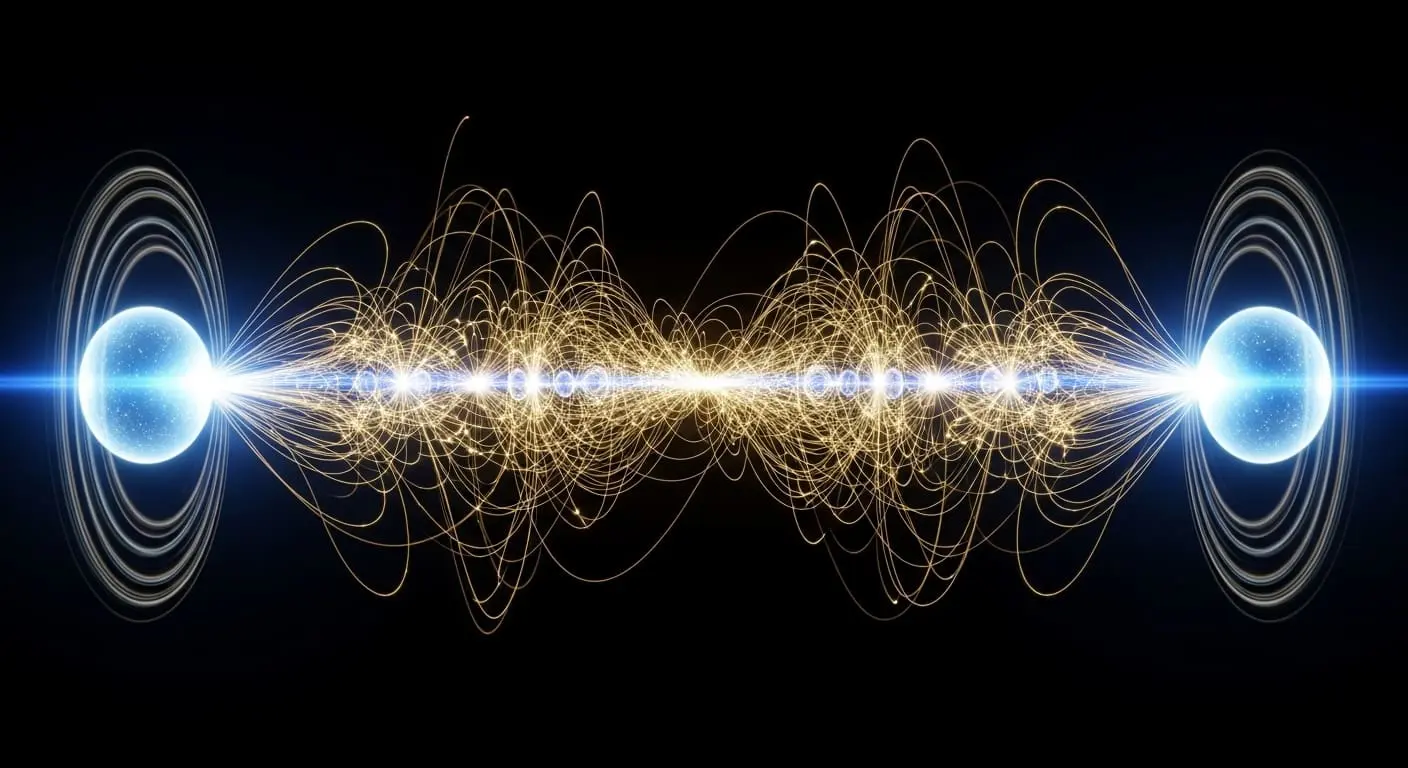
Scientists Luca Capizzi and Benoît Ferté at Université Paris-Saclay have presented an analytically solvable model of a random unitary circuit containing a single quantum many-body scar, detailing the thermalisation process that governs its stability. Their findings illuminate how perturbations affect this fragile state, revealing a crucial role for entanglement in diagnosing non-thermal behaviour within complex quantum systems.
Fluctuating interfaces reveal dynamics within a random quantum circuit
The foundation of this research lies in the construction of an analytically tractable random unitary circuit, a sophisticated arrangement of quantum operations that simulates the evolution of quantum bits. Unlike traditional quantum simulations which often rely on computationally intensive numerical methods, this circuit was designed to be mathematically solvable, allowing for precise calculations of its behaviour. Random unitary circuits are of increasing interest as models for benchmarking quantum computers and exploring the foundations of quantum chaos, representing a complex, yet controllable, environment for studying quantum dynamics. The circuit’s construction involved carefully selecting the quantum gates and their arrangement to ensure both randomness and analytical accessibility. This analytical tractability is paramount, as it circumvents the limitations inherent in numerical approximations, enabling the identification of subtle changes in the system’s quantum state that would otherwise be obscured by computational error.
A random unitary circuit was specifically engineered to host a single quantum many-body scar, a peculiar stationary state that defies the typical tendency of isolated quantum systems to thermalise. Quantum many-body scars represent rare exceptions to the expectation that complex quantum systems will evolve towards a state of maximum entropy, where all information about the initial conditions is lost. These scars lack the usual protective symmetries, such as conservation of energy or momentum, that stabilise other non-thermal states. Researchers investigated this circuit to understand the mechanisms by which thermalisation eventually occurs, leading to the scar’s instability and the system’s progression towards an infinite-temperature state. The analytical approach allowed for precise calculations of how external disturbances, modelled as fluctuating interfaces, affect the circuit’s quantum state, avoiding the approximations common in complex quantum systems. These fluctuating interfaces represent the boundaries between regions of coherent quantum behaviour and those undergoing thermalisation, providing a visual and mathematical framework for understanding the decay of the scar.
Entanglement reveals a quantum phase transition undetectable by local order parameters
Entanglement measures reveal a transition in the system’s dynamics at perturbation strengths where conventional local observables remain unaffected, shifting from a baseline of q to a demonstrably altered state. This signifies the first identification of a quantum phase transition solely through the observation of entanglement, a feat previously unattainable through reliance on local measurements alone. Local order parameters, which measure properties at specific points in space, are often insufficient to capture the global correlations that characterise quantum phase transitions. Entanglement, however, is sensitive to these long-range correlations, making it an ideal probe for detecting subtle changes in the system’s quantum state. An analytically tractable model, a random unitary circuit hosting a single quantum many-body scar, was constructed to pinpoint this entanglement transition, driven by perturbation strength and characterised by fluctuating interfaces resembling those found in percolation models. Percolation models, used to describe the connectivity of random networks, provide a useful analogy for understanding how the scar’s influence propagates through the circuit.
The instability of quantum many-body scars under perturbation was verified by examining the evolution of a local observable, O, which converged to an infinite-temperature state when the perturbation parameter λ equalled zero. Numerical simulations corroborated this convergence, demonstrating a relaxation rate consistent with predictions derived from the fluctuating interface picture and prior observations. Further analysis focused on the second Rényi entropy, a measure of entanglement, calculated using a model incorporating permutation operators and projections onto the scar itself. The generator of this model, represented by a matrix, was determined, allowing for detailed examination of entanglement dynamics. The second Rényi entropy is particularly sensitive to the presence of quantum correlations and provides a quantitative measure of the entanglement between different parts of the system. Despite these advances, the current framework does not yet demonstrate how to extend these findings beyond the simplified single-scar scenario, nor how to reliably predict scar fragility in more complex quantum systems. Understanding how multiple scars interact and influence each other remains a significant challenge.
Single quantum scars demonstrably reshape entanglement propagation in complex systems
Understanding how order emerges from chaos remains a central challenge in physics, particularly when examining systems far from equilibrium. This work offers a new perspective on quantum many-body scars, those unusual states defying expected thermal behaviour. The ability to characterise these scars through entanglement provides a powerful tool for studying non-equilibrium dynamics and exploring the boundaries between order and chaos. Determining how multiple scars interact, and whether this entanglement transition persists amidst a ‘tower’ of scars, presents a significant hurdle, as Andrade et al.’s previous work suggests scar observation becomes increasingly difficult with complexity. The proliferation of scars introduces additional correlations and interactions, making it more challenging to isolate and analyse their individual contributions.
Acknowledging the increasing difficulty of observing these scars as systems become more complex, this work establishes a key baseline understanding. A single quantum many-body scar, a rare exception to typical thermal behaviour in quantum systems, can demonstrably alter how entanglement spreads. This insight is valuable because it reveals a previously unknown sensitivity in these systems, allowing subtle changes to be detected via entanglement measurements unavailable to local observation. The altered entanglement propagation suggests that the scar acts as a source or sink of entanglement, influencing the correlations between distant quantum bits.
Quantum many-body scars, previously understood as fragile exceptions to typical thermalisation, induce a detectable shift in entanglement dynamics. Entanglement, a quantum link between particles, served as the key indicator of this transition, revealing changes invisible to conventional local measurements. Establishing this link between scar presence and entanglement behaviour opens a new avenue for characterising these complex quantum states, moving beyond reliance on conserved quantities or simple stability assessments. This approach has implications for the development of new quantum technologies, where the ability to control and manipulate entanglement is crucial for achieving quantum advantage.
The research demonstrated that a single quantum many-body scar alters the way entanglement spreads within a quantum system. This is significant because it reveals a sensitivity to these scars that cannot be detected by measuring local properties alone. Entanglement dynamics served as a key indicator of a transition driven by the scar’s presence, offering a new method for characterising these complex quantum states. The authors suggest further work is needed to understand how multiple scars interact and whether this entanglement transition persists in more complex systems.
👉 More information
🗞 Quantum many-body scars in random unitary circuits
🧠 ArXiv: https://arxiv.org/abs/2604.18244



See today’s quantum computing news on Quantum Zeitgeist for the latest breakthroughs in qubits, hardware, algorithms, and industry deals.