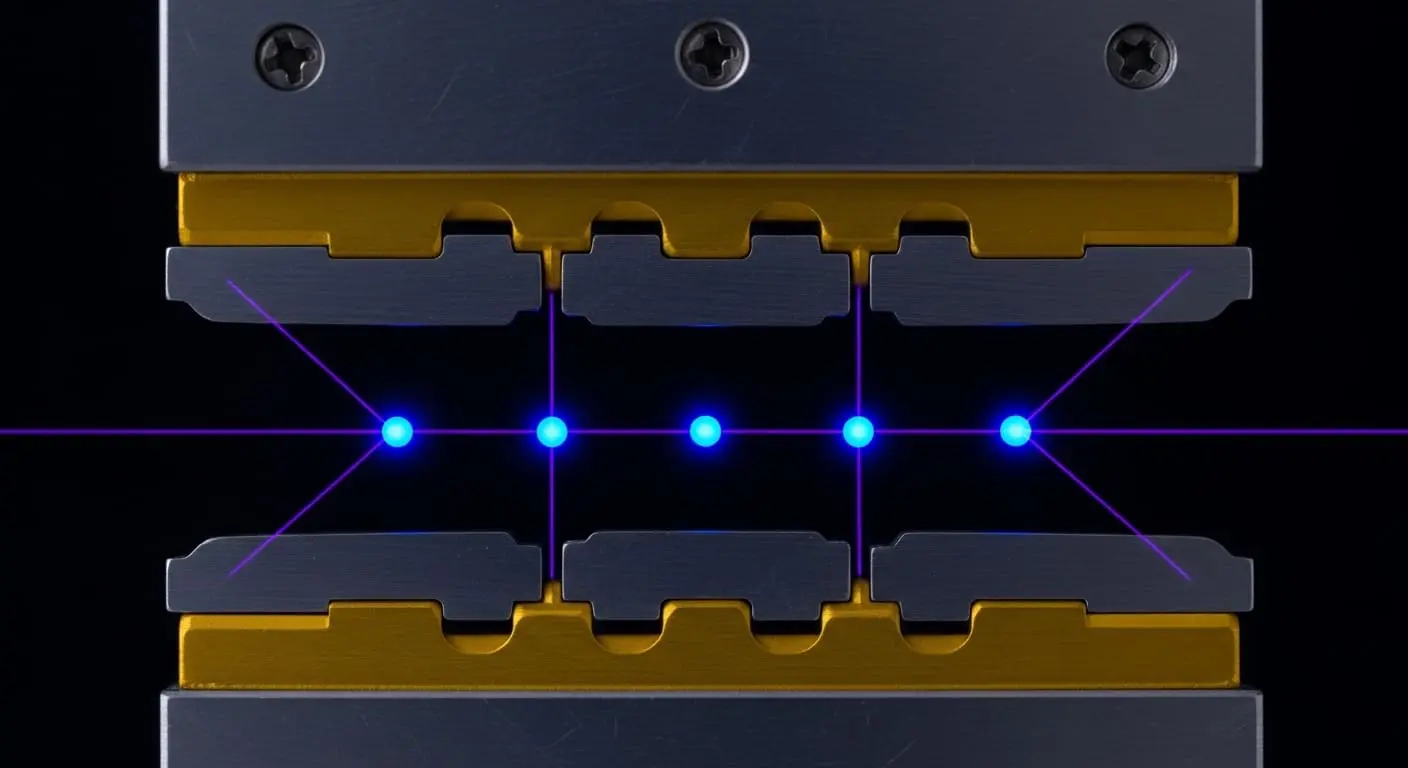
Scientists at ETH Zurich, in collaboration with the Fraunhofer Institute for Applied Solid State Physics IAF and Harvard University, have conducted a comprehensive theoretical investigation into phonon lasing with trapped ions, confirming observed lasing behaviour and proposing a novel method for achieving phonon lasing with a single trapped ion. This research, building upon experimental demonstrations detailed in T. Behrle, Phys. Rev. Lett. 131 (2023), details a pathway towards substantially enhanced precision sensing, potentially enabling multiple independent phonon lasers within a single experimental setup. Key to this advancement is the demonstration that utilising squeezed states within this system could enhance sensing sensitivity by up to two orders of magnitude, representing a significant leap forward in the field of quantum metrology
Phonon lasing in trapped ions delivers substantial gains in measurement sensitivity
Precision sensing sensitivity has now been enhanced by up to two orders of magnitude, surpassing the limitations of previous methods that struggled to detect subtle signals reliably. This improvement stems from a theoretical framework developed around phonon lasing in trapped ions, a process where coherent vibrational energy is amplified within the ion trap. Squeezed states, a quantum mechanical technique refining measurement precision by deliberately redistributing quantum uncertainty between conjugate variables, were employed in the theoretical modelling to achieve this enhancement. Traditionally, all quantum measurements are limited by the Heisenberg uncertainty principle, which dictates a fundamental lower bound on the precision achievable. Squeezed states circumvent this limit by reducing the uncertainty in one variable at the expense of increased uncertainty in its conjugate, allowing for more precise measurements of the variable of interest. The application of squeezed states to the phonon lasing scheme allows for a reduction in the noise floor, thereby improving the signal-to-noise ratio and enabling the detection of weaker signals.
A single trapped ion lasing scheme was proposed by the team, building on earlier two-ion designs to simplify experimental complexity and enable the creation of multiple phonon lasers within a single apparatus. Verification of phonon lasing behaviour above a defined threshold occurred in a two-ion system, confirming the analytic expression for the second-order coherence function, a key indicator of lasing. The second-order coherence function, denoted as g(2), quantifies the degree of correlation between photons (or in this case, phonons) emitted from the system. A value of g(2) greater than 1 indicates the presence of lasing, signifying that the emitted phonons are bunched together in time. However, these calculations rely on experimentally feasible parameters that still assume ideal conditions, such as perfect trapping potential and negligible environmental noise, and achieving this level of sensitivity in a real-world, noisy environment remains a key challenge. The analysis of the sensing protocol demonstrated a strong leap in precision measurement capability, with the potential to explore more complex quantum phenomena, such as investigating the fundamental limits of measurement and probing novel materials with unprecedented accuracy. This could have implications for fields ranging from gravitational wave detection to materials science and fundamental physics research.
Single-ion designs simplify phonon laser development for enhanced sensing capabilities
Exploiting the quantum realm promises enormous benefits for precision sensing, with phonon lasers, devices utilising vibrational energy instead of light, offering a potential route to dramatically improved accuracy. Unlike conventional optical lasers which rely on electromagnetic radiation, phonon lasers operate in the motional degrees of freedom of trapped ions, offering unique advantages for certain sensing applications. Current systems typically rely on two ions, presenting a practical hurdle as maintaining control over two separate particles introduces complexity and limits scalability. The need to individually address and control two ions significantly increases the complexity of the experimental setup and the associated control electronics. Reducing the system to a single ion circumvents many practical difficulties associated with controlling multiple particles, which is important for building more complex quantum devices and scaling up the technology.
This simplified approach opens the possibility of creating multiple independent phonon lasers within a single experimental setup, offering a significant advantage for scalability. Theoretical work established a pathway to phonon lasing using a single trapped ion, building on previous designs that leveraged strong coupling between the ion’s internal electronic states and its external motional modes. Lasing within this single-ion system relies heavily on the Lamb-Dicke regime, where the ion’s motion is quantised and confined to a small region of space. In this regime, the ion’s motional energy levels are discretised, allowing for precise control and manipulation of its vibrational state. Analysis confirms the generation of non-classical states, demonstrated through sub-Poissonian phonon distributions and Wigner function simulations. Sub-Poissonian statistics indicate that the phonon distribution exhibits less noise than a classical Poisson distribution, signifying the presence of quantum correlations. Further examination into higher-order terms describing the ion’s motion, alongside refinement of the squeezed states, potentially through the use of parametric down-conversion techniques, could unlock even greater precision in sensing applications. The ability to generate and control these non-classical states is crucial for achieving the enhanced sensitivity predicted by the theoretical model and represents a significant step towards realising practical quantum sensors based on phonon lasing.
The research demonstrated phonon lasing using both two-ion and, crucially, a single trapped ion system. This is important because reducing the complexity from two ions to one simplifies experimental setups and improves the potential for scaling up the technology. Researchers derived an analytic expression confirming lasing behaviour and showed sensitivity enhancements of up to two orders of magnitude in a sensing protocol utilising squeezed states. The authors suggest further refinement of squeezed states could unlock even greater precision in sensing applications.
👉 More information
🗞 Quantum theory for phonon lasing and non-classical state generation in mixed-species and single trapped ions
🧠 ArXiv: https://arxiv.org/abs/2604.18295


See today’s quantum computing news on Quantum Zeitgeist for the latest breakthroughs in qubits, hardware, algorithms, and industry deals.