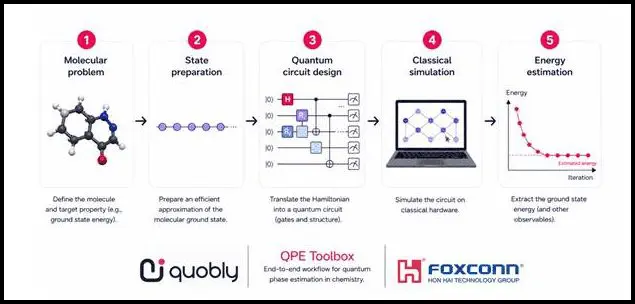
A French quantum-computing startup and a major Taiwanese electronics manufacturer have released a free numerical toolbox that lets researchers test Quantum Phase Estimation (QPE) implementations on a laptop. Quobly and Hon Hai Research Institute, the R&D arm of Foxconn, jointly developed the open-source tool to help bridge a gap that has slowed quantum-algorithm research for years: the difficulty of simulating realistic QPE workloads before fault-tolerant quantum hardware exists. The toolbox supports full circuit executions for up to 20 qubits and circuits between 1,000 and 100,000 gates, with ground-state preparation extending to 30 qubits.
Why Quantum Phase Estimation Matters
Quantum Phase Estimation is widely described as a cornerstone of fault-tolerant quantum computing. It is the engine behind several of the algorithms that quantum computing is expected to deliver real-world value on: simulating molecular energies for drug discovery, modelling new materials science applications, and Shor”s factoring algorithm that motivates the entire post-quantum cryptography transition. QPE estimates the eigenvalue of a unitary operator, which in chemistry corresponds to the energy of a molecular Hamiltonian. The accuracy and depth of the QPE circuit determines how precise the energy estimate is, and that depth-versus-accuracy trade-off is one of the central engineering questions in fault-tolerant algorithm design.
While QPE”s theoretical benefits are well understood, its practical resource demands have been hard to measure. Researchers have leaned on simplified cost models because full simulations of realistic QPE circuits are too expensive for most laptops, leaving published estimates of qubit and gate budgets uncomfortably wide. The Quobly-Foxconn toolbox is designed to close that gap with reproducible numerical experiments rather than back-of-envelope formulas.
What the Quobly-Foxconn Toolbox Does
The toolbox is open source and runs on standard hardware, not a quantum computer. It uses tensor-network simulation to handle quantum-circuit executions that exact statevector methods cannot reach at this size. Researchers can prepare initial states, encode molecular Hamiltonians into quantum circuits, simulate full QPE circuits end to end, and inspect the gate count, circuit depth, and error budget of different implementations.
The tool ships with two QPE variants side by side: the textbook QPE algorithm, and the single-ancilla Robust Phase Estimation (RPE) method. Standard QPE uses many ancillary qubits but completes the phase read-out in one shot. RPE uses just one ancilla but runs shorter circuits many times, trading width for depth. The toolbox lets researchers measure which approach is cheaper for a given problem under realistic hardware constraints, rather than guessing from asymptotic scaling alone.
Inside the Toolbox: Tensor Networks Meet QPE
The toolbox is built on the open-source quimb library and leverages two well-established tensor-network methods. Density Matrix Renormalization Group (DMRG) is a classical algorithm that finds the ground state of one-dimensional quantum systems efficiently, and the toolbox uses it to seed QPE simulations with high-quality starting states. Matrix Product States (MPS) compress those quantum states into a form that scales polynomially with system size, which is what makes the laptop-scale simulation tractable in the first place.
For encoding molecular Hamiltonians into quantum circuits the toolbox supports both trotterization and qubitization. Trotterization breaks the Hamiltonian into a sequence of small, simulable gate operations through a Trotter-Suzuki product-formula expansion. Qubitization is the more recent block-encoding approach that bounds error more tightly and is preferred for fault-tolerant designs because the gate cost scales more favourably with target precision. Researchers can compare both methods on the same molecular system and see the numerical impact on gate counts.
Practical Capabilities and Scale
The toolbox supports full circuit executions for approximately 20 qubits, with circuit depths ranging from fewer than 1,000 to around 100,000 gates. Ground-state preparation extends to 30 qubits. All of this runs on a standard laptop within a reasonable timeframe, which means academic groups without access to large clusters or quantum hardware can still investigate fault-tolerant algorithm design rigorously.
Output measurements include circuit depth, total gate counts split by gate type, and error budgets for both ideal and noisy QPE runs. The toolbox is designed for direct comparison: vary the encoding method, the state-preparation strategy, or the QPE variant, then read the cost difference off the same numerical scale. That replicable workflow is what existing theoretical cost models have struggled to provide.
Voices From the Collaboration
Thibaud Louvet, Quantum Algorithms Scientist at Quobly, framed the goal in everyday research terms. The team wants to provide a practical, numerical playground for QPE, one that helps researchers move beyond purely theoretical cost models and develop realistic intuition for fault-tolerant quantum algorithms.
Min-Hsiu Hsieh, Director of the Quantum Computing Research Center at Hon Hai Research Institute, positioned the release as a structured bridge between theory and practical engineering. His statement, captured in the pullquote below, emphasises the discipline the toolbox imposes on a corner of quantum-algorithm research that has too often relied on hand-waved resource estimates.
By combining state-of-the-art quantum algorithms with advanced tensor-network techniques, this toolbox offers researchers a structured environment to explore and better understand the practical requirements of future quantum applications.
Min-Hsiu Hsieh, Director of the Quantum Computing Research Center at Hon Hai Research Institute
What This Signals for Fault-Tolerant Quantum Computing
The release fits into a broader trend of algorithm-hardware co-design. Quantum-hardware roadmaps now span the next decade, and algorithm researchers need realistic cost estimates to choose which methods are worth pursuing today. By open-sourcing a simulation environment with practical scale and explicit gate-count metrics, Quobly and Hon Hai have given the QPE research community a shared baseline that should accelerate algorithm refinement across academic and industrial groups.
The wider quantum-hardware industry is converging on a ready-when-the-hardware-is-ready stance. Open tools like this toolbox let researchers stress-test their algorithms today, so that when fault-tolerant qubits arrive at scale, the algorithms expected to run on them are already mature, benchmarked, and engineered for the real resource constraints of the machines they will actually run on.
Source: https://www.quobly.io/




See today’s quantum computing news on Quantum Zeitgeist for the latest breakthroughs in qubits, hardware, algorithms, and industry deals.