Entanglement without the maths
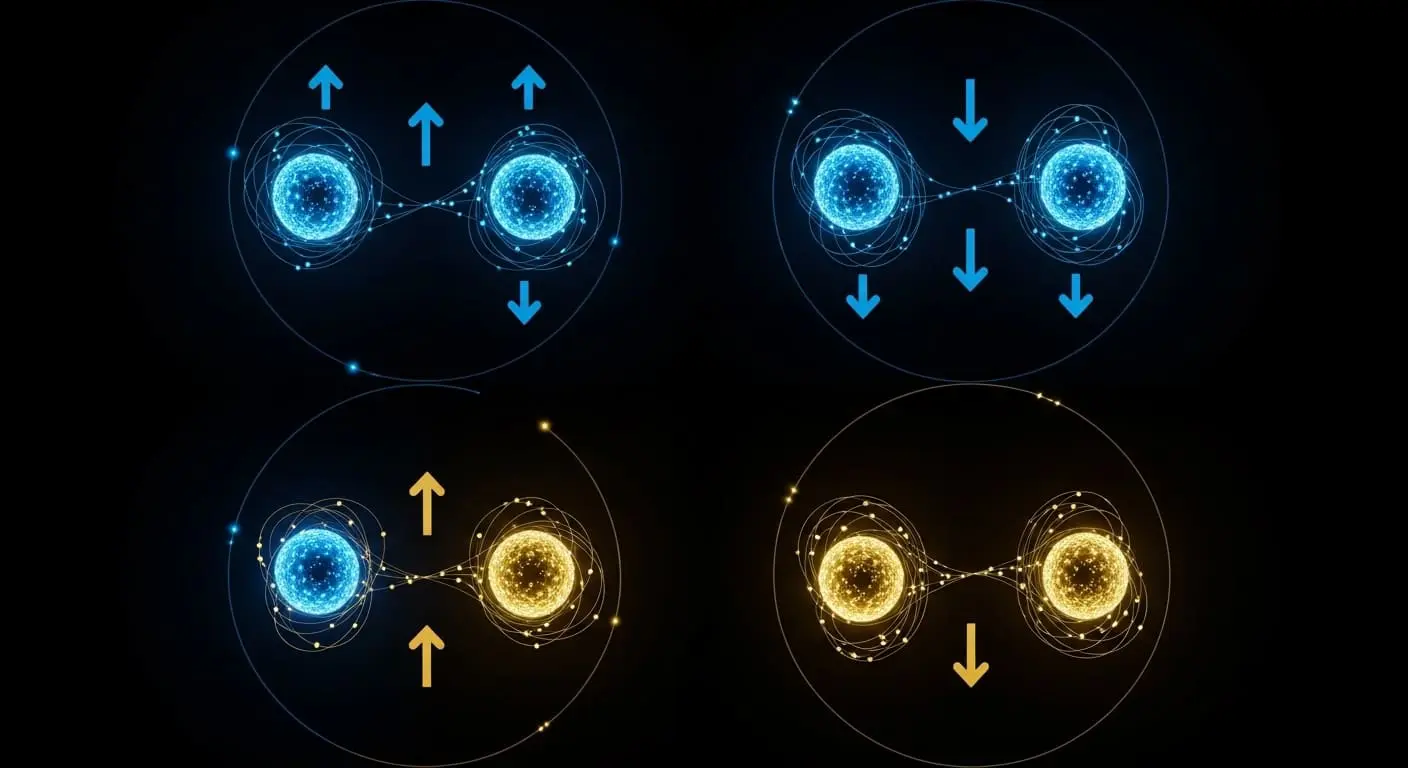
The textbook definition of quantum entanglement uses tensor products and Hilbert spaces, but the physics it describes can be talked about in plain English first. The shortest honest version is this: entanglement is what happens when two systems share a single quantum description and the parts are no longer independent. Measure one, and the outcome you see and the outcome someone else sees on the other system are linked in a way that survives any amount of physical separation between the two halves. The cleanest everyday analogy is two gloves packed into two boxes and shipped to opposite cities. Open one box and find a left glove, and you immediately know the other box contains a right glove, even though no signal travelled between the boxes when you opened yours. The strangeness here is mundane, not deep: the boxes had left and right gloves before you opened either of them. There was a fact of the matter from the start; opening the box just revealed it. The correlation existed before you looked. Entanglement is what happens when there is no analogous fact of the matter beforehand and yet the outcomes still match. Two qubits sharing quantum entanglement are like two boxes that, before you open them, contain neither a left nor a right glove, just the unbroken promise that whatever the first one turns out to be, the other will be the matching partner. The promise is enforced by the joint quantum state itself, not by hidden labels written down at the factory. The Bell test is the carefully designed experiment that distinguishes these two situations, and decades of experimental work have shown that real entangled particles behave like the second case, not the first. Conservation is the other useful intuition. If a single object splits into two halves in a way that conserves some quantity (total spin, total momentum, total polarisation), the two halves are constrained to give correlated outcomes when measured. A pion decaying into two photons must produce photons with opposite polarisations because the parent pion had zero net polarisation to begin with. The conservation law forces the correlation, but in the quantum case the individual photons do not have definite polarisations until measured. The correlation is real; the individual values are not pre-existing labels waiting to be read off. What quantum entanglement is not, despite the press coverage, is a faster-than-light communication channel or a metaphysical connection between souls. The mathematics of the joint state guarantees that no observable change happens at the far end when a measurement is made locally on one half of the pair. A scientist in the distant lab cannot tell whether or when you measured your half of the pair without also receiving a classical message from you over an ordinary channel, and that classical message is bound by the speed of light like any other. Entanglement is a correlation that cannot be explained by hidden labels, full stop. It is unusual, it is provable, and it is now an engineering primitive, but it is not magic.What is quantum entanglement, exactly?
Quantum entanglement is the property of a multi-particle quantum state in which the state of the whole cannot be factored into independent states of the parts. Mathematically: a pure state |Ψ⟩ of two systems A and B is entangled if and only if it cannot be written as |Ψ⟩ = |ψ_A⟩ ⊗ |φ_B⟩ for any choice of single-system states |ψ_A⟩ and |φ_B⟩. Operationally: measurements on A and B produce outcomes that are correlated in ways no classical theory can reproduce, even after every relevant classical communication has been accounted for. The cleanest concrete example is the singlet state |Ψ⊇−⟩ = (|01⟩ − |10⟩) / √2. Two qubits prepared in this state always give opposite results when measured in any matched basis, but neither qubit on its own has a definite value before measurement. The correlations survive separation across arbitrary distance, persist through any local operations, and violate the Bell inequality by the largest possible amount allowed by quantum mechanics.A brief history of entanglement
The arc from theoretical curiosity to production technology is one of the cleanest in modern physics, and the named milestones are short enough to remember. The 1935 Einstein-Podolsky-Rosen paper introduced what is now called the EPR paradox: the authors argued that quantum mechanics must be incomplete because it predicted instantaneous correlations between separated particles. Schrödinger coined the term “entanglement” the same year and called it the characteristic trait of quantum mechanics that enforces its entire departure from classical lines of thought. John Bell’s 1964 paper turned the philosophical question into an empirical one. Bell showed that any local hidden-variable theory must obey a specific inequality (now called the Bell inequality) that quantum mechanics violates. The first experimental violation came from Stuart Freedman and John Clauser in 1972, followed by Alain Aspect’s celebrated 1982 experiments at the Institut d’Optique that closed the locality loophole by switching measurement settings while the photons were in flight. The remaining loopholes (detection, fair sampling, freedom of choice) were closed one at a time across the next thirty years. The 2015 Delft loophole-free experiment (Hensen et al., Nature) closed every remaining loophole simultaneously, using entangled nitrogen-vacancy centres in diamond separated by 1.3 km. The same year saw confirming loophole-free tests from NIST and Vienna. The 2022 Nobel Prize in Physics was awarded jointly to Aspect, Clauser, and Anton Zeilinger for “experiments with entangled photons, establishing the violation of Bell inequalities and pioneering quantum information science.” Production deployment followed: by 2026 entanglement-based QKD links run on Chinese, European, and US fibre and satellite networks, and entanglement is the resource underlying every fault-tolerant quantum-computing roadmap.Entanglement 101: the 10 terms you need
The ten terms below are the working vocabulary every entanglement paper assumes; skim them and the rest of this guide is far easier to follow. The advanced terms (cluster states, Schmidt decomposition, witness operators, and the quantitative measures) live in the Entanglement 201 block further down so a first read stays focused on the essentials.A statistical ensemble of pure states described by a density matrix ρ with trace one and rank greater than one. Real-world quantum systems are mixed because they couple to an environment.
The mathematical operation that combines the Hilbert spaces of two systems into a single joint Hilbert space, written H_A ⊗ H_B. Dimensionality is the product of the components, which is where the exponential power of quantum information processing comes from.
A bipartite state that factorises as a convex combination of product states. Separable states are not entangled and can be prepared by local operations and classical communication alone.
A bipartite or multipartite state that is not separable. Equivalent definition: it cannot be prepared from any product state using only local operations and classical communication.
One of the four maximally entangled two-qubit states |Φ+⟩, |Φ−⟩, |Ψ+⟩, |Ψ−⟩, which form an orthonormal basis of the two-qubit Hilbert space. Every Bell test, teleportation protocol, and dense-coding scheme starts from one of these four states.
An inequality on correlations between measurement outcomes that any local hidden-variable theory must satisfy. Violating it is the experimental signature of entanglement.
Common shorthand for a Bell state, particularly the singlet |Ψ−⟩. Named for the Einstein-Podolsky-Rosen thought experiment that introduced the question of what entangled correlations imply about quantum mechanics.
The most general description of a quantum state: a positive semi-definite Hermitian operator with trace one. Required for mixed states, sufficient for all of quantum information theory.
Einstein’s pejorative phrase for what he believed entanglement implied. The phrase has stuck even though the modern understanding is that no causal action propagates faster than light; only correlations do.
Entanglement 201: the 10 advanced terms
These ten objects show up in the quantification, multipartite-structure, and verification sections later in this guide. You can skip them on a first read and come back when you hit a section that uses them. They are the working vocabulary of researchers and engineers building production entanglement systems in 2026.
The other canonical three-qubit entangled state: (|001⟩ + |010⟩ + |100⟩) / √3. Robust to single-qubit loss, unlike GHZ; complementary class of multipartite quantum entanglement.
A multi-qubit entangled state built by entangling neighbours on a graph, the resource state for measurement-based quantum computing. Single-qubit measurements on a large enough cluster can implement any unitary, which is why these states sit at the heart of photonic computing roadmaps.
The Clauser-Horne-Shimony-Holt form of the Bell inequality, |E(a,b) – E(a,b’) + E(a’,b) + E(a’,b’)| ≤ 2 classically, ≤ 2√2 quantum-mechanically. The quantum bound is Tsirelson’s bound, and reaching it is the operational signature of a maximally entangled state.
Any pure bipartite state can be written as Σ_i λ_i |i_A⟩|i_B⟩ with non-negative real coefficients summing to one. The Schmidt rank (number of non-zero λ_i) is greater than one if and only if the state is entangled.
The operation that obtains the reduced state of a subsystem by tracing out the others: ρ_A = tr_B(ρ_AB). The reduced state of an entangled subsystem is always mixed.
The von Neumann entropy of the reduced density matrix S(ρ_A) = -tr(ρ_A log ρ_A). For pure bipartite states, equal to the entropy of the other subsystem; the most natural measure for pure states.
A two-qubit entanglement measure ranging from 0 (separable) to 1 (maximally entangled), computable from the density matrix without optimisation. The Wootters formula is the standard reference.
An entanglement measure based on the absolute sum of the negative eigenvalues of the partial transpose, applicable to mixed states in any dimension. Unlike concurrence it scales to higher-dimensional systems, which is why it shows up in solid-state and many-body work.
A Hermitian observable whose expectation value distinguishes entangled states from separable ones, useful for verification without full tomography. Witnesses are how multi-qubit entanglement is certified in hardware experiments because full state tomography is prohibitively expensive past a few qubits.
Classical correlation vs quantum entanglement
Classical statistics has correlations that look superficially similar to entanglement, so the cleanest way to internalise the difference is to lay them next to each other along the dimensions that actually matter. Two perfectly anti-correlated coins (one heads, one tails, randomly assigned) share a classical correlation that survives separation, but the correlation comes with hidden labels (which coin is heads is decided before separation). Entangled qubits have no such labels, and the correlations they produce when measured in non-matching bases violate inequalities classical labels cannot.
| Dimension | Classical correlation | Quantum entanglement |
|---|---|---|
| Pre-measurement values | Hidden labels exist; measurements only reveal them | No definite values exist before measurement |
| CHSH inequality | Bounded by 2 (Bell) | Reaches 2√2 (Tsirelson) |
| Local marginals | Match the local distribution exactly | Also match, by no-signalling |
| Information capacity | One classical bit per pair | Two classical bits per pair via dense coding |
| Cloning | Trivially clonable | No-cloning theorem forbids perfect cloning |
| Communication speed | Limited by classical channel | Correlations are instantaneous; messages are not (no-signalling) |
| Monogamy | None; classical correlations share freely | Strict; maximally entangled pairs cannot share entanglement with a third party |
| Resource for protocols | None special | Enables teleportation, dense coding, entanglement-based QKD, error correction |
The four Bell states
The four maximally entangled two-qubit states are the most-used objects in entanglement theory and the building blocks of every entanglement-based protocol. They form an orthonormal basis of the two-qubit Hilbert space, which means any two-qubit pure state can be written as a linear combination of the four Bell states.|Φ+⟩ = (|00⟩ + |11⟩) / √2
|Φ−⟩ = (|00⟩ − |11⟩) / √2
|Ψ+⟩ = (|01⟩ + |10⟩) / √2
|Ψ−⟩ = (|01⟩ − |10⟩) / √2 ← the singletTypes of entanglement: bipartite, multipartite, and graph states
Entanglement is a richer concept beyond pairs. Multipartite entanglement (three or more systems) has structure that two-qubit theory misses, and the choice of multipartite class matters for the application.(|00…0⟩ + |11…1⟩) / √2 on N qubits. Maximal entanglement under one definition; collapses to a separable state under single-qubit loss. The canonical multi-party protocol state.
(|0…01⟩ + |0…10⟩ + … + |10…0⟩) / √N. Robust to single-qubit loss (the remaining N-1 qubits stay entangled). Inequivalent to GHZ under local operations.
Multi-qubit entangled states built by entangling all graph-neighbour pairs. The resource state for measurement-based (one-way) quantum computing; equivalent to GHZ on a star graph and to a chain of Bell pairs on a path.
Generalisation of cluster states to arbitrary graphs. Each vertex is a qubit; each edge is a CZ gate. The quantum entanglement structure mirrors the graph topology and is the foundation of many fault-tolerant codes.
States built by contracting tensors over a network (MPS, PEPS, MERA). Capture entanglement structure of physical many-body systems and underlie modern quantum-inspired classical algorithms for LLM compression.
How to create entanglement: gates, measurements, and swapping
There are three production-grade routes to generating an entangled state in 2026 quantum hardware: gate-based preparation, measurement-based projection, and entanglement swapping across a third party. Each method has a domain where it is the right tool, and most production quantum networks use combinations of all three.
Gate-based: the Hadamard plus CNOT recipe
The simplest and most-used route is to apply a single Hadamard followed by a controlled-NOT. Starting from |00⟩, the Hadamard puts the first qubit in superposition, producing (|0⟩+|1⟩)|0⟩ / √2 = (|00⟩+|10⟩) / √2. The CNOT then flips the second qubit when the first is |1⟩, producing (|00⟩+|11⟩) / √2 = |Φ+⟩. The whole circuit is two gates and produces a maximally entangled Bell pair.Measurement-based: projection onto a Bell basis
The second route works even when the two systems have never interacted. Prepare two separate Bell pairs (A1A2) and (B1B2), then jointly measure A2 and B1 in the Bell basis. The four possible outcomes project A1 and B2 into one of the four Bell states (depending on the measurement outcome), even though A1 and B2 have never interacted. This is the essential trick behind quantum repeaters and entanglement swapping at scale.Entanglement swapping over a network
Entanglement swapping generalises the measurement-based approach across many parties. The basic primitive of quantum repeater networks: every adjacent pair shares an entangled pair, then joint Bell-basis measurements at each repeater swap the entanglement across the chain. By the end, the two endpoints share an entangled pair without any photon having travelled the full distance. This is how 2026 metropolitan quantum networks achieve entanglement across hundreds of kilometres despite fibre attenuation.Tensor products and the separability test
The mathematical question “is this state entangled?” reduces to “can it be written as a tensor product of separate states?” For pure states the answer is decidable: any pure bipartite state has a Schmidt decomposition with a finite Schmidt rank, and the state is entangled if and only if the Schmidt rank is greater than one. For mixed states the question is harder and is in fact NP-hard in general dimension. The Peres-Horodecki criterion (also called the PPT criterion) gives a tractable test for low-dimensional systems. Take the density matrix ρ_AB, partially transpose with respect to one subsystem to get ρ_AB^, and check whether the result is positive semi-definite. For 2×2 and 2×3 dimensional systems this is a necessary and sufficient condition for separability; in higher dimensions, PPT-preserving states can still be entangled (so-called bound entanglement). The negativity entanglement measure is built directly on this test: it is the absolute sum of the negative eigenvalues of the partial transpose. Negativity is zero for separable states (in the dimensions where PPT is sufficient) and grows with the strength of the entanglement, providing a tractable quantification that does not require expensive optimisation.Bell inequalities and the CHSH test
Bell’s 1964 theorem proves that any local hidden-variable theory (one where outcomes depend only on local settings and pre-existing values) must obey a specific inequality on measurement correlations. Quantum mechanics violates this inequality, which makes Bell tests the empirical proof that nature is not locally realistic. The CHSH form (Clauser-Horne-Shimony-Holt 1969) is the most-used in modern experiments. Alice and Bob each have two measurement settings (a, a’ for Alice, b, b’ for Bob) and each measurement returns +1 or −1. Define the correlation E(a, b) as the expectation value of the product of outcomes. The CHSH quantity S = E(a,b) – E(a,b’) + E(a’,b) + E(a’,b’) satisfies |S| ≤ 2 classically; quantum mechanics with maximally entangled states reaches |S| = 2√2 (Tsirelson’s bound). The CHSH violation has been measured at increasing precision since 1972. The 2015 loophole-free experiments returned S values of 2.42 and higher with statistical significance well above five sigma, conclusively ruling out local hidden-variable theories. The 2022 Nobel Prize formalised the experimental consensus that the universe is not locally realistic in any meaningful sense.Loophole-free Bell tests and the 2022 Nobel Prize
The first Bell tests in the 1970s and 1980s closed some loopholes but not all. The locality loophole asks whether the two measurement choices could have influenced each other classically before the measurements; this is closed by separating the measurement apparatus far enough that no light-speed signal could connect them within the measurement window. The detection (or fair-sampling) loophole asks whether the detected events are a representative sample of all events; this is closed by raising the detection efficiency above a threshold computable from the Bell inequality. The freedom-of-choice loophole asks whether the measurement settings could have been correlated with the underlying state; this is closed by using independent random number generators. The 2015 Delft experiment (Hensen et al., Nature 526, 682-686) closed every loophole simultaneously. Two nitrogen-vacancy centres in diamond, separated by 1.3 km on opposite ends of the Delft campus, were entangled via an event-ready scheme that projected them into a singlet state through joint photon detection at a central station. The Bell test on the resulting pairs gave S = 2.42 with 96% confidence, and the timing of measurements satisfied space-like separation. The same year, independent loophole-free tests from NIST (Shalm et al., Phys. Rev. Lett.) and the University of Vienna (Giustina et al., Phys. Rev. Lett.) confirmed the result with photons. The 2022 Nobel Prize in Physics was awarded jointly to John Clauser (for the 1972 Freedman-Clauser experiment), Alain Aspect (for the 1982 locality-loophole closure), and Anton Zeilinger (for the 1998 freedom-of-choice and subsequent multi-party entanglement work). The Nobel committee citation explicitly named the contribution to “quantum information science” alongside the foundational physics, recognising the field’s transition from philosophy to engineering.Entanglement quantification: entropy, concurrence, negativity
Verifying that a state is entangled is one question; measuring how entangled it is is another, and the choice of quantification depends on the application. Three measures dominate the 2026 production landscape.Entanglement entropy (pure states)
For a pure bipartite state |Ψ⟩_AB, the entanglement entropy is the von Neumann entropy of the reduced density matrix S(ρ_A) = -tr(ρ_A ρ_A). It equals zero for product states, equals d for a maximally entangled state of dimension d (one ebit per qubit for Bell pairs), and is monotone under local operations. Entropy is the most theoretically clean measure but only well-defined for pure states.Concurrence (two-qubit mixed states)
Concurrence is the standard two-qubit measure, defined by the Wootters formula based on the eigenvalues of ρ(σ_y ⊗ σ_y) ρ* (σ_y ⊗ σ_y). It ranges from 0 (separable) to 1 (Bell-state pure), is computable in closed form without optimisation, and is the de-facto reference for two-qubit benchmarks across IBM, IonQ, and Quantinuum. The 2026 production headline numbers (99.9% gate fidelity translating to roughly 0.99 concurrence) are the practical anchor for hardware comparisons.Negativity (mixed states, any dimension)
Negativity is the absolute sum of the negative eigenvalues of the partial transpose, scaled to [0, 1]. It generalises the PPT separability test to a continuous quantification, works in any dimension, and is computable in polynomial time. The log-negativity (log_2(2N + 1)) has nicer information-theoretic properties and is the preferred measure for quantum-channel capacity calculations.High-fidelity entanglement in 2026 hardware
Generating high-quality entanglement on real hardware is the engineering problem that every 2026 quantum-computing vendor competes on. The headline metric is two-qubit gate fidelity, which translates almost directly to the fidelity of the produced Bell state for a Hadamard plus CNOT recipe.| Modality | Best 2026 two-qubit fidelity | Bell-state fidelity | Notes |
|---|---|---|---|
| Trapped ion (IonQ Forte Enterprise) | ~99.9% | ~99.8% | All-to-all connectivity; published native-2Q fidelity around 99.94% |
| Trapped ion (Quantinuum H2) | ~99.9% | ~99.8% | Helios upgrade in 2026 to higher counts; also all-to-all |
| Superconducting (IBM Heron R2) | ~99.7% | ~99.4% | 156 qubits, heavy-hex topology; per-layer-fidelity metric |
| Superconducting (Google Willow) | ~99.7% | ~99.4% | 105 qubits; surface-code milestone in 2024 |
| Neutral atom (Atom Computing, QuEra, Pasqal) | ~99.5% | ~99.0% | 1,000+ qubit registers; Rydberg-blockade native two-qubit gates |
| Photonic (Xanadu, Quandela, ORCA) | ~99% for measurement-based | ~98% | Probabilistic gates; loss is the dominant error mode |
Decoherence and entanglement lifetime
Entangled states are fragile because any coupling to an environment reduces the off-diagonal coherences in the density matrix that encode the entanglement. The lifetime of an entangled pair is therefore set by the same T1 (energy relaxation) and T2 (dephasing) timescales that limit single-qubit coherence, but with additional structure because entanglement is more sensitive than coherence in some modalities. The phenomenon of entanglement sudden death (Yu and Eberly 2004 theory, Almeida et al. 2007 experimental observation) is the most counter-intuitive consequence. While single-qubit coherence decays exponentially with T2, two-qubit entanglement can reach exactly zero in finite time and then stay zero, even when the qubits themselves still have non-zero coherence. The mathematical reason is that quantum entanglement measures (concurrence and negativity) involve maxima with zero, which can saturate before the underlying density matrix elements vanish. Practical Bell-pair lifetimes in 2026 are: trapped-ion ~10 seconds (IonQ Forte and Quantinuum H2), superconducting ~100 microseconds (IBM Heron R2), neutral atom ~1 second (Pasqal and QuEra), photonic limited by transmission rather than coherence. The dynamical decoupling sequences used in production (XY8, CPMG) extend these lifetimes by a factor of 3 to 10 depending on the noise spectrum.Entanglement in quantum computing
Entanglement is what makes quantum computing more powerful than any classical analogue. Every quantum algorithm with a proven speedup uses entanglement as the underlying resource: Shor’s factoring algorithm relies on entanglement to extract periods from the quantum Fourier transform, Grover’s algorithm builds entanglement during the amplitude-amplification iterations, and every variational quantum algorithm requires entanglement-generating layers to capture problem structure no classical separable ansatz can. In the production quantum-computing stack, entanglement appears at three places. First, in gates: any two-qubit entangling gate (CNOT, CZ, iSWAP) creates entanglement between its operands; without these, the circuit is classically simulable. Second, in encoders for quantum machine learning, where ZZ feature maps and other entangling encoders are the smallest step that crosses into provably-hard-to-simulate territory (see our quantum machine learning guide for the full treatment). Third, in error correction: every quantum error-correcting code distributes the logical information across an entangled subspace of physical qubits, and the entanglement structure is what enables correction of arbitrary single-qubit errors. Surface codes, the current frontrunner for fault-tolerant quantum computing, build a highly structured graph-state-like entanglement across hundreds or thousands of physical qubits. The Google Willow 2024 result demonstrated logical error rates falling below the threshold as the code distance grew, the first experimental confirmation that the entanglement structure of surface codes can outpace decoherence in real hardware.Quantum teleportation and dense coding
The two canonical entanglement-based communication protocols are quantum teleportation (Bennett, Brassard, Crépeau, Jozsa, Peres, Wootters 1993) and superdense coding (Bennett and Wiesner 1992). Both use a pre-shared Bell pair plus a classical channel to do something that classical resources alone cannot.Quantum teleportation
Teleportation transmits an unknown qubit state from Alice to Bob using a shared Bell pair and two classical bits. Alice performs a joint Bell-basis measurement on the qubit to be teleported and her half of the shared pair, obtaining one of four outcomes. She sends the two-bit outcome to Bob over a classical channel. Bob applies the corresponding Pauli correction (one of I, X, Z, XZ) to his half of the shared pair, after which his qubit is in the original state. The Bell pair is consumed; the original qubit’s state has been destroyed; no qubit ever travelled the actual distance. Teleportation is the backbone of distributed quantum computing and quantum networks. Every quantum repeater node uses entanglement swapping (a generalisation of teleportation) to propagate entangled states across long fibre runs. The 2017 Micius satellite (Pan group) demonstrated ground-to-satellite teleportation at 1,400 km, and the 2022-2024 generations have pushed this to operational metropolitan networks.Superdense coding
Superdense coding is the complementary protocol: it transmits two classical bits using one qubit, with a pre-shared Bell pair as the resource. Alice encodes one of four messages by applying one of I, X, Z, XZ to her half of the Bell pair, then sends her qubit to Bob. Bob performs a joint Bell-basis measurement on both qubits and reads out the two-bit message. Dense coding doubles the classical-channel capacity in the presence of pre-shared entanglement, which is why entanglement-assisted classical capacity (the Bennett-Shor-Smolin-Thapliyal theorem) is exactly twice the unassisted capacity for many channels. Production deployments are rare because the operational cost of distributing entangled pairs typically exceeds the doubling benefit, but the result is theoretically central to quantum Shannon theory.Entanglement-based quantum key distribution
Quantum key distribution (QKD) is the production technology that makes entanglement commercially relevant in 2026. Two protocol families dominate: prepare-and-measure protocols like BB84 (Bennett and Brassard 1984), which use single qubits, and entanglement-based protocols like E91 (Ekert 1991), which use distributed Bell pairs and prove security through a Bell-test verification. The E91 protocol exploits the monogamy of entanglement: any third party (the eavesdropper Eve) who attempts to learn information about the shared key necessarily disturbs the Bell-state correlations between Alice and Bob in a way that violates the CHSH inequality. Alice and Bob therefore use a fraction of their pairs to estimate the CHSH parameter; if the violation matches the no-eavesdropper prediction (S close to 2√2), they can use the remaining pairs to generate a secure key. By 2026, entanglement-based QKD links are running on the Chinese Beijing-Shanghai backbone (2,000 km), the European Quantum Communication Infrastructure (EuroQCI) initial deployments, and operational installations from Toshiba, ID Quantique, Quantum Xchange, and several smaller vendors. The Micius satellite enabled the first intercontinental entanglement-based QKD (Beijing-to-Vienna, 7,600 km) in 2018, and next-generation Chinese quantum-satellite missions extend toward multi-satellite constellations now in planning.Quantum networks and entanglement distribution
A quantum network is a system that distributes entanglement across geographic distances using quantum repeaters, entanglement swapping, and quantum entanglement purification protocols. The fundamental problem is that photons are lost in fibre at rates that grow exponentially with distance (roughly 0.2 dB/km at telecom wavelengths), so direct transmission of entangled photons fails beyond a few hundred kilometres. Quantum repeaters split the link into shorter segments, generate entanglement on each segment independently, then chain them together via entanglement swapping. The 2026 state of the art in quantum networks is a research-stage technology with a small number of public testbeds, not yet a commercial product class. The Quantum Internet Alliance (Delft-led European consortium) and the Harvard-MIT-Lukin programme are the most public quantum-memory-based repeater efforts, using nitrogen-vacancy centres in diamond and rare-earth-doped crystals as quantum memories. The Chicago Quantum Exchange operates a metropolitan-area testbed across Argonne, Fermilab, and the University of Chicago that has demonstrated entanglement distribution over tens of kilometres of dark fibre, and the Beijing-Shanghai trunk plus the Micius satellite remain the longest-distance entanglement-distribution links worldwide. Entanglement distillation (purification) is the protocol that takes many low-fidelity entangled pairs and produces fewer high-fidelity ones, trading rate for quality. The Bennett-DiVincenzo-Smolin-Wootters BBPSSW protocol is the canonical reference, and modern variants based on cluster-state entanglement-pumping schemes are what make end-to-end network entanglement at 99% fidelity tractable in 2026 production systems.Entanglement in quantum sensing
The third major application of entanglement is quantum sensing, where entangled states of N particles can achieve precision scaling as 1/N (the Heisenberg limit) rather than 1/√N (the classical standard quantum limit). The improvement is a factor of √N, which is the difference between needing 10,000 measurements and needing 100 to reach the same precision. The canonical entangled sensing state is the NOON state (|N0⟩ + |0N⟩) / √2, where N particles are all in mode A or all in mode B. Phase-sensitive measurements of the NOON state achieve the Heisenberg limit on phase estimation, which is the limit relevant for interferometric sensing of gravitational waves, magnetic fields, and accelerations. The 2025 LIGO-Virgo squeezed-light upgrade incorporates a related entanglement-enhanced state to push the strain sensitivity 4 dB below the standard quantum limit. Production-grade entanglement-enhanced sensing in 2026 is concentrated in three application areas. First, optical clocks (NIST and JILA strontium lattice clocks) use spin-squeezed entangled states of many neutral atoms to reach fractional frequency stabilities approaching 10⊇−¹&sup9;. Second, atomic magnetometers from groups at PTB, NIST, and several university labs use entangled or spin-squeezed atomic ensembles to push sensitivity toward the femtotesla regime. Third, defence-funded programmes (DARPA in the US, European national agencies) develop entanglement-enhanced gravimeters and gradiometers for inertial navigation in GPS-denied environments.Six common entanglement myths debunked
References
The list below is the short stack of primary sources that anchor every claim in this guide. We have deliberately kept it brief; the canonical comprehensive review (Horodecki 2009) is the right pointer if you want the full literature tree.
- Bell. “On the Einstein-Podolsky-Rosen paradox.” Physics Physique Fizika 1, 195-200 (1964). The original Bell inequality.
- Aspect, Grangier, and Roger. “Experimental tests of realistic local theories via Bell’s theorem.” Phys. Rev. Lett. 47, 460-463 (1981). The 1981/1982 Institut d’Optique experiments that closed the locality loophole.
- Hensen et al. “Loophole-free Bell inequality violation using electron spins separated by 1.3 kilometres.” Nature 526, 682-686 (2015). The Delft loophole-free test that closed every loophole at once; NIST (Shalm) and Vienna (Giustina) confirmed the same year.
- Horodecki, Horodecki, Horodecki, and Horodecki. “Quantum entanglement.” Rev. Mod. Phys. 81, 865-942 (2009). The canonical comprehensive review covering quantification, distillation, and witnesses.
- The Nobel Foundation. “The Nobel Prize in Physics 2022.” quantum entanglement Nobel laureates Aspect, Clauser, Zeilinger. Official Nobel committee citation.
About this guide
Who wrote it
This guide is produced by Quantum Zeitgeist, an independent quantum-computing news and analysis publication that has covered the field continuously since 2017. The editorial team includes physicists with PhD-level training in quantum information and condensed-matter theory, working researchers who maintain a parallel publication record on quantum-network and Bell-test experiments, and contributors with experience designing and verifying entanglement-based protocols on real hardware. Every technical claim in this article is sourced either to the primary literature or to vendor documentation that we have read directly and cite in-line.How it is updated
This page is maintained as a living reference rather than a one-time publication. The figures, milestones, hardware-fidelity numbers, and protocol-deployment claims are refreshed quarterly against the most recent vendor announcements and the conference proceedings of QIP, IEEE Quantum Week, and Q2B. The 2026 numbers here reflect the state of the field as of the most recent quarterly review; any item that looks out of date almost certainly will be the next item updated.How to use it
Treat the table of contents as a working index. If you are new to entanglement, read the definition, glossary, classical-vs-quantum comparison, and Bell-states section in order. If you are evaluating an entanglement-based application, jump straight to the protocols (teleportation, QKD, networks) and the hardware-fidelity section. If you are looking for the foundational physics, the Bell-inequalities and loophole-free sections are the practical reference. If you only have ten minutes, the Key Takeaways block at the top gives you the seven things every working entanglement practitioner needs to know.
Frequently asked questions
What is quantum entanglement in simple terms?
Quantum entanglement is a special correlation between two or more quantum particles whose joint state cannot be factored into independent states of the parts. When you measure one entangled particle, the result is correlated with what you would measure on the other in a way that no classical theory can reproduce. The correlation survives separation across arbitrary distance, persists through any local operations, and is the experimental signature that won the 2022 Nobel Prize in Physics.Does quantum entanglement allow faster-than-light communication?
No. The no-signalling theorem proves that measuring one entangled particle does not change the marginal distribution of outcomes at the other end, so an observer at the far end cannot tell whether or when a local measurement has happened. The correlations are revealed only when the two outcomes are compared via a classical channel, which is itself bounded by the speed of light.What is a Bell state?
A Bell state is one of the four maximally entangled two-qubit states that form an orthonormal basis of the two-qubit Hilbert space. The four states are |Φ+⟩ = (|00⟩ + |11⟩)/√2, |Φ−⟩ = (|00⟩ − |11⟩)/√2, |Ψ+⟩ = (|01⟩ + |10⟩)/√2, and |Ψ−⟩ = (|01⟩ − |10⟩)/√2. They are the canonical resource state for quantum teleportation, dense coding, and entanglement-based QKD.What is the difference between superposition and entanglement?
Superposition is a property of a single quantum system that can be in a linear combination of basis states. Entanglement is a property of two or more quantum systems whose joint state cannot be factored into independent states of the parts. A single qubit in superposition is not entangled; entanglement requires at least two systems with correlations that cannot be described by separate states.Did the 2022 Nobel Prize go to entanglement?
Yes. The 2022 Nobel Prize in Physics was awarded jointly to Alain Aspect, John Clauser, and Anton Zeilinger for experiments with entangled photons that established the violation of Bell inequalities and pioneered quantum information science. The work spans from Clauser’s 1972 experiment with Stuart Freedman through Aspect’s 1982 locality-loophole closure to Zeilinger’s later multi-party entanglement and quantum teleportation work.How is entanglement created in practice?
The most common recipe in 2026 hardware is a Hadamard gate on one qubit followed by a controlled-NOT (CNOT) targeting a second qubit. Starting from |00⟩, the Hadamard puts the first qubit in superposition and the CNOT then correlates the second with the first, producing the Bell state |Φ+⟩. The other Bell states are produced by adding single-qubit Pauli operations before or after the CNOT, and longer-range entanglement is created via entanglement swapping through a chain of intermediate Bell pairs.What is quantum teleportation?
Quantum teleportation is the protocol that transmits an unknown qubit state from Alice to Bob using a pre-shared Bell pair plus two classical bits. Alice performs a joint Bell-basis measurement on her qubit and her half of the shared pair, sends the two-bit outcome to Bob over a classical channel, and Bob applies the corresponding Pauli correction to his half of the shared pair. The original qubit is destroyed in the measurement; no qubit ever travels the distance; the state is reconstructed at the far end.Is entanglement always between two particles?
No. Multipartite entanglement involves three or more systems and has structure that two-qubit theory misses. The two canonical three-qubit entangled states (GHZ and W) are inequivalent under local operations and support different protocols, and graph states generalise the concept to arbitrary entanglement topologies. The cluster states used in measurement-based quantum computing are a particular multipartite entangled resource.How is entanglement used in quantum computing?
Entanglement is the resource that makes quantum computing more powerful than any classical analogue. It appears in three places: in two-qubit gates that entangle their operands, in entangling encoders for quantum machine learning that produce kernels classical algorithms cannot match, and in error-correcting codes that distribute logical information across an entangled subspace of physical qubits. Every algorithm with a proven quantum speedup uses entanglement as the underlying resource.What is entanglement entropy?
Entanglement entropy is the von Neumann entropy of the reduced density matrix S(ρ_A) = -tr(ρ_A ρ_A), where ρ_A is the partial trace of the joint state over the other subsystem. For a pure bipartite state it equals zero for product states and d for a maximally entangled state of dimension d (one ebit per qubit for Bell pairs). It is the most natural entanglement measure for pure states and the foundation of the area law in many-body physics.Is entanglement secure for cryptography?
Yes, in a specific sense. Entanglement-based quantum key distribution protocols like E91 (Ekert 1991) exploit the monogamy of entanglement: any eavesdropper who attempts to intercept the shared key necessarily disturbs the Bell-state correlations between the legitimate parties in a way that violates the CHSH inequality. Alice and Bob can detect the disturbance and abort the key, which gives information-theoretic security based on physics rather than computational hardness.Can entanglement be measured directly?
Entanglement itself is not a directly observable quantity, but it can be verified and quantified indirectly. Bell-state tomography measures the full density matrix and computes concurrence or negativity from it; CHSH-violation tests verify that the state is entangled without quantifying the amount; quantum entanglement witnesses are single observables whose expectation values distinguish entangled states from separable ones. The choice between these methods is set by the budget for measurements versus the precision required.What is entanglement swapping?
Entanglement swapping is the protocol that creates entanglement between two parties who have never interacted directly. Prepare two separate Bell pairs (A1A2) and (B1B2), then perform a joint Bell-basis measurement on A2 and B1. The four possible measurement outcomes project A1 and B2 into one of the four Bell states, even though A1 and B2 have never interacted. Entanglement swapping is the foundation of quantum repeaters and is what makes long-distance quantum networks possible in 2026.


See today’s quantum computing news on Quantum Zeitgeist for the latest breakthroughs in qubits, hardware, algorithms, and industry deals.