He took entanglement off the chalkboard and put it into orbit, where photons keep their bond across thousands of kilometers.
✓ Shared the 2022 Nobel Prize in Physics with Alain Aspect and John Clauser for loophole-closing tests of Bell’s inequalities.
✓ Led the first photonic demonstration of quantum teleportation (1997) and later extended it across roughly 143 km between the Canary Islands.
✓ Performed the first experimental demonstration of entanglement swapping (1998) and helped formulate GHZ states with Greenberger and Horne.
✓ Took part in the 2017 Micius satellite work, which distributed entangled photons to ground stations 1,203 km apart and separately relayed quantum keys between China and Austria across roughly 7,600 km, proving intercontinental quantum communication is achievable.
✓ Trained a generation of quantum scientists in Vienna, including Jian-Wei Pan, Časlav Brukner, and Markus Aspelmeyer.
✓ Developed the Brukner-Zeilinger information interpretation, proposing that quantum randomness and entanglement follow from limits on how much information an elementary system can hold.
Who Anton Zeilinger is
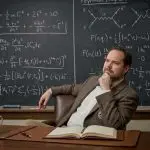
Anton Zeilinger is the Austrian physicist who shared the 2022 Nobel Prize in Physics for experiments that pinned down the strange behavior of entangled photons. Born in 1945 in Ried im Innkreis, he spent his career at the University of Vienna and went on to found the Institute for Quantum Optics and Quantum Information, known as IQOQI Vienna, under the Austrian Academy of Sciences. His name is attached to some of the most quoted experiments in modern physics.
What sets Zeilinger apart is the way he treated entanglement as something to engineer rather than merely to admire. He and his collaborators repeatedly built tabletop setups that turned abstract predictions into measurable results, then pushed those results across ever larger distances. That instinct, to ask what entanglement could actually do, shaped his entire body of work.
He also helped change how the public understands quantum physics, appearing in lectures and interviews that explained strange ideas in plain language. That combination of laboratory rigor and clear communication is rare, and it gave his discoveries unusual reach. Few physicists of his generation are as closely identified with a single phenomenon as Zeilinger is with entanglement.
From foundations to technology
For much of the twentieth century, the puzzles raised by Albert Einstein, Boris Podolsky, and Nathan Rosen sat in the territory of philosophy and debate. Zeilinger belonged to the generation that dragged those puzzles into the laboratory and asked nature for a verdict. His experiments showed that the predictions of quantum mechanics hold even under demanding tests, and that the resulting correlations can carry information.
Across decades of work, Anton Zeilinger kept circling back to a simple goal, which was to control entangled particles well enough to do something useful with them. He gathered a research group in Vienna that produced result after result on multi-photon states, teleportation, and long-distance links. That group became one of the most influential training grounds in experimental quantum physics, sending its members to lead programs around the world.
From neutron interferometry to entangled photons
Zeilinger’s scientific training began nowhere near photons. He completed his doctorate at the University of Vienna in 1971 under Helmut Rauch, with a thesis on neutron depolarization in a dysprosium single crystal, and spent his early career in Rauch’s group performing neutron-interferometry experiments, including measurements at the Institut Laue-Langevin in Grenoble.
Rauch’s group at the time was among a small number worldwide treating neutron interferometry as a serious platform for testing quantum mechanics directly, rather than only as a spectroscopic tool. Working inside that tradition meant Zeilinger absorbed, early and directly, the idea that foundational quantum questions were not just philosophical debating points but experimentally answerable if the apparatus was built carefully enough.
A Fulbright year with a future Nobel laureate
As a Fulbright fellow in the late 1970s he moved to the Massachusetts Institute of Technology to work with Clifford Shull, who would later share the 1994 Nobel Prize for neutron scattering, studying how neutrons diffract coherently through perfect crystals. He returned to MIT for a further spell as a visiting professor in the early 1980s before his career fully shifted toward the photon experiments that made him famous.
That early grounding in neutron interferometry turns out to matter more than a footnote. Slow neutrons behave as matter waves, and demonstrating their interference requires exactly the kind of careful, loophole-conscious experimental thinking that Zeilinger later brought to entangled photons. The habit of treating a quantum effect as something to build rather than merely calculate was already in place years before he ever worked with light.
The Nobel work on entangled photons
The 2022 Nobel Prize in Physics went jointly to Anton Zeilinger, Alain Aspect, and John Clauser for experiments with entangled photons, establishing the violation of Bell inequalities and pioneering quantum information science. Each laureate attacked a different part of the same question, namely whether quantum correlations are real and whether they can be used. Zeilinger’s contribution sat heavily on the applications side, building tools out of entanglement.
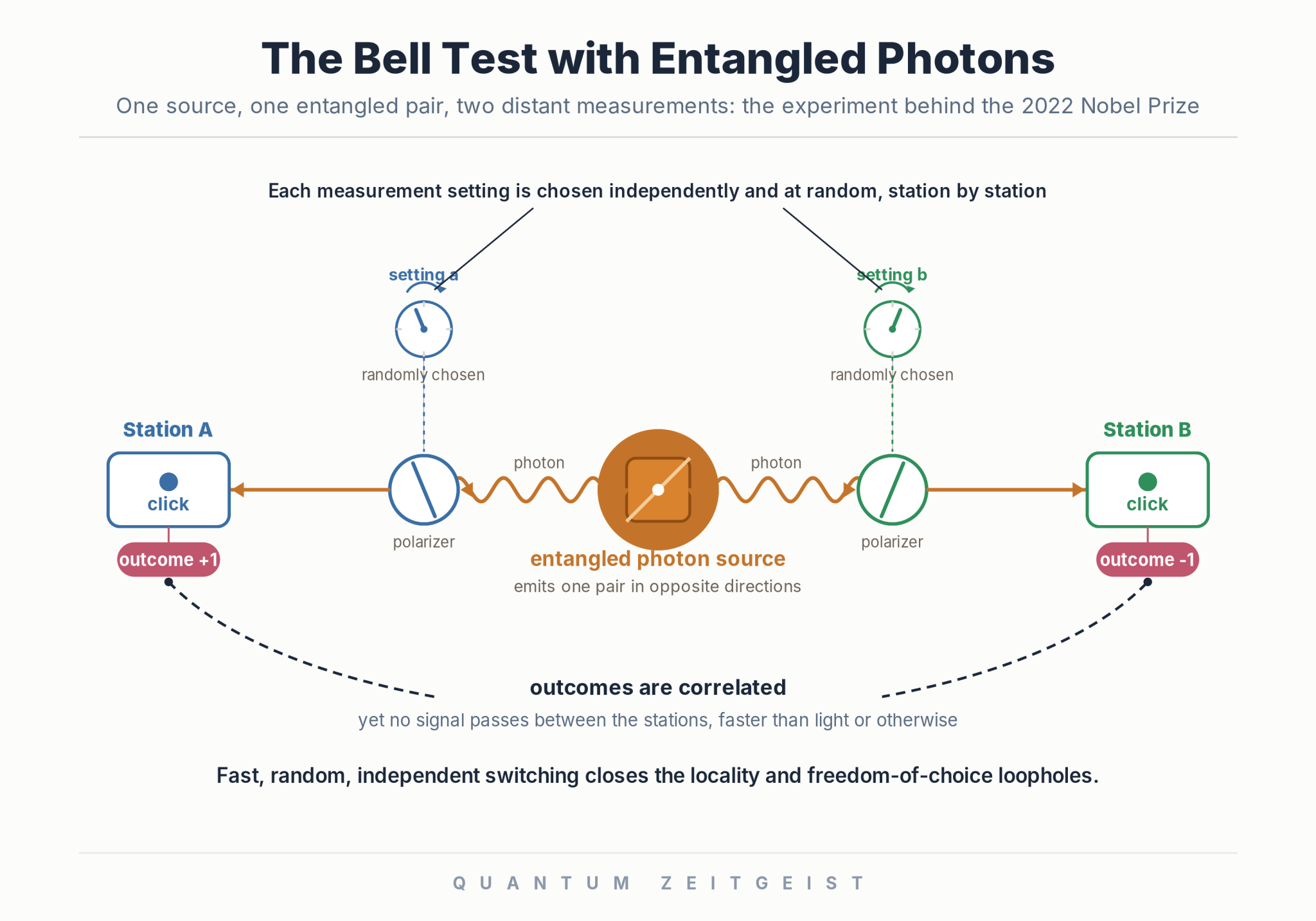
Bell inequalities are a way of asking whether the world could be explained by hidden, local variables instead of genuine quantum nonlocality. When experiments violate those inequalities, they rule out a large class of common-sense explanations. The work of these three physicists closed loophole after loophole until the violation was hard to dispute.
Anton Zeilinger contributed experiments that tackled some of the trickiest loopholes, including those tied to how and when measurement settings are chosen. Closing these gaps required fast, random switching of detectors and careful timing across separated stations. The cumulative effect was to leave very little room for any local hidden-variable account of the results.
Why the prize mattered
The award did more than honor three careers; it signaled that the foundations of quantum mechanics had become a working engineering discipline. Entanglement was no longer a curiosity to be argued about in seminars. It was a resource that could be measured, distributed, and protected, which is exactly the footing that quantum computing and quantum communication now stand on.
Anton Zeilinger had been a favorite to receive the prize for years before it finally arrived in 2022. The delay says something about how patiently the physics community waited for the loopholes to close and the results to harden. By the time the announcement came, the experiments had been reproduced and extended so thoroughly that the science was beyond reasonable doubt.
Quantum teleportation in the laboratory
One of the experiments most associated with Zeilinger is the demonstration of quantum teleportation, in which the exact quantum state of one photon is transferred to another distant photon without the original particle traveling between them. The state is destroyed at the source and rebuilt at the destination using entanglement and a classical message. Zeilinger’s group published one of the first realizations of this idea with photons.

Teleportation here does not move matter, and it does not beat the speed of light, because a classical signal is always required to complete the protocol. What it moves is information encoded in a fragile quantum state. That distinction matters because it makes teleportation a practical building block for moving quantum data between processors and across networks.
Anton Zeilinger treated the first teleportation result as a starting line rather than a finish. The setup required generating entangled pairs, performing a delicate joint measurement, and confirming that the rebuilt state matched the original. Getting all of those steps to work together in one experiment was a serious technical achievement for the late 1990s.
Scaling up the distance
Zeilinger and his collaborators did not stop at a benchtop demonstration. They later teleported quantum states across roughly 143 kilometers between two of the Canary Islands, a free-space link that showed the protocol could survive real atmospheric conditions. Pushing the distance was the point, because a teleportation scheme that only works across a few meters has little value for a future quantum internet.
Each step up in distance brought new engineering problems, from telescope pointing to filtering out background light. The fact that Anton Zeilinger’s teams kept solving them turned teleportation from a single proof of concept into a credible technology path. That is why his name comes up so often when researchers sketch the architecture of a quantum network.
Entanglement swapping and GHZ states
Beyond teleporting single states, Zeilinger’s group was the first to demonstrate entanglement swapping experimentally, in 1998. Entanglement swapping links two particles that have never interacted, by performing a joint measurement on partners they are each entangled with. This is the core trick behind quantum repeaters, which are needed to extend entanglement over long distances.

Zeilinger also helped pioneer multi-particle entanglement. Together with Daniel Greenberger and Michael Horne, he formulated the GHZ argument, which exposes quantum nonlocality in a way that does not require statistical averaging over many runs. A single set of measurements on a GHZ state can contradict any local hidden-variable account.

Why many-photon states matter
Multi-photon entangled states are not just deeper paradoxes; they are the raw material for error correction and for measurement-based quantum computing. Creating and verifying three and four photon entanglement in the lab was a demanding feat at the time. Those techniques became standard tools that other groups now build on routinely.
The GHZ work also reshaped how physicists argued about nonlocality. Instead of relying on inequalities that hold only on average, Zeilinger and his colleagues showed a single configuration where local realism simply fails. That sharper form of the argument has become a staple of textbooks and lecture courses on quantum foundations.
Sending entanglement into space
Perhaps the most public chapter of Zeilinger’s career is the distribution of entanglement over record distances, including through space. In 2017, the Austrian Academy of Sciences under Zeilinger and the Chinese Academy of Sciences, led by his former student Jian-Wei Pan, used the Micius satellite to support a quantum-encrypted video call between Beijing and Vienna, about 7,600 kilometers apart. The satellite orbited about 500 kilometers above Earth and acted as a trusted relay, establishing a separate quantum key with each ground station and then combining them; a companion Micius experiment that same year distributed entangled photons to two ground stations 1,203 kilometers apart.
This was a turning point for quantum key distribution, the method of using quantum states to share encryption keys that cannot be secretly copied. Ground-based fiber links lose photons quickly, so a satellite acts as a relay that covers continental distances. The intercontinental demonstration proved that a global quantum-secured network is a question of engineering, not physics.
The appeal of quantum key distribution is that any attempt to eavesdrop disturbs the quantum states and gives itself away. That property comes directly from the physics Zeilinger spent his career probing. The intercontinental keys themselves were generated with decoy-state quantum key distribution rather than entangled photon pairs, but the same satellite also carried the entanglement experiments that grew directly out of Zeilinger’s Vienna work, showing how foundational research turns into a security tool.
A mentor who multiplied the field
The Micius collaboration also tells a story about Zeilinger as a teacher. Jian-Wei Pan trained in Zeilinger’s research group before returning to China to lead a national quantum program. That lineage, from an Austrian laboratory to a satellite over Asia, shows how a single research school can seed an entire branch of technology.
Long-distance entanglement distribution is now a goal that governments fund as part of national infrastructure. Anton Zeilinger’s early experiments helped establish that such links are physically possible and worth the investment. The ground stations, the satellite, and the encrypted call together formed a public proof that quantum security can cross continents.
The physicist behind the experiments
Zeilinger’s institutional footprint in Austria is as large as his scientific one. He was a professor at the University of Vienna and the founding director of IQOQI Vienna, and he served as president of the Austrian Academy of Sciences from 2013 to 2022. He stepped back from the academy presidency around the time of the Nobel announcement, returning his attention to research.
Anton Zeilinger has long been known for a playful, accessible way of explaining quantum ideas, often reaching for vivid demonstrations rather than dense formalism. That public-facing style helped move quantum entanglement out of specialist journals and into the general conversation. It also drew a generation of students into the field.
An experimentalist at heart
Although his results bear on the deepest questions in the interpretation of quantum mechanics, Zeilinger is foremost an experimentalist. His habit was to ask whether a given quantum effect could be built and tested, and then to build it. That bias toward construction is why so many of his demonstrations became first steps toward usable technology.
Anton Zeilinger has also written and spoken about the philosophical weight of his results, arguing that information sits close to the heart of quantum theory. He has resisted easy slogans, preferring to let careful experiments frame the questions. That balance between bold ideas and rigorous measurement is part of why his work has held up so well.
A Vienna school of quantum science
Beyond Jian-Wei Pan, who went on to lead China’s national quantum-information program, Zeilinger’s research group became a training ground for a wider generation of quantum scientists. Časlav Brukner completed his doctorate under Zeilinger in 1999 and is now a leading theorist on the foundations of quantum mechanics in Vienna, and the two would go on to develop an influential joint interpretation of quantum theory together.
Markus Aspelmeyer, who worked in the group, became a central figure in quantum optomechanics, the study of quantum effects in mechanical, vibrating objects. Markus Arndt, another group member, built a research program on matter-wave interferometry with large molecules, extending the same wave-particle questions Zeilinger explored with photons to objects thousands of times heavier.
Carrying entanglement across continents and orbit
Philip Walther, also trained in the group, now leads photonic quantum-computing research in Vienna, applying entangled-photon techniques to computation rather than only to foundational tests. Rupert Ursin and Thomas Jennewein, two more researchers who came up through Zeilinger’s group, carried its expertise in entanglement distribution into long-distance and satellite-based quantum communication, work that fed directly into the kind of engineering later used on the Micius satellite.
Taken together, these researchers turned a single Austrian laboratory into one of the world’s principal centers for experimental quantum information. It is a rare thing for one research group to seed so many independent, internationally recognized programs, and it reflects a deliberate emphasis Zeilinger placed on giving students real ownership of ambitious, sometimes years-long experiments rather than smaller, safer projects. The group’s influence is also visible in how many of its alumni went on to found their own institutes or lead national-scale programs, rather than simply publishing individually notable papers, a rarer and arguably more consequential form of scientific legacy than any single experiment.
The breadth of these careers is part of the point. Časlav Brukner became a theorist of quantum foundations, Markus Aspelmeyer moved into quantum optomechanics, Markus Arndt into matter-wave interferometry with large molecules, and Philip Walther into photonic quantum computing, while Rupert Ursin and Thomas Jennewein carried entanglement distribution toward satellite links. A single group thus seeded work across theory, optomechanics, matter waves, computing, and communication, rather than cloning one narrow line of research, and that spread is a large part of why the group is remembered as much for the careers it launched as for the papers it published.
A physicist who also writes for everyone
Zeilinger is also a practiced author of popular science. His best-known book for general readers, Dance of the Photons: From Einstein to Quantum Teleportation, appeared in English in 2010, adapted from the German original Einsteins Spuk, published in 2005. Built around the recurring characters Alice and Bob, it walks a general reader from Einstein’s discomfort with entanglement through John Bell’s theorem and its experimental tests to quantum teleportation itself.
The book explains the reasoning behind the experiments rather than only their headline results, an approach consistent with how Zeilinger talks about physics in interviews and public lectures. It followed an earlier German popular work, Einsteins Schleier, published in 2003, which introduced many of the same themes to a general Austrian and German-speaking audience years before the English edition existed.
Explaining strangeness without hiding it
What distinguishes Zeilinger’s popular writing from much science communication is a refusal to soften the genuinely strange parts of quantum mechanics into comfortable analogies. He preferred to walk readers through the actual logic of an experiment, loophole by loophole, trusting a general audience to follow real reasoning rather than a simplified metaphor.
That approach mirrors his laboratory style, where the point was always to test an idea as rigorously as possible rather than to gesture at it. Readers of his books get something close to the same experience his students got in the laboratory, an argument built carefully from evidence rather than asserted from authority.
The two German-language books, Einsteins Schleier from 2003 and Einsteins Spuk from 2005, matter for another reason. They show that Zeilinger was writing seriously for a general audience in his own language for years before the English Dance of the Photons appeared in 2010, so his commitment to public explanation was not a late-career afterthought. The recurring use of the characters Alice and Bob, the standard names for the two parties in a quantum protocol, let him carry a lay reader through the same reasoning his students followed in the laboratory.
Honors long before the Nobel Prize
Zeilinger’s work was widely recognized well before the 2022 Nobel Prize arrived. In 2008 he became the inaugural recipient of the Institute of Physics’ Isaac Newton Medal, awarded for his conceptual and experimental contributions to the foundations of quantum physics, a strong early signal of how the field regarded his work.
He received the King Faisal International Prize in 2005, one of the most prestigious international science awards outside the Nobel system. In 2010 he shared the Wolf Prize in Physics with Alain Aspect and John Clauser, the same trio the Nobel committee would later honor together, for their tests of Bell’s inequalities using entangled quantum states.
A long list of recognition
He is also a member of the order Pour le Mérite for Sciences and Arts, a German honor reserved for a small number of scientists and artists of the highest international standing, along with numerous Austrian state honors reflecting his stature as one of the country’s most decorated scientists. Taken together, the pre-Nobel honors show that the Nobel committee was, in a sense, catching up with a consensus the physics community had already reached. Austria itself has repeatedly honored him as one of its most significant living scientists, a recognition that predates the international attention the Nobel Prize brought and that reflects decades of sustained, high-profile research conducted almost entirely within the country’s own university and academy system.
The pattern across these honors is worth noticing. The Isaac Newton Medal in 2008, the King Faisal International Prize in 2005, and the Wolf Prize in 2010 were each awarded for the same core body of work on entanglement and Bell-inequality tests that the Nobel committee would eventually recognize in 2022, so three of the most respected prize committees in physics had already reached that judgment years earlier.
That the Wolf Prize in 2010 went to Zeilinger alongside Alain Aspect and John Clauser is especially telling. It grouped the same three physicists, for the same tests of Bell’s inequalities using entangled quantum states, a full twelve years before the Nobel Prize honored that exact trio together, so the later Nobel confirmed a consensus rather than creating one.
Information as the core of quantum theory
Beyond running experiments, Zeilinger has argued for decades that information sits at the conceptual core of quantum mechanics itself. With his long-time collaborator Časlav Brukner he developed what is now called the Brukner-Zeilinger information interpretation, set out most fully in his 1999 paper “A Foundational Principle for Quantum Mechanics.”
Its central claim is a principle of the quantization of information, the idea that the most elementary quantum system carries exactly one bit, enough to answer a single yes-or-no question and no more. From that starting point, Zeilinger and Brukner argued that two of quantum theory’s strangest features, the genuinely random outcome of an individual measurement and the existence of entanglement, follow naturally rather than needing to be added as separate postulates.
Not quite Wheeler’s it from bit
Zeilinger has acknowledged the influence of the physicist John Wheeler, whose slogan it from bit proposed that physical reality is ultimately built from information. Zeilinger’s own position is narrower and more operational than Wheeler’s broader program, focused specifically on the information capacity of elementary systems rather than a sweeping claim that the universe is made of information in some literal sense.
The distinction matters, because it is easy to flatten Zeilinger’s view into a slogan it was never meant to be. His point is that what physics can meaningfully say about nature is always expressed as propositions and their truth values, and that this informational limit is written into the mathematical structure of quantum mechanics itself, not that reality is somehow made of bits the way a computer’s memory is.
That framing gives Zeilinger’s experimental career an unusually tight connection to his philosophical one. The same physicist who spent decades measuring exactly how much correlation two entangled photons can carry also spent those decades arguing, in his theoretical writing, that quantum theory’s strangeness follows from strict limits on how much information any single quantum system can hold. Critics of the interpretation have raised their own objections, arguing that recasting quantum postulates in the language of information does not by itself resolve the deeper puzzles of measurement and interpretation, only restates them in new vocabulary. Zeilinger and Brukner have continued to defend and refine the framework in response, treating it as a live research program rather than a finished philosophical position.
It is worth stressing how unusual this combination is. Most experimental physicists of Zeilinger’s stature leave the interpretation of quantum mechanics to specialists in the philosophy of physics, while most of those specialists never build an apparatus. Zeilinger did both across the same career, using the neutron and photon experiments described earlier as the empirical anchor for a genuinely philosophical claim about the role of information.
Zeilinger’s 1999 paper “A Foundational Principle for Quantum Mechanics,” which he wrote alone, is the clearest statement of that ambition. Its argument that a single elementary system carries exactly one bit, and that quantum randomness and entanglement follow from that limit, is offered not as a loose analogy but as a candidate first principle. Whether or not one accepts the interpretation, it shows a physicist trying to derive the theory’s strangest features from a single informational idea rather than accepting them as brute facts.
Why Anton Zeilinger matters in quantum computing
Anton Zeilinger matters to quantum computing because entanglement is the central resource that makes a quantum computer more powerful than a classical one. His experiments transformed entanglement from a debated thought experiment into a measured, controllable quantity. Every quantum algorithm that gains an advantage relies on the correlations that he and his collaborators learned to create and verify.
His work also connects computing and communication, the two strands of a future quantum internet. Teleportation and entanglement swapping are the protocols that will move quantum information between processors and across a quantum internet. Without reliable ways to distribute entanglement, networked quantum machines would remain isolated boxes.
A foundation others build on
The companies and laboratories chasing fault-tolerant machines today inherit a toolkit that Zeilinger helped assemble. Bell tests, multi-photon states, and long-distance links are now routine benchmarks rather than heroic one-off experiments. That shift from spectacle to standard practice is the clearest measure of his lasting influence on the field.
It is fair to say that Anton Zeilinger helped change the question the field asks about entanglement. The debate is no longer whether entanglement is real, since his experiments settled that, but how to scale it for computers and networks. Anyone working on a qubit, a teleportation link, or a quantum repeater is building on the results he and his collaborators established.
Frequently asked questions
Who is Anton Zeilinger?
What did Anton Zeilinger win the Nobel Prize for?
What is quantum teleportation, and how did Zeilinger contribute?
Did Anton Zeilinger really teleport matter?
What is entanglement swapping?
What are GHZ states?
What was the Micius satellite experiment?
How does Zeilinger’s work relate to quantum computing?
What is Anton Zeilinger doing now?
Where did Anton Zeilinger get his PhD?
What did Zeilinger work on before entangled photons?
Who trained in Zeilinger's research group?
What is Dance of the Photons about?
What awards did Zeilinger win before the Nobel Prize?
What is the Brukner-Zeilinger information interpretation?
Is Zeilinger's view the same as Wheeler's it from bit?
Did Zeilinger work with a future Nobel laureate before his own prize?
How far did Zeilinger's team teleport a photon?
What made Zeilinger's Bell test experiments especially rigorous?




See today’s quantum computing news on Quantum Zeitgeist for the latest breakthroughs in qubits, hardware, algorithms, and industry deals.