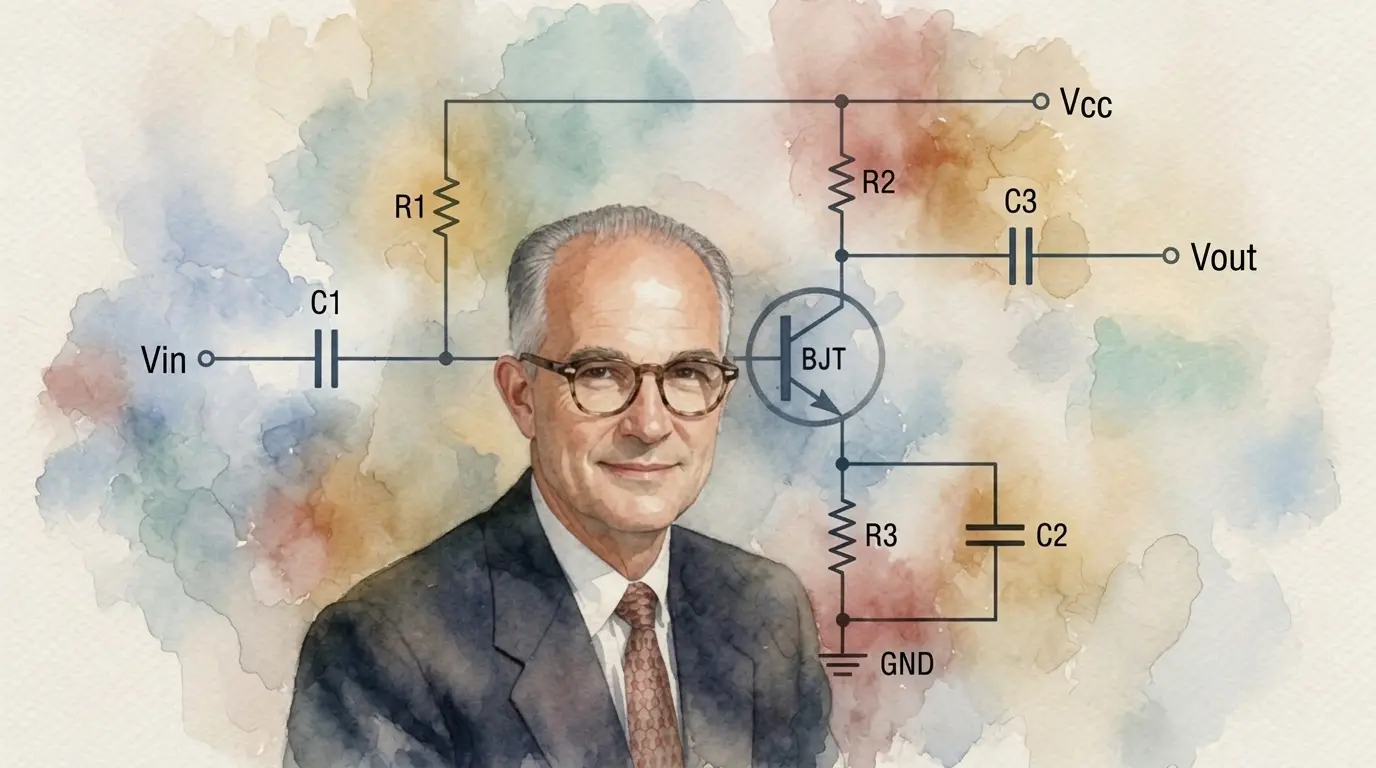
William Shockley shared the invention of the transistor, won a Nobel Prize for it, and started the chain of events that turned a stretch of California orchards into Silicon Valley. The device he helped create is the physical foundation of all modern computing, and understanding it is genuinely part of understanding the hardware being built to run quantum algorithms.
The reason a quantum publication records his work is direct rather than decorative. A transistor is a quantum device, the semiconductor industry it created is the industry that fabricates quantum processors, and in the silicon-qubit approach the qubit and the transistor are near neighbours on the same wafer. The line from Shockley’s junction transistor to a modern quantum machine runs through six decades of engineering, and it is worth tracing.
Shockley co-invented the transistor. He shared the 1956 Nobel Prize with Bardeen and Brattain, and his junction transistor became the commercially dominant design.
The transistor is a quantum device. It works because electrons in a semiconductor obey the same quantum mechanics of electrons in a solid that a silicon qubit is built on, though a qubit goes further and exploits superposition and entanglement that a transistor never uses.
He started Silicon Valley. His company assembled extraordinary talent, and the eight who left it founded Fairchild, from which Intel and the modern semiconductor industry descend.
That industry is the base of quantum hardware. Quantum control electronics and silicon spin qubits are made by the semiconductor industry the transistor created.
He wrote the field’s first textbook. His 1950 book on electrons and holes in semiconductors taught a generation of scientists and engineers the physics of the device.
The precision the industry built is what quantum borrows. The fabrication mastered in the decades of scaling that followed is exactly what a quantum processor needs.
- Who William Shockley was
- The war years and operations research
- Inventing the transistor
- The junction transistor
- The book that taught the field
- Why a transistor is a quantum device
- The Nobel Prize
- Founding Silicon Valley
- The traitorous eight
- The link to quantum hardware
- Moore’s Law and the road to small enough
- What he left behind
- Frequently asked questions
Who William Shockley was
William Shockley, born William Bradford Shockley in London in 1910 to American parents and raised in California, took his doctorate in physics at the Massachusetts Institute of Technology in 1936. He joined Bell Telephone Laboratories, where he led the solid-state physics group that would produce the most consequential electronic invention of the twentieth century.
He was one of the finest applied physicists of his generation, equally at home in deep theory and in the practical problem of turning a physical effect into a manufacturable device. That combination, of the theorist who could also see how a thing would be built, is what made his contribution to the transistor so decisive.

The war years and operations research
Before the transistor, Shockley spent the Second World War applying mathematics to military problems, and this part of his career shows the analytical range he brought to everything. In 1942 he took leave from Bell Labs to become research director of Columbia University’s Anti-Submarine Warfare Operations Group.
The work was operations research, the use of data and statistics to improve real military operations rather than to invent new hardware. Shockley studied convoy tactics, optimised depth-charge patterns against submarines, and later organised a training programme for the radar bombing equipment used by B-29 crews. It was rigorous, quantitative and genuinely useful, and it built the habit of finding the measurable structure in a hard problem that he would soon apply to semiconductors.
Inventing the transistor
In the years after the war, Shockley’s group at Bell Labs was trying to build a solid-state replacement for the fragile, power-hungry vacuum tube. In December 1947 two members of his group, John Bardeen and Walter Brattain, demonstrated the first working transistor, a point-contact device that could amplify an electrical signal.
Shockley’s role in that first demonstration was as the group’s leader rather than a hands-on inventor. His response to it was characteristic of his ability, since instead of disputing credit he went away and, within weeks, worked out a better design from the underlying physics, a device that would prove far more practical than the original.
The junction transistor
In early 1948 Shockley conceived the junction transistor, also called the bipolar junction transistor, a design built on a sandwich of differently doped semiconductor layers rather than delicate metal points. He worked out its theory in detail and it proved far more robust and manufacturable than the point-contact original.
This is the device that mattered commercially. The junction transistor and its descendants became the dominant form of the technology and the building block of essentially all electronics that followed. Shockley also wrote the standard theoretical account of how these semiconductor junctions behave, work that remains foundational to device physics, so his contribution was both the specific invention and the theory that let others build on it.
The book that taught the field
In 1950 William Shockley published Electrons and Holes in Semiconductors, a textbook that became the standard work for a generation of scientists and engineers entering the new field. For years it was the definitive account of how semiconductors behave and how transistors work, and it trained many of the people who would build the industry.
The book shows the depth of the contribution. Shockley did not simply have one good idea for a device, he developed and then taught the underlying quantum theory of semiconductor junctions with enough clarity that others could extend it. That combination of a foundational invention and the theory that made it teachable is what secures his place in the history of the technology.
Why a transistor is a quantum device
The reason a quantum publication takes Shockley’s science seriously is that a transistor is not a classical object at all. It works because electrons in a semiconductor occupy quantum energy bands separated by a gap, and whether current flows depends on quantum rules that have no classical explanation. That is the same quantum mechanics of electrons in a solid that a silicon qubit rests on, though a qubit goes further still, using superposition and entanglement that a transistor never touches.
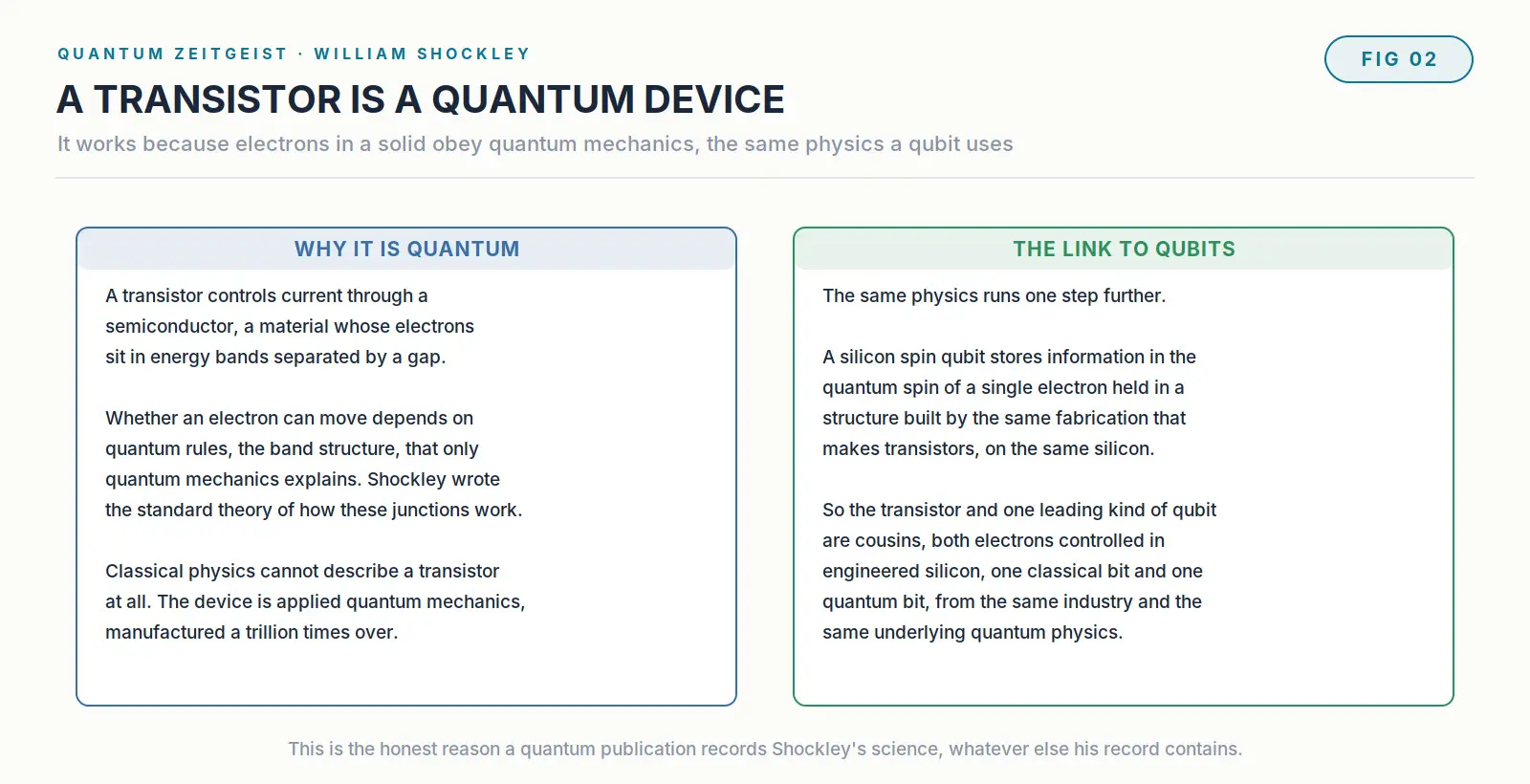
Shockley’s theory of the junction is applied quantum mechanics, and the transistor, specifically the later MOS transistor, is widely regarded as the most manufactured artifact in history. Classical physics cannot describe how a transistor switches, which means the entire digital world already runs on quantum mechanics, quietly, in every phone and processor.
That fact is the honest bridge to quantum computing. The field is not introducing quantum physics into computing for the first time, since computing has been quantum at the device level since the transistor itself. What changes with a quantum computer is that the quantum behaviour is used to represent and process information directly, rather than being used only to build a reliable classical switch.
The Nobel Prize
In 1956 William Shockley, Bardeen and Brattain shared the Nobel Prize in Physics for their researches on semiconductors and their discovery of the transistor effect. It was a deserved recognition of work that would reshape the world.
The prize confirmed the genuine importance of the science, and it marked the transistor as one of the pivotal inventions of the century. Within a few years the device would move from laboratory curiosity to the basis of a global industry, and Shockley would play a direct part in taking it there.
Founding Silicon Valley
In 1956 William Shockley left Bell Labs and founded Shockley Semiconductor Laboratory in Mountain View, California, one of the first companies focused on silicon semiconductor devices in what was then a region of orchards. He recruited a group of exceptionally talented young scientists and engineers, and by the measure of raw talent assembled, the venture gathered much of the future leadership of the industry in one building.
The choice of location and the concentration of ability were decisive for what followed. Shockley brought the silicon transistor to a particular corner of California and drew brilliant people to it, and the region he seeded would become the global centre of the industry.
The traitorous eight
In 1957, eight of Shockley’s recruits resigned together, the group that became known as the traitorous eight. They founded Fairchild Semiconductor, which became one of the most important companies in the history of technology.
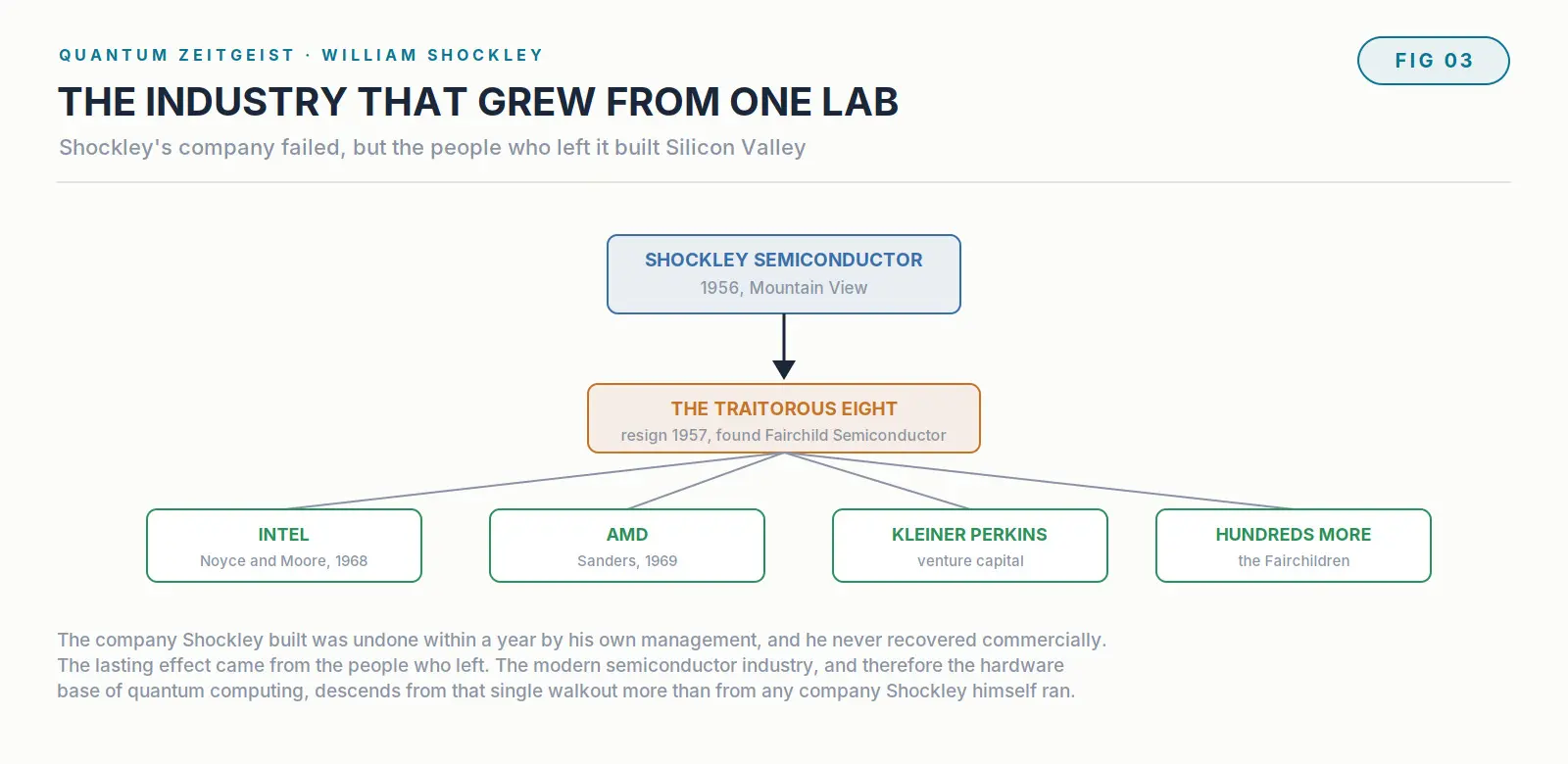
The consequences are hard to overstate. Two of the eight, Robert Noyce and Gordon Moore, went on to found Intel in 1968, and the wider group and their proteges seeded so many companies that the region’s firms are still called the Fairchildren. The structure of Silicon Valley, its companies, its venture capital and its culture of technical people leaving to start rivals, traces to that walkout from Shockley’s lab.
The line of descent is exact. Shockley gathered the talent and brought the silicon transistor west, and the industry that grew from his recruits became the manufacturing base of all modern computing.
The link to quantum hardware
That industry is the physical foundation of quantum computing, which is the reason this history belongs on a quantum site. A quantum computer is not built from exotic materials alone. Its control electronics, its cryogenic wiring and its measurement chains are semiconductor products, made by the industry the transistor created.
In one leading approach the connection is even closer. A silicon spin qubit stores quantum information in the spin of a single electron, held in a structure fabricated by the same processes that make transistors, on the same silicon wafers. In that architecture the qubit and the transistor are near neighbours, both electrons controlled in engineered silicon, differing in whether they hold a classical or a quantum bit.
So the line from Shockley’s junction transistor to a modern quantum processor is direct rather than metaphorical. The companies building quantum hardware depend on the semiconductor supply chain at every step, and that supply chain exists because of the device he helped invent and the industry his recruits founded.
Moore’s Law and the road to small enough
One of the traitorous eight, Gordon Moore, made an observation at Fairchild in 1965 that became known as Moore’s Law. His original figure was a doubling of the number of components on a chip roughly every year, which he revised in 1975 to about every two years, and that version held for decades and drove the relentless shrinking of the transistor from tens of micrometres to a few nanometres.
That shrinking is what eventually made quantum hardware feasible to build. The control electronics a quantum computer needs, the precise fabrication of qubit structures, and the ability to place and wire millions of components all depend on a semiconductor industry that spent sixty years learning to work at ever smaller scales. A silicon spin qubit is only possible because the industry can now pattern silicon down to features only a few nanometres wide, on the order of tens of atoms across.
So the line from Shockley runs through Moore and the whole scaling story. The transistor started it, his recruits industrialised it, and the precision the industry reached in chasing Moore’s Law is the same precision quantum hardware now borrows.
What he left behind
William Shockley’s legacy is a device and an industry. The transistor is the foundational component of all modern electronics, and in its MOS form it is widely regarded as the most manufactured artifact ever made, while the theory Shockley wrote to explain the junction device remains part of how the field is taught. He also brought the silicon transistor to California and gathered the people who would build the industry around it.
For quantum computing that inheritance is concrete rather than symbolic. The field’s hardware genuinely descends from his work, from the control chips that run a quantum processor to the silicon on which some qubits are built. The semiconductor industry that began with his junction transistor is the same industry that fabricates quantum machines today, which is why an account of where quantum hardware comes from has to begin with the transistor he helped invent.
Frequently asked questions
Who was William Shockley?
William Shockley was an American physicist, born in 1910 and died in 1989, who shared the 1956 Nobel Prize in Physics for co-inventing the transistor. He devised the junction transistor, wrote the field’s first textbook, and founded Shockley Semiconductor Laboratory, which indirectly started Silicon Valley.
Did Shockley invent the transistor alone?
No. The first transistor, a point-contact device, was demonstrated in December 1947 by John Bardeen and Walter Brattain, who worked in the group Shockley led. Shockley then invented the more durable junction transistor in early 1948, and the three shared the 1956 Nobel Prize together.
Why is the transistor relevant to quantum computing?
A transistor is itself a quantum device, working because electrons in a semiconductor obey quantum mechanics. More directly, the semiconductor industry the transistor created makes the control electronics for quantum computers, and one leading qubit design, the silicon spin qubit, is fabricated by the same processes that make transistors.
How did Shockley start Silicon Valley?
In 1956 he founded Shockley Semiconductor Laboratory in Mountain View, California, recruiting outstanding young scientists. Eight of them resigned in 1957 and founded Fairchild Semiconductor, from which Intel and much of the modern semiconductor industry descend, making Shockley the origin of Silicon Valley.
What is the junction transistor?
The junction transistor, or bipolar junction transistor, is the design Shockley conceived in 1948, built from a sandwich of differently doped semiconductor layers rather than delicate metal contacts. It was far more robust and manufacturable than the first point-contact transistor and became the dominant form of the technology.
What is the traitorous eight?
It is the name by which the eight employees who resigned from Shockley’s company in 1957 to found Fairchild Semiconductor became known. Two of them, Robert Noyce and Gordon Moore, later founded Intel, and the group’s wider influence seeded much of Silicon Valley.
Did Shockley write a textbook?
Yes. His 1950 book Electrons and Holes in Semiconductors was the standard text of the new field for years, teaching a generation of scientists and engineers the quantum physics of the transistor and the theory of semiconductor junctions.
Is a transistor really a quantum device?
Yes. A transistor controls current through a semiconductor whose electrons occupy quantum energy bands, and its operation cannot be explained by classical physics. In that sense modern computing has run on applied quantum mechanics since the transistor’s invention, which a quantum computer extends by using quantum behaviour to process information directly.



See today’s quantum computing news on Quantum Zeitgeist for the latest breakthroughs in qubits, hardware, algorithms, and industry deals.