Gordon Moore co-founded Intel and, almost as an aside, made the most famous forecast in the history of technology. In 1965 he observed that the number of transistors on a chip was doubling at a steady pace and predicted it would keep doing so, a pattern that became known as Moore’s Law and that held for close to sixty years.
That law is the reason a quantum computer can be built at all. The relentless shrinking it drove forced the semiconductor industry to learn how to pattern silicon at the scale of a few atoms, and that manufacturing precision is exactly what quantum hardware now borrows. Moore’s own question, how a real trend should be read, also supplies the sharpest tool for judging the qubit-count roadmaps the quantum industry now publishes.
Moore co-founded Intel. With Robert Noyce he started the company in 1968, having earlier been one of the eight who left Shockley to found Fairchild Semiconductor.
Moore’s Law is a forecast, not a law of nature. He observed transistor counts doubling and predicted the trend would continue, and it became the planning clock of the entire industry.
The doubling ran for nearly sixty years. Chips went from thousands of transistors in 1971 to tens of billions today, a straight line on a logarithmic chart.
It built the precision quantum hardware needs. Chasing the trend forced the industry to pattern silicon at the atomic scale, which is what fabricates quantum control chips and silicon qubits.
Quantum has no true Moore’s Law. Qubit counts are rising, but a qubit has a quality as well as a count, and raw numbers are the wrong measure of progress.
He was a chemist, not an electronics engineer. His training was in chemistry, and his contribution was as much about manufacturing and management as about physics.
- Who Gordon Moore was
- From Shockley to Fairchild
- The 1965 observation
- What the paper actually said
- A straight line on a log scale
- Founding Intel
- A forecast that made itself true
- Why it matters for quantum hardware
- Does quantum have a Moore’s Law?
- The metric that actually counts
- The end of the classical law
- What he left behind
- Frequently asked questions
Who Gordon Moore was
Gordon Moore, born Gordon Earle Moore in San Francisco in 1929, and died in 2023. He trained as a chemist, taking a doctorate in chemistry and physics at Caltech in 1954, and that background matters, because his great contribution was less a piece of physics than a deep understanding of how semiconductor manufacturing would improve over time.
He is remembered for two things above all, co-founding Intel, the company that came to define the microprocessor era, and formulating Moore’s Law, the observation about transistor scaling that guided the industry for two generations. Both grew out of the same lineage that began, awkwardly, in the laboratory of William Shockley.

From Shockley to Fairchild
Moore’s career began in the venture that accidentally created Silicon Valley. In 1956 he joined William Shockley’s semiconductor laboratory, recruited alongside a group of exceptional young scientists, but Shockley’s management drove the group away within a year.
In 1957 Moore was one of the eight who resigned together, the group Shockley bitterly called the traitorous eight, and co-founded Fairchild Semiconductor. Fairchild became one of the most important companies in the history of technology, and it was there, as head of research and development, that Moore made the observation that carries his name.
The 1965 observation
In 1965 the magazine Electronics asked Gordon Moore to predict the future of semiconductor components, and his answer, an article titled Cramming More Components onto Integrated Circuits, became famous. Looking at the few years of data then available, he noticed that the number of components that could be packed onto a chip had been doubling at a regular interval, and he projected that the doubling would continue for at least a decade.
It was a bold extrapolation from very little data, and it proved remarkably accurate. In 1975 he revised the pace to a doubling roughly every two years, and that version became the benchmark. The name Moore’s Law was coined by others, and Moore was always careful that it was an observation and a projection rather than a law of physics.
What the original paper actually said
The 1965 article is worth reading because its argument was economic as much as technical. Moore was not simply noting that chips were getting denser, he was making the case that there is a most cost-effective number of components to put on a chip at any given time, and that this optimum was rising exponentially as manufacturing improved.
That framing is easy to lose behind the slogan. Moore’s Law was, at root, a statement about the falling cost of complexity, not a mystical doubling, and its real content was that computing power would get dramatically cheaper year after year. Keeping that in view helps when reading quantum roadmaps, since the honest question there is not only how many qubits a machine has but what a unit of reliable quantum computation will cost, and whether that cost is falling.
A straight line on a log scale
The reason Moore’s Law is drawn the way it is repays a moment’s attention, because the same picture is now used, and misused, for quantum computing. Plotted on an ordinary chart, exponential growth curves upward so steeply it becomes unreadable, so transistor counts are shown on a logarithmic scale, where each step up the axis multiplies rather than adds.
On that scale, steady doubling becomes a straight line, and Moore’s Law is famously straight. From roughly two thousand transistors on the first microprocessor in 1971 to tens of billions on a modern chip, the trend holds its line across more than seven orders of magnitude. That straightness is what made the law so powerful as a planning tool, since a straight line is easy to extend into the future with confidence.
Founding Intel
In 1968 Gordon Moore and Robert Noyce left Fairchild to found their own company, which became Intel. Moore served as its chief executive and later chairman, and Intel went on to build the microprocessors that powered the personal computer revolution and much of the internet age.
Under Moore’s leadership the company organised itself around his law, treating the two-year doubling not as a passive prediction but as a target to be hit deliberately. That decision, to run a company by a self-imposed exponential schedule, is one of the more remarkable acts of industrial planning in modern history, and it is a large part of why the trend held for so long.
A forecast that made itself true
Moore’s Law occupies an unusual position between description and instruction, and understanding this is essential to reading its quantum imitators correctly. It began as a description of what had happened, but once the whole industry adopted it as a roadmap, it became a self-fulfilling prophecy.
Chip makers, equipment suppliers and software developers all planned on the assumption that the doubling would continue, invested to make sure it did, and coordinated their timetables around it. The law held partly because it was true and partly because everyone agreed to make it true, which is a very different thing from a law of nature that holds whether or not anyone believes it.
That distinction is the one to carry into quantum computing. A published roadmap of future qubit counts is a target that a company intends to hit, not a discovered regularity of the universe, and it should be read as a statement of intent rather than a guarantee.
Why it matters for quantum hardware
The deepest connection between Moore and quantum computing is not the law itself but what chasing it built. To keep doubling, the semiconductor industry had to shrink its features from around ten micrometres in 1971 to a few nanometres today, learning to pattern silicon at nearly the scale of individual atoms, reliably and billions of times per chip.
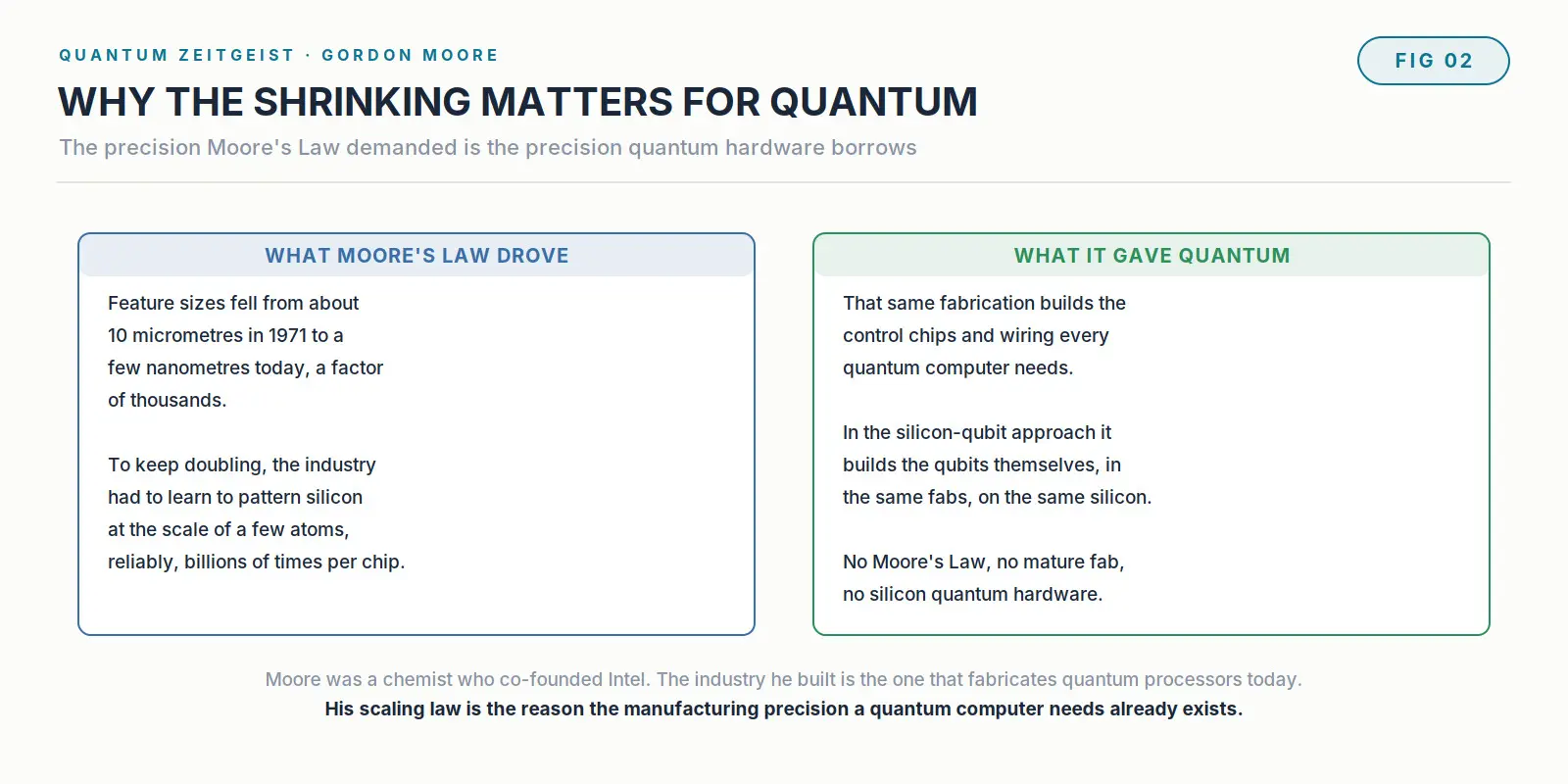
That precision is what quantum hardware now depends on. The control electronics, the cryogenic wiring and the fabrication of qubit structures all rely on a semiconductor industry that spent sixty years learning to work at ever smaller scales. In the silicon spin qubit approach the connection is direct, since the qubits are fabricated in the same fabs, on the same silicon, by the same processes that make transistors.
So Moore’s Law is upstream of quantum computing in a concrete way. Without the manufacturing capability it drove, the precision a quantum processor needs would not exist, and several leading quantum hardware efforts would have no foundry to build on.
Does quantum have a Moore’s Law?
The obvious question, once you see the transistor curve, is whether quantum computing has its own version, and the honest answer is no, not in any meaningful sense. The comparison is tempting and mostly misleading.
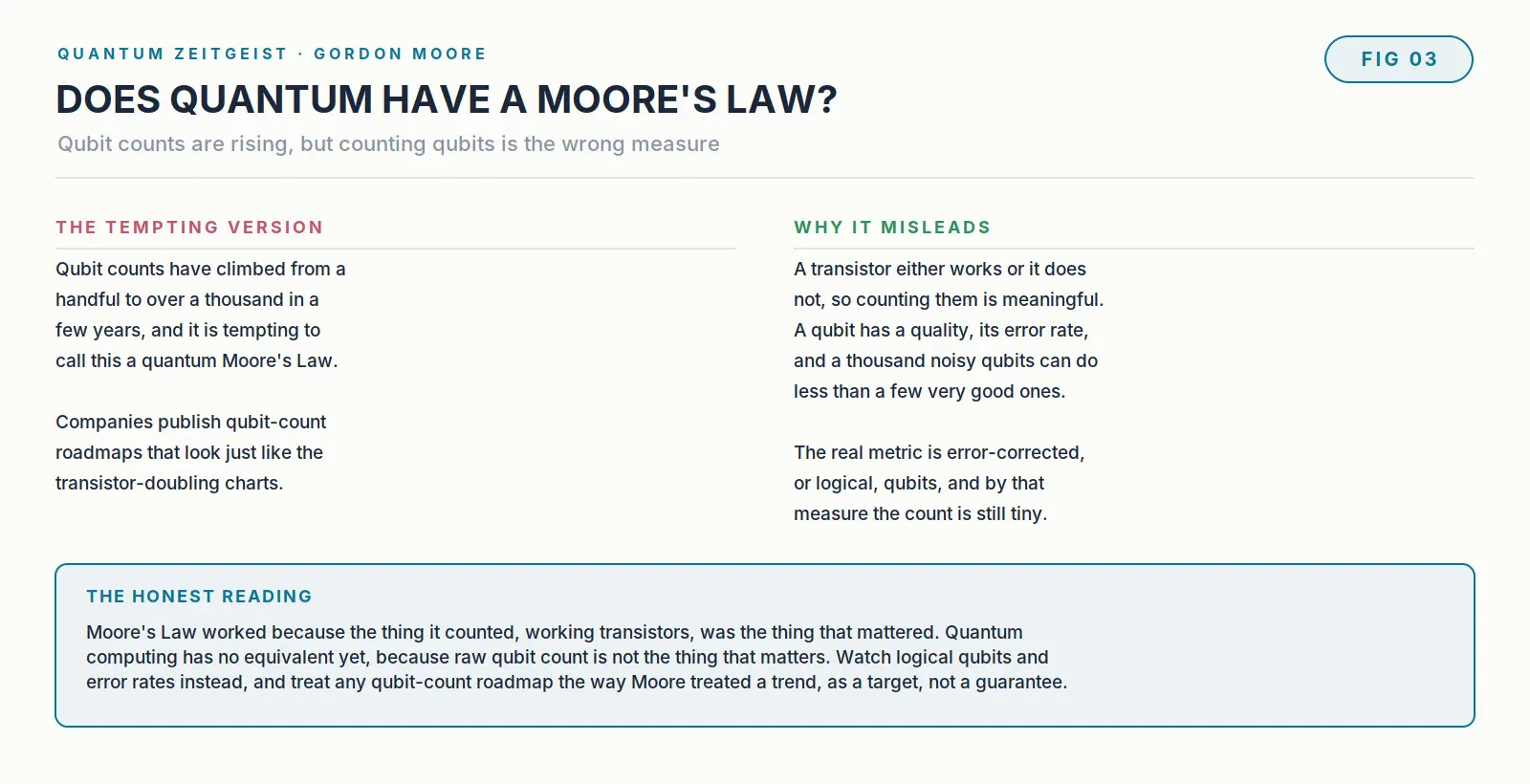
Qubit counts have indeed climbed quickly, from a handful to over a thousand in a few years, and companies publish qubit-count roadmaps that look just like the transistor charts. The problem is that the analogy breaks at the most important point. A transistor either works or it does not, so counting working transistors measures something real. A qubit has a quality as well as a count, expressed as its error rate, and a thousand noisy qubits can accomplish less than a few very good ones.
The metric that actually counts
The measure that matters for quantum computing is not raw qubits but error-corrected, or logical, qubits, and by that measure the numbers are still tiny. It can take hundreds or thousands of physical qubits to build one reliable logical qubit through quantum error correction, so a headline count of physical qubits can be a poor guide to what a machine can actually compute.
This is why a qubit-count roadmap should be read with Moore’s own caution in mind. Moore’s Law worked as a guide because the thing it counted, working transistors, was the thing that mattered. Quantum computing has no equivalent yet, because raw qubit count is not the thing that matters, and progress is better tracked by watching logical qubit numbers and error rates than by watching the physical count climb.
The useful lesson from Moore is therefore double. Exponential trends are real and can run for a long time, and a trend is only meaningful if it counts the right quantity. Applied to quantum computing, that means taking the progress seriously while refusing to be impressed by the wrong number.
The end of the classical law
Moore’s Law in its original form has slowed, and this too is instructive. As features approached the size of a few atoms, the physics of making them smaller became harder and more expensive, and the steady two-year doubling of the past no longer holds as cleanly. The industry now advances through other means, including stacking chips and specialising them, rather than simple shrinking.
That an exponential trend eventually met physical limits is a reminder that no such trend runs forever, quantum roadmaps included. Moore’s Law lasted an extraordinarily long time because a whole industry organised itself to sustain it, but even that coordination could not repeal physics indefinitely. Any projection of quantum progress deserves the same scepticism about where its physical limits lie.
What he left behind
Gordon Moore’s legacy is partly a company and partly a way of thinking about technological progress. Intel shaped the computing world for decades, and Moore’s Law gave the whole industry a shared clock, an agreed rate of improvement that coordinated an enormous, decentralised effort.
For quantum computing his deepest bequest is the manufacturing base his industry built, without which the field would have no hardware to speak of. His subtler bequest is a lesson in how to read a trend, with the discipline to ask whether an exponential curve is counting something that matters, which is precisely the question the quantum industry’s own roadmaps demand. Moore was a careful forecaster, and careful forecasting is exactly what assessing quantum computing requires.
Frequently asked questions
Who was Gordon Moore?
Gordon Moore was an American chemist and businessman, born in 1929 and died in 2023, who co-founded Intel and formulated Moore’s Law. He was one of the traitorous eight who left Shockley Semiconductor to found Fairchild Semiconductor, and he later led Intel as chief executive and chairman.
What is Moore’s Law?
Moore’s Law is the observation, made by Gordon Moore in 1965 and revised in 1975, that the number of transistors on a chip doubles roughly every two years. It is a forecast and an industry target rather than a law of physics, and it held for close to sixty years.
Is Moore’s Law a real law of nature?
No. It is an empirical observation and a projection that became a planning target for the semiconductor industry. It held partly because it was accurate and partly because the whole industry organised itself to make it come true, which is why it is best described as a self-fulfilling forecast.
How is Moore’s Law connected to quantum computing?
Through manufacturing. Chasing Moore’s Law forced the semiconductor industry to learn to pattern silicon at the atomic scale, and that precision is what fabricates the control electronics and, in the silicon-qubit approach, the qubits themselves for quantum computers.
Does quantum computing have a Moore’s Law?
Not in any meaningful sense. Qubit counts are rising quickly, but a qubit has a quality, its error rate, as well as a count, and a thousand noisy qubits can do less than a few good ones. The real measure is error-corrected logical qubits, by which the numbers are still very small.
Why is counting qubits misleading?
Because a transistor either works or not, so counting them is meaningful, whereas a qubit’s usefulness depends on its error rate. Building one reliable logical qubit can take hundreds or thousands of physical qubits, so a large physical qubit count does not necessarily mean a more capable machine.
Did Gordon Moore found Intel?
Yes, with Robert Noyce in 1968. Both had previously been at Fairchild Semiconductor, which they had co-founded after leaving Shockley Semiconductor. Moore served as Intel’s chief executive and later its chairman.
Has Moore’s Law ended?
Its original form has slowed substantially, because shrinking transistors further has run into physical and economic limits. The industry now improves performance through other means such as stacking and specialising chips, a reminder that no exponential trend continues indefinitely.




See today’s quantum computing news on Quantum Zeitgeist for the latest breakthroughs in qubits, hardware, algorithms, and industry deals.