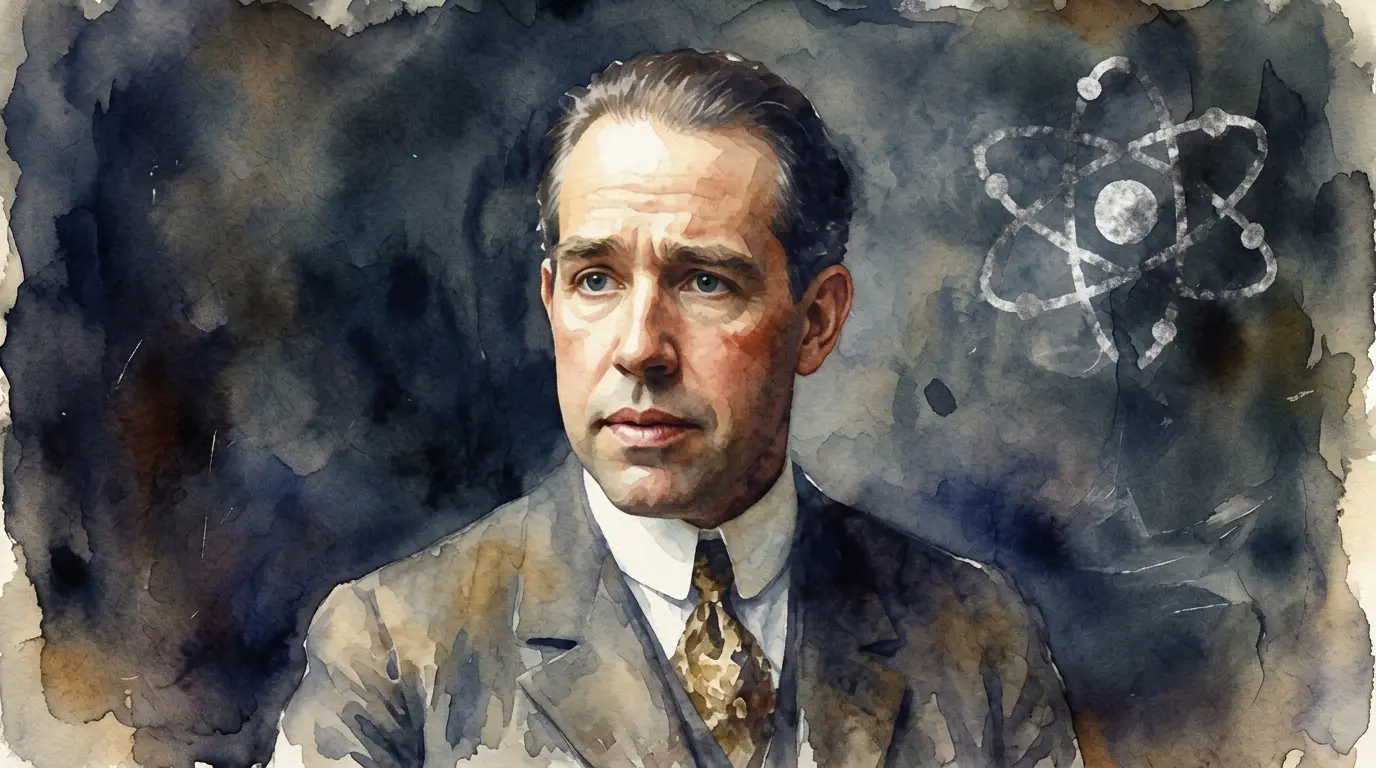
The Danish physicist who gave the atom its quantum structure, won the 1922 Nobel Prize, and built the Copenhagen school that still shapes how we read the quantum world.
The architect of the quantum atom
Niels Bohr is the Danish theoretical physicist who, more than any single figure, gave the atom its quantum character. Working in Copenhagen in the early twentieth century, he took the puzzling experimental facts about how atoms absorb and emit light and turned them into a precise, testable picture of matter.
Before Bohr, the atom was an unstable curiosity that classical physics could not explain, since orbiting electrons should have spiralled into the nucleus in an instant. His insight was that the rules at atomic scale are simply not classical, and that energy comes in discrete quantum steps rather than a smooth flow.
That move, treating the atom as a quantum object with allowed states and forbidden ones, opened the door to all of modern atomic physics. It is the reason his name sits beside Planck, Einstein, and Heisenberg among the founders of the quantum era.
The Bohr model and the old quantum theory
In 1913 Niels Bohr published the model that bears his name, describing the hydrogen atom as a nucleus surrounded by electrons confined to fixed orbits. Electrons could jump between these orbits by absorbing or releasing a precise quantum of energy, and nothing in between was permitted.
Quantised orbits explain the spectrum
The model’s triumph was that it reproduced the observed spectral lines of hydrogen with startling accuracy. Each line corresponded to an electron falling from one allowed orbit to another, emitting light of an exact, predictable colour.
This was the first time anyone had derived the fine detail of an atomic spectrum from first principles. It convinced a sceptical generation of physicists that the quantum hypothesis was not a mathematical trick but a description of how nature actually behaves.
The correspondence principle
Bohr also gave physics the correspondence principle, the requirement that quantum predictions blend smoothly into classical ones when systems grow large. It acted as a compass during the confusing years before quantum mechanics was put on a firm footing.
That principle guided the young theorists who would soon build the full theory, and it remains a sanity check that any quantum framework must pass. The bridge it drew between the small and the everyday was one of his most durable contributions.
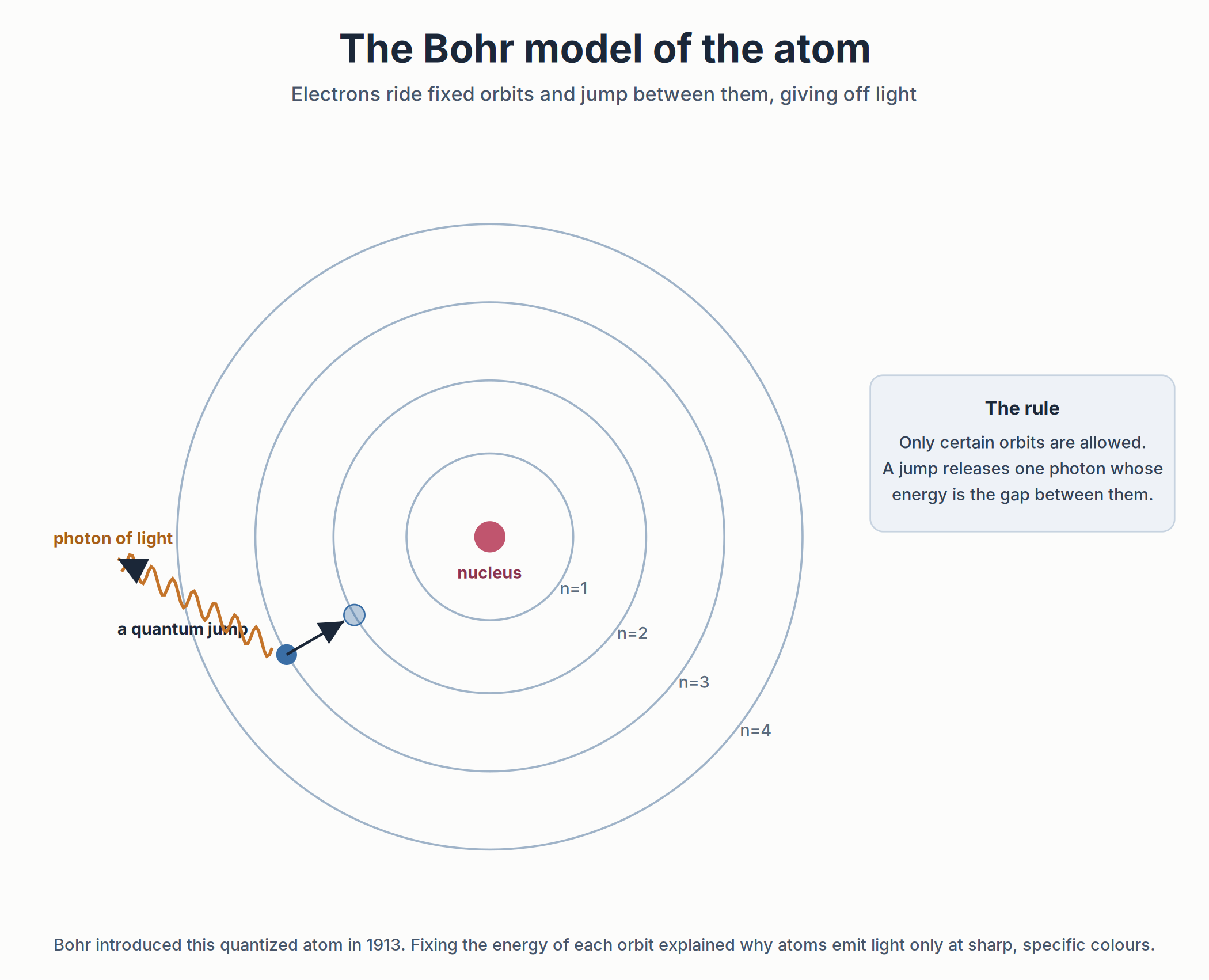
This picture of discrete energy levels is not a museum piece. A modern qubit stores its information in two of the sharp energy states that Bohr first insisted upon, the pair usually labelled zero and one, and a controlled jump between them is how the machine is driven. Superconducting and trapped-ion processors alike are, at bottom, engineered Bohr atoms whose quantum jumps are choreographed rather than left to chance.
The Copenhagen interpretation
When the mature quantum mechanics arrived in the mid 1920s, it worked beautifully but raised hard questions about what it actually meant. Bohr, together with Werner Heisenberg and others, shaped the answer that became known as the Copenhagen interpretation.
Complementarity
At its heart was Bohr’s principle of complementarity, the idea that a quantum object can display mutually exclusive properties, such as wave-like and particle-like behaviour, depending on how you choose to observe it. No single experiment reveals both at once, yet both are needed for a complete account.
Complementarity reframed apparent paradoxes as features of measurement rather than contradictions in nature. It told physicists that the question they ask of a quantum system partly determines the answer they receive.
The role of measurement
The Copenhagen view placed the act of measurement at the centre of quantum theory, treating the transition from a spread of possibilities to a single outcome as fundamental. That emphasis remains controversial, and rival interpretations still argue with it today.
Whatever one makes of the philosophy, the practical recipe Bohr helped codify is the one working physicists have used for a century. It is the default language in which quantum results are still reported and understood.

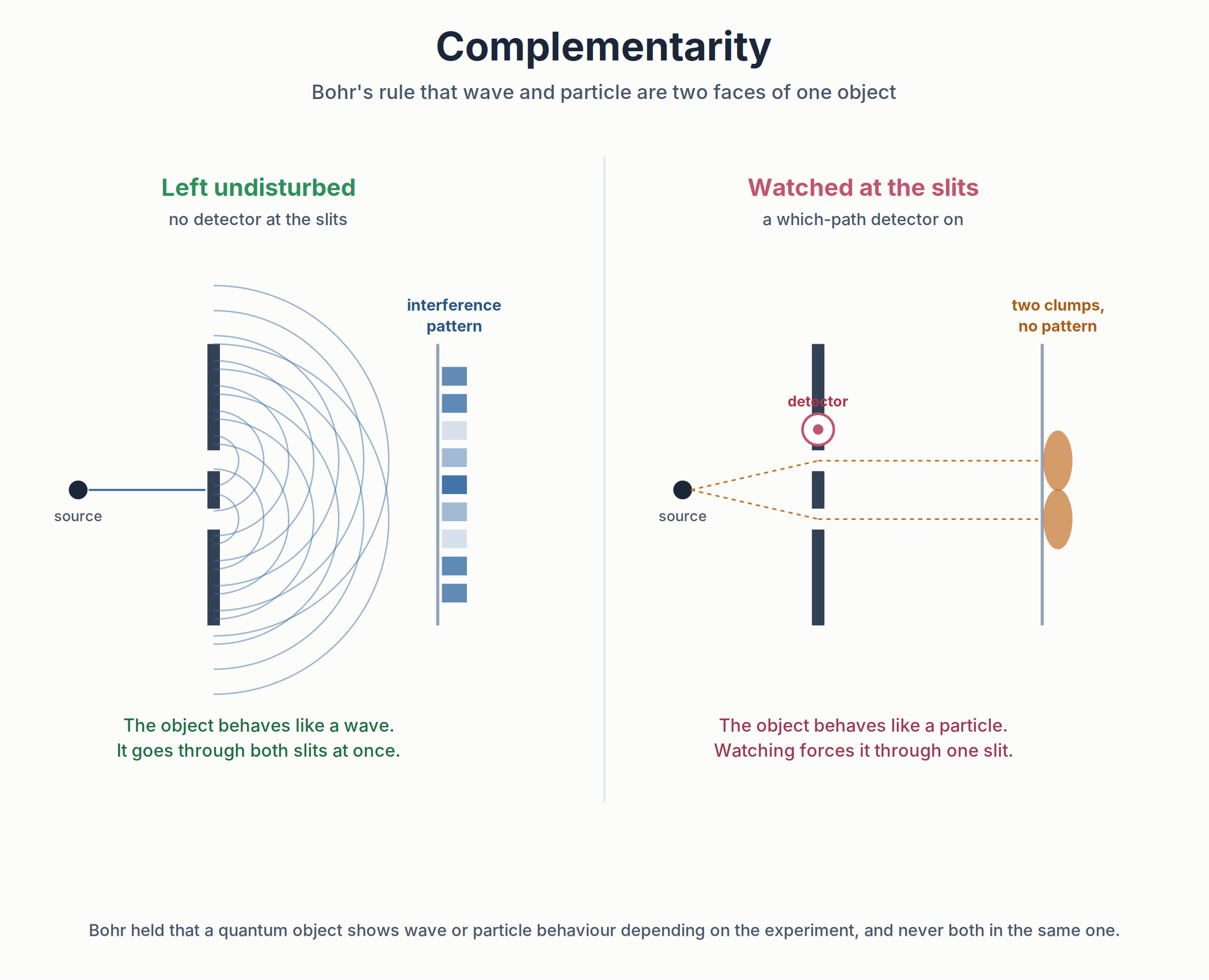
Bohr prized the idea so highly that he built his public life around it. When Denmark made him a knight of the Order of the Elephant in 1947, he designed his own coat of arms around the Chinese yin and yang symbol and the Latin motto Contraria sunt complementa, meaning opposites are complementary. It was a scientist declaring, in the language of heraldry, that contradiction could be a feature of nature rather than a fault in our understanding.
The Bohr Einstein debates
Few intellectual contests in science match the long exchange between Niels Bohr and Albert Einstein over the meaning of quantum mechanics. Einstein could not accept that nature was irreducibly probabilistic, while Bohr defended the new theory as complete on its own terms.
Their debates, staged at the Solvay conferences and continued in print, sharpened the questions that physicists still ask about reality and information. The sharpest round came in 1935, when Einstein, with Boris Podolsky and Nathan Rosen, argued that the theory had to be incomplete because it seemed to permit what Einstein called spooky action at a distance. Erwin Schrödinger, replying to the same paper, gave the effect its lasting name, entanglement, the very resource that quantum computers and quantum networks now run on. Einstein devised ingenious thought experiments to expose flaws, and Bohr answered each in turn, often deepening the theory in the process.
The argument was never settled to both men’s satisfaction, and in a sense it continues in modern work on entanglement and quantum foundations. That this dispute between two friends still echoes is a measure of how profound the stakes were.
The institute and the Copenhagen school
In 1921 Niels Bohr founded the Institute for Theoretical Physics at the University of Copenhagen, now known as the Niels Bohr Institute. It became the beating heart of quantum physics between the world wars, drawing the brightest young theorists from across Europe.
Heisenberg, Pauli, Dirac, Gamow, and many others passed through its rooms, and the collaborative, argumentative style Bohr cultivated there became a model for modern physics. He believed that truth in physics was hammered out in conversation, not handed down from above.
The institute also became a refuge, as Bohr helped scientists fleeing persecution in the 1930s find safety and work. His leadership made Copenhagen a place where a whole discipline was raised, not merely a laboratory where results were produced.
A style of doing physics
What Bohr built in Copenhagen was as much a culture as an institution, founded on relentless discussion and the testing of every idea against its sharpest objection. Visitors recalled long walks and longer arguments in which no claim survived unless it could withstand scrutiny.
That collaborative method spread outward as his students took up posts across the world. The way physics is now done, in groups that argue toward consensus, owes a real debt to the habits he established.
Bohr, the bomb, and an open world
In 1943 Niels Bohr escaped Nazi-occupied Denmark, crossing first to Sweden and then to Britain on a dramatic flight that nearly cost him his life. He soon joined the Allied atomic effort, working under a cover name as an adviser to the project that would produce the first nuclear weapons.
Bohr saw sooner than most that these weapons would reshape world politics, and he argued forcefully for openness between nations to head off an arms race. He met both Roosevelt and Churchill to press the case, though his warnings were largely brushed aside at the time.
After the war he turned that conviction into public advocacy, including a 1950 open letter to the United Nations calling for an open world built on shared knowledge. He believed the same candour that powered science could temper its most dangerous applications.
In 1957 he became the first recipient of the Atoms for Peace Award, recognising this campaign for responsible use of nuclear power. The episode shows a scientist who understood that discovery carries duties beyond the laboratory.
Niels Bohr’s legacy in quantum computing
The questions Bohr pressed about superposition, measurement, and complementarity are exactly the ones that quantum computing now turns into engineering. A qubit lives in a superposition of states until it is measured, and the measurement collapses it to a definite result, just as the Copenhagen view describes.
Quantum computers exploit, rather than resolve, the strangeness that Bohr insisted was real. Their power comes from holding many possibilities at once and steering interference between them, then reading out an answer through the very measurement process he placed at the centre of the theory.
Even the debates he had with Einstein feed directly into the field, because entanglement, the phenomenon at the core of those arguments, is the resource that makes quantum computing and quantum communication possible. The philosophy of the 1920s has become the hardware design of today.
From interpretation to engineering
The discrete energy levels that Bohr first proposed for the atom are the very thing engineers now use to define qubits in many platforms, from trapped ions to superconducting circuits. A quantum bit is, in essence, two of his allowed states pressed into service as the zero and one of computation.
Reading out such a qubit means performing exactly the kind of measurement he placed at the centre of quantum theory, with the same collapse to a definite value. The continuity between his early model and a modern processor is direct rather than merely poetic.
Why Niels Bohr still matters today
Niels Bohr matters because he taught physics how to think about the quantum world, and that way of thinking now underpins a growing industry. Every engineer calibrating a qubit and every student learning what a measurement does is working inside the framework he built.
His insistence that the quantum description is complete, and that measurement is not a flaw but a feature, set the terms of a debate that is still productive a century later. The vocabulary of states, observables, and complementarity that he helped fix remains the common tongue of the field.
As quantum technologies move from laboratories into commerce, Bohr’s legacy is visible in both the science and the culture of the discipline. The collaborative, deeply questioning spirit he modelled in Copenhagen is the one that the modern quantum community still tries to follow.
Frequently asked questions
Who was Niels Bohr?
What is the Bohr model of the atom?
What did Niels Bohr win the Nobel Prize for?
What is the Copenhagen interpretation?
What is complementarity?
Why did Bohr and Einstein disagree?
How does Niels Bohr relate to quantum computing?
What is the Niels Bohr Institute?
Is an element named after Niels Bohr?




See today’s quantum computing news on Quantum Zeitgeist for the latest breakthroughs in qubits, hardware, algorithms, and industry deals.