
The Viennese physicist who gave quantum mechanics its wave equation, named entanglement, and dreamed up the most famous cat in science, while never quite believing what his own equation implied.
Erwin Schrödinger is the rare physicist whose work escaped the laboratory and entered everyday language, because almost everyone has heard of his cat. Behind that famous half-alive, half-dead thought experiment sits one of the most important equations in all of science, the wave equation that bears his name and still governs how physicists calculate the behaviour of atoms and molecules. He gave quantum theory a language of smooth, continuous waves at the very moment the subject seemed destined for abstraction.
This is the story of the man behind both the equation and the cat. It runs from a surprisingly late burst of genius in the 1920s, through his long discomfort with what his own mathematics seemed to imply, to a late book on biology that helped inspire the discovery of the structure of DNA. He was a reluctant revolutionary who never fully accepted the strange world he had helped to reveal.
The making of a late bloomer
Erwin Schrödinger was born in Vienna in 1887, the only child of a cultured and comfortable family, and he grew up fluent in several languages and at ease with philosophy as well as physics. He served as an artillery officer in the First World War before settling into an academic career that, for many years, gave little hint of the breakthrough to come. Most great physicists do their boldest work in their twenties, yet he was approaching forty when his moment arrived.
That moment came during a working holiday in the Swiss Alps over the winter of 1925 and 1926, where, in a burst of concentrated effort, he wrote down the equation that would make him famous. The achievement earned him a share of the 1933 Nobel Prize in Physics and a permanent place among the founders of quantum theory. It also marked him out as living proof that originality in science is not only the preserve of the young.
His later life was as unconventional as his physics, marked by restless moves across Europe and domestic arrangements that scandalised polite society. Fleeing the rise of the Nazi regime, he eventually found a lasting home at the Dublin Institute for Advanced Studies in Ireland, where he spent seventeen productive years. He returned to his native Vienna only near the end of his life.
The wave equation that changed everything
The heart of his contribution is the wave equation, a precise rule describing how the quantum state of a system changes over time. Inspired by Louis de Broglie’s startling suggestion that particles of matter behave like waves, he looked for the equation those waves must obey and found it. The result describes a smoothly evolving mathematical object called the wave function, usually written with the Greek letter psi.
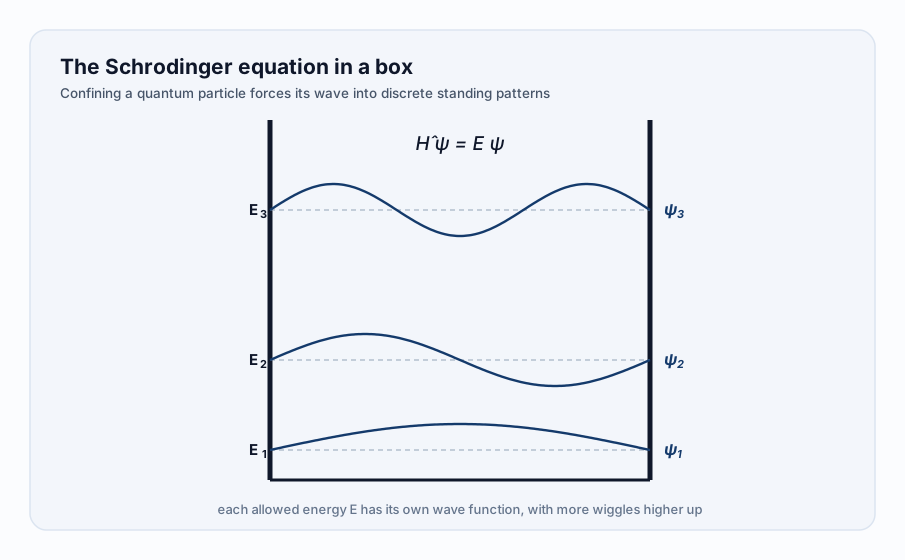
What made the approach so welcome was its familiarity. Where Werner Heisenberg’s rival matrix mechanics felt abstract and unintuitive, the Schrödinger equation used the language of waves that physicists already knew well from optics and sound. The diagram below shows the simplest example, a particle trapped in a box, where the equation forces the wave into a set of discrete standing patterns, each with its own fixed energy.
What the wave function actually means
He had his equation, but nobody, including its author, was sure what the wave function actually represented. He initially hoped it described a real, physical smearing of the electron through space, a comforting and concrete picture. That interpretation did not survive contact with the evidence.
It was Max Born who supplied the answer that stuck, proposing that the wave function gives only the probability of finding a particle in a given place. The square of the wave function at a point tells you how likely a measurement is to find the particle there, and nothing more. He disliked this probabilistic reading intensely, and his discomfort with it would shape the rest of his career.
Schrödinger’s cat and the trouble with measurement
By 1935 Schrödinger had grown deeply unhappy with where quantum theory was heading, and he expressed that unhappiness with the most famous thought experiment in science. He imagined a cat sealed in a box with a device that will kill it if a single radioactive atom decays, so that, by a strict reading of the quantum rules, the cat is both alive and dead until someone opens the box. The scenario was meant as a reduction to absurdity, not a celebration of mystery.
The point he wanted to make was that superposition, perfectly sensible for a lone atom, becomes ridiculous when scaled up to a living animal. His cat dramatised the unsolved measurement problem, the question of how and when the fuzzy quantum world of possibilities snaps into the single definite reality we observe. Ironically, the paradox he offered as a criticism became the most beloved illustration of quantum weirdness ever devised.
The equation in action across science
Whatever its philosophical puzzles, the Schrödinger equation works with extraordinary success. Applied to the hydrogen atom, it reproduces the exact pattern of energy levels that experiments had measured, explaining the colours of light that atoms emit and absorb. The familiar shapes of atomic orbitals, the regions where electrons are likely to be found, are direct solutions of the equation.
From there its reach extends across the whole of chemistry and materials science. The structure of the periodic table, the nature of chemical bonds, and the behaviour of semiconductors all flow from solving the equation for the system in question. It remains the workhorse calculation of modern physics, taught to every student and run on computers everywhere from drug design to battery research.
The same mathematics also explains why matter is stable and why atoms have the sizes they do, questions that classical physics simply could not answer. Engineers designing lasers, transistors and quantum sensors are, at bottom, solving this one equation for ever more elaborate systems. Few pieces of mathematics have repaid their inventor so many times over.
Schrödinger against the Copenhagen view
Like his friend Albert Einstein, he never made peace with the dominant Copenhagen interpretation championed by Niels Bohr and Heisenberg. He resisted the idea that nature is fundamentally probabilistic and that the act of observation plays a special role, preferring to believe that a deeper and more orderly account must exist. The cat was only the most memorable shot in this long campaign.
It was in the course of this argument, in 1935, that he coined the term entanglement to describe the deep links between quantum particles that so troubled Einstein. He called it not one but the characteristic trait of quantum mechanics, the feature that most sharply separates it from classical physics. The phenomenon he named would later become the central resource of quantum computing and quantum communication.
What Is Life and the leap to biology
In 1944 he published a short book called What Is Life, based on lectures he gave in Dublin, in which he turned the tools of physics on the puzzle of heredity. He argued that the stability of genetic information demanded some kind of aperiodic crystal, a molecule whose structure could carry a code without endless repetition. It was a bold attempt to apply physical reasoning to the deepest questions of biology.
The book had an influence out of all proportion to its length. Both James Watson and Francis Crick credited it with drawing them toward the problem of the gene, the work that led them to the double helix of DNA. In imagining how physics might explain life, Schrödinger helped seed the entire field of molecular biology.
Schrödinger’s legacy in the quantum age
More than a century after his great year in the Alps, Schrödinger’s equation is everywhere, the indispensable starting point for almost any quantum calculation. The superposition that he found so troubling is now a deliberate tool, the raw material of the qubits inside a quantum computer, and the entanglement he named is treated as a resource to be engineered. His reluctant discoveries underpin technologies he could scarcely have imagined.
Schrödinger’s cat, meanwhile, has wandered far beyond physics, becoming a symbol of paradox in art, fiction and ordinary speech. That a thought experiment designed to expose an absurdity should become the friendly face of quantum theory is a fitting irony for a man who spent his life questioning the answers his own work provided. Schrödinger gave the quantum world both its working equation and its most enduring story.
Frequently asked questions
Who was Erwin Schrödinger?
What is the Schrödinger equation?
What is Schrödinger’s cat?
Did Schrödinger believe in his own cat paradox?
Why is Schrödinger important to quantum computing?




See today’s quantum computing news on Quantum Zeitgeist for the latest breakthroughs in qubits, hardware, algorithms, and industry deals.