The Göttingen mathematician whose axiomatic vision reshaped geometry, logic and number theory, and whose infinite-dimensional spaces became the natural home of quantum mechanics.
Few mathematicians shaped as many fields at once as David Hilbert did. Fewer still left behind a tool that working physicists reach for every day. He is the reason a quantum state can be written as a vector, the reason a qubit has a precise mathematical meaning, and the reason an entire branch of analysis carries his name. The range was extraordinary. His career ran from pure geometry through the foundations of logic to the mathematics of general relativity, and almost everywhere he worked he left the subject tidier than he found it.
Born in the Prussian city of Königsberg, David Hilbert spent nearly all of his working life at the University of Göttingen. He turned one provincial department into the world capital of mathematics, and for roughly three decades almost every important young mathematician in Europe passed through it. He believed that every well posed problem could in principle be solved, and he spent decades trying to put that conviction on a rigorous footing. The vision both succeeded and failed. What it seeded, in the end, was modern logic on one side and the mathematics of quantum theory on the other.
The man who organised modern mathematics
David Hilbert was born in 1862 and studied at Königsberg, where he formed lifelong friendships with Hermann Minkowski and Adolf Hurwitz. He took his doctorate there in 1885 under Ferdinand von Lindemann. Invariant theory came first. His finite basis theorem of 1888 proved that whole classes of problems could be settled without ever building the answer by hand, which unsettled contemporaries who were used to explicit constructions. Paul Gordan is said to have protested that this was not mathematics but theology. The non-constructive style won anyway.
In 1895 he moved to Göttingen, the university of Gauss and Riemann, and he stayed there for the rest of his working life. His Zahlbericht of 1897 reorganised the whole of algebraic number theory into a single coherent report. Then came the Foundations of Geometry in 1899. It rebuilt Euclid on a clean and explicit set of axioms, treating the basic objects as undefined and the axioms as the only rules in play. The method became his signature. It was also a template for much of twentieth century mathematics.
His faith in solvability found its most famous expression in a single phrase. We must know, we will know, he declared in Königsberg in 1930, in a short address that was broadcast on radio and survives today as a recording. He meant it literally. The words were later carved on his gravestone in Göttingen, and they capture a temperament that refused to accept any problem as permanently out of reach.
What a Hilbert space actually is
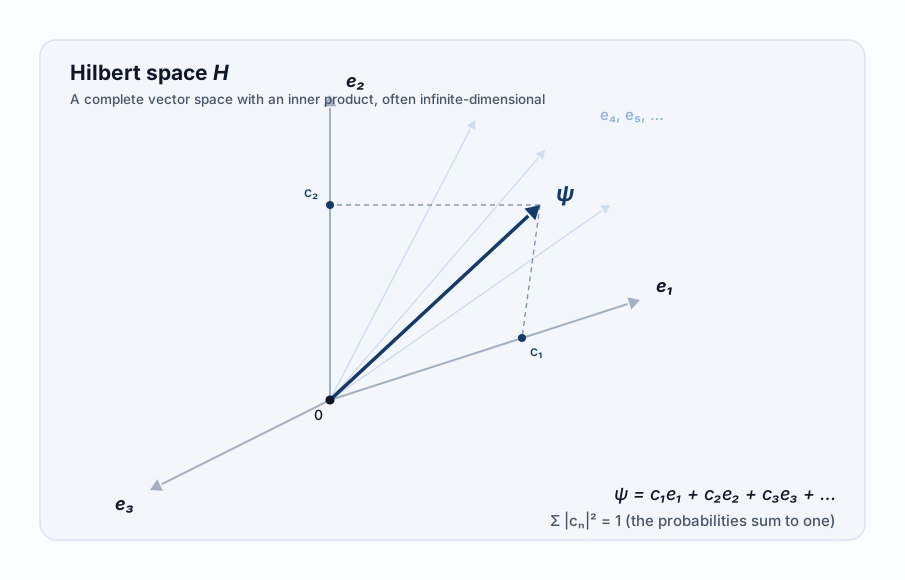
A Hilbert space is a generalisation of ordinary flat space to any number of dimensions, including infinitely many, which is a good deal less exotic than the phrase suggests. It is a vector space carrying an inner product. That operation lets you measure the length of a vector and the angle between two of them. It also turns a bare collection of vectors into a genuine geometry, a place where distance and perpendicularity mean something. The geometry is the whole point.
One extra requirement makes the construction powerful. Completeness says that sequences which ought to converge really do converge to a point inside the space. That is the technical condition that allows calculus, limits and approximation to work safely in infinitely many dimensions, and it is what separates a Hilbert space from a merely convenient one. Without it the setting would be full of gaps. The analytical machinery of physics would have nowhere solid to stand.
Three dimensions are enough to see the idea. A state is a vector, the basis vectors act as coordinate axes, and the components along those axes record how much of each basis state the vector holds. A real quantum system needs far more. A single particle moving along a line already demands infinitely many axes, which is precisely the situation the completeness condition was built to handle.
Why quantum mechanics needs an infinite home
Quantum mechanics arrived in the 1920s as a clash of rival formalisms, with Heisenberg’s matrices on one side and Schrödinger’s wave functions on the other. John von Neumann settled the argument in 1932. His Mathematische Grundlagen der Quantenmechanik showed that both were descriptions of vectors and operators living in a Hilbert space, and it was von Neumann who gave the space Hilbert’s name. The framework built for pure analysis turned out to be the exact language the new physics needed.
In this picture a physical state is a unit vector. A measurement corresponds to projecting that vector onto the axes that represent the possible outcomes. The squared length of each projection gives the probability of the matching result. Max Born wrote that rule down in 1926. Observable quantities such as energy and position become operators acting on the vectors, and their allowed values emerge as the spectrum of those operators, which is why an atom has discrete energy levels.
Superposition makes quantum behaviour feel strange. In this setting it is nothing more exotic than vector addition. A particle that can be here or there is described by a sum of the here vector and the there vector, and interference is simply the geometry of those sums. The strangeness sits in the physics, not in the mathematics.
The twenty-three problems David Hilbert set for a century
In 1900 David Hilbert stood before the International Congress of Mathematicians in Paris and set out the problems he thought should guide the new century. He named ten in the lecture itself. The published list eventually ran to twenty-three questions spanning logic, number theory, geometry and physics. It read less as a set of puzzles than as a programme for the whole discipline, and mathematicians treated it that way for the next hundred years. Few documents have done more to shape what mathematicians chose to work on.
Some were solved within a few years. Others have resisted every assault and remain open today. The Riemann hypothesis sits among them, is still regarded as the most important unsolved problem in mathematics, and now carries a million dollar prize from the Clay Mathematics Institute. The question of the continuum turned out to have an answer far stranger than anyone in 1900 could have anticipated.
What unified the list was a conviction that mathematics advances by confronting sharply stated problems rather than by drifting, and that a good question is worth more than a tidy answer. Generations have measured their progress against it. Settling even one of the Hilbert problems remains a route to lasting fame.
Hilbert’s program and the dream of certainty
By the 1920s his attention had turned to the foundations of mathematics themselves. The paradoxes in set theory troubled him. He proposed an ambitious rescue, now called Hilbert’s program. It aimed to place all of mathematics on a finite set of axioms, then prove by simple and uncontroversial reasoning that those axioms could never lead to a contradiction.
The goal was a kind of permanent security for mathematical knowledge. Establish the consistency of arithmetic once, and the alarming paradoxes would be banished for good. Hilbert thought it within reach. He gathered a generation of logicians at Göttingen to pursue the programme through the rest of the decade, and for a while it looked as though they would get there.
How Gödel and Turing answered the dream
The answer, when it came, was not the one he had hoped for. In 1931 the young logician Kurt Gödel proved his incompleteness theorems. Any consistent system rich enough to describe arithmetic must contain true statements it can never prove. Worse for the programme, no such system can demonstrate its own consistency from within, and that removed the precise guarantee Hilbert had spent a decade asking for. The dream died in a single stroke.
Alan Turing took up a related question. Hilbert had asked for a mechanical procedure that could determine whether any given statement was provable, a challenge known as the decision problem. Turing showed in 1936 that no such universal procedure can exist, and in doing so he invented the abstract machine that now sits under every computer. The collapse of one Hilbert dream gave birth to the theory of computation.
Hilbert space inside the quantum computer
Every quantum computer ever built operates inside a Hilbert space. The engineers rarely say so. A single qubit is a unit vector in a two dimensional Hilbert space, and the familiar Bloch sphere is just a way of drawing that small space on paper. Computation is the controlled movement of a point around it.
The power shows up when qubits are combined. Two qubits live in a four dimensional space and three in an eight dimensional space. A register of n qubits therefore needs a Hilbert space with two to the power n dimensions, and that exponential growth is the root of the promise of quantum computing. The machine holds and steers a vast superposition at once.
Quantum gates are rotations of this space. The operators that represent them preserve length and angle. Entanglement appears as those joint states that cannot be split into independent parts, which is a geometric fact about the space before it is a physical claim. The deep correlations of quantum entanglement and the careful bookkeeping of quantum error correction are both, in the end, statements about the geometry of a Hilbert space.
Göttingen and the cost of history
Under David Hilbert the mathematics department at Göttingen became the most important in the world, drawing students and visitors from every continent and turning a provincial town into a destination. Hermann Weyl worked there. So did John von Neumann. Emmy Noether was there too, and her 1918 theorem linking symmetry to conservation laws became central to modern physics. For a few decades that small university town was where the future of the subject was being written.
That world was dismantled with shocking speed after 1933. The new German government dismissed Jewish and dissident academics, and Göttingen lost most of its mathematical strength almost overnight. The story is often told that a minister asked Hilbert how mathematics was faring in Göttingen now that it was free of Jewish influence, and his answer has been repeated ever since. He is said to have replied that there was simply none left. He died in 1943, in a city and a discipline the war had emptied of the people he had gathered.
The legacy of a formalist
His influence is woven so deep into mathematics that it is easy to miss. The axiomatic method he championed is simply how the subject gets written now, from the opening definitions of a textbook to the last line of a research paper. Functional analysis grew directly out of his work on integral equations, and it is the study of exactly those infinite dimensional spaces. His name is everywhere. It attaches to spaces, to transforms, to a famous hotel that dramatises the paradoxes of infinity, and to the problems that still guide research.
His deepest legacy may be an attitude to knowledge. Hilbert insisted that clarity, rigour and explicit assumptions were not obstacles to creativity but the conditions for it, and that conviction shaped the century that followed. The same structures he built for abstract reasons now run inside quantum machines. That is a vindication he did not live to see. It is also a reminder that pure mathematics has a habit of becoming indispensable.
Frequently asked questions
Who was David Hilbert?
What is a Hilbert space?
Why is Hilbert space important in quantum mechanics?
What were Hilbert’s 23 problems?
What happened to Hilbert’s program?



See today’s quantum computing news on Quantum Zeitgeist for the latest breakthroughs in qubits, hardware, algorithms, and industry deals.