Infleqtion builds quantum computers and quantum sensors out of neutral atoms, from a headquarters in Louisville, Colorado. In February 2026 it became, on its own account, the first neutral-atom specialist to trade on a major public exchange. It was founded in Boulder in 2007 as ColdQuanta by the University of Colorado physicist Dana Anderson. It then spent nearly two decades turning laboratory cold-atom physics into hardware it could ship, before listing on the New York Stock Exchange under the ticker INFQ and becoming a quantum stock overnight.
The interesting question is not whether the listing happened. It is whether a business selling clocks and radio receivers today can fund a quantum computer for the 2030s.
1. A neutral-atom quantum company. Infleqtion builds quantum computers, precision sensors and software around neutral atoms. The company argues that this is the most scalable and economical path to commercial quantum systems. One platform, three product lines.
2. Boulder roots, founded in 2007 as ColdQuanta. The business was incorporated in Colorado on 7 February 2007 by the University of Colorado physicist Dana Anderson. It took the Infleqtion brand in November 2022, to mark the shift from research work toward selling finished products commercially. Anderson is still chief science officer. The legal entity kept the ColdQuanta name right up to the merger that took the company public.
3. The first public neutral-atom stock. The company trades on the New York Stock Exchange under the ticker INFQ after a February 2026 merger. The company says that makes it the first listed business dedicated to neutral-atom quantum technology, and the shares started trading on 17 February 2026.
4. Computing and sensing under one roof. Unlike most quantum firms, the company sells both quantum computers and a line of quantum sensors, including atomic clocks and radio-frequency receivers. A cross-vendor software stack rounds out the portfolio.
5. A staged logical-qubit roadmap. The flagship Sqale platform has supported arrays of up to 1,600 trapped atoms. Its published two-qubit gate fidelity is 99.35 per cent. That rises to 99.73 per cent only once atom-loss events are excluded, and the roadmap targets more than 1,000 logical qubits and 100,000 physical atoms by 2030. The company had reached twelve logical qubits by the end of 2025, and the quarterly report puts the count at the same twelve on 30 June 2026. The company labels those figures estimates rather than guarantees.
6. Government and defence customers. Its systems and sensors are used by NASA, the US Department of Defense and the UK government. The work spans aerospace, defence and critical infrastructure. These contracts bring in early revenue while quantum computing matures.
7. It arrived on the public market with cash, not just a ticker. The merger with Churchill Capital Corp X delivered 528.2 million dollars, being 401.6 million from the SPAC’s trust and cash and 126.5 million from a private placement. That was against a pre-money equity value of roughly 1.8 billion. Barely a tenth of one per cent of public shares were redeemed, so the balance sheet arrived close to intact.
What Infleqtion sells, and to whom
The company designs, builds and sells quantum technology based on neutral atoms, individual atoms held and steered with lasers. One platform, two markets. It spans quantum computing on one side and quantum sensing on the other, which most rivals treat separately, and that breadth is the heart of its commercial pitch.
Neutral-atom machines work by trapping arrays of atoms and using them as qubits, an approach shared with the wider field of neutral-atom quantum computing companies. The argument for the technology is that atoms are identical, plentiful and can be packed into large arrays. The company says that makes them cheaper to scale than rival qubit types, and that scalability thesis runs through everything it does, from its computers to its sensors.
Nineteen years of building cold-atom hardware
The business was incorporated in Colorado on 7 February 2007 as ColdQuanta. Its founder was the University of Colorado physicist Dana Anderson, and it was built on decades of research into cooling and trapping neutral atoms with lasers. The company describes Anderson as a pioneer of the laser techniques that produce ultra-cold atoms. The early company sold the specialised hardware other laboratories needed to do the same work, and for years it was known as a components supplier rather than a quantum computer maker.
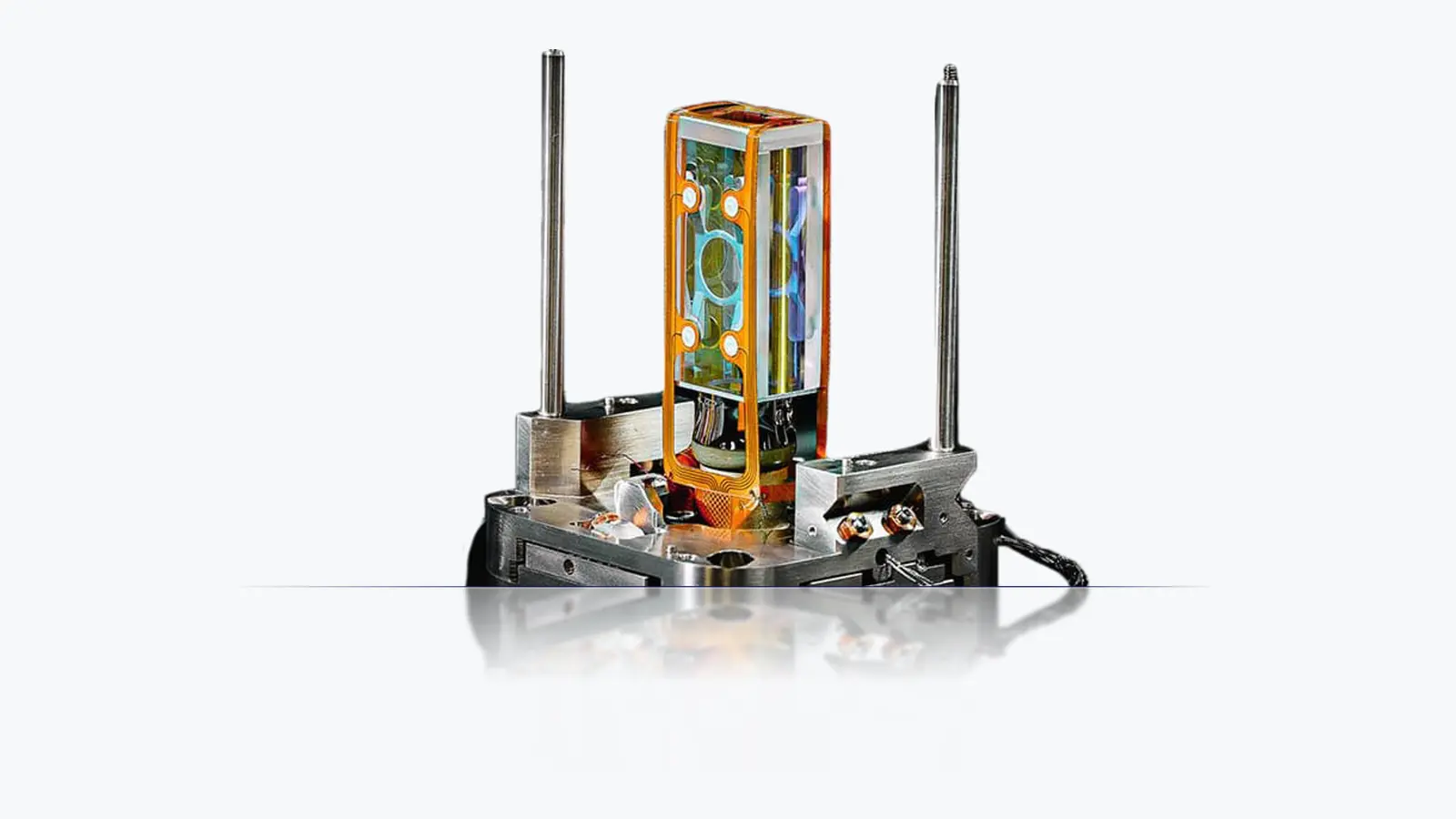
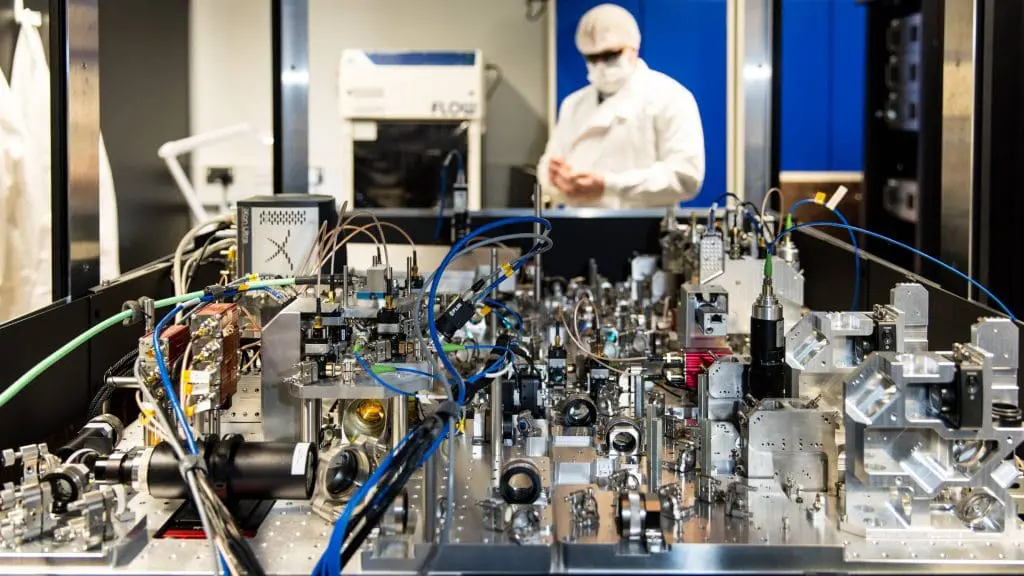
That heritage gave the company a manufacturing base, in a field where most rivals started from a blank sheet. By building the lasers, vacuum cells and control systems that cold-atom experiments need, ColdQuanta learned to produce the hardware at the core of a neutral-atom machine. It still makes that hardware itself, in Colorado and Oxford, rather than buying it in.
Anderson remains with the business as chief science officer, a thread of continuity reaching back to the original Boulder laboratory. He was elected to the National Academy of Engineering in 2026, nearly twenty years after founding the business. The head office has since moved a few miles down the road to Louisville, with research and manufacturing sites in Chicago, Madison, Oxford and Melbourne.
The name change that marked a commercial turn
In 2022 the company retired the ColdQuanta name and rebranded as Infleqtion. The change signalled a shift from research and development toward commercial deployment, and the old name spoke to the cold-atom science at the core of the business rather than to any product. The new one was chosen to describe an inflection point, as the business moved from selling laboratory tools to selling finished quantum products. It came alongside a strategy of building a family of quantum technologies rather than a single device.
The change of name tracked a change of ambition. Where ColdQuanta had supplied parts to researchers, the renamed business set out to deliver complete quantum computers and sensors to governments and enterprises. That turn, more than any single product, set up the move to public markets.
Why identical atoms are easier to scale
Neutral atoms differ sharply from the superconducting circuits and trapped ions used by better-known rivals. The recipe starts by cooling a cloud of atoms, usually rubidium or caesium, almost to absolute zero with laser light. The atoms slow until they barely move. The commercial consequence is the part that matters, and the company puts it in its quarterly report, where Sqale is described as “a room-temperature quantum computer”. Superconducting machines need a dilution refrigerator. This one does not. Once cold, individual atoms are caught in tightly focused beams of light called optical tweezers, and those tweezers can be steered to arrange the atoms into neat grids.
Each trapped atom serves as a qubit, with information stored in its internal energy levels and read out with lasers. To make two qubits interact, the machine briefly excites atoms into a swollen, high-energy condition known as a Rydberg state. One electron orbits far from the nucleus. Rydberg atoms feel each other across a gap. That interaction is the two-qubit gate. That is the operation the 2025 PRX Quantum paper measured at 99.35 per cent, and the same physics that cools the atoms also lets the machine pack hundreds of them into a small space.
The appeal is simple. Atoms of a given element are perfectly identical, so there is no manufacturing variation between qubits, as there is with the fabricated circuits rivals use. The arrays can in principle be scaled to thousands of atoms without building thousands of separate devices. Infleqtion has reached 1,600, and its 2030 target is 100,000.
Those traits matter most when a machine has to run quantum error correction, which bundles many physical qubits into a smaller number of error-protected logical ones. Schemes such as the surface code need large, uniform grids of qubits, and a dense atom array is a natural fit. The wider field of neutral-atom quantum computing companies is built on these same ideas, and Infleqtion competes within it.
Sqale, and how its fidelity is measured
On the computing side, the flagship platform is a neutral-atom quantum computer called Sqale. Its quarterly report says the platform is already running workloads at customer sites. It has been installed at national centres including the UK National Quantum Computing Centre at Harwell. The team behind it published its results in PRX Quantum in 2025, reporting a controlled-Z gate fidelity of 99.35(4) per cent and a local single-qubit gate fidelity of 99.902(8) per cent. The same paper reports a controlled-Z figure of 99.73(3) per cent when atom-loss events are excluded from the count.
Two figures are in circulation, four tenths of a percentage point apart. The lower one describes every gate the machine attempted. The higher one describes the gates that survived, after runs in which an atom went missing were set aside. Infleqtion quotes the higher figure in its annual report and on its published roadmap, and its quarterly report for the second quarter of 2026 calls Sqale “a room-temperature quantum computer with demonstrated high fidelity (99.73% controlled-Z (“CZ”) gate)”. Vendors report gate fidelity on different bases, so the two numbers are worth keeping distinct when comparing machines.
The scale numbers need the same care. The annual report says Sqale supported arrays of up to 1,600 trapped atoms as of December 2025, and that the company had achieved twelve logical qubits. Those logical qubits are encoded and measured rather than continuously repaired while a circuit runs.
The system Infleqtion delivered to the NQCC was described by the company as the United Kingdom’s only operational 100-qubit quantum computing system, reached in December 2025 and announced the following March.
That work sits inside a project the centre calls SQALE, the Scalable Quantum Atomic Lattice computing tEstbed, one of the testbeds the NQCC runs at Harwell. A year before that, in February 2025, the company reported trapping 256 atoms in a sixteen-by-sixteen array. Tom Noel, its vice-president of quantum computing, called it “the largest reported neutral atom array in the UK”. That was a trapping milestone with the gate lasers still being integrated, so it was not 256 working qubits. Either way, the delivered hardware sits well below the 1,600-atom laboratory ceiling. The company sells time on the system to research and government customers while it works toward the next stage.
A roadmap that asks for sixty times the atoms
The plan runs in stages. Turning Sqale into a useful machine means error-corrected logical qubits, and the roadmap sets out how the company intends to get there. The company once badged the effort Sqorpius. That name appears nowhere in its current roadmap, its website or its annual report, and the stages now sit under the Sqale platform itself. The idea is to grow both the raw atom count and the number of logical qubits in deliberate stages, rather than chasing a single distant target. Each stage pairs more physical atoms with better control and error correction, so a larger share of the array can be devoted to logical, error-protected information.
Reading the roadmap numbers
The arithmetic in the published milestones is more revealing than the headline. The roadmap was last updated in September 2025 and sets four stages, each pairing a logical-qubit target with the atom count and gate performance needed to reach it.
The first column is dated 2024. It is badged Error Detection, at two logical qubits from 1,600 atoms and 99.73 per cent gate performance. Then 30 or more from 4,000 atoms at 99.90 per cent in 2026, badged Error Correction, and 100 or more from 10,000 atoms at 99.95 per cent in 2028, the Infleqtion Point. The last column is 1,000 or more from 100,000 atoms at better than 99.99 per cent in 2030, badged Utility Scale.
Matt Kinsella, the chief executive, said on 17 August 2026 that “we remain on track for 30 logical qubits this year, and the pace of quantum commercialization is accelerating”, and that “the quantum market is entering an execution phase”. Against that, the company reports having reached twelve logical qubits. That is six times the two its roadmap sets against 2024, and it was the same twelve at 31 December 2025 and at 30 June 2026. The 2026 stage asks for 30.
Follow the atom count rather than the logical-qubit count, and the shape of the bet becomes clear. The atom count has to rise roughly sixtyfold in five years while the error rate falls by a factor of about twenty-five. Both have to happen at once, because a bigger array at the same fidelity buys nothing, and better gates on a small array buy very little either. Infleqtion labels the 2030 column Utility Scale, and prints a line under the roadmap saying the target numbers are estimates and not guarantees of future performance.
Reaching those numbers is not only a matter of trapping more atoms. Error correction is the harder problem. The operations that protect quantum information are themselves noisy, and they have to run fast enough to keep up with errors as those errors appear. That is why the company has invested in faster, classically assisted decoding, and in tighter links between its quantum hardware and conventional computers.
Error correction only works if the classical side keeps up
Error correction at scale means a quantum computer must talk to classical machines almost instantly, because a logical qubit only survives if errors are caught and fixed within microseconds. That is the constraint behind the work with NVIDIA on NVQLink. It is a link meant to tie quantum processors directly to graphics-processor supercomputers, with very little delay between the two halves of the machine. It also explains why Sqale uses NVIDIA’s Ising AI models to calibrate the processor and read error signals. The aim is one tightly coupled system, where the quantum hardware and the classical accelerators work as a unit.
The practical payoff would be faster, machine-assisted error correction, where classical hardware decodes the stream of error signals coming off the atom array while a computation is still running. On 22 July 2026 the company said it would deploy a Sqale system at the Illinois Quantum and Microelectronics Park for delivery in 2027. The quarterly report says the Illinois system initially targets 50 logical qubits, with a roadmap to 100 logical qubits through modular upgrades. That machine, if it lands on time and at that size, is the first hard test of the roadmap above.
The sensing line, and what it actually earns
Most quantum firms chase computing alone. Infleqtion does not. Its sensors use the same cold-atom physics to measure time, motion and electromagnetic fields with extreme precision. That draws on the company’s long heritage in trapping and reading atoms, and places it among the leading quantum sensing companies as well as in neutral-atom computing.
The headline sensing product is an optical atomic clock called Tiqker. It uses the natural oscillations of rubidium atoms to keep time far more accurately than conventional clocks. Timing matters most when satellite signals are jammed. Navigation then falls back on dead reckoning, which drifts as the clock drifts.
In a trial with the Royal Navy and the firm MSubs in October 2025, the company ran a Tiqker clock aboard an uncrewed underwater vehicle. It called that the first quantum optical clock demonstrated on such a craft, and published no accuracy figure for it. The picosecond-level accuracy the company quotes comes from a separate demonstration six months later, over a fibre network in Chicago with Safran. A separate partnership with the aerospace and defence group Safran has packaged the timing technology into a commercial product.
Rydberg sensors for radio frequency
Alongside the clock sits a line of quantum radio-frequency sensors built on Rydberg atoms, the same swollen, high-energy states used in the company’s two-qubit gates. They are sold as the Sqywire receiver, under the Quantum Spectrum banner. Rydberg atoms are exquisitely sensitive to electromagnetic fields and can detect signals across a very wide band, so one instrument covers frequencies that would otherwise need a rack of conventional receivers. A third line, the Exaqt inertial sensor, uses the same ultra-cooling techniques the quantum computer relies on. That is the clearest illustration of why the company insists computing and sensing are one platform rather than two businesses.
The space work runs deeper than a single contract. Infleqtion equipment has operated aboard the International Space Station since 2018, in NASA’s Cold Atom Laboratory, and it delivered upgraded hardware for that facility in early 2026. On NASA’s Quantum Gravity Gradiometer Pathfinder it is responsible for designing, maturing and integrating the quantum core. It says that programme has brought in more than 20 million dollars of contracted mission funding so far. Quantum Spectrum was the second-largest contributor to sensing revenue in the first quarter of 2026.
What the line actually earns is a harder question than the product list suggests. Product revenue fell to 6.8 million dollars in the six months to 30 June 2026, from 9.9 million a year earlier, while service revenue rose to 16.7 million from 3.6 million. Group gross margin fell from about 31 per cent to about 20 per cent across the same half.
Both lines moved the same way. Product gross margin went from about 21 per cent to about 16, and service gross margin from about 59 per cent to about 22, while service revenue quadrupled. Government work was 89 per cent of half-year revenue, against 84 per cent a year earlier.
Timing and sensing systems can still be sold and deployed today, even as the computing roadmap stretches into the next decade. That spreads the company’s risk across markets which mature at different speeds, and the dual footing is central to how it presents itself to investors and to government customers alike. On the current numbers the sensing line is selling more, at a narrower margin.
The compiler Infleqtion bought rather than built
The software matters too. Infleqtion builds the layer that makes its hardware usable. Its optimising compiler, Superstaq, takes quantum programs written in common frameworks such as Cirq and Qiskit, and tunes them to run efficiently on real hardware, including machines from other vendors. That cross-platform reach lets the software stand on its own as a product.
Superstaq was bought, not built. It came with Super.tech, a University of Chicago spin-out Infleqtion acquired in 2022, whose co-founder Pranav Gokhale is now the company’s chief technology officer. Buying a compiler team rather than building one is a small decision that says something about the company’s instincts. They run to acquiring capability and integrating it, rather than waiting for it to mature internally.
Applications are where commercial value finally appears, and a compiler that squeezes more out of a noisy machine is worth as much as a better machine. The annual report describes Superstaq as the control panel through which every customer reaches the hardware, whether the system sits on their own premises or is rented through the cloud. Alongside it the company sells CML, a classical software product built on quantum-physics principles that runs on ordinary graphics processors. That is revenue today from a quantum idea, rather than revenue tomorrow from a quantum computer.
Customers, contracts and installations
The customer list is long, and revenue within it is concentrated. It runs to contracts, installations and partnerships across defence, space and research.
One customer supplied 74 per cent of revenue in the six months to 30 June 2026, against 56 per cent a year earlier, and 82 per cent of the second quarter alone. A single customer accounted for 40 per cent of accounts receivable at 30 June 2026, down from 78 per cent at the end of 2025.
Infleqtion put a neutral-atom quantum computer into the United Kingdom’s National Quantum Computing Centre. It won timing and sensing work from British and American defence agencies, and worked with NASA’s Jet Propulsion Laboratory on cold-atom instruments built for orbit. It has also worked closely with government deployments of its quantum technologies.
- 2007Dana Anderson, a University of Colorado physicist, founds ColdQuanta in Boulder.
- 2022The company rebrands from ColdQuanta to its current name to mark its commercial turn.
- 2024Matthew Kinsella becomes chief executive and the company expands its United Kingdom operations.
- 2025The company agrees a merger with Churchill Capital Corp X.
- 2026Shares begin trading on the New York Stock Exchange under the ticker INFQ in February.
- 2026A Sqale system is announced for the Illinois Quantum and Microelectronics Park in July, for delivery in 2027.
Matthew Kinsella took over as chief executive in 2024. He is a former venture investor who had sat on the board since 2018, and the business deepened its presence in the United Kingdom that year with a new Oxford centre. The next year it signed the merger that would take it public, and in July 2026 it announced a utility-scale machine for Illinois, for delivery in 2027. You can follow these developments through our coverage of the company’s United Kingdom quantum computer and its new Oxford quantum centre.
How Infleqtion was funded before the listing
Infleqtion funded its growth through venture capital and government grants before turning to the public markets. On 2 June 2025 it announced a 100 million dollar Series C backed by Glynn Capital, Counterpoint Global, S32 and SAIC among others. The registration statement filed after the listing sets out how that round was assembled. About 74.5 million dollars of Series C preferred stock was sold for cash across closings running from December 2024 to May 2025, alongside earlier convertible instruments that converted into the same round.
A separate 100 million dollar letter of intent with the US Department of Commerce followed on 21 May 2026. It was part of a wider federal package, under which the government took equity stakes in nine quantum companies. The two figures are separate commitments. They should not be run together into a single total, and that mix of private money and public contracts is common among hardware-heavy quantum firms, where machines are expensive and revenue is slow.
Private money runs out. A business trying to deliver quantum computers at industrial scale needs more than rounds and grants can stretch to. A public listing offered a deeper pool of funding, a tradable currency for deals, and a higher profile with the governments and enterprises it sells to, all at once. By late 2025 the leadership had chosen that route, setting up the merger that would put the shares on the New York Stock Exchange the following February.
The timing fit a broader wave of quantum companies reaching the public markets in 2025 and 2026, as investors looked past pure research toward firms with shipping products and government contracts. Infleqtion’s pitch leaned on exactly that mix. It had a working computer, a sensing line with paying customers and a software stack. How that breadth performs is one of the open questions a public shareholder now weighs.
The INFQ listing on the NYSE
Infleqtion went public through a business combination with Churchill Capital Corp X. That was a special purpose acquisition company, incorporated in the Cayman Islands, whose units traded on the Nasdaq Global Market under the ticker CCCX. The deal was announced on 8 September 2025 and valued the business at a pre-money equity of roughly 1.8 billion dollars. Churchill X had raised 414 million dollars in its own initial public offering that May, so the vehicle was already funded and waiting for a target. The company says the deal made it the first publicly listed business dedicated to neutral-atom quantum technology, a claim that rests on there being no comparable registrant.
The units, ordinary shares and warrants ceased trading on Nasdaq on 13 February 2026. On 17 February the shares opened on the New York Stock Exchange under the ticker INFQ, with the warrants under INFQ WS. You can read our coverage of the moment the company began trading on the NYSE and of the completed business combination that set it up. The listing turned a Colorado cold-atom supplier into a public quantum stock almost overnight.
What the deal delivered
The deal delivered 528.2 million dollars. The company’s first quarterly report breaks it into two parts. There was 401.6 million from Churchill X’s trust and cash, after redemptions and fees, plus 126.5 million from a private placement of 12,654,760 shares at ten dollars each. Only 37,821 public shares were redeemed. That is about nine hundredths of one per cent of the 41.4 million sold in the SPAC’s offering. That is why so much of the trust reached the balance sheet.
A SPAC merger can hand a company a listing while its trust is emptied by shareholders taking their ten dollars back. That leaves the newly public business with a ticker and very little else. Infleqtion kept almost all of it. The combination completed on 13 February 2026, a few days before the shares opened for trading. The company now reports its results in public on the cadence markets demand, a sharp change from its years as a private firm. You can track those disclosures through our review of its financial results and outlook, and weigh them against the roadmap and contract milestones described above.
Infleqtion by the numbers
The financial figures on this page come from Infleqtion’s own filings with the Securities and Exchange Commission. They are reported here for general information and are not investment advice. Several were revised by the company in August 2026, and those are flagged where they appear.
A handful of facts frame the business. They do more than any single headline. It is hardware-heavy. Its value rests on scaling the platform and winning customers in both computing and sensing, and its progress is best read through product milestones, government contracts and the terms of its listing.
What the accounts say
The first reported figures give that framing some numbers, and they need care about which entity is being reported. The annual report filed in March 2026 carries the SPAC’s accounts, because the merger closed after the year end. Infleqtion’s own audited 2025 results were filed separately, in an amended current report, and they put revenue at 32.5 million dollars against a loss from operations of 35.3 million and a net loss of 31.8 million.
Those figures were revised in August 2026 to revenue of 31.1 million, an operating loss of 35.7 million and a net loss of 32.2 million. On the revised numbers revenue grew about 11 per cent on 2024, with product sales falling and service revenue almost doubling. About 29 per cent of 2025 revenue came from outside the United States. That share has fallen sharply since. Non-US customers were about 16 per cent of revenue in the six months to 30 June 2026, and under 8 per cent in the second quarter alone.
The first quarter of 2026 brought 9.5 million dollars of revenue, since revised to 9.9 million, against a GAAP operating loss of 33.6 million, since revised to 33.0 million, and 569 million dollars of cash and securities at the end of March. Guidance then stood at least 40 million. It was raised to about 43 million with the second-quarter results on 12 August, then to about 45.1 million five days later when those results were updated. Cash and investments were about 582 million dollars at 30 June 2026, being 59.3 million in cash and equivalents and 522.5 million in available-for-sale securities.
What the cash says
Operating cash is a better guide than the loss, and it moved the other way. The company used 6.0 million dollars of operating cash in the six months to 30 June 2026, against 9.7 million in the same half of 2025. The first quarter accounted for 19.2 million of it. So the second quarter put cash back in, mostly through working-capital swings rather than trading. One quarter is not a burn rate.
The operating loss is the steadier measure. At about 30 million dollars a quarter, 582 million in cash and investments funds roughly four to five years, if the loss does not widen. That is the horizon of the 2030 roadmap. It is the closest thing to an answer the filings give. On these figures the products do not yet cover the cost of building the machine. The money raised at the listing does, on a horizon close to the one the roadmap sets out.
The second quarter, and the growth rate
The company reported second-quarter results on 12 August 2026 and updated them on 17 August, after correcting an error in how it had recognised revenue on two government contracts. Revenue for the quarter came in at 13.5 million dollars, which it described as a record and as growth of 157 per cent on the same quarter of 2025. The revision moved the figures at both ends of that comparison.
The quarter itself was lifted from 12.6 million to 13.5 million, and the second quarter of 2025 was cut from 5.8 million to 5.3 million. On the numbers as first reported the growth would have been about 116 per cent. The company makes the point in its own headline, which says the increases are offset by a corresponding reduction in revenue recognised in 2024 and 2025. The operating loss for the quarter was 29.9 million dollars against 10.4 million a year earlier, which it attributes to higher operating expenses and stock-based compensation.
The question posed at the top of this piece now has a date attached to it. Infleqtion has roughly half a billion dollars in the bank. It has a sensing and timing business selling to customers who need clocks and receivers whether or not quantum computing ever arrives. And it has a roadmap that needs the atom count to rise sixtyfold and the error rate to fall twenty-five-fold by 2030. The Illinois machine promised for 2027, targeting 50 logical qubits, is the first checkpoint where the two halves of the company have to meet.
Being the first public neutral-atom company is a fact about listings rather than about the technology. It is that the dual business gives it something almost no pure-play quantum computing firm has, which is a reason for a customer to pay it money this year. Whether the breadth proves a strength is the thing to judge it on. The fairest test is simple. Does the sensing revenue keep growing while the logical-qubit count does, or does one start eating the other?
The figures here are drawn from Infleqtion’s filings with the Securities and Exchange Commission. They include its quarterly report for the period ended 30 June 2026, together with the amended current report and the notice under which the company took a five-day extension to file, all filed on 17 August 2026. All filings are available through the company’s SEC EDGAR filing history. This page was last reviewed against those filings on 23 August 2026.
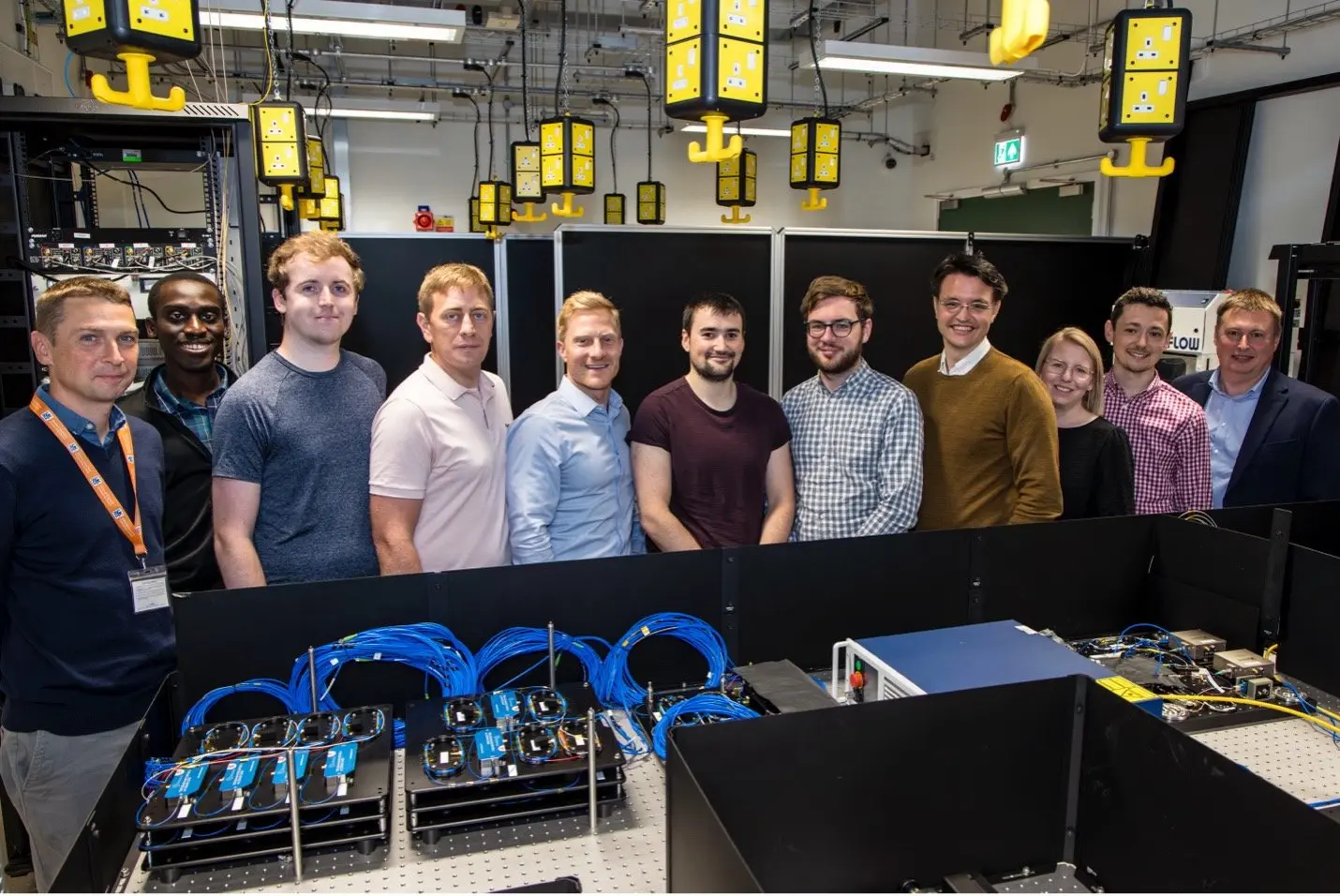
The photographs are Infleqtion’s. The two inside the article came into our library with our coverage of the company’s National Quantum Computing Centre installation in July 2024 and its Series C round in June 2025. The featured image is from Infleqtion’s own website. Quantum Zeitgeist is not affiliated with Infleqtion, and company and product names are used here for identification only.
Infleqtion FAQ
What does Infleqtion do?
The company builds quantum computers and quantum sensors based on neutral atoms, atoms held and controlled with lasers. It sells computing systems and precision sensors, including atomic clocks and radio-frequency receivers, to governments, defence agencies and enterprises.
What is the Infleqtion stock ticker?
Infleqtion trades on the New York Stock Exchange under the ticker symbol INFQ. The shares began trading on 17 February 2026 after the company merged with the listed shell Churchill Capital Corp X.
Is Infleqtion a public company?
Yes, it is a public company. It listed on the New York Stock Exchange on 17 February 2026, through a business combination with Churchill Capital Corp X. The company says that makes it the first publicly listed business dedicated to neutral-atom quantum technology.
Was Infleqtion formerly called ColdQuanta?
Yes. The business was founded in 2007 as ColdQuanta by the University of Colorado physicist Dana Anderson. It rebranded to its current name in November 2022, to mark the shift from research toward selling finished products.
Where is Infleqtion based?
The company is headquartered in Louisville, Colorado, a short drive from Boulder, where it began as ColdQuanta in 2007. Its annual report also lists research and manufacturing sites in Boulder, Chicago, Madison, Oxford and Melbourne. It has installed systems at national laboratories in several countries.
What is Sqale?
Sqale is the company’s neutral-atom quantum computer, which uses arrays of cold atoms as qubits and has been installed at national laboratories including the United Kingdom’s National Quantum Computing Centre. Its published two-qubit gate fidelity is 99.35 per cent, rising to 99.73 per cent only when atom-loss events are discarded, and the higher of those two numbers is the one the company quotes. It sits at the centre of a roadmap aimed at more than 1,000 logical qubits by 2030.
Who is the chief executive of Infleqtion?
The chief executive is Matthew Kinsella, a former venture investor who joined the board in 2018 and took the top job in 2024. The company was founded by the physicist Dana Anderson, who remains with the business as founder and chief science officer.
How is Infleqtion different from other quantum companies?
Most quantum firms focus on computing alone, whereas this company sells both quantum computers and quantum sensors built on the same neutral-atom physics. That dual footing in computing and precision sensing, together with its standing as the first public neutral-atom business, is what sets it apart from rivals such as IonQ, Rigetti and D-Wave.
What is the Infleqtion logical-qubit roadmap?
The roadmap scales logical qubits in four stages and was last updated in September 2025. It targets 30 or more logical qubits from about 4,000 atoms in 2026, then 100 or more from about 10,000 atoms in 2028. The last stage is 1,000 or more from about 100,000 atoms in 2030, with gate performance rising from 99.73 to better than 99.99 per cent across the same span. The chart carries its own warning, that “target numbers are estimates and not guarantees of future performance”.
Why does Infleqtion use neutral atoms instead of superconducting qubits?
Atoms of a given element are perfectly identical, so there is no fabrication variation between qubits, and large arrays can be built without manufacturing thousands of separate devices. The company argues this makes neutral atoms cheaper and easier to scale, which matters for error correction schemes that need big, uniform grids of qubits. Lasers and optical tweezers do the trapping, and Rydberg states create the interactions that drive two-qubit gates.
What is Tiqker?
Tiqker is the company’s optical atomic clock. It uses rubidium atoms to keep time with very high precision, and it is aimed at navigation and timing where satellite signals are jammed or absent. The company has trialled it aboard an uncrewed underwater vehicle with the Royal Navy, and packaged it commercially with Safran. It is one of three sensing lines running alongside the computing business.
How much did Infleqtion raise by going public?
The listing delivered about 528 million dollars, made up of roughly 401.6 million from Churchill Capital Corp X’s trust account after redemptions and sponsor fees, plus a common-stock placement. The placement was about 126.5 million dollars for roughly 12.65 million shares, and the company has said it will use the capital to accelerate development and deployment of its quantum systems. Nothing here is investment advice.
Disclaimer. This article is for informational purposes only and does not constitute investment, financial or professional advice. The quantum technology industry evolves rapidly and information may become outdated. Always conduct your own research and consult qualified advisers before making investment decisions. Investing in quantum computing companies involves significant risk, including the potential loss of your entire investment, and past performance is not indicative of future results.



See today’s quantum computing news on Quantum Zeitgeist for the latest breakthroughs in qubits, hardware, algorithms, and industry deals.