The surface code without the maths
Picture a chessboard where every corner holds a coin, and every square holds a tiny referee. The coins store the quantum information, and the referees keep checking the coins around them for anything that looks wrong. No single referee ever sees the actual message, so the message stays safe; each referee only reports whether the local parity flipped. That constant gossip between referees is enough to reconstruct where an error struck and to undo it, which is the whole trick behind the surface code. This matters because raw qubits are fragile. A physical qubit forgets its state in microseconds to seconds depending on the hardware, and every gate has a small chance of going wrong. A useful quantum algorithm needs billions of operations, so without protection the noise scrambles the answer long before the computation ends. The surface code spreads one reliable logical qubit across a patch of unreliable physical qubits and corrects errors continuously, the same idea covered in our guide to quantum error correction. What makes the code special among error-correcting codes is how undemanding it is. The referees only ever talk to their immediate neighbours, so the hardware never needs long-distance wiring or exotic connectivity. That nearest-neighbour layout fits superconducting chips, trapped-ion shuttling, and neutral-atom tweezer arrays with very little contortion. For a refresher on the underlying object being protected, see our explainer on what a qubit is and how it differs from a classical bit. The cost is honesty about scale. Today a single high-quality logical qubit can demand hundreds or thousands of physical qubits, so a machine that runs serious chemistry or cryptography work implies millions of physical qubits. The surface code does not hide that overhead, it accepts it in exchange for the easiest hardware on the menu, and the race now is to shrink the ratio while keeping the friendly geometry.What is the surface code, exactly?
It is a topological stabilizer code defined on a two-dimensional lattice of physical qubits, in which a single logical qubit is encoded into the joint state of many physical qubits and protected by a set of local, commuting parity-check operators called stabilizers. It descends from Alexei Kitaev’s toric code of the late 1990s, a construction that placed qubits on a torus so that logical information lived in the global topology of the lattice rather than in any single qubit. The planar surface code removes the awkward torus and keeps the protection on an ordinary flat patch with boundaries. Two facts make the code topological in a useful sense. The encoded information is stored non-locally, smeared across the whole patch, so no small cluster of errors can corrupt it. An error has to form a connected chain stretching all the way across the patch before it can damage the logical qubit, and short error chains are simply detected and removed. That non-local storage is what gives the surface code its robustness. The stabilizer formalism does the bookkeeping. Each stabilizer is a multi-qubit operator that commutes with every other stabilizer and with the logical operators, so measuring it reveals an error signature without revealing or disturbing the logical state. The surface code uses two flavours of stabilizer, one built from Pauli-X operators and one built from Pauli-Z operators, arranged in a checkerboard so that neighbouring checks always commute. The same stabilizer machinery supports the broader family discussed in our quantum error correction explainer.The lattice of data and ancilla qubits
Every patch divides its physical qubits into two jobs. Data qubits hold the encoded quantum state and sit on the vertices or edges of the lattice depending on the convention. Measure qubits, also called ancilla or syndrome qubits, sit in the faces between them and exist only to read out the stabilizers. The two populations interleave so that each measure qubit touches exactly the handful of data qubits its stabilizer checks.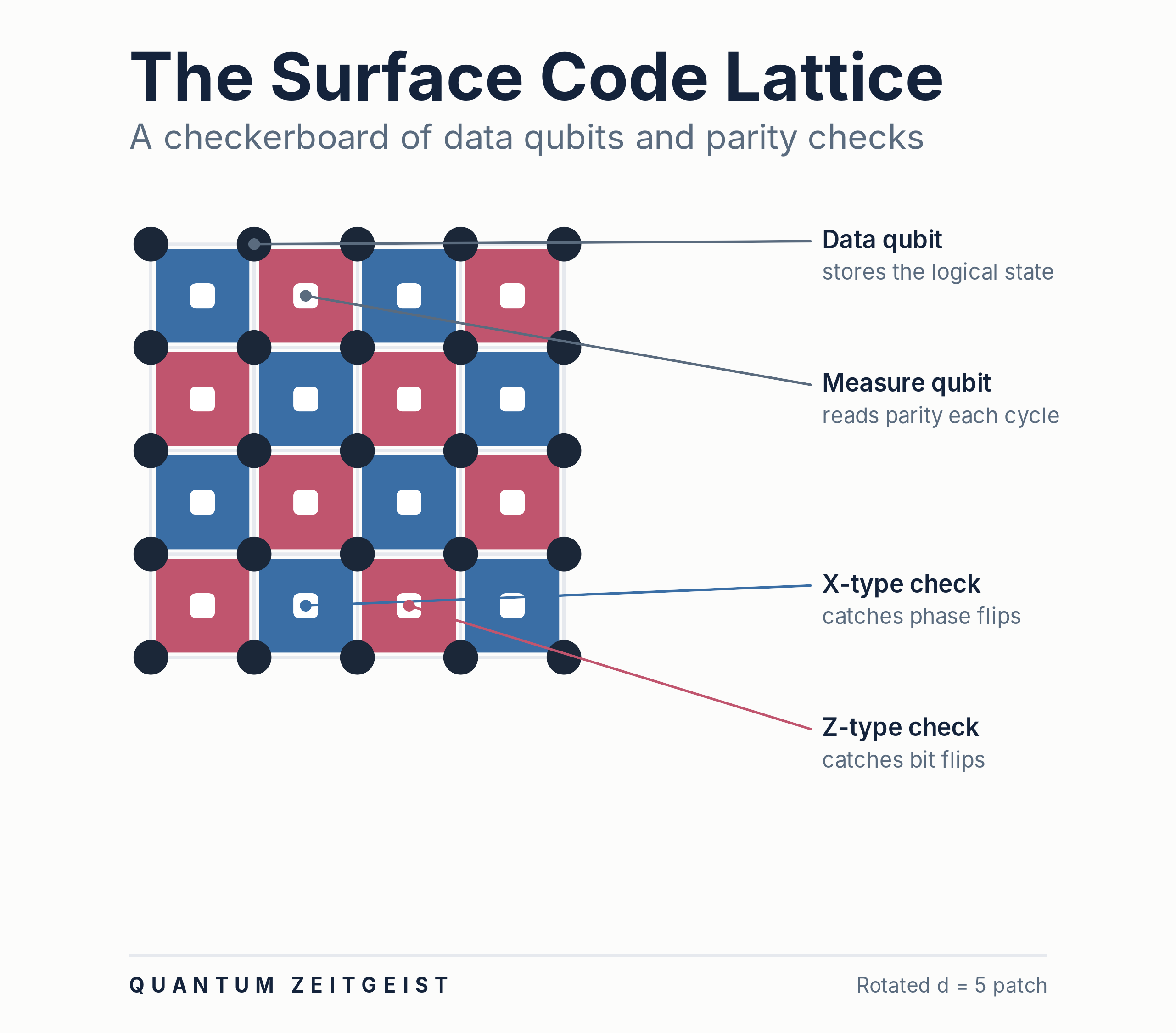 A small surface code patch laid out as a checkerboard. The dark filled circles are data qubits that hold the encoded logical state, while the small open squares are measure qubits that repeatedly read out parity. Each shaded tile is a stabilizer check, with blue tiles marking the X-type checks that catch phase flips and red tiles marking the Z-type checks that catch bit flips.
Why the checkerboard matters
The checkerboard arrangement is not decorative; it is what keeps the checks compatible. Neighbouring X-type and Z-type stabilizers always share an even number of data qubits, so their operators commute and can be measured at the same time without interfering. This is the geometric reason the surface code packs so neatly onto hardware, and it is why the layout looks the same whether the qubits are transmons on a chip or atoms in an optical-tweezer grid. Each check is local in the strongest sense. A weight-four stabilizer touches only the four data qubits immediately around it, so the ancilla that measures it needs to couple only to its nearest neighbours. That locality is the property that makes the surface code the friendliest code for real devices, a point covered alongside the hardware modalities in our guide to decoherence and why qubits lose their state.Syndrome extraction, cycle by cycle
The code never sits still. In each cycle the device runs a short circuit that entangles every ancilla qubit with its surrounding data qubits, measures the ancillas, and resets them for the next round. The pattern of ancilla measurement outcomes is called the syndrome, and a change in any ancilla’s outcome from one cycle to the next flags that an error occurred nearby. Crucially, the data qubits are never measured, so the logical state survives the whole process.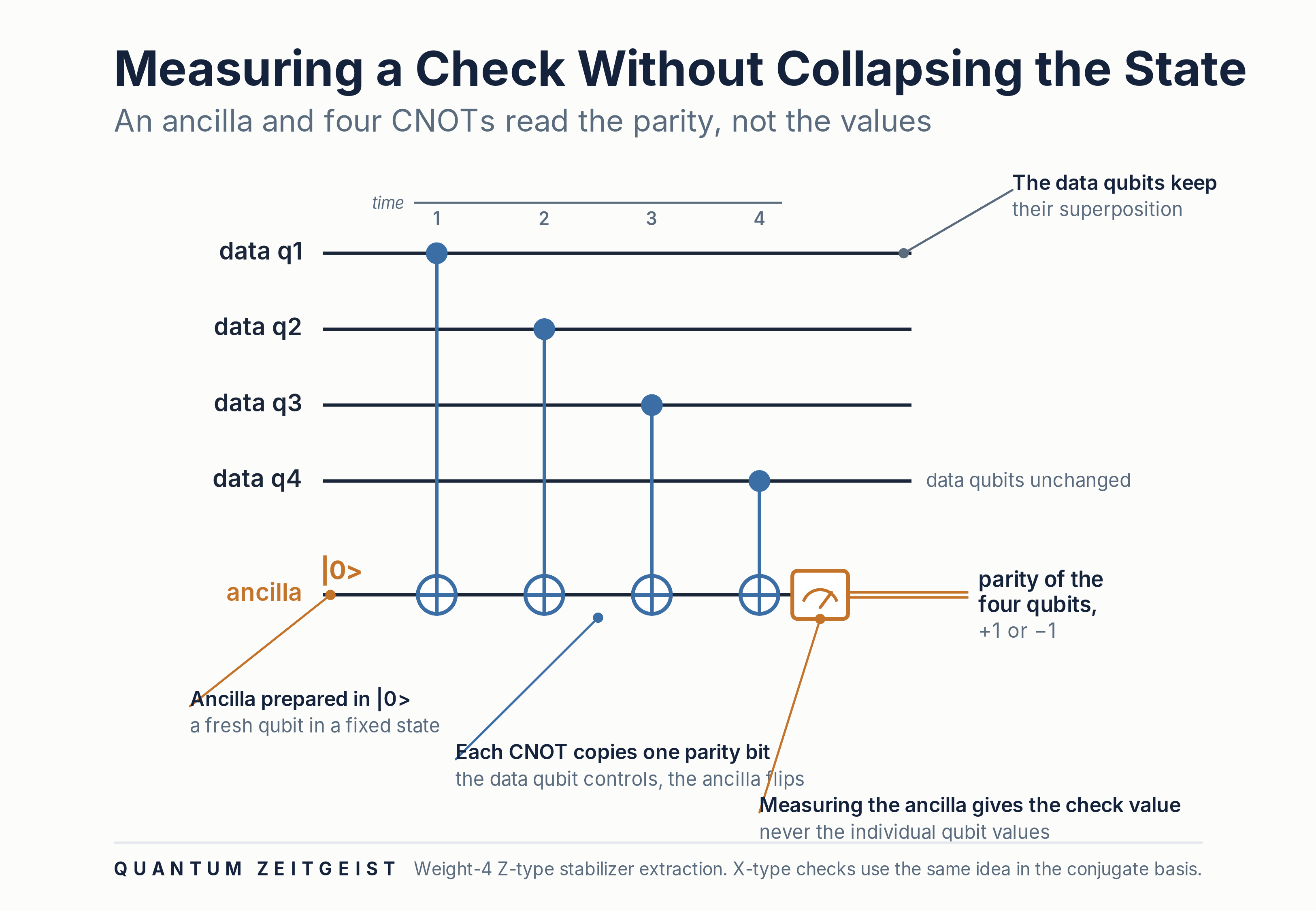 A parity check is measured with one ancilla qubit and a short sequence of controlled-NOT gates. The ancilla starts in a fixed state, each gate copies the combined parity of the data qubits onto it, and measuring the ancilla returns the check value of plus or minus one. Because the gates record only the joint parity, the data qubits keep their superposition untouched.
Decoding the syndrome
A single syndrome bit does not name the error on its own. The job of turning syndromes into corrections falls to a classical decoder, an algorithm that takes the pattern of flipped checks and infers the most likely chain of physical errors that produced it. Minimum-weight perfect matching is the textbook decoder for the surface code, pairing up flipped checks with the shortest possible error chains, and modern systems increasingly use faster or neural-network decoders to keep pace with the hardware. Speed is the hard constraint. The decoder has to keep up with the cycle time, which runs around a microsecond on superconducting chips and longer on trapped-ion and neutral-atom platforms, or the backlog of unprocessed syndromes grows without bound. This is why real-time decoding became a research field of its own, and why error correction is as much a classical-computing problem as a quantum one. Feeding syndromes to that decoder and returning corrections inside the cycle budget depends on the orchestration layer that coordinates CPUs, GPUs and QPUs, the same tight classical loop that hybrid workloads rely on. The decoder often runs on an FPGA or GPU wired close to the quantum chip so the data never has to travel far. The gates that build the syndrome-extraction circuit are the ordinary entangling operations described in our explainer on quantum logic gates. Fault tolerance demands that the extraction circuit tolerate its own mistakes. A naive syndrome measurement could inject more errors than it catches, so the circuits are built so that a single fault during extraction never cascades into an uncorrectable pattern on the data. Repeating the measurement over many cycles and decoding the full space-time history, rather than a single snapshot, is what lets the surface code survive errors in the very machinery that detects errors.Code distance and logical qubits
Code distance is the single number that captures how much protection a patch provides. The distance d is the length of the shortest error chain that can corrupt the logical qubit without being detected, which is also the smallest number of physical errors that can cause an undetected logical failure. A distance-d patch corrects any error pattern of weight up to floor((d-1)/2), so a distance-3 patch fixes a single error, a distance-5 patch fixes two, and a distance-7 patch fixes three.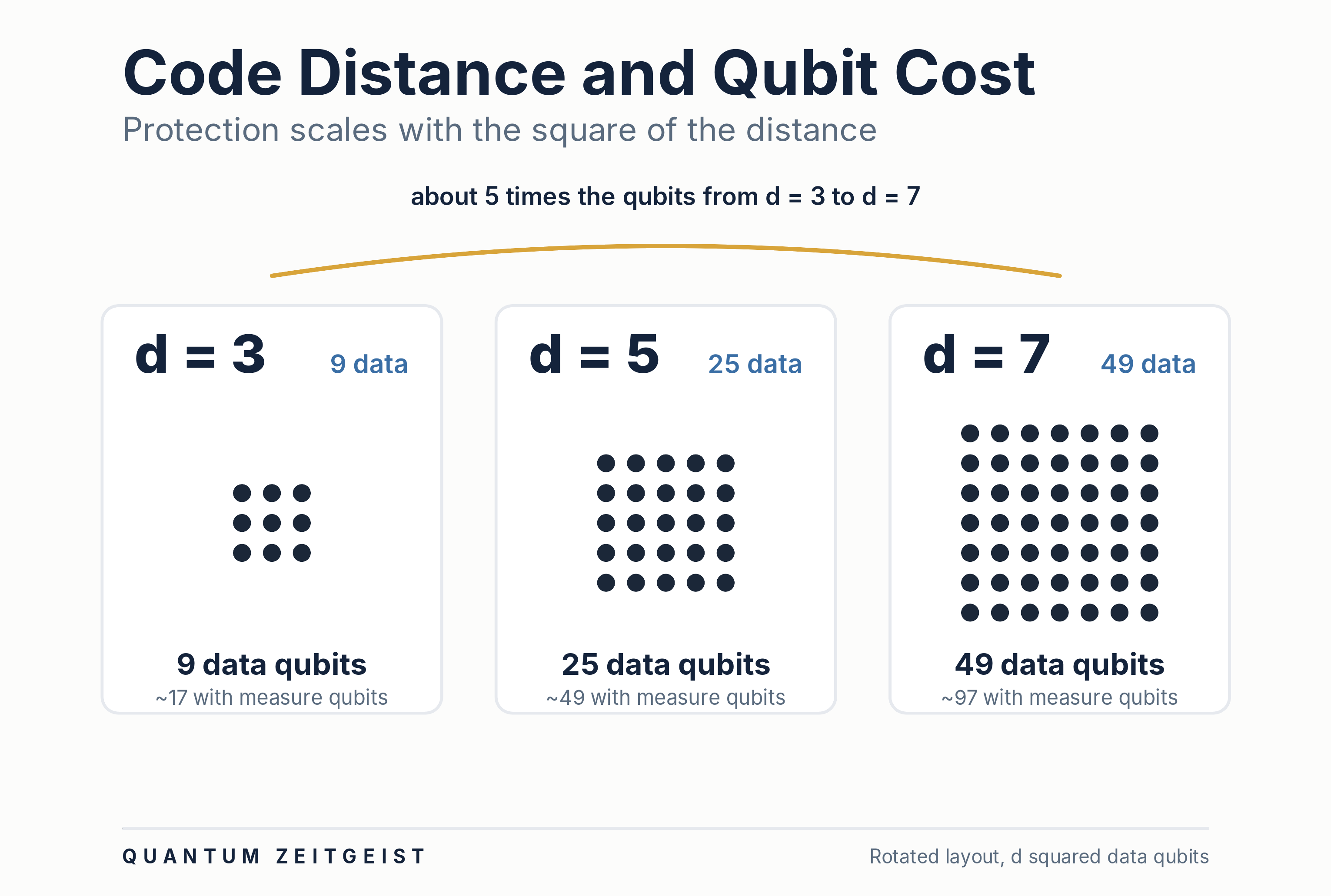 How the code grows as the distance d increases from 3 to 5 to 7. Each panel shows the square block of data qubits for that distance, and the count rises from 9 to 25 to 49 data qubits, or roughly 17, 49, and 97 physical qubits once the measure qubits are included. Reading left to right makes the quadratic cost plain, since every step up in distance buys lower error rates at a much larger qubit footprint.
The cost of more distance
The qubit cost grows quadratically. A distance-d patch needs roughly d squared data qubits plus a comparable number of measure qubits, so doubling the distance roughly quadruples the footprint. A distance-11 logical qubit therefore consumes on the order of a hundred data qubits before ancillas, and the large-distance patches that fault-tolerant algorithms demand push the total toward a thousand physical qubits for one well-protected logical qubit. This is the overhead that makes the surface code expensive. Distance also sets the headline trade-off. Increasing d lowers the logical error rate but consumes more physical qubits, while decreasing d frees qubits at the cost of reliability. The right distance for a given algorithm depends on how long the computation runs and how low the logical error rate has to be, since a longer circuit needs a smaller per-step error rate and therefore a larger distance. The leaderboard of demonstrated logical qubits across modalities is tracked on our quantum logical-qubit leaderboard. The distinction between physical and logical qubits is the heart of it. A physical qubit is a single noisy hardware element, and a logical qubit is the protected object the surface code builds from many of them. The whole point of choosing a distance is to push the logical error rate far below the physical error rate, and the verified count of such logical qubits has become the benchmark vendors compete on, as our guide to quantum error correction lays out in detail.Why the Distance Is Usually Odd
Code distances are nearly always chosen to be odd, and the reason comes straight from how many errors a code can fix. A distance-d code corrects the largest whole number not exceeding half of d minus one, so the correction power only steps up at each odd distance. Moving from an odd distance to the next even one costs more physical qubits without improving the guaranteed number of errors corrected.
| Distance d | Errors corrected |
|---|---|
| 1 | 0 |
| 2 | 0 |
| 3 | 1 |
| 4 | 1 |
| 5 | 2 |
| 6 | 2 |
| 7 | 3 |
There is a second reason rooted in decoding. With an odd distance there is always a clear majority when the decoder weighs competing explanations, much as an odd-sized vote never ends in a tie. An even distance allows an error of exactly half the distance to sit equally between two outcomes, leaving the decoder no principled way to choose, so odd distances avoid that ambiguity.
Logical operators as strings
The logical qubit lives in the global structure of the lattice, and its operations are literally lines drawn across the patch. A logical X operator is a chain of Pauli-X operators running from one boundary to the opposite boundary, and a logical Z operator is a chain of Pauli-Z operators running between the other pair of boundaries. Because these strings span the whole patch, the only way to apply a logical operation by accident is for an error chain to stretch edge to edge, which is exactly why a larger patch is harder to corrupt.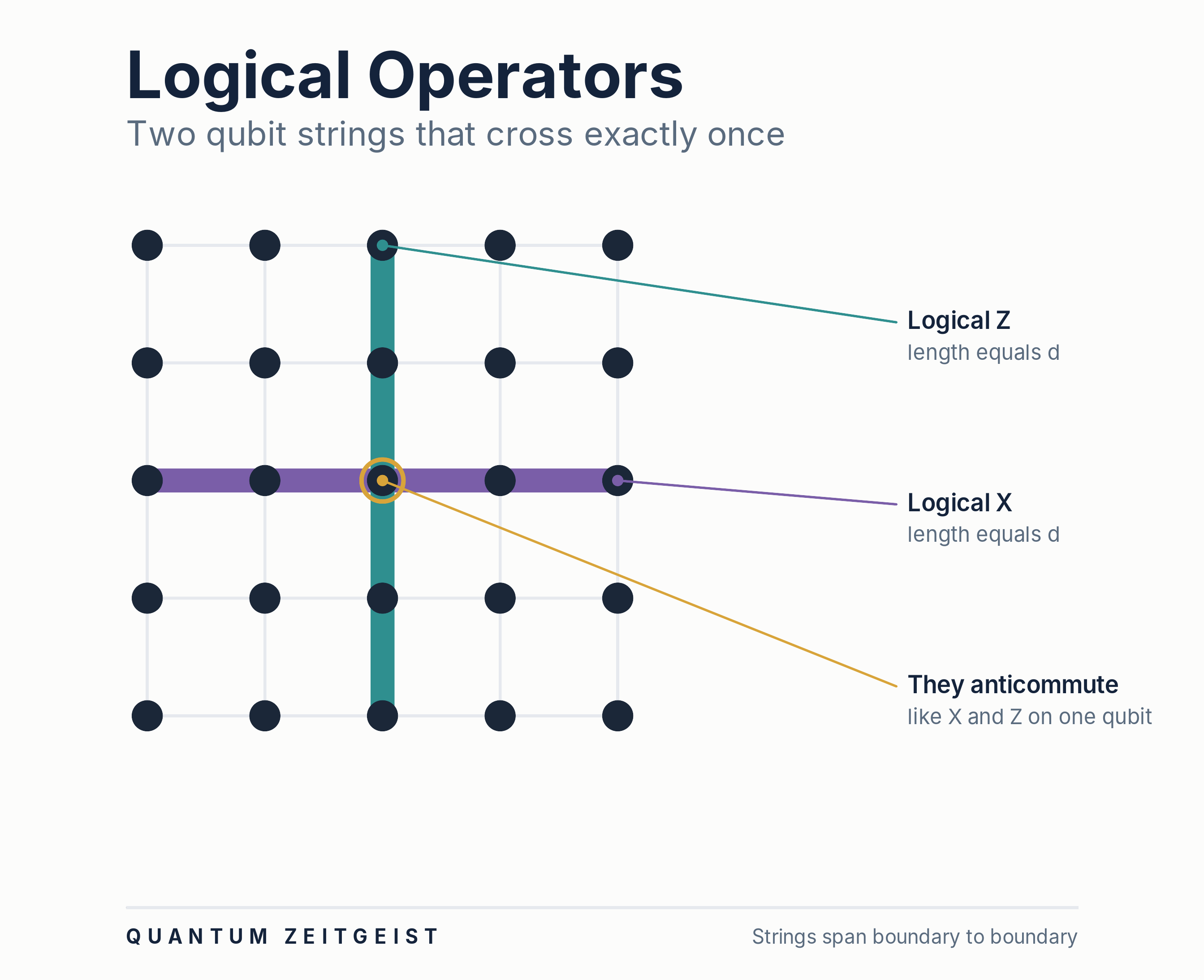 The two logical operators drawn as strings of qubits crossing the same patch. The purple logical X runs horizontally from the left boundary to the right one, and the teal logical Z runs vertically between the top and bottom boundaries. Each string is exactly d qubits long, so a longer string means a larger distance and a logical qubit that is harder to corrupt by accident.
Why the strings can move
These strings are deformable, not fixed. A logical operator can be slid and bent across the lattice as long as it keeps connecting the correct boundaries, because multiplying it by stabilizers leaves the logical action unchanged. That flexibility is what lets the code tolerate errors: a partial error chain that does not yet span the patch is just a detectable disturbance, and only a complete boundary-to-boundary chain registers as a genuine logical flip. The string picture also explains why distance equals length. The shortest possible logical operator is a straight line across the narrow dimension of the patch, and its length is the code distance, so the smallest undetectable error is precisely a logical-operator-sized chain. Stretching the patch lengthens the minimum string, raises the distance, and exponentially suppresses the chance that random errors happen to assemble a full crossing.The threshold theorem and below-threshold scaling
The threshold theorem is the result that makes the code worth building. It states that if the physical error rate sits below a code-specific threshold, then increasing the code distance drives the logical error rate down exponentially, with only polynomial growth in the number of physical qubits. For the surface code under realistic noise the threshold sits in the neighbourhood of one percent, which is a comparatively forgiving target and a large part of why this code leads the field.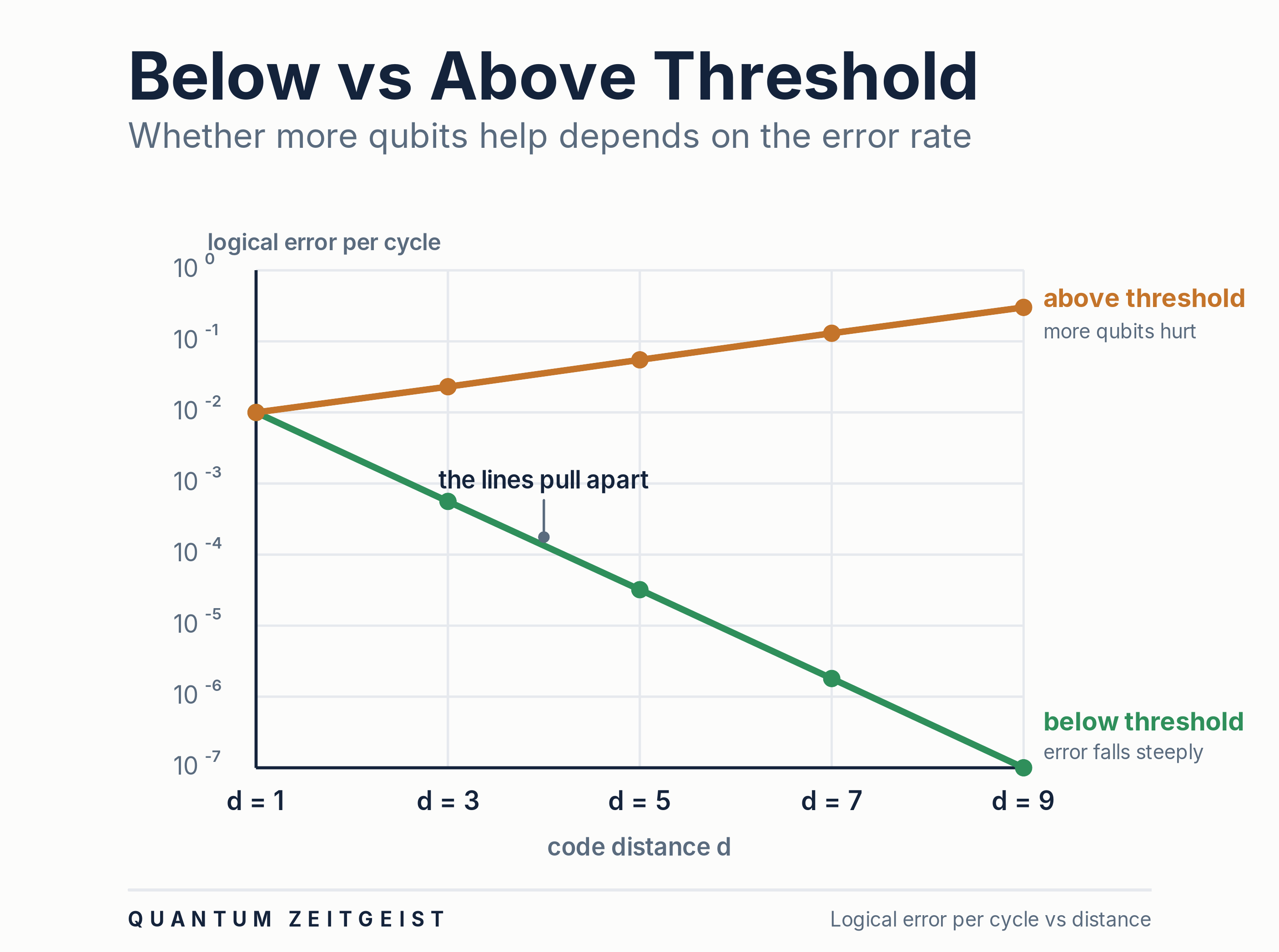 What the threshold theorem looks like as a picture, with code distance on the horizontal axis and the logical error rate per cycle on a logarithmic vertical axis. The green line is the below threshold regime, where the physical error rate sits under the threshold and the logical error rate falls steeply as distance grows. The faint orange line is the above threshold regime, where adding more qubits actually makes the logical qubit worse, so the two lines pull apart as the patch gets larger.
Above and below the tipping point
The threshold behaves like a tipping point. Above it, adding more physical qubits actually makes the logical qubit worse, because each extra component contributes more noise than the code can remove. Below it, the opposite holds, and every increase in distance roughly multiplies the reliability. The whole engineering goal of a quantum-hardware programme is to push physical error rates under that line and then scale distance, which is why crossing the threshold is the defining moment for any modality. Below-threshold operation, not qubit count, is the real fault-tolerance milestone. A machine with thousands of qubits sitting above threshold is a dead end, while a small below-threshold demonstration proves the scaling argument that fault tolerance rests on. The exponential suppression means that each two-step increase in distance can cut the logical error rate by roughly an order of magnitude, so a modest below-threshold margin compounds into arbitrarily low error rates as the patch grows. The practical reading is encouraging. Hardware error rates only have to drop below the threshold once, and from then on every improvement in the physical qubits and every increase in distance compounds. This is the mathematical guarantee that fault-tolerant quantum computing is an engineering problem rather than an impossibility, and the surface code is the code that turned the guarantee into a concrete hardware target.Google Willow and the real demonstrations
The code stopped being purely theoretical in December 2024, when Google’s Willow processor delivered the first convincing below-threshold result on superconducting hardware. Google ran the surface code at distance 3, then distance 5, then distance 7 on the same chip and measured the logical error rate at each step. The rate fell by roughly a factor of two for every increase of two in distance, the exponential suppression the threshold theorem predicts, reported in the team’s Nature paper. This was the demonstration the field had spent two decades chasing. Earlier experiments had encoded logical qubits and even shown error detection, but none had cleanly shown the logical error rate dropping as the code grew, which is the only signature that proves scaling will pay off. Willow’s distance-3-to-5-to-7 ladder showed exactly that downward trend, establishing that the chip’s physical error rate sat below the surface-code threshold. Our coverage of alternative error-correction paths such as cat qubits sets the result in the wider landscape of approaches.The honest limits of the result
Honesty about scale matters here. Willow’s result protected a single logical qubit, and even that consumed the better part of a hundred physical qubits at distance 7. A fault-tolerant machine that runs useful algorithms needs thousands of high-distance logical qubits, which implies physical-qubit counts in the millions, far beyond any chip operating today. The below-threshold demonstration is a proof of principle for scaling, not a finished fault-tolerant computer. Other platforms are crossing similar lines with related codes. Trapped-ion systems from Quantinuum have pushed logical-qubit fidelity dramatically, as our report on the Quantinuum logical-qubit Nature paper describes, and neutral-atom roadmaps such as QuEra’s fault-tolerant plans aim at the same destination from a different hardware base. The surface code remains the common reference point against which these results are measured.Reading Errors With Parity Checks
The simplest way to see detection at work is the three-qubit code, which stores one logical qubit across three physical qubits as the logical states |000> and |111>. You never read a single qubit on its own, because that would collapse the superposition and expose the logical value. Instead you compare qubits in pairs and ask only whether two neighbours agree.
Two checks are enough to cover three qubits. Check A compares qubits 1 and 2, and check B compares qubits 2 and 3, where comparing means taking the parity, the exclusive-or of the two bit values. Each check reads exactly two qubits because parity is a relationship between qubits rather than the value of any single one, so it can reveal disagreement without revealing the encoded state.
Parity check = XOR of the two qubit values.   0 = "same" (+1),   1 = "different" (-1)
  Check A = q1 XOR q2        Check B = q2 XOR q3

NO ERROR, state a|000> + b|111>
  |000> branch:   A = 0 XOR 0 = 0  (+1)     B = 0 XOR 0 = 0  (+1)
  |111> branch:   A = 1 XOR 1 = 0  (+1)     B = 1 XOR 1 = 0  (+1)
  both branches give syndrome (+1, +1): no error seen, amplitudes a and b untouched

SINGLE FLIP
  flip q1:   A = 1 (-1)    B = 0 (+1)    syndrome (-1, +1)  -> qubit 1
  flip q2:   A = 1 (-1)    B = 1 (-1)    syndrome (-1, -1)  -> qubit 2
  flip q3:   A = 0 (+1)    B = 1 (-1)    syndrome (+1, -1)  -> qubit 3
For completeness, the exclusive-or that defines each parity check has a simple four-row truth table. The check reads plus one when the two values match and minus one when they differ.
| a | b | a XOR b | Check reads |
|---|---|---|---|
| 0 | 0 | 0 | +1, same |
| 0 | 1 | 1 | -1, different |
| 1 | 0 | 1 | -1, different |
| 1 | 1 | 0 | +1, same |
| Error | Check A (q1,q2) | Check B (q2,q3) | Syndrome | Points to |
|---|---|---|---|---|
| none | +1 | +1 | (+1, +1) | no error |
| qubit 1 | -1 | +1 | (-1, +1) | qubit 1 |
| qubit 2 | -1 | -1 | (-1, -1) | qubit 2 |
| qubit 3 | +1 | -1 | (+1, -1) | qubit 3 |
The clean-state rows show why the checks preserve the superposition. In the |000> branch qubits 1 and 2 are both 0, and in the |111> branch they are both 1, so each branch reports “same” and the check returns +1 without distinguishing the two branches. The amplitudes a and b therefore survive the measurement, which is the whole point of using parity rather than reading a qubit directly.
The error rows show why two checks are enough. Two parity bits give four possible patterns, one for the clean state and three more that each point at a single flipped qubit, so any single error is located exactly. A third check would add nothing, because three qubits hold only two independent neighbour relationships.
The surface code scales this same idea onto a two-dimensional lattice. Its stabilizers are parity checks as well, with Z-type checks catching bit flips and X-type checks catching phase flips, and a single error still lights up the checks at its two ends. The decoder then reads that pattern of flipped checks the way the three-qubit syndrome points straight at one qubit.
Reading the Syndrome
Detecting a parity is only the first step, because the pattern of flipped checks still has to be turned into a guess about which qubits failed. That pattern of stabilizer outcomes is called the syndrome, and reading it means measuring every check qubit each cycle and then decoding what the results imply. A check reads minus one only when an error anticommutes with it, so an error chain lights up the checks at its two endpoints rather than along its whole length.
This is why the syndrome points to the ends of an error, not the error itself. The lit-up checks are often called defects, and a single error chain produces a pair of them, one at each end. Many different chains can produce the very same pair of defects, a feature known as degeneracy, so the syndrome alone never identifies the exact qubits that flipped.
Resolving that ambiguity is the job of a classical decoder. For the surface code the standard method is minimum-weight perfect matching, which pairs up the defects using the shortest chains that connect them, on the principle that fewer errors is more likely than many. The decoder returns its best guess for the underlying error, and the system either applies the matching correction or simply records it in software as a Pauli frame and carries on.
One more layer makes the reading reliable, since the check measurements are themselves noisy. Rather than trusting a single round, the hardware compares each check against its value in the previous round and flags only the changes, then decodes the whole history as a three dimensional record across the lattice and time. If the inferred correction and the real error together close into small loops the logical qubit is safe, and only when they combine into a string spanning the patch does a logical error slip through.
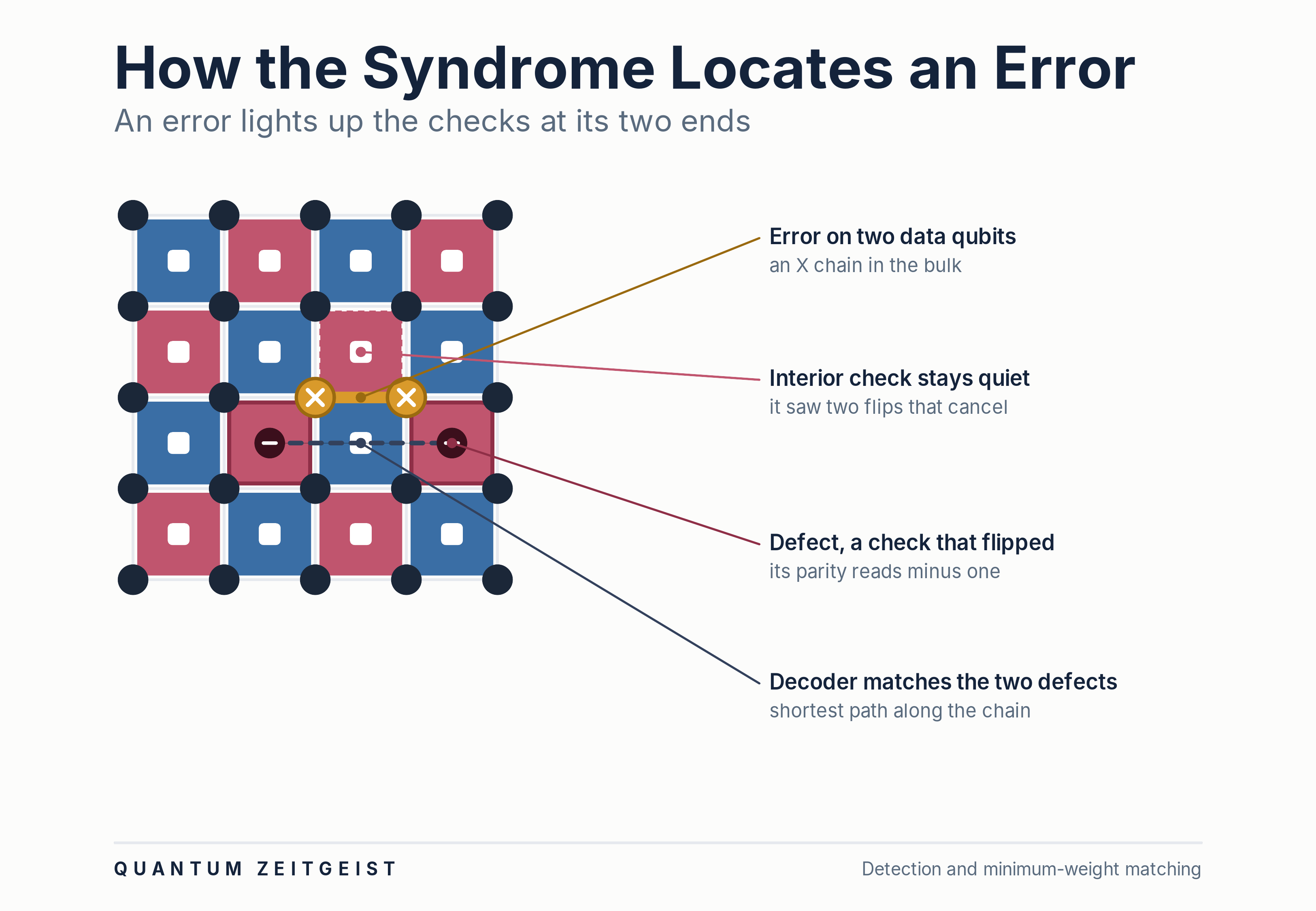 A single error chain on the data qubits is detected by the parity checks at its two ends, which flip to minus one and become defects. The checks between the errors stay quiet because they each see two flips that cancel out. A decoder then pairs the two defects with the shortest matching path, which is its best guess at the underlying error.
How Often the Cycle Repeats
Error correction is not a one-time event but a heartbeat that runs for as long as the logical qubit exists. Each cycle resets the measure qubits, entangles them with their neighbouring data qubits through several layers of two-qubit gates, and then reads them out to produce one fresh round of syndrome information. The readout and reset are usually the slowest steps, so they set the pace of the whole round.
On today’s superconducting hardware a single cycle takes roughly one microsecond, which means the code is read out on the order of a million times every second. Google’s below threshold demonstrations ran rounds of about this length, repeated continuously throughout each experiment. The logical qubit is protected only while this loop keeps running, since the moment the measurements stop the patch becomes an unprotected set of bare qubits.
The figure that really matters is the ratio between the cycle time and the qubit coherence time. A cycle near one microsecond against coherence times of tens to roughly a hundred microseconds gives about a hundred correction rounds within a single qubit lifetime. That margin is what keeps the physical error per cycle below threshold, because each round catches errors faster than they pile up.
The time direction carries its own protection as well. A distance-d memory experiment usually runs about d rounds of syndrome extraction, so the decoder works over a block that is d wide in space and d deep in time. Slower platforms such as trapped ions and neutral atoms take much longer per round, yet their far longer coherence keeps the same ratio workable while the wall clock simply runs at a gentler pace.
How the Double Bracket Notation Works
Quantum error correcting codes are summarised with a compact label written in a double bracket, [[n, k, d]]. The first number n is the count of physical qubits the code uses, the second number k is how many logical qubits those physical qubits encode, and the third number d is the code distance that sets how many errors the code can tolerate. The double bracket marks it as a quantum code, where single brackets would denote a classical one.
For the surface code these numbers fall straight out of the lattice. A rotated patch that protects one logical qubit at distance d uses d squared physical qubits, so it is written [[d², 1, d]]. A distance-5 patch is [[25, 1, 5]] and a distance-7 patch is [[49, 1, 7]], which shows how steeply the physical-qubit cost climbs as the distance rises.
The distance still governs protection through the rule used across this guide, since a code of distance d corrects up to half of d minus one errors, rounded down. That makes [[25, 1, 5]] able to fix two errors per cycle and [[49, 1, 7]] able to fix three. Increasing k packs more logical qubits into one block, as the toric code does when it is written [[2d², 2, d]], though that version needs a periodic boundary that real hardware finds harder to wire up.
How Many Measure Qubits a Patch Needs
The double bracket also fixes how many measure qubits a patch needs, because every stabilizer check is read out by one ancilla. A code defined on n physical qubits that encodes k logical qubits is held in place by n minus k independent stabilizer generators, so the number of measure qubits is simply n minus k. This is a general rule for stabilizer codes rather than a quirk of the surface code.
For the rotated surface code that rule gives a tidy formula. With n equal to d² data qubits and k equal to one logical qubit, a distance-d patch carries d² minus 1 measure qubits, which split evenly into X-type and Z-type checks. The full footprint is therefore d² data qubits plus d² minus 1 measure qubits, or 2d² minus 1 physical qubits in total.
| Distance | Data qubits (d²) | Measure qubits (d²-1) | Total (2d²-1) |
|---|---|---|---|
| d = 3 | 9 | 8 | 17 |
| d = 5 | 25 | 24 | 49 |
| d = 7 | 49 | 48 | 97 |
The unrotated layout follows the same n minus k rule with a larger n. Its 2d² minus 2d plus 1 data qubits come with 2d² minus 2d measure qubits, close to double the rotated count, which is one more reason hardware teams prefer the rotated patch.
Rotated and Unrotated Layouts
The surface code comes in two layouts that encode the same logical qubit with different qubit budgets. The original unrotated layout, sometimes called the standard or planar surface code, places data qubits and measure qubits on a plain square lattice, and reaching distance d costs about 2d² minus 2d plus 1 data qubits. The rotated layout turns that lattice by 45 degrees and trims the boundary, so the same distance d needs only d² data qubits while keeping one logical qubit and the same X-type and Z-type checks.
The saving is close to a factor of two, and it grows with distance, which is why every hardware team builds the rotated version. The table below compares the data-qubit cost at the distances that current experiments target.
| Distance | Unrotated data qubits | Rotated data qubits |
|---|---|---|
| d = 3 | 13 | 9 |
| d = 5 | 41 | 25 |
| d = 7 | 85 | 49 |
Google’s below threshold demonstrations at distance 3, 5 and 7 all used the rotated layout, and so do the qubit counts quoted throughout this guide. When a paper writes the surface code as [[d², 1, d]], it is describing the rotated version, since the unrotated code carries the heavier 2d² minus 2d plus 1 cost for the same protection.
Preparing and Reading Out a Logical Qubit
Storing and correcting a logical qubit is only useful if you can also load a value into it and read one back out. Preparing a logical zero is done by setting every data qubit to the physical zero state and then running a few rounds of stabilizer checks, which projects the patch into the protected code space with the logical qubit in its zero state. Preparing a logical plus state works the same way starting from physical plus states, which fixes the complementary set of checks.
Reading the logical qubit out runs the same parity machinery in reverse. To measure the logical Z value you measure every data qubit in the Z basis and combine the outcomes along a logical Z string, since the product of those single-qubit results gives the logical bit while the stabilizers confirm that no error spoiled the readout. Measuring the logical X value uses the X basis and an X string in the same way.
Both operations stay fault tolerant because they lean on the same redundancy as the rest of the cycle. The preparation rounds and the final readout are each repeated and cross-checked against the syndrome history, so a stray error during loading or measurement is caught rather than silently corrupting the result. This is what lets a logical qubit be initialised, computed on, and measured without ever exposing it to a single unprotected step.
Lattice surgery and logical gates
Storing a logical qubit is only half the problem; the code also has to compute with it. The standard technique is lattice surgery, in which two logical patches are placed side by side and their shared boundary is merged for a few cycles and then split again. Merging and splitting along a boundary enacts a joint measurement between the two logical qubits, and from those joint measurements the device builds the entangling gates that computation requires. Lattice surgery keeps the friendly geometry intact. Because the operation only ever touches the boundary between adjacent patches, it never demands long-range connections or qubits leaving the plane, which preserves the nearest-neighbour property that made the surface code attractive in the first place. Moving, growing, and shrinking patches on the lattice becomes the vocabulary of surface-code computation, and a compiler’s job is to schedule these patch operations efficiently.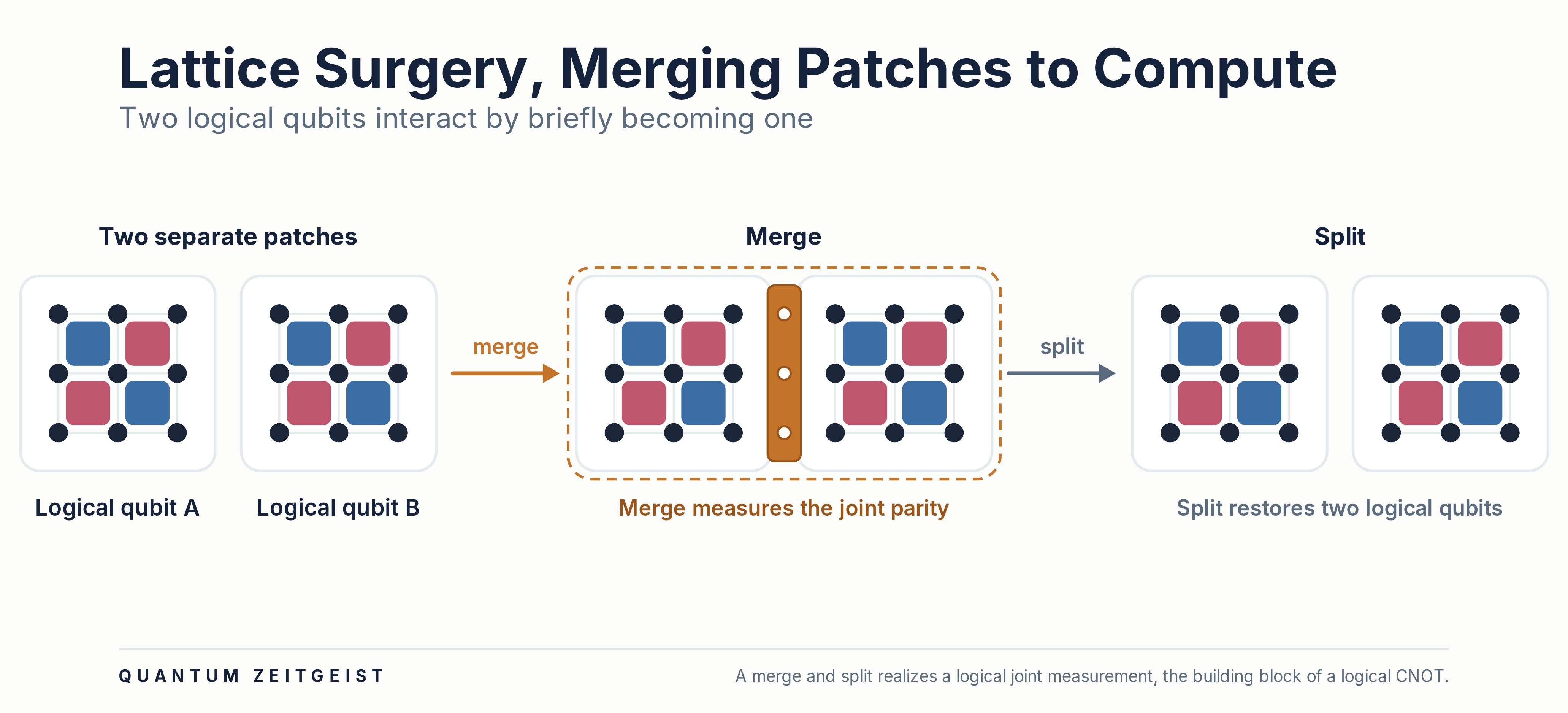 Two logical patches interact by lattice surgery. For a few rounds the checks along the boundary between them are switched on, which merges the patches into one and measures the joint parity of the two logical qubits. Splitting them apart again leaves two logical qubits, and this merge and split is the building block of a logical CNOT.
The cost of universal gates
Not every gate comes for free. The code implements the Clifford group of gates, including the entangling operations, fault-tolerantly through lattice surgery and patch deformation, but a universal quantum computer also needs a non-Clifford gate such as the T gate. Supplying that gate requires magic-state distillation, a resource-hungry process that injects specially prepared states into the computation, and those distillation factories often dominate the physical-qubit budget of a full surface-code machine. This is where the overhead really bites. A useful surface-code computer spends a large fraction of its qubits not on storing logical information but on producing the magic states that make universal computation possible. Reducing that distillation cost, through better protocols and architectural tricks, is one of the central engineering frontiers for turning surface-code demonstrations into machines that solve real problems.How it compares to colour codes and qLDPC
The code is the leader, but it is not the only option, and its rivals attack its weaknesses directly. The two most discussed alternatives are colour codes and quantum low-density parity-check codes, each trading away some of the surface code’s friendliness for a different advantage. Understanding the contrast clarifies why the surface code leads today and why it might not lead forever.| Code family | Connectivity | Qubit overhead | Main advantage |
|---|---|---|---|
| Surface code | Nearest-neighbour, 2D | High (hundreds to thousands per logical qubit) | Easiest hardware, ~1% threshold, proven on Willow |
| Colour code | Nearest-neighbour, 2D | High, slightly worse than surface | Richer transversal gate set, easier non-Clifford access |
| qLDPC code | Long-range, non-planar | Much lower per logical qubit | Far better encoding rate, fewer physical qubits |
Where qLDPC codes win
Quantum LDPC codes come at the problem from the opposite direction. They abandon the strict nearest-neighbour layout in exchange for a dramatically better encoding rate, packing many logical qubits into far fewer physical qubits than the surface code could manage. The catch is the connectivity, since qLDPC codes need some long-range links that flat chips do not naturally provide, and reconciling that demand with real hardware is the active frontier explored in our survey of quantum error correction companies. The honest summary is a trade between convenience and efficiency. The code is hardware-friendly but qubit-expensive, qLDPC codes are qubit-efficient but connectivity-hungry, and colour codes sit in between with better gates but more overhead. Most near-term machines bet on the surface code because the geometry is solved, while the longer-term roadmaps increasingly eye qLDPC to escape the overhead wall.Why the surface code matters
The code matters because it converted fault tolerance from a theorem into a hardware target. For two decades it has been the default assumption in nearly every quantum-hardware roadmap, the code that companies design their chips and atom arrays to support, and the yardstick against which every error-correction result is measured. When a vendor talks about logical qubits and thresholds, the surface code is usually the implicit reference. Its strengths and weaknesses are both clarifying. The strength is the gentlest connectivity in the field plus a forgiving threshold, which is why the surface code reached the first below-threshold demonstration on superconducting hardware. The weakness is overhead, the hundreds to thousands of physical qubits each logical qubit demands, which is the wall that pushes the next generation of research toward qLDPC and other higher-rate codes. The near-term trajectory is clear even if the destination is far off. Hardware teams are driving physical error rates further below threshold and scaling patches to higher distances, while decoder researchers race to keep real-time decoding fast enough for larger lattices. Compilers are learning to schedule lattice surgery and magic-state distillation efficiently, and the verified logical-qubit count keeps climbing across superconducting, trapped-ion, and neutral-atom platforms tracked on our logical-qubit leaderboard. For anyone following quantum computing, it is the concept that ties the hardware story together. It connects qubits, gates, decoherence, and error correction into a single picture of how a noisy device becomes a reliable computer, and it is the reason below-threshold operation, rather than headline qubit counts, is the milestone worth watching. The companies pursuing it are profiled in our guide to top quantum error correction companies, and the broader hardware field in our roundup of superconducting quantum computing companies.Primary sources and further reading
The foundational reference is the long paper by Austin Fowler and colleagues that turned the surface code into a practical engineering blueprint, freely available as the 2012 Fowler et al. surface code preprint on arXiv. The topological idea behind it traces back to Alexei Kitaev’s fault-tolerant anyon proposal, the work that introduced the toric code. The first below-threshold hardware result appears in Google’s 2024 Nature paper on quantum error correction below the surface code threshold, and the wider conceptual background sits in the Stanford Encyclopedia of Philosophy entry on quantum computing. These are primary and reference works rather than news coverage, which keeps the citations stable over time.Frequently asked questions
What is the surface code in simple terms?
The surface code is a quantum error correction scheme that stores one protected logical qubit across a flat two-dimensional grid of physical qubits. Half the qubits hold the quantum information and the other half continuously measure local parity checks that reveal where errors struck, all without reading the protected information directly. It is the leading code for fault-tolerant quantum computing because it only needs each qubit to talk to its immediate neighbours, which fits real hardware unusually well.
Why is the surface code the leading quantum error correction code?
The surface code leads for two reasons that hardware engineers care about most. Its checks involve only nearest-neighbour qubits, so it maps cleanly onto superconducting chips, ion traps, and neutral-atom arrays without exotic long-range wiring. It also has a relatively forgiving error threshold of around one percent, meaning physical qubits do not need to be impossibly perfect for the code to start suppressing errors. Google’s Willow chip made the case concrete by demonstrating below-threshold operation with the surface code in 2024.
What is the difference between data qubits and ancilla qubits?
Data qubits store the encoded quantum information that the code is protecting, and they are never measured during normal operation so the logical state stays intact. Ancilla qubits, also called measure or syndrome qubits, exist only to read out the stabilizer checks each cycle and are measured and reset repeatedly. The pattern of ancilla outcomes, called the syndrome, tells a classical decoder where errors occurred so it can correct them without ever touching the data qubits’ protected state.
What are X-type and Z-type stabilizers?
The code uses two kinds of parity check arranged in a checkerboard. X-type stabilizers are built from Pauli-X operators and detect phase-flip (Z) errors, while Z-type stabilizers are built from Pauli-Z operators and detect bit-flip (X) errors. Because any single-qubit quantum error breaks down into a combination of bit flips and phase flips, catching both classes is enough to catch any error. The checkerboard layout ensures neighbouring X and Z checks commute, so they can be measured together without interfering.
What is code distance in the surface code?
Code distance, written d, is the length of the shortest chain of errors that can corrupt the logical qubit without being detected. A distance-d surface code patch uses roughly d squared data qubits and corrects any error pattern of weight up to floor((d-1)/2), so distance 3 fixes one error, distance 5 fixes two, and distance 7 fixes three. Larger distance means a lower logical error rate but a quadratically larger number of physical qubits, which is the central cost trade-off of the code.
How many physical qubits does one logical qubit need?
It depends entirely on the code distance, which sets the protection level. A distance-d patch needs about d squared data qubits plus a comparable count of measure qubits, so a distance-11 logical qubit consumes on the order of a hundred data qubits and a full ancilla complement. Fault-tolerant algorithms that run long circuits need high-distance patches, which pushes the requirement toward roughly a thousand physical qubits for a single well-protected logical qubit, and that overhead is the surface code’s main drawback.
What does below threshold mean and why does it matter?
Below threshold means the physical error rate of the hardware sits under the code’s critical value, around one percent. When that condition holds, increasing the code distance drives the logical error rate down exponentially rather than up, so adding qubits actually helps. Below-threshold operation, not raw qubit count, is the real fault-tolerance milestone, because it proves that the scaling argument behind error correction works on real hardware. Above threshold, adding qubits only makes the logical qubit noisier.
What did Google Willow demonstrate with the surface code?
In December 2024 Google’s Willow superconducting processor ran the code at distance 3, then 5, then 7 on the same chip and measured the logical error rate at each step. The error rate fell by roughly a factor of two for every increase of two in distance, the exponential suppression the threshold theorem predicts, which proved the chip operated below the surface-code threshold. It was the first convincing below-threshold surface-code demonstration on superconducting hardware, although it protected only a single logical qubit using close to a hundred physical qubits.
How does the surface code perform logical gates?
The code computes mainly through lattice surgery, where two logical patches are placed side by side and their shared boundary is merged for several cycles and then split. That merge-and-split sequence enacts a joint measurement between the two logical qubits, and from those measurements the device builds entangling gates. Lattice surgery keeps everything nearest-neighbour, preserving the friendly geometry. A non-Clifford gate such as the T gate additionally requires magic-state distillation, a resource-heavy process that often dominates the qubit budget of a full machine.
What is a logical operator in the surface code?
A logical operator is a chain of single-qubit Pauli operators that runs across the surface code patch from one boundary to the opposite boundary. The logical X operator is a string of Pauli-X operators spanning one pair of boundaries, and the logical Z operator is a string of Pauli-Z operators spanning the other pair. Because these strings have to cross the whole patch, only an error chain that stretches edge to edge can cause an undetected logical flip, which is why a larger patch with a longer minimum string is harder to corrupt.
How does the surface code compare to qLDPC codes?
The surface code and quantum LDPC codes make opposite trade-offs. The former uses only nearest-neighbour connectivity, which fits hardware beautifully, but pays a high overhead of hundreds to thousands of physical qubits per logical qubit. qLDPC codes pack many more logical qubits into far fewer physical qubits, dramatically improving the encoding rate, but they require some long-range connections that flat chips do not naturally provide. Near-term machines favour the surface code because its geometry is solved, while longer-term roadmaps increasingly look to qLDPC to escape the overhead wall.
How does the surface code relate to the color code?
Colour codes are close relatives, also topological and also defined on a two-dimensional lattice, but they place three colours of check around each face instead of the surface code’s two stabilizer types. That richer structure lets colour codes apply a larger set of logical gates directly, easing access to non-Clifford operations without as much magic-state distillation. The cost is a somewhat higher physical-qubit overhead and more complex syndrome extraction, which is why the surface code has stayed ahead in raw hardware demonstrations so far.
When will the surface code enable a useful quantum computer?
Most published roadmaps target useful fault-tolerant operation in roughly the 2029 to 2033 window, and the surface code is the default code those plans assume. The 2024 below-threshold demonstrations proved the scaling principle, so the remaining work is engineering: driving physical error rates further below threshold, scaling patches to higher distances, building real-time decoders fast enough for large lattices, and cutting the magic-state-distillation overhead. A machine running serious chemistry or cryptography algorithms implies millions of physical qubits, which is the central scaling challenge of the coming decade.


See today’s quantum computing news on Quantum Zeitgeist for the latest breakthroughs in qubits, hardware, algorithms, and industry deals.