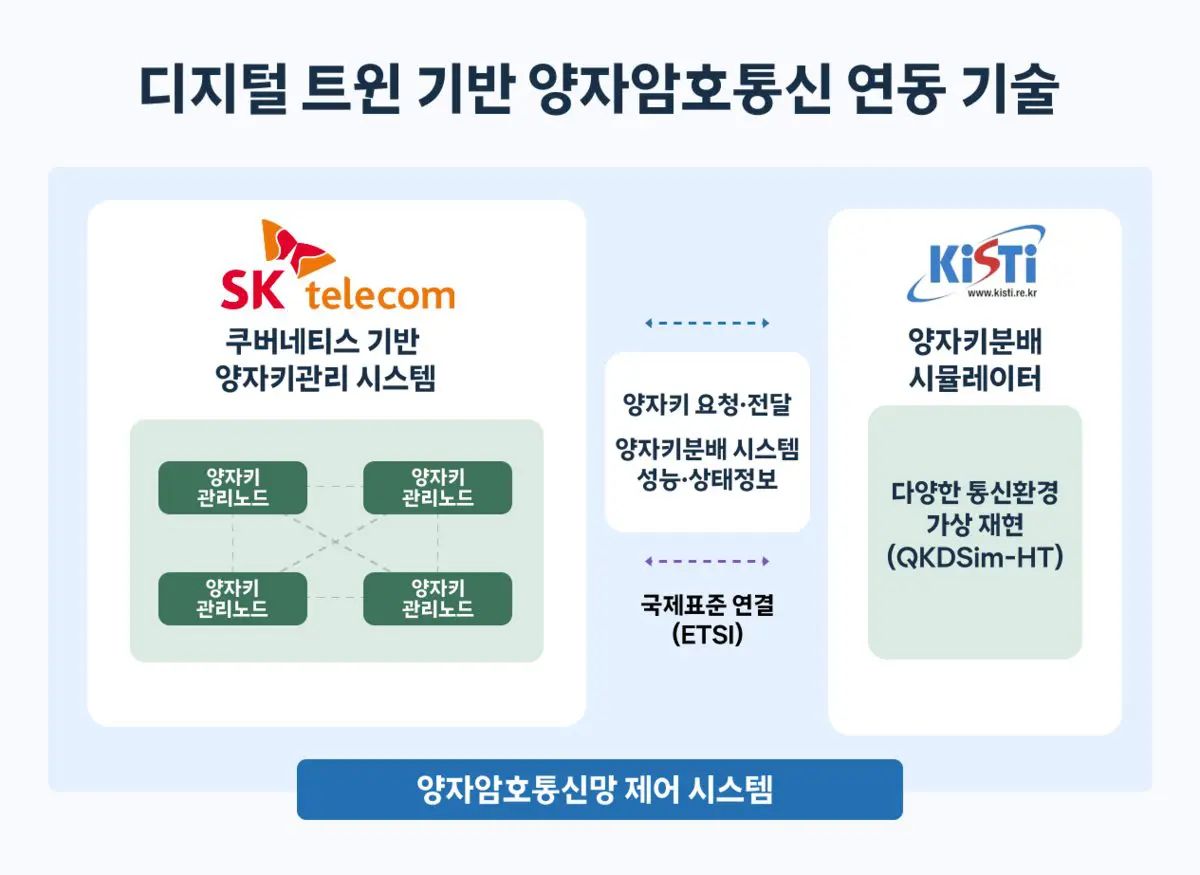
SK Telecom and the Korea Institute of Science and Technology Information (KISTI) have jointly developed a digital twin technology to virtually verify quantum cryptography networks before construction begins. Unveiled at ECOC 2026 in Malaga, Spain, the system links SK Telecom’s quantum key management system with KISTI’s QKD simulator using interfaces compatible with European Telecommunications Standards Institute (ETSI) standards.
This approach allows engineers to optimize network design and verify the entire quantum key process, from generation to supply, without installing costly quantum encryption equipment at every site. According to SK Telecom and KISTI, this marks the first public demonstration of an independently developed quantum key management system linked with a QKD simulator.
Digital Twin Verifies Quantum Key Distribution Network Designs
This connection, demonstrated at ECOC 2026 in Malaga, Spain, bypasses the need for costly, iterative testing with physical equipment across diverse communication environments. The digital twin technology virtually reproduces critical parameters like transmission distance and optical loss, alongside characteristics of QKD equipment such as detection efficiency and post-processing algorithms, enabling optimized network designs. The core of this system relies on interfaces compatible with standards set by the European Telecommunications Standards Institute (ETSI), a deliberate choice to avoid vendor lock-in and promote interoperability.
Quantum encryption equipment from various developers can be integrated into the virtual environment, enhancing scalability and future-proofing the network infrastructure. Equipment layouts and configuration values verified in the virtual environment can then be applied to actual network construction, streamlining the deployment process and reducing potential errors. Altering physical conditions like optical cable length after network construction proved difficult and expensive.
SK Telecom’s quantum key management system is built on container technology and operated with Kubernetes, providing the flexibility to adapt to different network environments and key management needs, the company says. KISTI developed the QKD simulator, which accurately models transmission conditions and optical loss, creating a realistic virtual testing ground. The ability to simulate diverse conditions is particularly valuable given the sensitivity of quantum key distribution to environmental factors.
This digital twin technology represents a step toward practical, scalable quantum communication networks, offering a cost-effective and efficient method for design verification and optimization. By enabling virtual testing and reducing reliance on expensive physical infrastructure, SK Telecom and KISTI are paving the way for wider adoption of quantum encryption technologies, and the system’s adherence to ETSI standards ensures compatibility and avoids vendor lock-in, fostering a more open and interoperable quantum communication ecosystem.