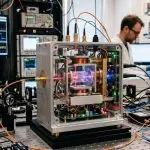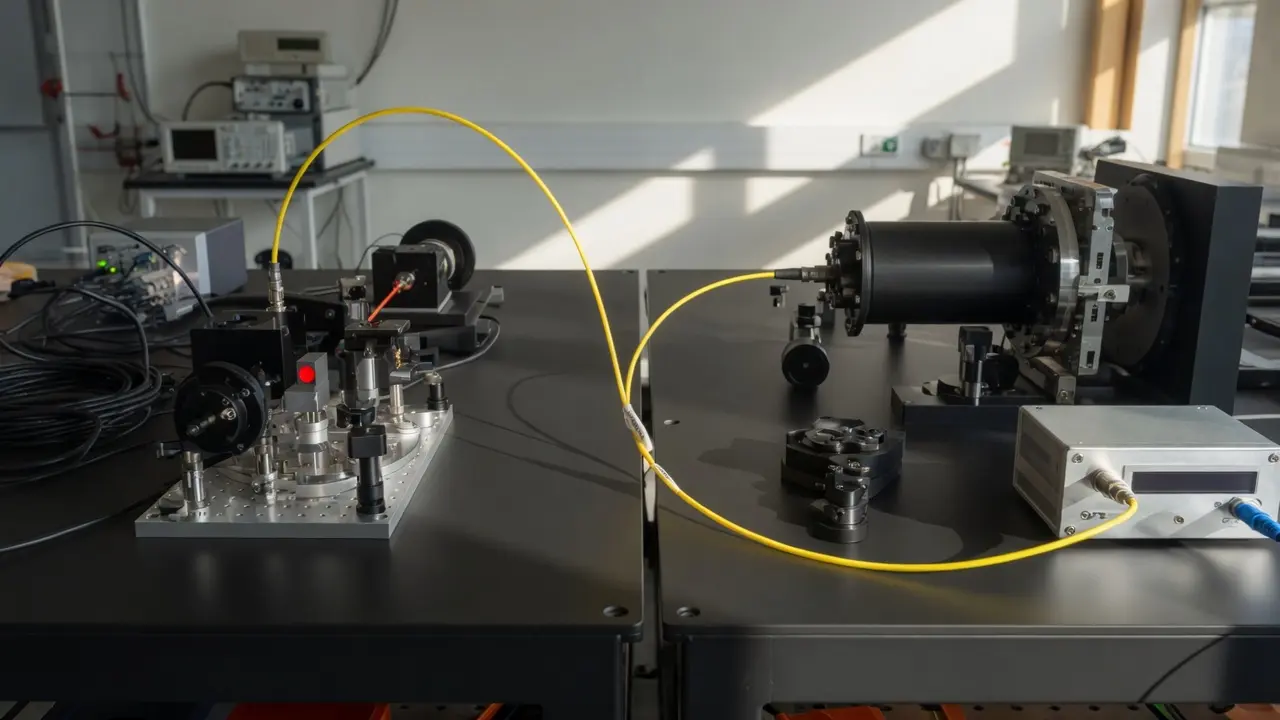
Researchers at Tsinghua University and the University of Science and Technology of China have demonstrated universal two-qubit control between superconducting quantum processors housed in separate dilution refrigerators connected by a 10-kilometer optical cable. The team’s coherent optical link transmits microwave control signals over this distance, compensating for frequency mismatches between the devices. Through this link, they achieved a Bell-state fidelity of 80.6% while delivering a universal gate set to a transmon qubit and a cavity qubit, establishing a classical backbone for building modular quantum processors.
Two-Refrigerator Entanglement via 10km Coherent Optical Link
A 10-kilometer coherent optical link successfully delivered the signals needed to entangle qubits residing in separate dilution refrigerators, a distance exceeding previous demonstrations of such control. This achievement bypasses the limitations of direct wiring between quantum processors, offering a pathway toward scalable, modular quantum computing architectures. The system uses a laser to convert microwave signals into light for transmission through optical fiber, then reconverts them back into microwaves at the receiving end while preserving phase information critical for precise qubit manipulation.
The implemented coherent optical link isn’t merely a signal conduit. It delivers complete control over remote qubits, enabling the execution of a universal set of quantum gates. Researchers performed single-qubit gates on a transmon qubit and created a second qubit from a storage cavity, then applied conditional gates between them, all controlled from a separate refrigerator.
This level of remote control is essential for building larger quantum processors from interconnected modules, overcoming the physical constraints of building everything on a single chip. This experiment’s success hinges on maintaining the phase of the microwave signals across the 10-kilometer fiber optic cable, a significant technical hurdle. The team compensated for frequency differences between the devices using optical references derived from the same laser, ensuring accurate signal regeneration at the receiving end.
Characterization of the link revealed the optical spectra reflected from the microwave-to-optical transducer both with and without the microwave drive applied, confirming the system’s functionality. The resulting Bell state fidelity reached 80.6%, indicating a high degree of entanglement quality between the qubits in the two refrigerators.
The implications extend beyond simply connecting two systems. The architecture supports adaptive control, a necessity for harnessing shared entanglement in distributed quantum networks. Direct classical links are essential for mid-circuit measurements and feed-forward signals, allowing for real-time adjustments and optimization of quantum computations.
“Such modules need two kinds of links,” the researchers state, “quantum links share entanglement between them, and classical links coordinate them by carrying the drives that set their gates and the feed-forward signals that act on mid-circuit measurements.” This integrated approach, combining quantum and classical communication channels, is a key step toward realizing the full potential of distributed quantum computing for applications in communication, computation, and sensing.
Microwave-to-Optical Conversion for Distant Qubit Control
The use of light to control quantum bits across a 10-kilometer fiber optic cable represents an advance in overcoming the limitations of traditional wiring in distributed quantum systems. This coherent optical link (COL) delivers microwave waveforms and their associated phase references between separate dilution refrigerators, a critical step toward scalable quantum computing architectures. The system combines a laser, a microwave-to-optical transducer, and an optical-to-microwave photodiode to transmit control signals while simultaneously compensating for frequency discrepancies between the devices.
This approach bypasses the need for attenuators typically required in coaxial drive lines, reducing power consumption, size and overall cost of control channels. Optical fiber’s inherent properties offer distinct advantages for this application, including low signal loss and minimal thermal conductance, allowing for efficient signal transmission into cryogenic environments. Unlike conventional control methods, the receiving module requires neither a synthesizer nor a local oscillator, eliminating decoding latency and digital-to-analog conversion delays.
A microwave-to-optical transducer within one refrigerator converts control signals into optical signals, which travel through the 10.1-kilometer fiber to the second refrigerator. There, a beating signal and reference on a photodiode convert the optical signal back into microwave pulses, enabling control of a transmon qubit and its coupled storage cavity for entanglement. Characterization of the transducer revealed a full width at half maximum of 3.6 MHz, demonstrating the precision of the conversion process.
The remote control scheme uses an electro-optic modulator sideband at a specific frequency as a reference for the qubit drive, ensuring accurate signal delivery. The reflected pump light is the reference for the microwave signal, further enhancing the stability and accuracy of the control.
The experimental setup involved operating the microwave-to-optical transducer at approximately 4.3 Kelvin and the optical-to-microwave photodiodes on a 4 Kelvin stage, both within their respective dilution refrigerators. This precise temperature control is essential for maintaining the coherence of the qubits and ensuring reliable signal transmission. The system’s design allows for adaptive control, enabling real-time adjustments and optimizations of the quantum circuit.
Advantages of Coherent Light for Classical Quantum Links
Optical fiber transmission offers substantial practical benefits for interconnecting quantum systems, notably reducing the complexity and cost associated with traditional control channels. Unlike coaxial cables requiring numerous attenuators, fiber’s inherent low loss and minimal thermal conductance simplify cryostat integration, a critical factor in maintaining the delicate coherence of superconducting qubits. This streamlined approach minimizes power demands and the physical footprint of control infrastructure. Beyond simplified infrastructure, the coherent optical link delivers microwave waveforms directly to the qubit without intermediate conversion steps.
The receiving module bypasses the need for local oscillators or digital-to-analog converters, eliminating associated latency and potential sources of error. This direct delivery of both the control signal and its phase reference is a key advantage, enabling precise and responsive manipulation of qubits across extended distances. The system’s design avoids the decoding delays inherent in other methods, which is important for real-time adaptive control schemes.
The benefits of this approach extend to the stability of the delivered signal. By preserving the phase of the original microwave waveform throughout the 10-kilometer fiber optic transmission, the coherent optical link minimizes signal degradation and ensures accurate qubit control. This preservation is achieved through a system that converts the microwave signal into light, transmits it, and then regenerates it at the receiving end, maintaining the integrity of the waveform. This level of fidelity is essential for performing complex quantum operations and achieving high-performance entanglement between qubits located in separate dilution refrigerators.
System Design: Delivering Control Signals Across Dilution Refrigerators
The architecture relies on co-propagating the microwave control signal and its optical reference within the same fiber, a design choice that significantly enhances phase stability and allows for flexible frequency adjustments to match qubit transitions. This approach circumvents the limitations of traditional electrical tuning methods, which become increasingly difficult and imprecise over extended distances. By deriving optical references from the same laser used for signal transmission, the system effectively compensates for frequency mismatches between devices, a critical factor in maintaining coherence.
The resulting system is designed for cooperating cryogenic quantum processors over long distances, enabling a modular approach to quantum computing. Successful implementation of a universal gate set, the foundation for general-purpose distributed computation, required precise control over both qubits. Researchers achieved a Bell-state fidelity of 80.6% through the coherent optical link, demonstrating the system’s capability to prepare entangled states between qubits in physically separated refrigerators.
This fidelity was confirmed through reconstruction of the density matrix of the Bell state (|g,1⟩ + |e,0⟩)/ , prepared by a cavity π/2 pulse followed by a vacuum-selective transmon π pulse, with wireframes displaying the ideal state for comparison. The experimental setup, as depicted in the published schematic, features a 10-kilometer coherent optical link connecting two dilution refrigerators, labeled An and B, for qubit and cavity control.
A SNAP gate between two cavity π/2 pulses imparts a phase θ to |1⟩, demonstrating the precision of the control signals. Photon-number readout and tomography use local microwave lines, with the exception of certain measurements where number-selective pulses are also delivered through the coherent optical link. These results establish the coherent optical link as a viable method for delivering quantum-control waveforms between dilution refrigerators over 10 km of fiber.
Universal Gate Set Achieved with Remote Transmon and Cavity Qubits
This achievement bypasses the need for traditional cryogenic wiring by using a Brillouin microwave-to-optical transducer to write control waveforms onto an optical signal at room temperature, a departure from conventional in-refrigerator signal generation. The system employs a unique approach to address frequency mismatches between the remote quantum processors. The optical references set the frequency, phase and amplitude of each drive, allowing a single transducer to target qubits at differing frequencies.
Characterization of the optical link revealed reflected spectra confirming the successful transmission of microwave drives, with fits and error bars representing the mean and standard deviation of multiple repetitions. Through this remotely delivered gate set, researchers prepared a Bell state of the transmon and cavity qubits, demonstrating entanglement between processors in physically distinct refrigerators.
Averaged excited-state population measurements, taken as a function of the number of Clifford gates, yielded an estimated average single-qubit gate fidelity of 95.36 ± 0.13 percent, with observed infidelity attributed to relaxation, dephasing and fluctuations in drive amplitude. The cavity-qubit system, described by a Hamiltonian incorporating cross-Kerr interaction and self-Kerr effects, was successfully manipulated using the remotely delivered control signals. The experimental setup uses switched electro-optic modulators as references for both the qubit and the cavity, each driven by separate UTC-PDs, allowing for precise control over the quantum states.
Photon-number distributions of the prepared states, and Ramsey interference measurements of the cavity qubit, further validated the fidelity of the remote control scheme. “We prepare a Bell state of the two qubits, completing the chain from a waveform programmed in one refrigerator to an entangled state characterized in the other,” the paper reports, highlighting the successful integration of waveform generation, transmission and quantum state preparation across the 10-kilometer link.
Frequency Matching and Phase Preservation in the Optical Link
Maintaining the precise phase of microwave signals over 10 kilometers of optical fiber proved critical to this work, as the system relies on the interference between the delivered signal and a local reference to accurately address the remote qubit. This approach ensures that both the amplitude and phase of the control signal are faithfully reproduced at the receiving dilution refrigerator, a feat previously challenging at such distances.
The design of the optical link incorporates a Brillouin microwave-to-optical transducer to convert the microwave control waveform into an optical signal, and a uni-traveling-carrier photodiode in the receiving module to regenerate the microwave signal. This transducer operates by writing the microwave signal onto an optical carrier, and the efficiency of this conversion scales linearly with the on-chip pump power.
Characterization of the optical spectra revealed the presence of both the reference signal and the converted microwave signal, confirming the successful transmission and regeneration of the control waveform. The team’s method also addresses the frequency mismatch between devices, a common obstacle in remote quantum control, by precisely matching acoustic and optical wavevectors. By generating a beat note, the difference in frequency between the reference and the converted signal, researchers can accurately set the qubit’s transition frequency.
This beat note reproduces the envelope of the applied drive, carrying its phase variations with reversed sign, and is essential for maintaining coherence during gate operations. The ability to address targets at different frequencies is enabled by the use of a single transducer, which allows for flexibility in controlling multiple qubits or implementing more complex control schemes.
The optical reference, traveling alongside the signal, ensures that laser phase noise and fiber phase fluctuations are largely cancelled in the beat note, further enhancing the stability and fidelity of the remote control. This level of precision is important for performing entanglement operations and building modular quantum processors, where individual quantum modules need to be coordinated and controlled remotely. The work establishes a classical backbone for these modular processors.
👉 More information
🗞 Universal two-qubit control across dilution refrigerators via a 10-km coherent optical link
✍️ Chuanlong Ma, Jiajun Chen, Lintao Xiao, Xiaoxuan Pan, Weiting Wang and Luyan Sun (Center for Quantum Information, Institute for Interdisciplinary Information Sciences, Tsinghua University, Beijing 100084, China); Jia-Qi Wang, Zheng-Xu Zhu, Jia-Hua Zou, Yuan-Hao Yang, Xin-Biao Xu and Chang-Ling Zou (Laboratory of Quantum Information, University of Science and Technology of China, Hefei, Anhui 230026, China); Linze Li, Dingran Gu and Baile Chen (School of Information Science and Technology, ShanghaiTech University, Shanghai, China); Haifeng Yu (Beijing Academy of Quantum Information Sciences, Beijing 100193, China)
🧠 ArXiv: https://arxiv.org/abs/2611.12481

See today’s quantum computing news on Quantum Zeitgeist for the latest breakthroughs in qubits, hardware, algorithms, and industry deals.