Researchers have demonstrated the first experimental quantum analogue-to-digital converter, a device that transforms a continuous quantum parameter into a digital signal. The advanced photonic platform uses a fully reconfigurable integrated circuit and a quantum dot source of highly indistinguishable photons to achieve this conversion, moving beyond theoretical proposals in quantum metrology.
This new protocol surpasses classical strategies in terms of mutual information, redefining benchmarks like the Heisenberg bound, and relies on machine learning techniques for noise deconvolution and estimation process refinement. The results, published this week, open new perspectives for future implementation of quantum digital estimation strategies.
Photonic Chip Realizes Quantum Analogue-to-Digital Conversion
Researchers fabricated a fully reconfigurable integrated photonic circuit to realize the first experimental quantum analogue-to-digital converter, encoding an analogue phase into three bits of information. This advance moves beyond theoretical proposals for quantum digital estimation, a technique that assesses precision by quantifying the number of significant bits of a parameter. The implemented protocol uses the quantum phase estimation algorithm, functioning as a quantum analogue-to-digital converter specifically for optical phase estimation.
Digitally, classical bounds scale with the logarithm base 2 of the number of bits, while the quantum scenario achieves double that scaling, according to the research. Data analysis benefited from the application of machine learning techniques, specifically for noise deconvolution and refinement of the estimation process.
Digital Estimation Redefines Quantum Metrology Benchmarks
The work directly addresses limitations in traditional quantum metrology, which relies on continuous-valued parameter estimation figures of merit. This approach allowed for improved signal recovery in the experiment, a critical step toward practical implementation given the inherent challenges of maintaining quantum coherence. The researchers quantified the performance of this conversion by measuring the number of significant bits representing the input parameter. The protocol is experimentally benchmarked against classical strategies via the number of recoverable bits of the unknown parameter.
Integrated Photonic Circuit Enables Phase Estimation
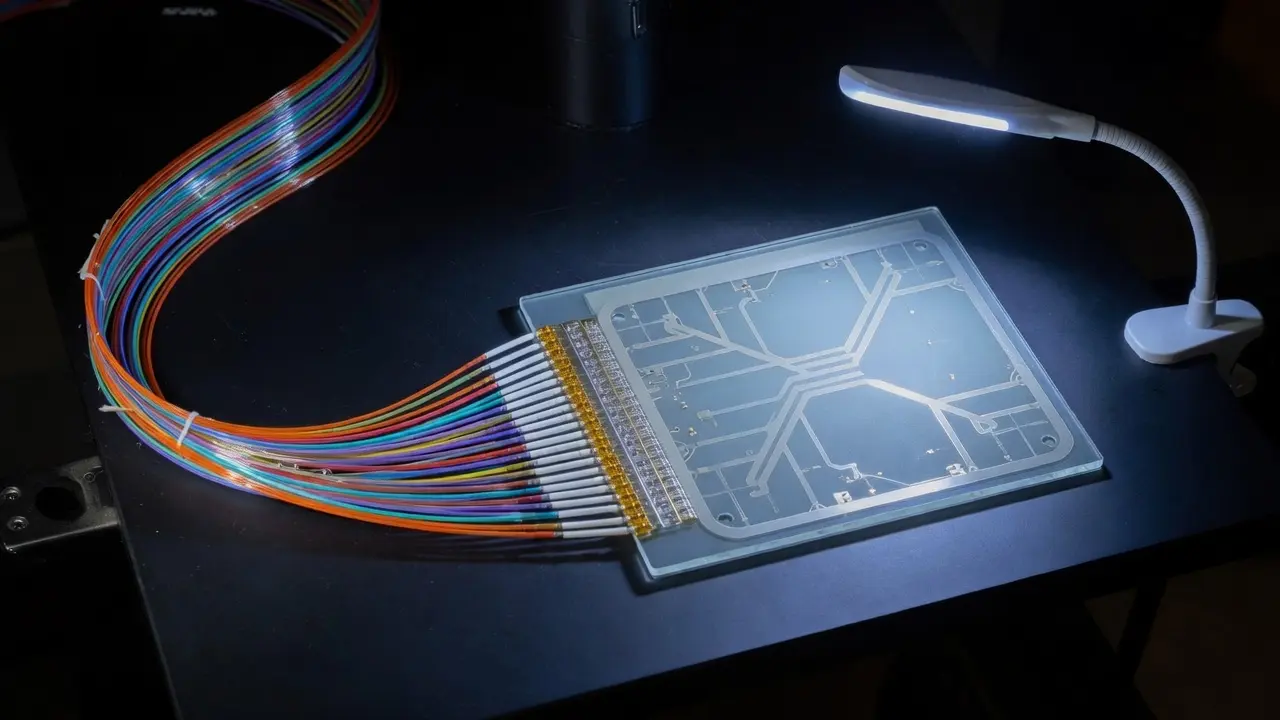
The experimental setup relies on a fully programmable eight-mode photonic integrated circuit, constructed with 28 Mach-Zehnder unit cells arranged in a rectangular layout. This circuit implements arbitrary unitary transformations by actuating thermal phase shifters, allowing precise control over the photons used in the quantum analogue-to-digital conversion process. The integrated design is critical, as it enables the manipulation of multiple photons simultaneously, a key requirement for the quantum phase estimation algorithm used as the core of the QADC.
The team’s protocol benchmarks quantum performance against classical strategies by evaluating mutual information, a metric that quantifies the amount of information shared between the output bit string and the unknown optical phase. In the quantum scenario, this mutual information scales as log base 2 of N, where N represents the number of states, surpassing the scaling of one-half log base 2 of N achieved by classical methods.
Entangled States Enhance Digital Phase Recovery
The experimental protocol relies on a sequence of Hadamard gates and controlled σ z operations to achieve chained NOT gates, a critical component for manipulating quantum information within the photonic circuit. The team’s design divides the experiment into three ordered parts: four-photon, two-photon and one-photon steps, each contributing to the overall phase estimation.
Quantum Phase Estimation Algorithm as a QADC
This circuit uses the quantum phase estimation algorithm, transforming it from a theoretical tool into a functional component for phase estimation protocols. The approach relies on preparing Greenberger-Horne-Zeilinger states, specifically groups of probes constructed from qubits, to encode the optical phase. Each probe undergoes evolution with a unitary operator dependent on the phase, followed by a series of controlled-NOT gates to prepare the system for measurement.
The resulting state, after applying an inverse quantum Fourier transform, yields a binary expansion of the optical phase, effectively functioning as a QADC. This scaling is a key indicator of the quantum advantage, demonstrating an improved ability to extract information about the unknown phase compared to traditional methods. The team’s implementation demonstrates a digital quantum estimation of an optical phase, a departure from continuous-valued parameter estimation common in quantum metrology.
Further refinement of the estimation process involved the use of a neural network, trained on simulated data to compensate for imperfections in the experimental setup. This network-assisted strategy enhances accuracy and consistency, mitigating the impact of noise sources without requiring additional physical resources. The neural network’s ability to deconvolve noise and refine the estimation process highlights a practical approach to overcoming limitations inherent in real-world quantum experiments. The work demonstrates a digital quantum protocol for estimating an unknown phase parameter, representing a step toward more robust and accurate quantum sensing technologies.
See today’s quantum computing news on Quantum Zeitgeist for the latest breakthroughs in qubits, hardware, algorithms, and industry deals.