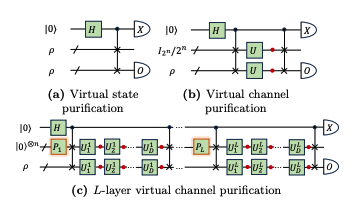
Research demonstrates enhanced precision in metrology through the use of probabilistic virtual channels and state purification. These methods mitigate noise accumulation and self-introduced errors, yielding reduced bias and improved sampling efficiency when channel error rates are below a defined threshold. Numerical analysis confirms improved parameter estimation for single and multi-parameter tasks.
Precise measurement underpins much of modern science and technology; yet, the inherent fragility of quantum systems introduces noise that limits the achievable accuracy. Researchers are actively developing error mitigation techniques to counteract these limitations in near-term quantum devices. A new approach, detailed in ‘Error-Mitigated Quantum Metrology via Probabilistic Virtual Purification’, proposes a refined method for reducing accumulated noise and improving the reliability of parameter estimation.
This work, conducted by Xiaodie Lin of Fuzhou University and Haidong Yuan of The Chinese University of Hong Kong, introduces probabilistic virtual channel purification, a technique that enhances existing virtual state purification protocols and demonstrably improves precision in both single- and multi-parameter quantum metrology. The team’s analysis indicates a reduction in bias and improved sampling efficiency when encoding parameters using a limited number of quantum channels, offering a pathway to more robust and accurate measurements.
Enhanced Error Mitigation Improves Quantum Measurement Precision
Precise measurement underpins much of modern science and technology, yet the inherent fragility of quantum systems introduces noise that limits achievable precision. Researchers continually seek methods to overcome these limitations and enhance the performance of quantum-enabled sensors and measurement devices. A recent study details a novel approach to error mitigation for precision metrology, addressing limitations inherent in existing virtual state purification techniques and demonstrating improved performance in both theoretical analysis and numerical simulations.
Current error mitigation protocols often introduce additional noise during implementation, leading to further errors that compromise measurement accuracy. The researchers propose a method – probabilistic virtual channel purification – designed to manage accumulated noise and simultaneously suppress self-introduced noise, offering a pathway to more accurate and reliable quantum measurements.
Virtual state purification aims to create a cleaner quantum state by filtering out noise. However, existing methods can inadvertently accumulate noise during the purification process and introduce further noise through imperfect implementation. Probabilistic virtual channel purification efficiently manages accumulated noise while simultaneously mitigating self-introduced noise, representing a significant improvement over traditional methods. This refinement naturally extends to an enhanced version of virtual state purification, termed probabilistic virtual state purification, broadening its applicability.
The study’s analysis, conducted within a sequential metrology scheme – a process of repeated, refined measurements – demonstrates a substantial reduction in estimation bias and a decrease in sampling cost when the number of channels encoding the parameters of interest is less than the error rate of the encoding channel. This finding defines a range within which the proposed probabilistic purification methods offer substantial improvements in accuracy and robustness against realistic noise sources. Essentially, the method performs best when the information being measured is encoded in fewer channels than the rate at which errors occur.
Numerical simulations, conducted for both single- and multi-parameter estimation tasks, validate these theoretical findings and demonstrate the practical benefits of the proposed approach. The results consistently demonstrate the superior performance of the proposed probabilistic methods compared to standard virtual purification techniques, particularly in noisy environments.
This work contributes to the ongoing effort to build more robust and reliable quantum sensors and measurement devices. The research highlights the importance of carefully considering the entire error mitigation pipeline, from channel encoding to state purification, to achieve optimal performance in noisy quantum systems.
Further research will focus on exploring the limitations of this approach and developing strategies to further improve its performance. The team plans to investigate the impact of different noise models and explore the potential for combining probabilistic virtual channel purification with other error mitigation techniques, paving the way for a wide range of applications in fields such as materials science, medical imaging, and fundamental physics.
👉 More information
🗞 Error-Mitigated Quantum Metrology via Probabilistic Virtual Purification
🧠 DOI: https://doi.org/10.48550/arXiv.2506.07618




See today’s quantum computing news on Quantum Zeitgeist for the latest breakthroughs in qubits, hardware, algorithms, and industry deals.