Founder of Cambridge Quantum Computing and founding CEO of Quantinuum, the company he helped build into the world’s largest quantum business.
Ilyas Khan is the entrepreneur who turned a Cambridge software startup into the largest quantum computing company in the world. He founded Cambridge Quantum Computing in 2014, then engineered its merger with Honeywell’s quantum division to create Quantinuum, and he remains one of the defining figures of the British quantum industry.
His path is unusual because he came to quantum computing as a builder of companies rather than as a laboratory physicist. He bet early that quantum software would matter as much as quantum hardware, and that conviction shaped a business that now trades on public markets. This profile traces how he built it and why his influence still runs through the field.
The story of Ilyas Khan is also the story of how a national science base can turn into a commercial industry. He kept research and engineering in Cambridge while reaching for global scale, and the company he started has since become a reference point for how a deep-technology venture grows up. Few people have done more to make quantum computing look like a business rather than only an experiment.
From finance to a Cambridge quantum startup
Ilyas Khan was born in 1962 and raised in Lancashire, in the north of England, the grandson of immigrants who had settled in Britain in the 1930s. He studied at the School of Oriental and African Studies at the University of London, an unusual starting point for a future technology founder. From there he trained as a merchant banker and began his career in the City of London.
Over the next two decades Khan built a career in finance, much of it spent in Hong Kong between 1989 and 2009. He founded the merchant bank Stanhill Capital Partners in 1998, and he also built techpacific, a Hong Kong technology venture that listed on the Hong Kong Stock Exchange in 2000 and is described in his own biographies as a unicorn. That long run in investment and company building gave him an instinct for capital and timing that few scientists bring to a startup, and he even bought his hometown football club, Accrington Stanley, along the way.
He was also closely tied to British science and to Cambridge. Khan was the founding chairman of the Stephen Hawking Foundation, a Fellow of St Edmund’s College at the University of Cambridge, and a Leader in Residence at the Judge Business School, where he helped establish the Accelerate Cambridge programme for early-stage deep-technology companies. That blend of a financier’s instincts and a patron’s interest in frontier science set the stage for what came next.
When Ilyas Khan founded Cambridge Quantum Computing in 2014, he brought that experience to a market that barely existed yet. The company rested on the belief that quantum software, the layer between exotic hardware and real applications, would become an industry in its own right. It was a contrarian wager, and it took years before the rest of the field came round to it.
Founding Cambridge Quantum Computing
Khan founded Cambridge Quantum Computing in the United Kingdom in 2014, well before most investors believed quantum computing was a real commercial prospect. The company set out to develop quantum software and algorithms rather than chase the hardware race directly, a contrarian choice at a time when the field was dominated by physics labs. That focus gave it a distinctive position in a market crowded with chip makers.
Cambridge Quantum grew into one of the most successful deep-science companies to come out of the United Kingdom. It built a reputation for serious research in quantum chemistry, cybersecurity, and natural language processing, and it still runs significant operations in Cambridge today. Khan became a fixture of the British quantum scene, helping to put the country on the map in a technology increasingly seen as strategic.
Part of what set the company apart was its insistence on hiring scientists and letting them publish, treating peer-reviewed research as a competitive asset rather than a distraction. That culture attracted strong talent to a young firm and gave its products real technical depth. By the end of the decade Cambridge Quantum was being mentioned alongside far larger names in the field.
Building the quantum software stack
Under Khan, Cambridge Quantum created software that other quantum companies came to rely on. Its TKET toolkit became a widely used system for compiling and optimizing quantum programs so they could run across different hardware, and its Quantum Origin product used quantum processes to generate cryptographic keys that are harder to predict. The company also pioneered quantum natural language processing, an early attempt to bring quantum methods to the way machines handle human language.
That software-first strategy mattered because near-term quantum machines are noisy and hard to program. Tools that squeeze more useful computation out of imperfect hardware became valuable to the whole industry, and they gave Cambridge Quantum a product line that did not depend on owning the most qubits. It was a hedge that made the company attractive to a much larger partner.
The strategy also gave Ilyas Khan a clear answer to a question that dogged the sector, namely how a quantum company makes money before fault-tolerant machines arrive. By selling compilers, security products and chemistry platforms that work on today’s hardware, the company built revenue and relationships while the larger prize was still years away. That patience would prove central to its survival and growth.
Quantum cybersecurity and Quantum Origin
One of Khan’s most consistent themes has been the security risk that quantum computing creates for the rest of the internet. Powerful quantum machines will eventually break much of the public-key encryption that protects data today, and he argued early that organisations needed to prepare long before that day arrived. That warning shaped one of his company’s flagship products.
Quantum Origin uses the unpredictability of quantum measurement to produce verifiable randomness, the raw material for strong cryptographic keys. Because the randomness is rooted in physics rather than in a software algorithm, the keys are harder for an attacker to anticipate, which matters for everything from banking to critical infrastructure. The product turned an abstract worry about future quantum attacks into something a customer could buy and deploy now.
This focus placed Ilyas Khan among the voices pressing industry and government to take post-quantum security seriously. He framed the migration to quantum-safe systems as a practical engineering project with a deadline, not a distant hypothetical. The argument has aged well as standards bodies and large enterprises have begun that migration in earnest.
That early stance has matured into mainstream policy as national standards bodies finalise post-quantum cryptography and large organisations start to inventory the systems they will need to upgrade. Khan had pressed for exactly this kind of methodical migration years before it became urgent, and his company was positioned to help when the moment came. A product first conceived as a hedge now sits close to the centre of the security conversation.
The merger that created Quantinuum
In November 2021, Cambridge Quantum Computing merged with Honeywell Quantum Solutions to form Quantinuum, combining Khan’s software business with Honeywell’s trapped-ion hardware. Honeywell became the controlling shareholder with a stake of about 54 percent, while the former Cambridge Quantum shareholders, led by Khan through Cambridge Quantum Holdings, took the rest. The deal created what is now described as the world’s largest integrated quantum computing company.
Khan served as the founding chief executive of Quantinuum before Dr Rajeeb Hazra took over as CEO, and since 2023 he has been the company’s Vice-Chairman and Chief Product Officer. The combined company paired the H-Series trapped-ion machines with the software stack Cambridge Quantum had built, and it went on to set records in logical qubits and error reduction, including a closely watched collaboration with Microsoft.
The logic of the merger was that hardware and software were stronger together than apart, especially in a field where the two have to be co-designed. Bringing Honeywell’s precision engineering under the same roof as Cambridge Quantum’s algorithms gave the new company a rare end-to-end position. It was the kind of structural deal that reflected Khan’s background in finance as much as his interest in physics.
Inside Quantinuum technology
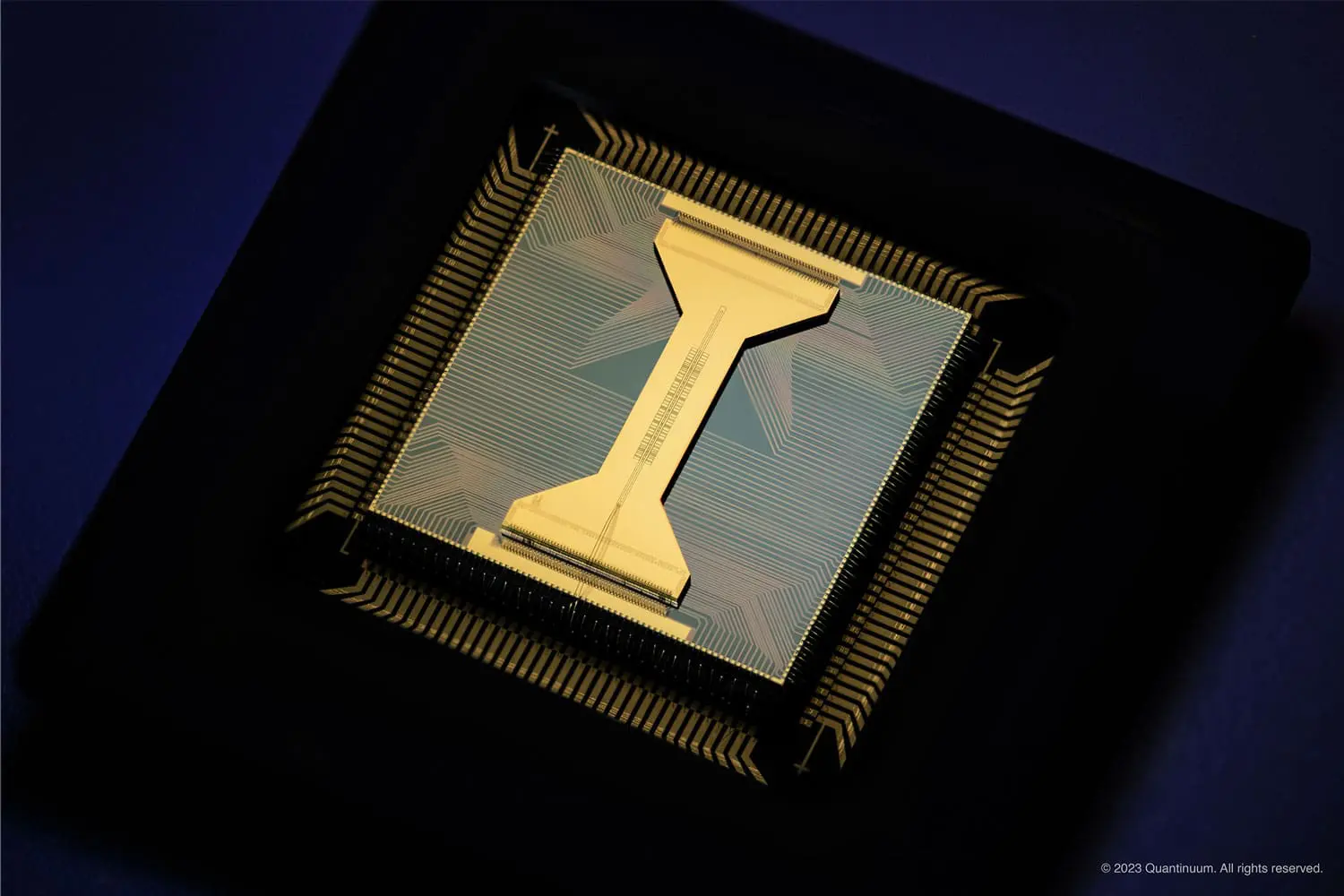
The company Khan helped build now operates some of the world’s highest-performing trapped-ion machines. Its Helios system, launched in November 2025, runs 98 physical qubits and 48 logical qubits at a two-qubit gate fidelity above 99.9 percent, while the production H2-1 system works at 56 qubits. Quantinuum also holds the industry’s Quantum Volume record at more than 33 million, a benchmark that measures the overall quality of a machine rather than its raw qubit count.
The hardware relies on a quantum charge-coupled device architecture, which shuttles individual ions between distinct trapping zones to keep them entangled across the chip. That control supported a closely watched partnership with Microsoft that produced some of the most cited logical-qubit results of recent years, including a 2024 demonstration of entangled logical qubits with error rates better than the physical qubits underneath them. Quantinuum went on to demonstrate 48 error-corrected logical qubits on Helios in November 2025, a result of its own rather than of the Microsoft collaboration. These results pushed forward the timeline for reliable, error-corrected quantum computing.
The trapped-ion approach the company took also carries technical advantages that suit Khan’s long view of the field. Ions of the same element are identical and hold their quantum states for relatively long times, and in these machines any qubit can be made to interact with any other, which simplifies many algorithms. Those properties help explain why the company has been able to claim leading fidelity and quantum-volume figures even with comparatively modest qubit counts.
Software, customers and capital
The software heritage from Cambridge Quantum still runs through the business. The InQuanto platform tackles quantum chemistry, the lambeq toolkit handles quantum natural language processing, and Quantum Origin generates cryptographic randomness, extending the company well beyond raw processor access. BMW has used InQuanto to model the chemistry of hydrogen fuel cells, and Mitsubishi Electric signed a memorandum of understanding with Quantinuum in June 2026 to explore quantum methods for industrial engineering. Under a partnership with Singapore’s National Quantum Office, Singapore is due to become the first country outside the United States to host a Helios system, with installation expected during 2026.
That breadth is backed by serious capital. A 600 million dollar equity raise announced in September 2025, with new money from Quanta Computer, NVIDIA’s NVentures and QED Investors alongside existing backers including Honeywell, valued the company at 10 billion dollars pre-money and lifted its total funding past 900 million dollars, and the business runs major operations in both Broomfield, Colorado and Cambridge in the United Kingdom. The scale of the operation is what set up the public listing that followed.
Quantinuum goes public
The company Khan helped found reached a milestone few quantum businesses have managed when Quantinuum floated on the Nasdaq under the ticker QNT in 2026. The offering priced at 60 dollars a share, five dollars above its raised range after the deal was upsized twice, and raised about 1.68 billion dollars, the largest quantum listing on record. Reporting at the time described the order book as more than 20 times oversubscribed, a level of demand that outstripped most recent technology floats.
On its first day of trading the shares opened at 68 dollars, and the stock finished the session close to its offer price, leaving the company valued at about 15.7 billion dollars. Chief executive Dr Rajeeb Hazra rang the Nasdaq closing bell to mark the debut. The float answered years of speculation about which quantum name would test public markets at scale first, and it placed Quantinuum among the small group of publicly traded quantum computing companies that investors now follow closely.
For Ilyas Khan, the float validated a bet placed more than a decade earlier, that a British software startup could grow into a quantum company of global scale. He held roughly 15 percent of the company at the listing, a stake reported to be worth well over a billion pounds, which made the founder a paper billionaire overnight. The debut also gave the wider sector a benchmark for what a quantum company can be worth, turning a long research project into a public-market story.
Why Ilyas Khan matters in quantum computing
Few founders have shaped the quantum industry from the software side as Khan has. He proved that quantum algorithms, compilers, and cryptography could anchor a serious business, and he built the company that became the field’s largest through a merger he helped design. The company Ilyas Khan founded, now part of Quantinuum, still carries that software-first philosophy forward.
He also matters as a symbol of British and European ambition in quantum technology. By keeping major operations in Cambridge and steering the company to a landmark public listing, he showed that a quantum business born outside the United States could compete at the very top. He has stayed close to the work as Quantinuum’s Vice-Chairman and Chief Product Officer rather than stepping away, so his judgment and track record continue to give him outsized influence over where the field goes next.
Perhaps his most lasting contribution is a change in how the sector thinks about value. Where many early companies measured themselves only in qubit counts, Ilyas Khan insisted that software, security and real customers mattered just as much, and the market has gradually agreed. That broader definition of a quantum company is now close to standard, and it owes a great deal to the path he chose in 2014.
Frequently asked questions
Who is Ilyas Khan?
Is Ilyas Khan still the CEO of Quantinuum?
What is Cambridge Quantum Computing?
What is Quantinuum?
What did Ilyas Khan contribute to quantum computing?
What is TKET?
What is Quantum Origin?
When did Quantinuum go public?
What did Ilyas Khan do before quantum computing?
Disclaimer. This article is for informational purposes only and does not constitute investment, financial or professional advice. The quantum technology industry evolves rapidly and information may become outdated. Always conduct your own research and consult qualified advisers before making investment decisions. Investing in quantum computing companies involves significant risk, including the potential loss of your entire investment, and past performance is not indicative of future results.




See today’s quantum computing news on Quantum Zeitgeist for the latest breakthroughs in qubits, hardware, algorithms, and industry deals.