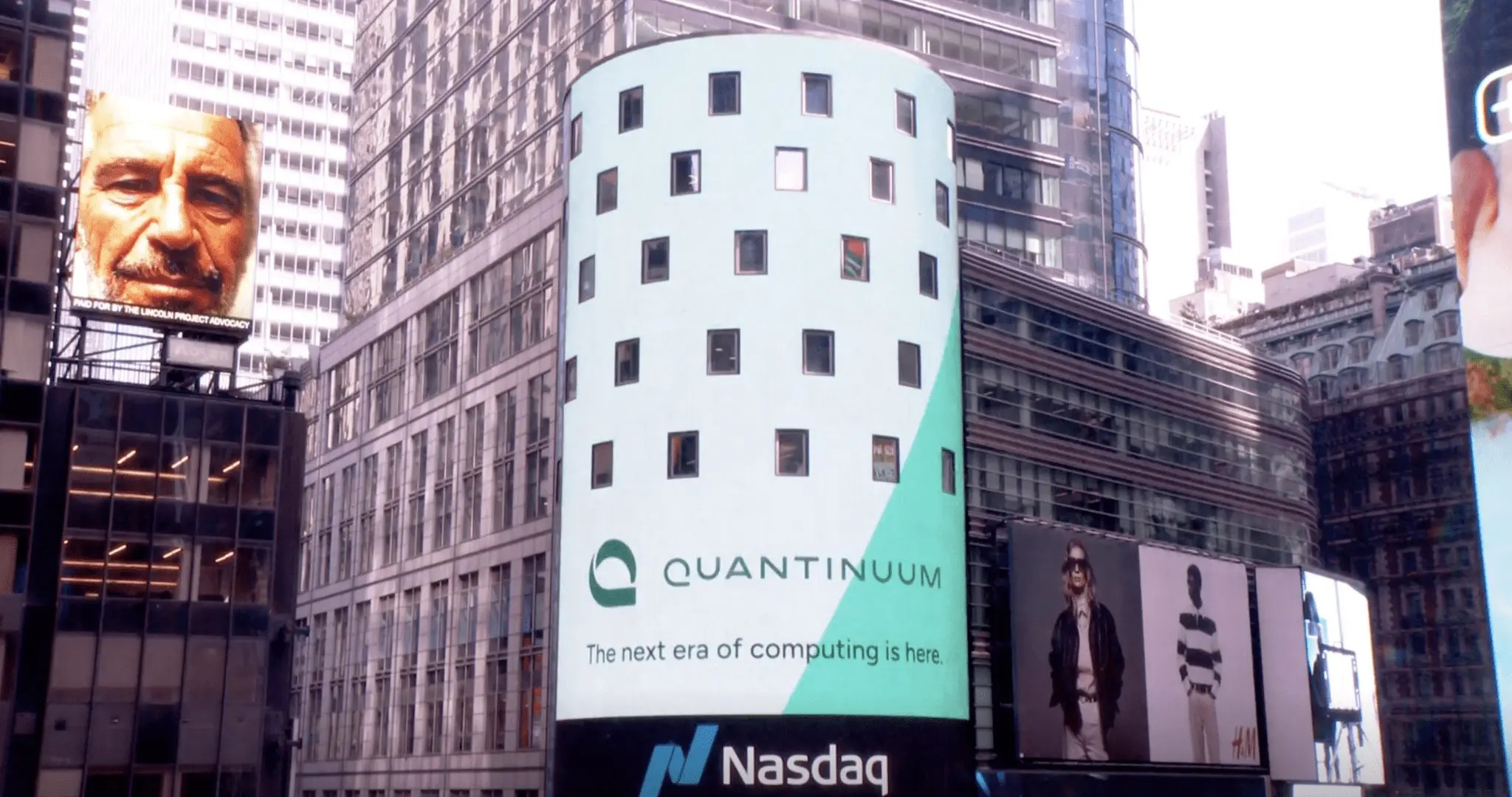
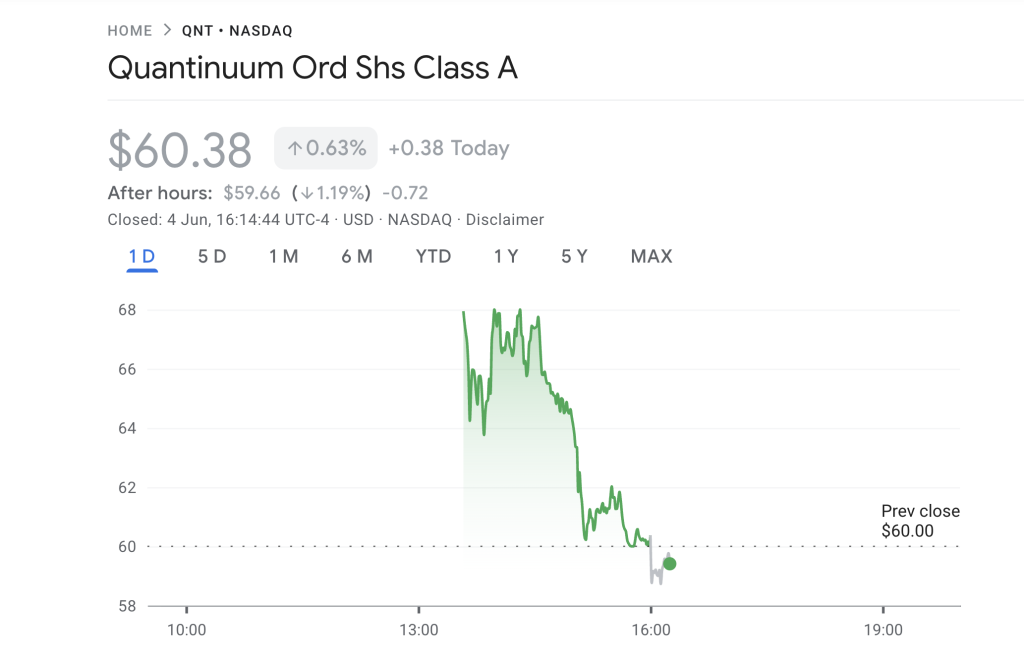
Quantinuum (Nasdaq: QNT) started trading on Thursday after pricing its IPO at $60 a share, raising about $1.68 billion in the largest quantum listing on record. CEO Dr Rajeeb Hazra rang the Nasdaq closing bell, capping a deal we first flagged when the company filed its S-1. After years of speculation about which quantum name would test public markets at scale first, the answer arrived with a price tag in the mid-teens of billions and an order book that embarrassed most recent tech floats. Bloomberg put the order book at more than 20 times oversubscribed, with the order book weighted toward long-only institutions. The deal was priced $5 above its raised range after being upsized twice. Shares opened at $68, about 13% above the $60 issue price. They reached a high of $71.35 and a low of $60.12 before settling near $61 by the afternoon.
The deal in brief
- Ticker: QNT, Nasdaq Global Market. First trade 4 June, closing 5 June 2026.
- Price: $60, above the marketed $53-$55 range. Upsized twice from an original $45 to $50.
- Size: 28 million Class A shares, raising about $1.68 billion, plus a 30-day greenshoe of up to 4.2 million shares.
- Demand: more than 20x oversubscribed, per Bloomberg, with a skew toward long-only institutions.
- Day one: opened $68, high $71.35, low $60.12, settled near $61.
- Valuation: about $15.6bn at the offer, about $17.6bn at the first trade.
- Books run by: J.P. Morgan and Morgan Stanley, with Jefferies, Evercore ISI and others.
A brief history of Quantinuum
The software half began as Cambridge Quantum Computing, founded in the UK in 2014 by Ilyas Khan to develop quantum software and algorithms, including the TKET toolkit and the Quantum Origin encryption product. The hardware half was Honeywell Quantum Solutions, the industrial group’s in-house trapped-ion programme. The two merged in 2021 to form Quantinuum, with Honeywell as the majority owner, and the combined business has run as a full-stack operation from Broomfield, Colorado, ever since. Thursday’s listing is the third act, carrying it from private merger to public company.
Khan, a British financier turned deep-tech entrepreneur, was Quantinuum’s founding CEO and is now vice-chairman and chief product officer, and is the largest individual shareholder at about 15%. Before quantum, he ran a merchant bank and, for a few years, owned and rescued the Lancashire football club Accrington Stanley near where he grew up. Day-to-day leadership has since passed to Rajeeb Hazra, a former Intel data-centre executive who took the chief executive role to drive the company’s commercial push. The business now employs more than 500 people, of whom over 370 are scientists and engineers split across sites in Colorado, Minnesota and Cambridge.
The merger logic was straightforward. Honeywell had spent years and a great deal of money building some of the best trapped-ion hardware in the world but had little software to wrap around it, while Cambridge Quantum had strong software and algorithms but no machines of its own. Putting the two together created the only large player that owns the full stack from qubits to applications, which is the pitch Quantinuum has carried into its listing.
Ion Trap Qubits Commercialised
Quantinuum builds trapped-ion quantum computers, which store quantum information in individual charged atoms held in place by electromagnetic fields and manipulated with lasers. This is a different bet from the superconducting circuits used by IBM, Google and Rigetti, and the trade-offs matter. Trapped ions tend to hold their quantum states longer and make fewer errors, and they allow any qubit to talk to any other qubit directly, which simplifies the programming of complex algorithms.
The specific design is what Quantinuum calls a quantum charge-coupled device, or QCCD, in which ions are shuttled between memory and processing zones on a chip. That architecture supports all-to-all connectivity, mid-circuit measurement and qubit reuse, features that competitors using fixed grids of superconducting qubits struggle to match. The catch is speed and scale, because shuttling ions is slower than firing microwave pulses at a chip, and getting from dozens of qubits to the thousands needed for genuinely useful machines is an enormous engineering problem.
The company has a track record of hitting benchmark milestones along the way. Its systems have repeatedly set quantum volume records, a composite measure of how much real computation a machine can do, and it has demonstrated large entangled logical-qubit states that point toward error correction at scale. On the software side, it has pulled its tools together into the Nexus platform, giving customers a single place to write, run and manage quantum workloads across its hardware generations.
The Quantinuum roadmap
None of today’s quantum computers, including Quantinuum’s, can yet run the money-making algorithms that justify the hype, such as cracking hard chemistry problems or breaking encryption. The whole investment case is a roadmap, and Quantinuum’s is unusually specific. The current flagship, Helios, launched in late 2025 with 98 physical qubits delivering 48 logical, error-corrected qubits, and it switched from ytterbium to barium ions to lower gate errors and simplify the laser systems.
From there, the company has laid out two more generations. Sol, due in 2027, is designed as its first two-dimensional-grid machine, with roughly 192 physical qubits and roughly twice the speed of Helios, intended as the scalability stepping stone. Apollo, targeted for 2029, is the prize: a fully fault-tolerant, universal machine with thousands of physical qubits and hundreds of logical ones, capable of running circuits with millions of gates. In mid-2025, the company said it had cleared what it called the last major hurdle to that goal by demonstrating a fully error-corrected universal gate set, the technical precursor to scaling up.
The roadmap has heavyweight validation attached. Quantinuum was selected by DARPA to advance its Quantum Benchmarking Initiative, and it has deepened ties with Nvidia, linking Helios to the GB200 Grace Blackwell platform via NVQLink and using Nvidia GPUs to decode errors in real time. Industry watchers reasonably caution that quantum roadmaps have a long history of slipping, and that these dates are company projections rather than independently verified outcomes. The 2026 and 2027 demonstrations will be the real test of whether the timeline holds.
The public markets get Two Ion Trap Companies
The reason to want these machines is concrete, even if the timeline is not. The main uses are simulating molecules and materials that classical computers cannot handle, which matters for drug discovery, batteries and catalysts; solving optimisation problems in logistics and finance; and running quantum machine learning. Quantinuum’s customers are already testing these applications rather than waiting for fully fault-tolerant hardware. The other listed trapped-ion company, IonQ, is chasing much the same set of problems.
The customer list shows the range. JPMorgan Chase has worked with Quantinuum on finance and algorithms, with Amgen on drug discovery, and with carmakers on materials, with the BMW partnership now targeting catalyst chemistry for cleaner fuel cells and the Mitsubishi Electric agreement covering industrial design and fluid dynamics. None of these deals brings in much revenue yet, but they are the kind that become paying contracts once the hardware is good enough to be useful.
The near-term business is cybersecurity. Quantinuum’s Quantum Origin product uses quantum processes to generate genuinely unpredictable encryption keys, and the company is built for the shift to post-quantum cryptography. The worry behind that shift, sometimes called Q-day, is that a large quantum computer will eventually break today’s encryption, so governments and banks fear that data stolen now could be decrypted later. That gives Quantinuum a security product it can sell today, without waiting for 2029.
Capital Markets
In September 2025, it raised about $600 million at a $10 billion pre-money valuation, in a round that brought in Quanta Computer, Nvidia’s venture arm NVentures and QED Investors alongside existing backers including JPMorgan Chase, Mitsui, Amgen, Serendipity Capital and Honeywell itself. That round set the reference point that the IPO has now comfortably exceeded.
The fresh $1.68 billion is essentially fuel for the roadmap. Building successive generations of hardware, standing up new fabrication and lab space, and funding a workforce that is overwhelmingly research staff burns cash quickly, and the proceeds buy Quantinuum several years of runway to reach Sol and push toward Apollo without returning to investors cap in hand. Like most pre-revenue deep-tech companies, it frames the use of proceeds broadly around research, development and general corporate purposes rather than committing to specific line items.
What it means for Honeywell shareholders
This is an IPO, not a spin-off, so Honeywell holders receive no QNT shares in their accounts, a point we set out in full before the deal priced. Their exposure remains indirect through Honeywell’s retained stake of roughly 48-49% of the voting power, with Cambridge Quantum Holdings holding around a third. The listing simply marks that holding to a public price rather than handing existing investors a separate, tradable security.
There is a second moving part to track, because Honeywell is breaking itself up at the same time. The aerospace separation is slated for around 29 June, splitting the group into Honeywell Technologies and a standalone Honeywell Aerospace, and the Quantinuum stake is expected to sit with the technology side. Anyone who wants continued quantum exposure after the split, therefore, needs to make sure they end up holding the right successor company, a detail worth confirming against the final separation documents.
The financials, and how they compare
Quantinuum booked $30.9 million in revenue in 2025 against a $192.6 million net loss, and the latest quarter was even thinner, with revenue down 73% year on year to about $5.2 million and a quarterly loss of nearly $136.5 million. Bookings, the forward measure of contracted work, ran around $1.3 million for the quarter. At a mid-teens-billion valuation, that implies a sales multiple above 500x, so buyers are paying for the roadmap, not the current business.
The comparison with IonQ, the other listed trapped-ion specialist, is instructive and not entirely flattering. IonQ reported about $43 million of revenue for its 2024 financial year, roughly 95% growth, which is more actual revenue than Quantinuum currently generates despite Quantinuum’s stronger hardware benchmarks. IonQ also carries large losses and trades on its own demanding multiple, so the read-across is less that one company is cheap and more that the entire sector is being valued on a future nobody can yet price with confidence. The honest summary is that revenue across listed quantum names remains tiny, lumpy and years away from the scale their valuations assume.
The competitive field
Quantum computing in public markets is still a small club with very different technologies inside it. Quantinuum and IonQ run trapped-ion systems; IBM and Google pursue superconducting qubits with their own fault-tolerant targets around 2029; Rigetti is the listed superconducting pure-play; and D-Wave occupies the separate niche of quantum annealing aimed at optimisation problems. Each tells investors a slightly different story about when and how quantum becomes useful, which makes direct comparison hard and marketing claims easy.
Quantinuum’s chosen path to market also stands out. Most of its listed peers reached public markets through SPAC mergers during the 2021 boom, whereas Quantinuum ran a conventional, bank-underwritten IPO, which tends to bring more institutional scrutiny and a cleaner shareholder base. Whether that pedigree earns it a durable valuation premium over the SPAC cohort is one of the more interesting questions the listing raises.
A British company, an American listing
For all the Colorado headquarters and the Nasdaq ticker, half of Quantinuum’s DNA is British. Cambridge Quantum was one of the most successful deep-science companies to come out of the UK, and the group still runs significant operations in Cambridge, with founder Ilyas Khan a fixture of the British quantum scene. The decision to list in New York rather than London, therefore, adds to the familiar and uncomfortable pattern for the UK.
British technology champions keep ending up under American ownership or on American exchanges. DeepMind was sold to Google, Arm chose Nasdaq for its blockbuster 2023 return to public markets despite heavy lobbying for a London listing, and Quantinuum has now taken the same route to the deepest pool of growth capital and the most natural investor base for a quantum story. For UK policymakers who talk about building a sovereign quantum industry, a flagship, partly British company raising $1.68 billion in New York is a reminder of how hard that ambition is to hold on to in practice.
Policy tailwinds
Timing helped. Late last month, the Trump administration committed more than $2 billion to the US quantum sector, with the Commerce Department taking equity stakes in nine companies tied to the quantum ecosystem, Quantinuum due about $100 million, and IBM taking the $1 billion headline award for its chip foundry. Quantinuum had already signed a letter of intent under the CHIPS programme to advance fault-tolerant trapped-ion work, which we covered in a recent Quantum Zeitgeist digest.
Government money on that scale does little for near-term revenue, but it lowers financing risk and stamps the field as a strategic national priority rather than a speculative sideshow. It also ties the company more tightly to US industrial policy, which cuts both ways depending on how the sector’s politics evolve. For a business with the blue-chip customer base described above, federal backing is one more signal that the demand side is real, even if the revenue is not yet.
The near-term question is whether QNT can rebuild a premium once allocation flows clear and the greenshoe and lock-ups work through over the coming weeks. Newly listed deep-tech stocks often trade on sentiment and headlines until there are fresh numbers to anchor them, and Quantinuum will not report as a public company for a while yet.
The longer story is the roadmap. If Helios performs in customers’ hands, if Sol arrives on schedule in 2027, and if the error-correction milestones keep landing, the valuation will start to look less heroic, and revenue from the enterprise partnerships should begin to scale. If the timeline slips, as quantum timelines have a habit of doing, a company priced at hundreds of times sales has a long way to fall.
Disclaimer. This article is for informational purposes only and does not constitute investment, financial or professional advice. The quantum technology industry evolves rapidly and information may become outdated. Always conduct your own research and consult qualified advisers before making investment decisions. Investing in quantum computing companies involves significant risk, including the potential loss of your entire investment, and past performance is not indicative of future results.




See today’s quantum computing news on Quantum Zeitgeist for the latest breakthroughs in qubits, hardware, algorithms, and industry deals.