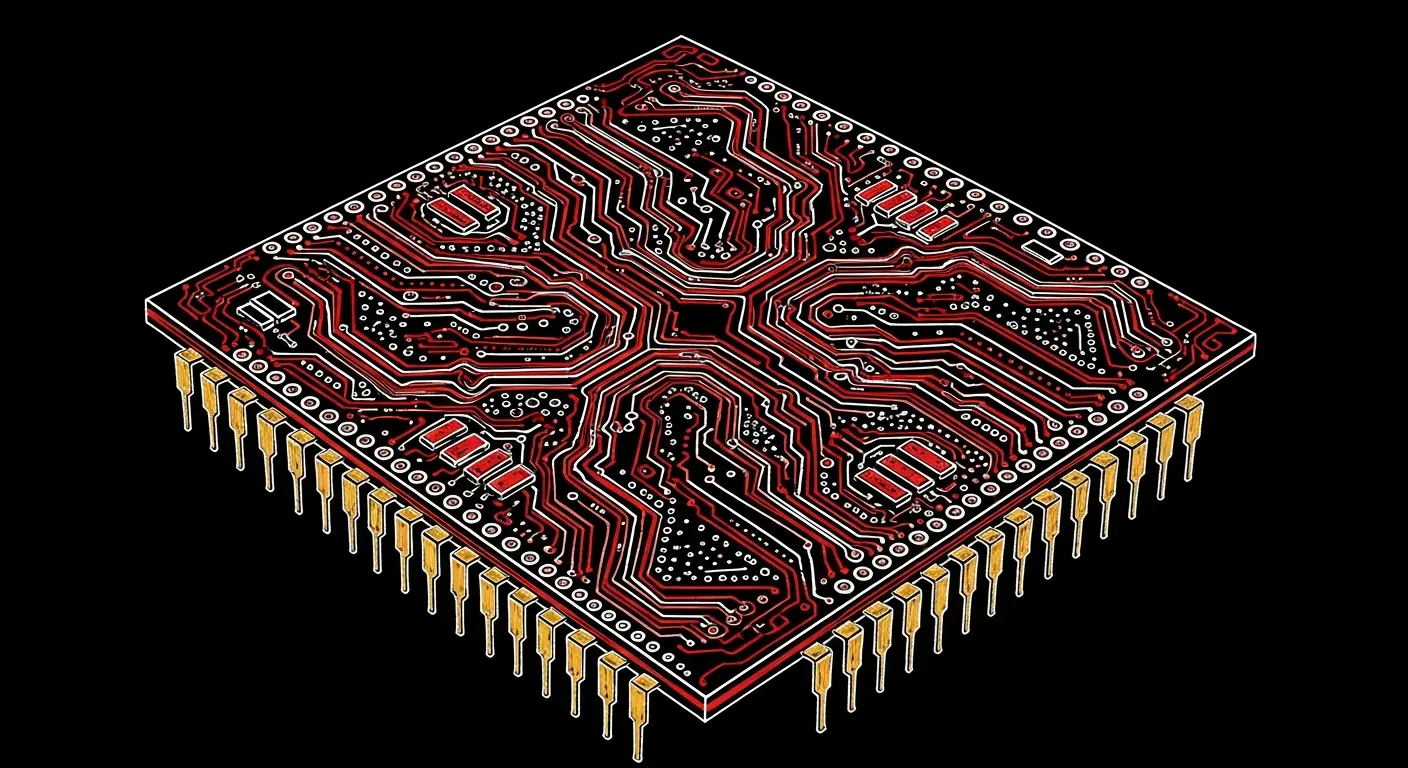
The leading top trapped ion quantum computing companies in 2026 build qubits from individual atomic ions held in radio-frequency Paul traps and entangled through laser- or microwave-mediated motional-mode interactions, the modality with the highest published gate fidelities of any quantum-computing platform (99.99% two-qubit fidelity announced by IonQ in 2025). The top trapped ion quantum computing companies are concentrated around six commercial vendors split across two technical camps: laser-driven gates (IonQ, Quantinuum, AQT) and microwave-driven gates (Oxford Ionics, Universal Quantum, eleQtron). The IonQ acquisition of Oxford Ionics for $1.075B in 2025 was the largest single trapped-ion transaction to date and consolidated the laser-vs-microwave question inside a single company.
Why trapped ion still leads on fidelity
Trapped-ion quantum computing held the published gate-fidelity lead from the first proof-of-principle experiments in the 1990s through the 2025 announcement of IonQ’s 99.99% two-qubit gate fidelity, the highest published number on any quantum-computing platform. The reason is physics: ions are charged atoms that interact with their neighbours through long-range Coulomb forces, which makes them easy to entangle through shared motional modes, and they are identical by physics, which removes the device-variability problem that plagues solid-state qubits. The trade-off is qubit count: trapped-ion systems run from tens to a few hundred qubits where superconducting and neutral-atom systems run at four-digit counts.
The 2024-2026 trajectory has been about scaling trapped ion to compete on qubit count without giving up fidelity. Quantinuum’s 33.5M Quantum Volume record and the Quantinuum IPO on Nasdaq as QNT reflect the modality’s continuing investor confidence. IonQ’s Forte processors now run Q-CTRL’s optimisation solver natively, and IonQ revenue surged 755% to $64.7M in a single quarter validates the commercial demand. The trapped-ion modality is the smallest by qubit count but the most mature by deployed customer base.
How trapped-ion quantum computing works
A trapped-ion QPU holds individual atomic ions (typically ytterbium-171, calcium-40, calcium-43, or barium-137) in a radio-frequency Paul trap, where alternating electric fields create a stable potential well at the centre of an electrode array. Each ion encodes a qubit in two long-lived hyperfine or optical-clock energy levels, and the ions form a linear chain (or 2D crystal in newer architectures) through their mutual Coulomb repulsion. Modular chiplet fabrication is the path to scaling beyond single-trap qubit counts, and the QCCD (quantum charge-coupled device) architecture used by Quantinuum shuttles ions between distinct trapping zones to maintain entanglement across larger registers.
Single-qubit gates use Raman or microwave transitions between the two qubit levels and have demonstrated fidelities above 99.99% on production hardware. Two-qubit gates exploit the shared motional mode of the ion chain (the Mølmer-Sørensen gate is the canonical implementation) and have reached 99.99% on IonQ Forte and Aria systems. The single-shot read-out is achieved by state-dependent fluorescence: the qubit-1 state scatters laser light brightly while qubit-0 stays dark, and a CCD camera or photomultiplier tube reads the result. Connectivity within a single ion chain is all-to-all through the shared motional bus, which is the deepest architectural advantage over the lithography-fixed connectivity of superconducting chips.
The top trapped ion quantum computing companies
Six commercial vendors define the top trapped ion quantum computing companies in 2026. Two are publicly traded (IonQ on NYSE since 2021; Quantinuum on Nasdaq as QNT since its June 2026 IPO, backed by Honeywell), and four are private with significant venture or government funding behind them. Geographic distribution covers the United States, the United Kingdom, Austria, and Germany, with the strongest commercial concentration in the US and the deepest research-lineage concentration in the UK and Austria. The QED-C industry consortium tracks the top trapped ion quantum computing companies alongside the broader quantum-hardware ecosystem with quarterly status updates on QPU access and deployments.
Independent directories of the top trapped ion quantum computing companies list a similar shortlist of names. The profiles below cover the leading organisations in depth.






What the lineup reveals
Three observations stand out. First, the modality is split cleanly into laser-driven (IonQ, Quantinuum, AQT) and microwave-driven (Oxford Ionics, Universal Quantum, eleQtron) gate camps, and the 2025 IonQ acquisition of Oxford Ionics put both camps inside the same company. The strategic logic is hedge: laser gates give the highest fidelities today; microwave gates promise easier manufacturing and lower component cost at scale. IonQ now has both technology stacks under one roof, the others have one each.
Second, the trapped-ion modality has the deepest academic-lineage concentration of any quantum-computing modality. IonQ traces to Chris Monroe at Maryland; Quantinuum’s Cambridge Quantum half traces to the Cambridge Centre for Quantum Information and Foundations; AQT spun out of Rainer Blatt’s group at Innsbruck (the longest-running ion-trap research lineage in commercial QC); Oxford Ionics emerged from David Lucas and Andrew Steane at Oxford; Universal Quantum traces to Winfried Hensinger at Sussex; eleQtron traces to Christof Wunderlich at Siegen. Every commercial vendor is a direct spin-out from a single physics-department group.
Third, the corporate-development pattern is the opposite of neutral-atom: heavy consolidation through IonQ. IonQ rolled up Qubitekk for quantum networking in early 2025, completed the $250M ID Quantique acquisition in May 2025, completed Lightsynq for photonic interconnect in June 2025, completed the $1.075B Oxford Ionics acquisition in September 2025, acquired Vector Atomic in October 2025 for atomic clocks and inertial sensing, added Skyloom Global in November 2025, Seed Innovations in January 2026, and announced the $1.8B SkyWater Technology acquisition in January 2026 (pending close Q2-Q3 2026). No comparable rollup is visible in any other modality.
Laser-driven versus microwave-driven gates
The technical fork at the heart of trapped-ion is whether to drive two-qubit gates with laser pulses (the historical default) or microwave radiation paired with magnetic-field gradients. Laser-driven gates use Mølmer-Sørensen-style state-dependent forces with detuned beams and are the approach behind IonQ Forte, IonQ Aria, the Quantinuum H-series, and AQT IBEX. Laser gates currently hold the gate-fidelity record (99.99%) and are the well-trodden path for commercial trapped-ion systems. The cost is the laser supply chain: ytterbium and calcium ion species require multiple coherent ultraviolet and infrared lasers, and laser systems are the dominant capex line for trapped-ion hardware.
Microwave-driven gates (the MAGIC approach used by Universal Quantum and eleQtron, and the integrated electronic-qubit-control approach used by Oxford Ionics) drive gates with conventional microwave electronics paired with strong magnetic-field gradients across the ion chain. The fidelities are slightly behind laser gates today but the supply-chain story is dramatically better: microwave components are commodity electronics rather than custom optics. Oxford Ionics’s electronic-qubit-control approach pushes this further by integrating the gate hardware into a semiconductor chip, which is why Oxford Ionics partnered with Iceberg Quantum on fault-tolerance and why DARPA selected Oxford Ionics for the Quantum Benchmarking Initiative targeting fault-tolerant operation by 2033.
The IonQ rollup story
The single most consequential structural development in trapped-ion across 2025-2026 was IonQ’s acquisition spree. The $1.075B Oxford Ionics deal set the precedent (announced early 2025, completed September 2025), the May 2025 completion of the ID Quantique transaction added quantum networking, the June 2025 Lightsynq close added photonic interconnect, the October 2025 Vector Atomic deal added timing and inertial sensing, the November 2025 Skyloom Global close added a space-laser-communications stack, and the January 2026 announcements of Seed Innovations plus the $1.8B SkyWater Technology acquisition (pending Q2-Q3 2026 close) extended IonQ into integrated-photonics foundry capability. Combined with the existing Forte Enterprise, Aria, and Tempo AQ64 fleet, the rollup gives IonQ the broadest commercial quantum-technology product portfolio in the Western market.
The strategic logic mirrors the cloud-vendor playbook: enterprise customers in defence, finance, and government increasingly want a single supplier for compute, networking, and timing rather than three separate procurement engagements. IonQ CEO Niccolo de Masi’s 2025 shareholder letter framed the strategy explicitly as building the trapped-ion-centric quantum-technology stack, and the Washington-state quantum-computing expansion anchors the manufacturing footprint. Horizon Quantum’s 256-qubit IonQ system purchase is the largest single-customer trapped-ion transaction in the industry and signals where on-premise trapped-ion procurement is heading.
When trapped ion matters for your industry
Pharmaceutical and chemistry
The combination of high gate fidelity and all-to-all connectivity makes trapped-ion uniquely well-suited to molecular simulation that demands precise variational ansatz preparation. Quantinuum’s quantum-chemistry InQuanto platform and the BMW partnership for materials science are the dominant published use cases, and Quantinuum systems power BMW’s advanced materials science workloads in production. IonQ Forte serves pharmaceutical and biotech customers through Amazon Braket and Microsoft Azure Quantum.
Optimisation, finance, and operations research
Quantum-approximate-optimisation (QAOA) workloads benefit from all-to-all connectivity since the cost of mapping graph problems to a chip topology drops to zero. Ant Group, Hyundai Motor, and the Quantinuum financial-services customer base anchor the optimisation use case on trapped-ion hardware, and the Q-CTRL Fire Opal optimisation solver runs on IonQ machines as the primary deployment target.
Government and defence
Trapped-ion is the dominant modality in defence procurement because the combination of high fidelity and small footprint maps cleanly to deployed-asset use cases. Oxford Ionics installed a quantum computer at the UK National Quantum Computing Centre, eleQtron supplies DLR and Forschungszentrum Jülich, AQT supplies Leibniz Supercomputing Centre, and IonQ runs the largest US government testbed footprint. The combined IonQ acquisitions of ID Quantique, Vector Atomic, and Oxford Ionics were largely driven by defence-customer-procurement requirements for a single trapped-ion-plus-networking-plus-timing supplier.
Frequently asked questions
Who are the leading top trapped ion quantum computing companies in 2026?
Six commercial vendors define the modality. IonQ (NYSE: IONQ) is the largest publicly-traded pure-play and the dominant rollup story after the 2025-2026 acquisitions of Oxford Ionics ($1.075B, September 2025), ID Quantique ($250M, May 2025), Lightsynq (June 2025), Vector Atomic (October 2025), Skyloom Global (November 2025), Seed Innovations (January 2026), and the pending SkyWater Technology ($1.8B, January 2026). Quantinuum is the joint Honeywell-Cambridge-Quantum entity with the Helios system (98 physical / 48 logical qubits at 99.921% 2Q fidelity), the Quantum Volume record (33.5M), and a June 2026 Nasdaq listing under ticker QNT after its IPO. It once filed for a Nasdaq listing under ticker QNT at a $10B pre-money valuation.
Alpine Quantum Technologies (Innsbruck) ships the IBEX Q1 rack-scale 12-qubit ion-trap on Amazon Braket and Scaleway. Oxford Ionics (now part of IonQ) pioneered ions-on-chip with electronic qubit control. Universal Quantum (Brighton, UK) builds a 64-qubit QCCD microwave-control architecture toward million-qubit machines, and eleQtron (Siegen, Germany) operates 30-qubit systems on the MAGIC microwave-driven gate platform under the German ATIQ consortium.
What is the difference between trapped ion and neutral atom quantum computing?
Trapped-ion qubits are charged atoms held in radio-frequency Paul traps and entangled through laser- or microwave-mediated motional modes; neutral-atom qubits are uncharged atoms held in optical tweezers and entangled through Rydberg-blockade interactions. Trapped-ion delivers higher gate fidelities (above 99.99%) but at smaller qubit counts (tens to hundreds), with all-to-all connectivity through the motional bus. Neutral-atom systems run at hundreds to over a thousand qubits with somewhat lower fidelities but reconfigurable software-defined connectivity. The two modalities currently complement rather than compete on most workloads.
Why did IonQ acquire Oxford Ionics for over $1B?
The $1.075B Oxford Ionics acquisition gave IonQ a second trapped-ion technology stack (microwave-driven, ions-on-chip) alongside its existing laser-driven Forte and Aria platforms, hedging the laser-vs-microwave gate-architecture question inside a single company. Oxford Ionics also brought a sophisticated semiconductor-fabrication-aligned manufacturing approach that IonQ can use to drive cost down at scale, the DARPA Quantum Benchmarking Initiative selection targeting fault-tolerant operation by 2033, and the Oxford-University research depth around David Lucas and Andrew Steane. The transaction completed in September 2025 and was the largest single trapped-ion acquisition to date.
How many qubits do the top trapped ion quantum computing companies operate?
IonQ Forte Enterprise exposes 36 algorithmic qubits (#AQ 36), Tempo AQ64 runs at 256 physical qubits with 99.99% 2Q fidelity, and Horizon Quantum is the largest single-customer deployment at 256 qubits. Quantinuum Helios runs at 98 physical qubits and 48 logical qubits at 99.921% 2Q fidelity (launched November 2025), alongside the production H2-1 at 56 qubits; Quantinuum holds the Quantum Volume record at 33.5M. AQT IBEX Q1 runs 12 calcium-40 qubits in a 19-inch rack with 97.7% 2Q fidelity. Oxford Ionics (now part of IonQ) runs a 32-qubit processor at 99.97% 2Q fidelity with a roadmap toward 256 qubits. Universal Quantum operates a 64-qubit QCCD architecture, and eleQtron runs up to 30 qubits on the MAGIC microwave-control platform.
What is a Paul trap and why does trapped ion use it?
A Paul trap (named after Wolfgang Paul, who shared the 1989 Nobel Prize for the design) uses alternating radio-frequency electric fields to create a stable potential well at the centre of an electrode array. Charged particles like atomic ions feel the time-averaged force of the alternating field as a confining harmonic potential, so individual ions can be held in vacuum for hours or days. The Paul trap is the foundational hardware primitive for trapped-ion quantum computing because it provides ultra-stable confinement of identical qubits without solid-state interfaces, and the modality has held the gate-fidelity lead for three decades because the trap environment is intrinsically clean.
Are trapped ion companies publicly traded?
IonQ is publicly traded on the New York Stock Exchange under the ticker IONQ, the first quantum-computing pure-play to list on a major US exchange (2021 SPAC business combination). Quantinuum is publicly traded on Nasdaq under ticker QNT following its June 2026 IPO, backed by Honeywell and a prior $600M financing round. AQT, Universal Quantum, and eleQtron are private. Oxford Ionics was acquired by IonQ in 2025 and is no longer independent. The trapped-ion modality has the most mature public-market presence of any quantum-computing modality: IonQ (NYSE: IONQ) is the longest-running pure-play public listing, and the June 2026 Quantinuum IPO on Nasdaq created the largest pure-play quantum-computing public company by valuation.
What is the difference between laser-driven and microwave-driven trapped ion gates?
Laser-driven gates use detuned laser beams to drive two-qubit Mølmer-Sørensen gates through the shared motional mode of the ion chain. They currently hold the gate-fidelity record (99.99%) but require multiple coherent ultraviolet and infrared laser systems that dominate the capex line. Microwave-driven gates (the MAGIC approach used by Universal Quantum and eleQtron, and the electronic-qubit-control approach used by Oxford Ionics) drive gates with conventional microwave electronics paired with strong magnetic-field gradients. Microwave gates are slightly behind on fidelity today but use commodity electronics rather than custom optics, which dramatically improves the supply-chain story for production-deployable trapped-ion machines.
How does trapped ion relate to the broader quantum-technology stack?
Trapped-ion sits in the quantum-computing layer alongside neutral-atom, superconducting, photonic, silicon-spin, and topological modalities. Trapped-ion platforms are accessed through the same quantum cloud providers as other modalities, programmed with the same quantum software stacks (Qiskit, Cirq, PennyLane, Q#, Classiq), and benchmarked on the same fidelity and Quantum Volume metrics. The modality’s structural advantage is in gate fidelity and all-to-all connectivity, and that advantage is most visible in chemistry and optimisation workloads where circuit depth dominates the error budget.
Disclaimer. This article is for informational purposes only and does not constitute investment, financial or professional advice. The quantum technology industry evolves rapidly and information may become outdated. Always conduct your own research and consult qualified advisers before making investment decisions. Investing in quantum computing companies involves significant risk, including the potential loss of your entire investment, and past performance is not indicative of future results.



See today’s quantum computing news on Quantum Zeitgeist for the latest breakthroughs in qubits, hardware, algorithms, and industry deals.