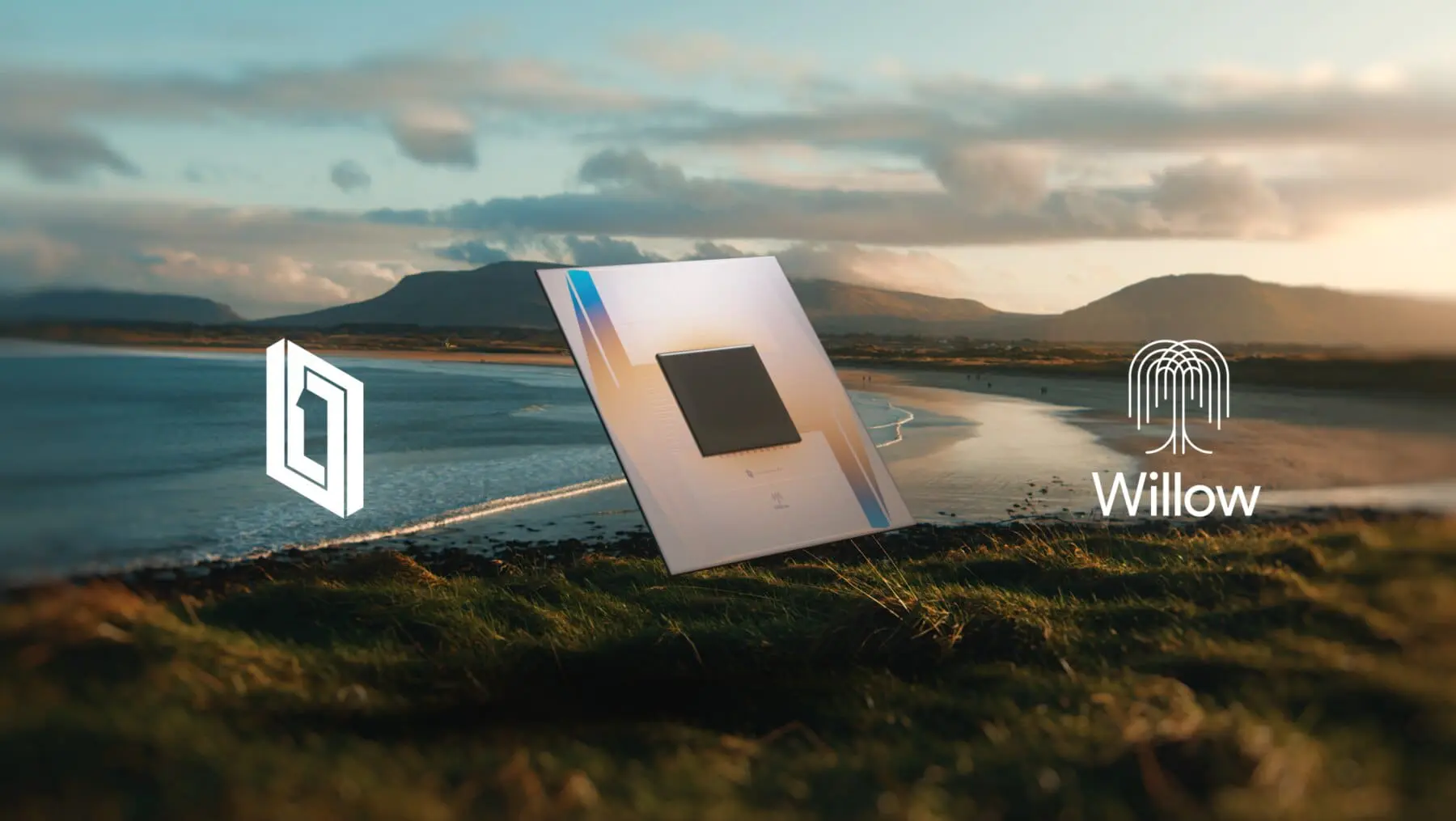
Featured image: Google’s Willow quantum processor, courtesy of Google Quantum AI.
Alphabet’s quantum lab built the chips behind two of the field’s most famous milestones, the 2019 beyond-classical result and the Willow error-correction breakthrough. This is the story of Google Quantum AI, its hardware, its two modalities and its roadmap.
Google Quantum AI is the quantum computing division of Alphabet, the parent company that trades on the Nasdaq under the tickers GOOGL and GOOG. The program has spent more than a decade pursuing superconducting qubits, and it produced two of the most discussed hardware results of the era, the 2019 Sycamore beyond-classical demonstration and the 2024 Willow below-threshold error-correction milestone.
In March 2026 the lab widened its bet by adding neutral atom hardware as a second modality, positioning itself to scale in both circuit depth and qubit count. This article traces the program’s history, its chips, its software, its roadmap, and how it stacks up against the rest of the field, with every date and number drawn from a cited source.
1. Alphabet division. Google Quantum AI sits inside Alphabet, which trades as GOOGL and GOOG. Hartmut Neven founded the effort in 2012 and still leads it.
2. Superconducting flagship. Willow, announced on 9 December 2024, is a 105-qubit superconducting chip fabricated in Santa Barbara. It is the lab’s current flagship processor.
3. Below threshold. On Willow, Google showed that a larger surface code lowers the logical error rate, the long-sought below-threshold regime. This was reported in Nature in December 2024.
4. Two modalities now. In March 2026 Google added neutral atom hardware alongside superconducting qubits. It frames the two as complementary, one strong in circuit depth, the other in qubit count.
5. Verifiable advantage. In October 2025 the Quantum Echoes algorithm ran on Willow about 13,000 times faster than the best classical estimate. The result, published in Nature, was repeatable on other quantum hardware.
6. Long road ahead. Google Quantum AI’s six-milestone roadmap targets a large error-corrected machine controlling roughly one million qubits. Sundar Pichai has set a goal of a useful, error-corrected computer by 2029.
What Google Quantum AI is today
Before tracing how Google Quantum AI was built, it helps to picture where the program stands now. It is a vertically integrated lab that designs its own chips, runs them on its own campus, publishes the results in peer-reviewed journals, and gives the surrounding software away for free. The sections below unpack each of those pieces in turn, starting with the corporate structure and ending with the open tooling that lets outsiders engage with the work.
An Alphabet research division
Google Quantum AI is the quantum hardware and software program run inside Alphabet, the holding company that lists on the Nasdaq as GOOGL and GOOG. The team operates a dedicated fabrication and research campus in Santa Barbara, California, where it designs, builds, and cools its own quantum processors. That vertical integration, from chip design through control electronics to algorithms, separates it from groups that rely on external foundries. The lab publishes its major results in peer-reviewed venues such as Nature rather than only in press releases.
For most of its life the program has been a superconducting-qubit shop, and it remains the recognised leader in that approach, a position detailed in our roundup of the top superconducting quantum computing companies. Its processors use transmon qubits operated at temperatures near absolute zero inside dilution refrigerators. The current flagship is the Google Willow chip, which carries 105 qubits and was announced on 9 December 2024. Google fabricates these chips in house at its Santa Barbara facility rather than outsourcing them.
Now a dual-modality program
In March 2026 the lab stopped being a single-technology operation. It added neutral atom quantum computing, a second hardware lane in which individual atoms held by laser tweezers serve as qubits. Google describes the two technologies as complementary and intends to run both in parallel toward the same goal of a large error-corrected machine. The neutral atom effort is led from Boulder, Colorado, separate from the Santa Barbara superconducting work.
The split is geographic as well as technical, with the neutral atom group based in Boulder, Colorado, separate from the long-standing superconducting operation in Santa Barbara. Google has been careful to present the addition as a widening of its ambition rather than a hedge against its superconducting timeline. The company said it remained confident in the established line even as it opened the second lane.
Software and access
The program also maintains a widely used open-source software stack. Its main entry point is Cirq, a Python framework for building and running quantum circuits, first released in alpha in July 2018. Around Cirq sit related libraries for chemistry and for fault-tolerant algorithm design, which the lab uses internally and shares publicly. That combination of self-built hardware, peer-reviewed science, and open tooling defines what Google Quantum AI is today.
That open stance extends beyond the code itself, since Google routinely releases circuit definitions and experimental data alongside its papers so that outside groups can re-run and re-check its results. The practice matters most for the error-correction and advantage claims, where independent verification carries real weight. It also means researchers without access to Google Quantum AI’s processors can still study how the experiments were built.
From the NASA collaboration to its own chips
Google Quantum AI did not begin as a chip maker at all. Its first hardware was borrowed, its first questions were about machine learning, and only later did it commit to building general-purpose processors of its own. This section follows that shift, from a NASA-hosted annealer to an in-house fabrication team, because the choices made in those early years still shape how the lab works today.
A NASA partnership and D-Wave
The story begins in 2012, when Hartmut Neven founded the Quantum Artificial Intelligence Laboratory together with Pete Worden at NASA Ames Research Center. The early lab did not build its own hardware. Instead, through a collaboration with NASA and the Universities Space Research Association, it hosted a D-Wave quantum annealer, starting with a 509-qubit D-Wave Two machine that was later upgraded to a 1,097-qubit D-Wave 2X. Neven’s group used that annealer to test whether quantum effects could speed up machine-learning and optimisation tasks.
The early focus was squarely on machine learning and optimisation, the problems that the annealer was thought best suited to test. That orientation reflected Neven’s own background in computer vision and pattern recognition rather than in superconducting physics. The annealer years gave the lab a reason to exist while it worked out whether to build hardware of its own.
Building a superconducting team
Annealers are specialised devices, and Google wanted a general-purpose, gate-based machine of its own design. In 2014 Neven recruited John Martinis and his research group from the University of California, Santa Barbara, where Martinis had spent years refining superconducting qubits. That hire moved the program from renting hardware to building it, and it established the Santa Barbara fabrication operation that the lab still runs. The Martinis group brought the experimental expertise needed to push transmon qubit fidelities upward. The team has kept growing since, and in 2025 Google said the MIT-founded startup Atlantic Quantum would join its quantum effort, a talent-and-technology move that amounted to an acqui-hire, aimed at scaling its superconducting hardware faster.
The significance of that 2014 hire became clearer years later, when the macroscopic quantum tunnelling work that grounds the whole superconducting field was recognised with the 2025 Nobel Prize in Physics, shared by John Martinis, John Clarke, and Michel Devoret for experiments dating to the mid-1980s. Martinis had left Google by the time the prize was announced. The lineage still runs through the lab, with Devoret later serving as Google Quantum AI’s chief scientist for quantum hardware.
The path to its own chips
With an in-house team, Google began producing successive generations of superconducting processors through the late 2010s, a journey set in the wider history of quantum computing. The effort was organised around a clear target, namely a controlled experiment that would beat the best classical supercomputers on a well-defined task. That ambition shaped the chip designs and the choice of random circuit sampling as the proving benchmark. The work culminated in the 2019 Sycamore result and, later, in the error-correction milestones that define the program’s current phase.
The superconducting processor family
The clearest way to read Google Quantum AI’s progress is through its processors, each a named step in a steady climb in qubit count and quality. The chips below move from early test devices to the current flagship, and the same superconducting recipe runs through all of them. Understanding how the hardware is laid out, packaged, and cooled also explains why later milestones in error correction became possible at all.
Early superconducting chips
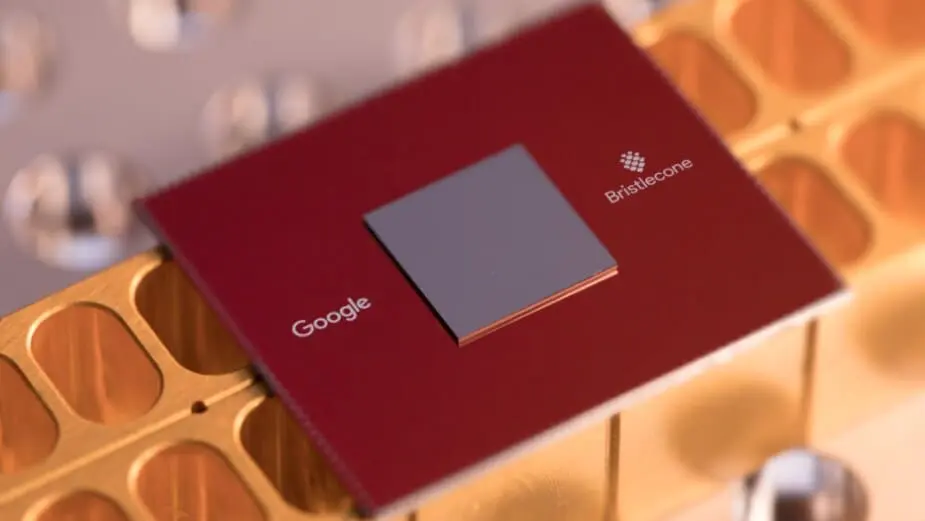
Google Quantum AI’s named processors trace a steady climb in qubit count. Foxtail, a 22-qubit superconducting device, appeared in 2017 as an early architecture. Bristlecone followed in March 2018, presented at the American Physical Society meeting with 72 qubits arranged in a pattern that gave the chip its name. Bristlecone was built with the hope of demonstrating a beyond-classical computation, though that goal was reached on a different device.
Bristlecone was unveiled by Google researcher Julian Kelly at the 2018 American Physical Society meeting in Los Angeles, where the team set out a clear technical bar for a beyond-classical demonstration: roughly 49 active qubits, a circuit depth beyond 40, and a two-qubit error rate under about 0.5 percent. Those targets framed the chip designs that followed. Although Bristlecone never delivered the headline result itself, it served as the proving ground for the fabrication and control techniques that Sycamore later carried across the line.
Sycamore and its successor
Sycamore became the program’s best-known chip. The processor was fabricated with 54 qubits, of which 53 were functional and used in the landmark 2019 experiment, a detail worth stating precisely because both 53 and 54 appear in coverage. In 2021 Google operated an improved Sycamore generation that suppressed errors roughly one hundred-fold per round through better fabrication, lower crosstalk, and faster readout. That upgraded device, sometimes referred to as a second-generation Sycamore, also hosted the 2023 surface-code error-correction study.
The same Sycamore architecture also carried the 2020 chemistry demonstration and the early supremacy follow-ups, making it the workhorse of an entire phase of the program. Reusing one well-characterised design across sampling, chemistry, and error-correction studies let the team build up detailed knowledge of its noise behaviour. That accumulated understanding fed directly into the design choices that produced Willow.
Willow, the current flagship
Willow, announced on 9 December 2024, carries 105 qubits and is fabricated at Google Quantum AI’s Santa Barbara facility. It improved qubit lifetimes substantially, with reported T1 coherence times approaching 100 microseconds, a roughly five-fold gain over the prior generation. Willow is the chip that delivered both the below-threshold error-correction result of December 2024 and the verifiable quantum advantage result of October 2025. Every Google quantum processor to date has been a superconducting transmon device built in California rather than purchased from an outside foundry.
One striking detail from the Willow results is that the distance-seven logical qubit lived longer than any of the 101 physical qubits it was built from, a crossing of the break-even point that error correction had long aimed for. In other words, the encoded qubit outlasted its best individual component rather than merely keeping pace with the added noise. That is the practical meaning of going below threshold on real hardware.
The qubit lattice and tunable couplers
Google arranges its transmon qubits in a square lattice rather than the heavy-hexagonal layout that IBM favours. On Willow, 105 tunable transmon qubits sit on this square grid and are joined by tunable transmon couplers, which let engineers switch the coupling between neighbouring qubits on and off. This adjustability helps isolate idle qubits and reduce crosstalk, one of the error sources that scales badly as devices grow. The square lattice maps cleanly onto the surface code, where data and measurement qubits alternate across a two-dimensional grid, so the hardware layout and the error-correction scheme are matched by design.
Packaging, materials, and coherence
Scaling a flat chip to dozens of qubits forces a packaging problem, because control and readout wiring must reach every qubit without crowding the surface. Google addresses this with an inverted, flip-chip style of integration, in which a separate chip carrying wiring is bonded to the qubit chip, freeing the qubit layer from dense routing. The Willow generation also benefited from materials and fabrication improvements aimed at lowering loss. Google reported that these changes raised the qubit relaxation time, the T1 figure, by roughly a factor of five over the prior generation, into the range approaching 100 microseconds, with some sources citing an average nearer 68 microseconds.
Longer coherence gives a circuit more time to run before information leaks away, which is why this metric matters so much. Alongside the coherence gains, Willow posted single-qubit gate fidelity near 99.97 percent and two-qubit gate fidelity near 99.88 percent, both reported by Google. Those numbers, together with the lattice and packaging choices, are what allowed the chip to reach the below-threshold regime.
| Chip | Year | Qubits | What it introduced |
|---|---|---|---|
| Foxtail | 2017 | 22 | Early Google superconducting transmon processor architecture |
| Bristlecone | 2018 | 72 | Larger superconducting array shown at the APS meeting, aimed at a beyond-classical demonstration |
| Sycamore | 2019 | 54 made / 53 working | Delivered the beyond-classical random circuit sampling result, about 200 seconds versus a disputed 10,000-year estimate |
| Sycamore, 2nd generation | 2021 | 54 | Roughly 100-fold error suppression per round; hosted the 2023 distance-3 to distance-5 surface-code study |
| Willow | 2024 | 105 | First below-threshold error correction and the 2025 Quantum Echoes verifiable advantage; fabricated in Santa Barbara |
| Neutral atom processor | target | not yet specified | Second modality added March 2026, led from Boulder, aimed at large, highly connected atom arrays |
| Large error-corrected machine | 2029 goal | ~1,000,000 qubits | Final roadmap milestone for a fault-tolerant, useful quantum computer |


The two modalities, superconducting and neutral atoms
For most of its life Google pursued a single qubit technology, and that choice defined its strengths and its limits. In 2026 the lab broadened the bet by running superconducting circuits and neutral atoms side by side, framing them as complementary rather than competing. This section sets out what each modality does well, why Google added the second one, and how the two are meant to converge on the same fault-tolerant goal.
Superconducting transmons
For over a decade Google Quantum AI’s single modality was the superconducting transmon qubit, and it remains the program’s core technology. These qubits are lithographically patterned circuits cooled to near absolute zero, and they switch states in tens to hundreds of nanoseconds. That speed lets the hardware run very deep circuits, meaning long sequences of gate operations, within the time a qubit holds its information. Google Quantum AI’s chips have demonstrated circuits with millions of gate cycles, which is the strength of the approach.
The flip side of that speed is sensitivity, because transmons must be kept within thousandths of a degree of absolute zero and isolated from stray electromagnetic noise to hold their states. Every added qubit also brings more control and readout wiring into a tightly packed cryostat, which is one reason scaling this modality is so demanding. Google Quantum AI’s progress has come as much from packaging and materials work as from the qubit design itself.
Neutral atoms join the roadmap
On 24 March 2026 Google announced that it was adding neutral atom quantum computing to its program. In this approach, individual neutral atoms are trapped and arranged by laser tweezers, with each atom acting as a qubit. Neutral atom systems have already scaled to arrays of roughly ten thousand atoms, far more than any superconducting chip, though they operate on slower millisecond cycle times. Google hired Dr. Adam Kaufman, a JILA Fellow and University of Colorado Boulder faculty member, to lead the neutral atom hardware team from Boulder.
Why Google calls them complementary
Google frames the choice as a space-time trade-off in quantum scaling. In its own words, superconducting processors are easier to scale in the time dimension, meaning circuit depth, while neutral atoms are easier to scale in the space dimension, meaning qubit count. Superconducting hardware gives fast, deep circuits, and neutral atom arrays give large, highly connected sets of qubits. The dual-modality strategy aims to combine these strengths on the way to a commercially relevant, error-corrected machine, with the neutral atom effort organised around error correction, simulation, and experimental hardware. Google said it remained confident in its superconducting timeline even as it opened the second lane.
What the neutral-atom lane is meant to build
When Google announced its neutral-atom program on 24 March 2026, it framed the effort around three areas: quantum error correction, modeling and simulation, and experimental hardware development. Neutral-atom platforms already assemble arrays of roughly ten thousand atoms, far more qubits than any superconducting chip, though their gate cycles run on millisecond rather than nanosecond timescales. Google Quantum AI’s stated reasoning is that atoms are easier to scale in qubit count while superconducting circuits are easier to scale in circuit depth. The team led from Boulder by Adam Kaufman is meant to push neutral-atom error correction toward the same fault-tolerance goal that drives the superconducting work, rather than treating the two as separate destinations.
Digital-analog hybrid simulation
On its superconducting hardware, Google has also developed a hybrid mode that blends digital gates with analog evolution. In a study published in Nature, the team used a 69-qubit superconducting processor as an analog-digital quantum simulator to study thermalization and criticality, emulating a two-dimensional quantum magnet. The work observed signatures consistent with a Kosterlitz-Thouless phase transition and reported deviations from standard scaling predictions, with the device operating in a regime that cross-entropy benchmarking placed beyond easy classical simulation.
The hybrid approach lets one device run high-precision discrete gates and continuous analog evolution as a problem requires. This capability sits alongside the gate-based supremacy and error-correction experiments rather than replacing them, and it shows how the same superconducting chips serve physics simulation directly.
The roadmap to a fault-tolerant machine
Google has been unusually explicit about its long-term plan, publishing a sequence of milestones that runs from the first beyond-classical result to a machine large enough to be genuinely useful. Reading that roadmap carefully means separating the steps already demonstrated from the ones still ahead. The subsections below lay out the six milestones, the headline million-qubit ambition, and an honest accounting of targets versus achievements.
Six milestones
Google organises its long-term plan around a roadmap of six milestones. The first milestone, a beyond-classical computation, was reached in 2019 with Sycamore. The second, a prototype error-corrected logical qubit, was demonstrated in 2023, when a larger surface code outperformed a smaller one. The remaining milestones cover a long-lived logical qubit, a logical gate between logical qubits, scaling the technology, and finally a large error-corrected machine.
The roadmap is deliberately structured so that each milestone is a measurable hardware demonstration rather than a vague aspiration. That framing lets outsiders judge progress against published results instead of marketing language. It also sets a high bar, since the later milestones around long-lived logical qubits and logical gates have not yet appeared in the peer-reviewed record.
The million-qubit ambition
The sixth and final milestone is the headline goal, a large-scale error-corrected quantum computer that connects and controls on the order of one million physical qubits. Those physical qubits would be bundled into a much smaller number of stable logical qubits capable of running useful algorithms. This is a long-term target rather than a near-term deliverable, and the gap between today’s roughly 100-qubit chips and a million-qubit system is enormous. Google presents the figure as the destination, not a current capability.
To put the gap in perspective, IBM’s own large-scale plan targets a system of around 200 logical qubits built from roughly 10,000 physical qubits by 2029, which is itself a major undertaking and still far short of a million physical qubits. Google Quantum AI’s figure should therefore be read as the endpoint of a decade-long engineering effort, not a near-term specification. The jump from today’s roughly 100-qubit chips to that scale will require advances in fabrication, wiring, and control that nobody has yet demonstrated.
Targets versus achievements
It helps to separate what Google has shown from what it has promised. The achievements so far are the 2019 beyond-classical result, the 2023 logical-qubit prototype, the 2024 below-threshold demonstration, and the 2025 verifiable advantage. The targets include a useful, error-corrected quantum computer that Sundar Pichai framed around 2029, and the eventual million-qubit machine at the end of the roadmap. Google has been explicit that further reductions in physical error rates and far larger qubit arrays are still required. Treating the milestones already reached as proof of the timeline for the milestones still ahead would overstate the current position.
Below-threshold error correction on Willow
Error correction is the heart of Google’s scientific case, because no quantum computer can run long algorithms while errors accumulate faster than they can be fixed. The breakthrough on Willow was showing that growing the code actually lowers the error rate, the so-called below-threshold regime. These subsections explain the surface code, the incremental 2023 result, what Willow proved in 2024, and the decoding software that makes any of it usable.
The surface code
Quantum error correction spreads the information of one logical qubit across many physical qubits so that errors can be detected and fixed without destroying the data, a concept we explain in our guide to what quantum error correction is. Google’s primary scheme is the surface code, in which qubits sit on a two-dimensional grid of data and measurement qubits. The code’s distance describes the grid size, and a larger distance should, in principle, correct more errors. The central question for years was whether real hardware was good enough that growing the code actually lowered the error rate rather than adding more faulty parts.
The 2023 distance-three to distance-five result
In 2023 Google reported in Nature that a logical qubit built from 49 physical qubits slightly outperformed one built from 17 physical qubits, the first time scaling the code helped on its hardware. The larger distance-five code showed a logical error rate near 2.9 percent per cycle against about 3.0 percent for the smaller distance-three code. The margin was thin, but the direction was the point, since errors fell as the code grew. That study is the program’s second roadmap milestone.
What Willow proved in December 2024
Willow turned the thin 2023 margin into a clear trend. Reported in Nature in December 2024, the experiment scaled the surface code from a distance-three to a distance-five to a distance-seven grid, and the logical error rate fell by roughly half at each step. The distance-seven logical qubit reached a logical error rate of about 0.143 percent per cycle, beating the smaller codes and the best individual physical qubits. This is the below-threshold regime, where adding qubits makes the encoded qubit better rather than worse. It is a necessary condition for scaling toward fault tolerance, though far from sufficient on its own.
Real-time decoding and the AlphaQubit decoder
Detecting errors is only half the job, because a working machine must also decode the stream of error signals fast enough to keep up with the hardware. Surface-code cycles run in roughly a microsecond, so the decoder has to interpret syndrome data in real time or the backlog grows without bound. In November 2024 Google, working with Google DeepMind, published AlphaQubit in Nature, a recurrent, transformer-based neural network trained to decode surface-code errors. The team trained it on data from a 49-qubit Sycamore device plus simulated examples, and reported that it identified errors more accurately than the prior leading decoders, while testing it on codes using up to 241 qubits.
Leakage, erasure, and milestones three and four
A persistent problem in transmons is leakage, where a qubit drifts into an unwanted higher energy state that is long-lived and can spread correlated errors. Google published a reset protocol in Nature Communications in 2021 that returns a qubit to its ground state from these higher levels without extra hardware, and reported lower logical error rates and better scaling as a result. Related work in the field converts such leakage into erasure errors, whose locations are known and therefore easier to correct, raising the code threshold.
On the roadmap, Google reached milestone two, the logical-qubit prototype, with the 2023 and 2024 results. The later milestones, namely a long-lived logical qubit and a logical gate between logical qubits, remain active research targets that the published record does not yet show as completed, so they should be read as work in progress rather than finished achievements.
Quantum supremacy and verifiable advantage
Two of Google’s most famous claims, the 2019 supremacy result and the 2025 verifiable advantage, both rest on comparisons with classical computers that can shift over time. That makes the details matter: what was measured, how it was scored, and how strongly the classical baseline can be trusted. The subsections below walk through the original sampling experiment, the criticism it drew, the newer verifiable result, and why every such ratio should be read as provisional.
Sycamore and beyond-classical sampling
Google’s 2019 result, published in Nature on 23 October 2019, used Sycamore to sample the output of a random quantum circuit, the experiment that popularised quantum supremacy. The team reported that the 53-qubit processor finished the task in about 200 seconds, and estimated that a leading classical supercomputer would need roughly 10,000 years. The company described this as crossing into a beyond-classical regime. The benchmark was deliberately chosen to be hard for classical machines rather than to be directly useful.
The choice of random circuit sampling was strategic as well as scientific, since the task was engineered to be maximally hard for classical machines rather than to solve any practical problem. That made it an effective stress test of the hardware but an easy target for critics who noted it computed nothing useful. Google framed it from the start as a demonstration of capability, a marker that quantum hardware had crossed a threshold, not a product.
IBM’s pushback
The 10,000-year figure was contested almost immediately. IBM argued that with better use of disk storage on its Summit supercomputer, the same task could be simulated in about 2.5 days, not millennia. That dispute did not erase Google’s result, but it showed that classical estimates are model-dependent and can move sharply. The episode is a useful reminder that quantum advantage claims rest on the best available classical comparison, which can improve over time.
The lasting lesson from that exchange is that classical simulation keeps improving, so any single speedup figure is a snapshot rather than a fixed boundary. Better algorithms, more memory, and smarter use of disk storage can all chip away at a quantum claim after it is published. This is precisely why Google’s later emphasis shifted toward results that can be verified on independent quantum hardware rather than resting solely on a classical estimate.
Verifiable advantage in 2025
In October 2025 Google reported a different kind of milestone, a verifiable quantum advantage, published in Nature on 22 October. Running the Quantum Echoes algorithm on Willow, the team measured out-of-time-order correlators, which track how information scrambles through a quantum system, and reported running about 13,000 times faster than the best classical estimate. The key word is verifiable, since the result can be repeated and cross-checked on other quantum machines of similar quality, unlike the harder-to-confirm 2019 sampling task. Even so, such speedup ratios depend on classical baselines, so honest reporting keeps the comparison provisional.
Cross-entropy benchmarking explained
The yardstick behind Google’s sampling experiments is cross-entropy benchmarking, usually shortened to XEB. The idea is to run a random circuit, then compare the bitstrings the hardware produces against the probabilities an ideal noiseless circuit would assign, scoring how strongly the two agree. The linear XEB fidelity condenses this into a single number that runs from zero for random noise toward one for a perfect device. A high XEB score on a circuit too large to simulate classically is what Google offers as evidence of a beyond-classical result. The measure is not without subtlety, since researchers have shown that XEB only tracks true fidelity in certain noise regimes and can break down sharply outside them.
A moving target
Random circuit sampling claims are best understood as a contest that both sides keep improving. In 2024 Google published an updated random-circuit-sampling experiment that roughly doubled the circuit volume of its 2019 work while holding fidelity, pushing further from the reach of classical machines. At the same time, classical algorithms and hardware have advanced, which is exactly what happened when IBM challenged the original 10,000-year estimate in 2019.
Each improvement in classical simulation lowers the bar a quantum result must clear, so a speedup that looks decisive one year can shrink the next. This is why Google’s 2025 emphasis on verifiable advantage matters, since a result that can be reproduced on independent quantum hardware does not rest solely on a classical estimate that may later fall. Honest reporting treats every such ratio as provisional rather than permanent.
Cirq and the software stack
Google’s hardware reaches a narrow set of partners, but its software reaches everyone, and that openness is a deliberate part of the strategy. At the centre sits Cirq, surrounded by domain libraries and simulators aimed at chemistry, algorithm design, and error-correction research. These subsections cover the main framework, the specialised tools, how the hardware is exposed, and the machine-learning decoders that now form part of the stack.
Cirq
Cirq is Google’s open-source quantum software development kit, a Python framework for writing, editing, and running quantum circuits. It was first announced as a public alpha in July 2018 and reached version 1.0 in 2022. Cirq was designed for noisy intermediate-scale quantum machines, those with a few hundred qubits and a few thousand gates, which matches the hardware available today. Because it is licensed permissively, it can be embedded in commercial or research software freely.
On a personal note, this writer finds Cirq a real pleasure to work with, since its clean and readable Python syntax makes laying out a circuit feel natural rather than fiddly. That kind of subjective appeal matters more than it sounds, because a framework people enjoy writing tends to be the one they actually learn and stick with, and anyone weighing the options can see how it compares in our look at Cirq, Qiskit and Q#. It competes, naturally, with Qiskit, the IBM-born framework that has become the ever-popular FORTRAN 77 of quantum computing, the dependable workhorse that turns up everywhere and shows no sign of going away, whatever one makes of its style.
Google continues to develop and maintain Cirq actively, and its permissive Apache licence lets companies and academics fold it into their own tools without restriction. The framework gives users fine-grained control over qubit placement and gate timing, which suits the noisy hardware of the current era where every operation must be scheduled carefully. That low-level control is part of why researchers reach for it when they need to match circuits to specific devices.
Specialised libraries
Around Cirq, Google maintains domain libraries for specific problems. OpenFermion translates chemistry and materials problems into quantum circuits, focusing on the fermionic systems that describe molecules and solids. Qualtran, the quantum algorithms translator, provides abstractions for expressing and analysing fault-tolerant algorithms and estimating their resource costs. Additional tools such as qsim for high-performance simulation and Stim for error-correction circuits round out the stack.
The breadth of the stack reflects how many distinct skills a serious quantum effort now demands, from translating molecular Hamiltonians into circuits to estimating the resource cost of a fault-tolerant algorithm before any hardware exists. Tools such as Stim, in particular, let researchers study error-correction circuits far larger than today’s chips can run, which is essential for planning ahead. By open-sourcing these libraries, Google effectively lets the wider community pressure-test the assumptions behind its own roadmap.
Exposing the hardware
Google has historically kept its best processors for internal research rather than offering broad public cloud time, an access question we cover in our look at the Google quantum cloud. Its software can nonetheless target third-party hardware, and Cirq users can reach machines from other vendors through cloud services such as Microsoft Azure Quantum. The lab also publishes circuit definitions and data alongside its papers so that results can be reproduced. This combination of open tooling and selective hardware access shapes how outsiders interact with the program.
AlphaQubit as a research decoder
Beyond Cirq, Google’s software now includes machine-learning tools aimed squarely at error correction. AlphaQubit, the recurrent transformer-based decoder published with Google DeepMind in Nature in November 2024, is the most prominent example, learning to interpret surface-code error signals from training data. It was trained on examples from a 49-qubit Sycamore device and from simulation, and evaluated on codes using up to 241 qubits. The decoder shows how Google folds its broader AI expertise back into the quantum program, treating decoding as a learning problem rather than a fixed algorithm.
Simulators and open data
Two specialised simulators sit under the research stack. Qsim is Google’s high-performance state-vector simulator for running circuits on classical hardware, useful for validating small quantum programs. Stim, created by Craig Gidney at Google, is a fast stabilizer simulator built for error-correction research, able to analyse a distance-100 surface-code circuit of around 20,000 qubits and millions of gates in seconds and then sample shots at kilohertz rates.
Stim is limited to Clifford operations, which is exactly the regime most error-correction studies need. Google also publishes circuit definitions, experimental data, and code alongside its papers, so that outside groups can reproduce and re-decode its results. That practice of releasing datasets is part of how the field cross-checks claims such as the below-threshold and verifiable-advantage experiments.
Applications and simulations
The hard question for any quantum program is what its machines will actually be good for. Google’s clearest near-term answer is simulating physics and chemistry, where the computer and the problem obey the same quantum rules, while optimisation and machine learning remain longer-term bets. The subsections below separate the named, dated demonstrations from the broader aspirations, so the practical state of play stays clear.
Chemistry and materials
The application Google emphasises most is simulating nature itself, especially molecules and materials. Sundar Pichai has argued that quantum systems will help model nature precisely and could aid materials research, energy, and medicine. The OpenFermion library exists precisely to map chemistry problems onto quantum circuits. These are research demonstrations rather than commercial products today, and Google has been careful to frame practical chemistry as a future payoff.
Google’s leadership has repeatedly pointed to molecular and materials modelling as the application where quantum machines should first prove genuinely useful, because classical computers struggle to capture quantum behaviour exactly. The appeal is that the computer and the chemistry obey the same underlying physics, so the mapping is natural rather than forced. Even so, the lab has been careful to present practical chemistry as a future payoff that depends on much larger, error-corrected machines.
Physics simulation
Simulating quantum physics is where current hardware is most natural, since the machine and the target share the same underlying rules. Google has run digital and hybrid digital-analog simulations on its chips to study many-body phenomena, including exotic states of matter. The October 2025 Quantum Echoes work fits here, using time-reversal protocols to probe how information spreads through a quantum system. In a proof-of-principle study with the University of California, Berkeley, the team applied the algorithm to nuclear magnetic resonance data on two organic molecules, describing it as a molecular ruler for measuring structure.
Optimisation and machine learning
Optimisation and machine learning were the original motivations behind the 2012 NASA collaboration, which tested quantum annealing on learning tasks. These remain active research areas rather than settled advantages, and the field is cautious about near-term claims. Google’s later focus shifted toward error correction and physics simulation, where the case for quantum hardware is clearer. The lab continues to publish across these areas without promising imminent commercial returns.
Part of the caution here comes from hard experience, since early hopes that quantum annealing would speed up learning tasks did not translate into clear, durable advantages. The field has since learned that many proposed quantum speedups shrink or vanish once classical methods are tuned to compete. Google’s own emphasis has accordingly migrated toward error correction and physics simulation, where the theoretical case is firmer and the demonstrations are more concrete.
A named chemistry result
Google’s most concrete early chemistry demonstration came in 2020, published in Science. Using the Sycamore processor with up to 12 qubits, the team ran Hartree-Fock simulations that computed the binding energy of hydrogen chains as large as H12 and modelled the isomerisation of diazene. At the time this was described as the largest chemical simulation performed on a quantum computer, roughly doubling the qubit count and exceeding tenfold the gate count of prior experiments. The work paired the quantum device with a classical optimiser in a loop and used error-mitigation techniques to raise the effective fidelity, which is a realistic picture of how near-term chemistry runs on current hardware.
Physics simulation and a chemistry-adjacent ruler
Google’s strongest application results have come in physics simulation, where the machine and the target share the same quantum rules. The 69-qubit analog-digital study of thermalization and criticality, published in Nature, is one such result, probing how a model magnet approaches equilibrium in a regime beyond easy classical simulation. The 2025 Quantum Echoes work added a chemistry-adjacent angle, applying the out-of-time-order-correlator method to nuclear magnetic resonance data on two organic molecules in a proof-of-principle study with the University of California, Berkeley.
Google described that experiment as a molecular ruler for measuring atomic distances and structure. These are research demonstrations with named dates and collaborators rather than commercial products, and Google has presented them as steps toward practical use rather than finished tools.
Leadership under Hartmut Neven
The people steering Google Quantum AI explain a great deal about its direction, from the founder who set the goal to the academic experimentalists hired to anchor each hardware line. Above them sits Alphabet’s executive team, which has placed quantum among its long-horizon priorities. This section profiles the key figures and the partner ecosystem that surrounds the lab.
Hartmut Neven
Hartmut Neven founded Google Quantum AI in 2012 and still leads the division. He created the original NASA Ames laboratory with Pete Worden and drove the recruitment of the superconducting team. His framing of the program, building a useful, large-scale quantum computer, has guided its strategy from annealers through Sycamore and Willow. Neven remains the public face of the lab’s roadmap.
Neven came to quantum computing from artificial intelligence, having earlier built the image-recognition technology behind Google’s visual search, which helps explain the lab’s name and its early machine-learning focus. That background also shaped a recurring habit of folding Google’s broader AI expertise back into the quantum effort, most visibly in the neural-network decoders developed for error correction. He has remained the constant thread across the program’s annealer, Sycamore, and Willow phases.
Hardware leadership
The program’s hardware grew out of John Martinis and his University of California, Santa Barbara group, who joined in 2014 and established the fabrication effort. For the new neutral atom lane, Google brought in Dr. Adam Kaufman, a JILA Fellow and University of Colorado Boulder faculty member, to lead that hardware team from Boulder. These hires show a pattern of recruiting established academic experimentalists to anchor each hardware modality. The split between Santa Barbara superconducting work and Boulder neutral atom work reflects the dual-modality structure.
The pattern of recruiting a leading academic experimentalist to anchor each modality is itself a strategic signal, since it brings years of accumulated laboratory know-how that cannot be hired quickly any other way. It also distributes the program across two strong physics communities, the superconducting tradition in Santa Barbara and the cold-atom community around Boulder. That division of expertise mirrors the dual-modality structure rather than cutting across it.
Alphabet context
Above the lab sits Alphabet and its chief executive, Sundar Pichai, who has spoken publicly about quantum and said quantum computing is where AI was five years ago. He told BBC Newsnight that the next five years should be an exciting phase for the field. Pichai has also set the goal of a useful, error-corrected quantum computer, with public framing pointing to 2029. That executive attention places quantum among Alphabet’s long-horizon research priorities.
Quantum sits inside Alphabet alongside other long-horizon research bets, and the company has been clear that its near-term value rests overwhelmingly on advertising, cloud, and its other established businesses rather than on quantum returns. That framing matters for readers who might otherwise treat quantum milestones as material to Alphabet’s share price. The executive attention is real, but the financial stakes for the parent company remain modest for now.
Ecosystem, partners, and how outsiders get access
Google Quantum AI works through a network of academic and institutional partners rather than in isolation. Its highest-profile public program is the XPRIZE Quantum Applications competition, a three-year, five million dollar contest for which Google Quantum AI is the title sponsor alongside Google.org and the Geneva Science and Diplomacy Anticipator. Launched in March 2024, the competition asks teams to design quantum algorithms for problems in health, climate, energy, and materials, and in late 2025 it named seven finalist teams selected from 133 submissions worldwide. Those teams shared an initial one million dollars and will compete for a further four million in 2027, with independent evaluation drawing on industry and academic experts.
On the research side, Google runs its hardware effort from a dedicated campus in Santa Barbara, California, and publishes collaborative work with university groups, including the University of California, Berkeley study tied to the 2025 Quantum Echoes result. Access to the hardware itself is far more restricted than IBM’s model, a difference worth stating plainly. Google’s Quantum Computing Service has remained in a limited preview, granting time to selected research partners rather than offering open self-service, so general users cannot simply sign up and run circuits on Willow.
By contrast, IBM operates an open cloud with many superconducting processors that anyone can reach remotely. Google did widen access somewhat through a partnership with the United Kingdom’s National Quantum Computing Centre reported in January 2026. The practical takeaway is that Google’s hardware reaches a narrow set of vetted researchers while its software and published data reach everyone.
How Google compares with its rivals
Google does not pursue fault tolerance alone, and the pace of its progress is shaped by serious rivals across several qubit technologies. IBM presses it hardest in superconducting circuits, trapped-ion firms compete on gate quality, and the move into neutral atoms put Google up against established specialists. The subsections below map those fronts and what each contest is really about.
The table below sets Google against the rivals it is most often measured against, across the different qubit technologies in play. It is a snapshot of a fast-moving field, so the flagship entries describe the current state of play rather than a finishing line.
| Company | Qubit technology | Latest flagship | Where it stands |
|---|---|---|---|
| Google Quantum AI | Superconducting, plus neutral atoms | Willow (105 qubits) | Below-threshold error correction in 2024 and a verifiable advantage result in 2025 |
| IBM | Superconducting | Heron and IBM Quantum System Two | The largest published roadmap, betting on qLDPC codes toward Starling in 2029 |
| IonQ | Trapped ions | Forte and Tempo systems | Competes on gate quality and its algorithmic-qubit metric; trades on the NYSE |
| Quantinuum | Trapped ions | H-Series and the Helios chip | Record two-qubit gate fidelities, with a public listing pursued in 2026 |
| PsiQuantum | Photonic | Foundry-built photonic chips | Skips small machines for a million-qubit, fault-tolerant goal with GlobalFoundries |
IBM and the superconducting race
IBM is Google’s closest rival in superconducting qubits, and our coverage of IBM quantum computing tracks how it competes on scale and error correction. While Google has leaned on the surface code, IBM has pursued quantum low-density parity-check codes, often shortened to qLDPC, which aim to protect logical qubits with fewer physical qubits. The two companies represent different bets within the same broad technology. Their competition has driven much of the public progress in the field.
The two companies have also diverged on hardware access, with IBM running an open cloud that anyone can reach while Google has kept its best processors largely for internal research. That difference shapes how the wider community experiences each program, even where the underlying transmon technology is similar. IBM’s published plan for a fault-tolerant system around 2029 makes the rivalry an explicit race toward the same destination by different coding routes.
Trapped ions
A second front comes from trapped-ion companies, chiefly Quantinuum and IonQ, which encode qubits in charged atoms held by electromagnetic fields. Trapped ions offer high gate fidelities and all-to-all connectivity, trading raw speed for quality. They scale differently from superconducting chips and serve as a benchmark against which Google’s fidelities are compared. The contrast highlights that no single modality has yet won.
The trade-off is essentially speed against quality, since ion gates run far slower than superconducting ones but typically reach higher fidelities and connect every qubit to every other. That all-to-all connectivity can shorten the circuits needed for a given algorithm, partly offsetting the slower clock. Comparing Google’s gate fidelities against the best ion systems is one of the standard ways the field measures whether superconducting hardware is closing the quality gap.
Neutral atom players
Google’s March 2026 move into neutral atoms put it into direct competition with established specialists in that approach, including QuEra, Pasqal, and Atom Computing. Those companies have already built large atom arrays and demonstrated error-correction results, so Google enters as a well-resourced newcomer rather than a pioneer in this lane. The decision signals that Google views neutral atoms as a serious scaling path, not a side project. It also intensifies a field where several modalities are now advancing at once.
By entering in 2026, Google arrives in a lane where specialists have spent years assembling large atom arrays and demonstrating their own error-correction results, so it competes as a well-resourced newcomer rather than a pioneer. Its advantage is the depth of its error-correction and fabrication experience, which it can carry over from the superconducting work. The move also raises the overall pace of a field in which several modalities are now advancing in parallel.
Google Quantum AI by the numbers
It is easy to lose the verifiable facts among the headlines, so this closing section gathers the figures that actually carry weight. It recaps founding dates, qubit counts, and the headline error-correction and advantage results, then turns to the concrete developments worth watching for the rest of the decade. Each forward-looking item is framed as a target to be checked, not a result already in hand.
The figures that matter
A short recap helps anchor the verifiable facts. Google Quantum AI was founded in 2012 by Hartmut Neven, and its current flagship, Willow, carries 105 qubits and was announced on 9 December 2024. The 2019 Sycamore chip had 54 fabricated qubits with 53 working, and its random circuit sampling ran in about 200 seconds against a disputed 10,000-year classical estimate.
It is worth holding two of these numbers apart, since Sycamore’s 53 working qubits in 2019 and Willow’s 105 qubits in 2024 mark a roughly fivefold growth in scale alongside large gains in coherence and gate quality. The qubit count alone understates the progress, because the later chips also corrected their own errors rather than simply running larger circuits. Read together, the figures trace a shift from raw demonstration toward genuine error suppression.
Recent milestones
On the error-correction side, the 2023 study compared 49-qubit and 17-qubit logical qubits at distance five and three, and Willow later reached a distance-seven logical error rate near 0.143 percent per cycle in December 2024. The October 2025 Quantum Echoes result on Willow reported a roughly 13,000-fold speedup and appeared in Nature. The long-term roadmap targets a machine controlling about one million qubits, with a useful, error-corrected computer framed around 2029.
The Quantum Echoes result is the one to watch most closely, because it can in principle be reproduced on other quantum machines of similar quality, unlike the harder-to-confirm 2019 sampling task. That repeatability is what Google means by a verifiable advantage, and it is the property that makes the claim more durable against improving classical simulation. As with every such figure, the honest reading treats the speedup as provisional until independent groups confirm it.
What to watch through the rest of the decade
Several concrete developments will signal whether Google’s roadmap is on track, and each should be read as a target rather than a result until it lands. The first is the next superconducting generation after Willow, since the 105-qubit chip is a milestone-two device and a useful machine will need far more qubits with lower error rates. Google has not published a named successor chip with verified specifications, so the size and timing of the next processor remain open.
The second thing to watch is progress on roadmap milestones three and four, namely a long-lived logical qubit and a logical gate between logical qubits. The 2024 below-threshold result cleared the way for these, but the published record does not yet show either milestone as completed, so a peer-reviewed demonstration would be the marker. The third is the first hardware result from the neutral-atom team announced in March 2026, which would show whether the second modality can match the pace of the superconducting work.
The fourth and largest target is Sundar Pichai’s stated goal of a useful, error-corrected quantum computer framed around 2029, sitting on the path toward the roadmap’s million-qubit endpoint. None of these is guaranteed, and classical simulation continues to advance in parallel, so the honest stance is to track each as a claim to be verified when the data arrives.
Frequently asked questions
What is Google Quantum AI?
What is the Willow chip?
How many qubits did Sycamore have?
Did Google really achieve quantum supremacy?
What is the Quantum Echoes result?
Why did Google add neutral atoms?
What is Google’s quantum roadmap?
What software does Google Quantum AI offer?




See today’s quantum computing news on Quantum Zeitgeist for the latest breakthroughs in qubits, hardware, algorithms, and industry deals.