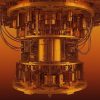
In a wide-ranging BBC Newsnight interview, Pichai signals major quantum breakthroughs on the horizon
Google CEO Sundar Pichai has offered a striking prediction for the quantum computing industry, suggesting the technology is now at a similar inflection point to where artificial intelligence stood half a decade ago.
Speaking to the BBC in a rare extended interview at Google’s Silicon Valley headquarters, Pichai was asked about the company’s quantum computing efforts amid the current frenzy of AI investment.
“The progress is so exciting,” Pichai said. “I would say quantum is there where maybe AI was five years ago. So I think in five years from now we’ll be going through a very exciting phase in quantum, and we are investing with a view towards that.”
The comparison is notable given how dramatically AI has transformed technology and markets since 2020. If Pichai’s timeline holds, the quantum industry could be approaching its own breakthrough moment within the latter half of this decade.
Google Claims World-Leading Position
Pichai was unequivocal about Google’s standing in the quantum race, asserting that the company has “the state-of-the-art quantum computing efforts in the world.”
The claim comes as competition intensifies among tech giants, well-funded startups, and nation-state programmes all pursuing quantum advantage. Google made headlines in 2019 with its quantum supremacy demonstration using the Sycamore processor, and more recently with its Willow chip announcement.
Simulating Nature at Its Fundamental Level
When pressed on the technology’s potential, Pichai framed quantum computing in almost philosophical terms, connecting it to the fundamental fabric of reality.
“Nature, the universe, all fundamentally is based on the principles of quantum mechanics,” he explained. “Building quantum systems I think will help us better simulate and understand nature and unlock many benefits for society.”
This perspective aligns with Richard Feynman’s original vision for quantum computers as tools capable of simulating physical systems that classical computers cannot efficiently model, a capability with profound implications for drug discovery, materials science, and fundamental physics research.
Context: The AI Investment Tsunami
The quantum remarks came within a broader discussion of Google’s massive technology investments. Pichai revealed that Google’s capital expenditure has tripled from under $30 billion annually four years ago to over $90 billion this year, with collective industry investment in AI infrastructure now exceeding one trillion dollars.
The scale of these investments raises questions about how much of that capital might flow toward quantum computing as the technology matures, particularly given Pichai’s bullish timeline.
What This Means for the Industry
For quantum computing investors and observers, Pichai’s comments carry significant weight. Google’s deep pockets, research capabilities, and track record in bringing AI from laboratory curiosity to mainstream product suggest the company will be a major force in commercialising quantum technology.
However, Pichai’s five-year prediction also implies patience is required. If quantum is where AI was in 2020, the technology may still be several years away from the explosive growth and public awareness that characterised AI’s recent trajectory.
At its heart, quantum computing fundamentally deviates from classical bits, which can only exist in a definitive zero or one state. Instead, quantum systems utilize quantum bits, or qubits, which leverage the principles of superposition and entanglement. Superposition allows a qubit to represent a combination of both zero and one simultaneously, vastly increasing the computational space. Entanglement links the fates of multiple qubits, ensuring that manipulating one instantaneously affects the others, a correlation key to solving complex problems far beyond the reach of even the most powerful classical supercomputers.
Despite the promise, translating theoretical power into reliable computation faces immense engineering hurdles, chief among them being decoherence. Qubits are extremely fragile, interacting unpredictably with their environment (such as temperature fluctuations or stray electromagnetic fields), causing them to lose their quantum state almost instantaneously. Researchers are currently tackling this through sophisticated error correction codes and architectural designs that require maintaining qubit coherence for much longer periods, a challenge often requiring near-absolute-zero operating temperatures.
The industry is not monolithic regarding qubit implementation; major contenders include superconducting transmon qubits, trapped ion systems, and topological qubits. Superconducting qubits, employed by Google and IBM, operate in highly controlled cryogenic environments and are currently pushing qubit counts. Conversely, trapped ion systems are praised for their high fidelity and inherent connectivity, enabling more precise gate operations, making the hardware platform itself a critical differentiator in the quantum race.
Beyond mere processing power, the practical utility of quantum systems lies in solving specific class of intractable problems. These include simulating molecular interactions for novel drug discovery, optimizing complex logistical networks (like global supply chains), and breaking modern encryption standards. This targeted applicability means that early breakthroughs are expected to revolutionize fields like materials science, which aims to design superconductors or batteries with previously unattainable efficiencies.
The interview serves as a reminder that while AI dominates today’s headlines and investment flows, quantum computing remains firmly on the roadmap of the world’s largest technology companies, and according to Google’s chief executive, its moment may be approaching faster than many expect.
The full BBC Newsnight interview covered topics including AI investment, energy demands of data centres, copyright concerns, and Google’s relationship with the Trump administration.




See today’s quantum computing news on Quantum Zeitgeist for the latest breakthroughs in qubits, hardware, algorithms, and industry deals.