The simple line drawings that turned the hardest calculations in quantum field theory into pictures, invented by Richard Feynman and now the universal language of particle physics.
Feynman diagrams are the most recognisable doodles in all of physics, a set of simple lines and squiggles that hide some of the hardest calculations ever attempted. Invented by Richard Feynman in the late 1940s, they turned the forbidding algebra of quantum field theory into pictures a student can sketch on a napkin. Behind each innocent drawing sits a precise mathematical recipe, which is exactly what makes the diagrams so powerful.
This guide explains what Feynman diagrams actually represent, how they encode real calculations, and why they spread so quickly that within a decade every particle physicist was drawing them. The story runs from a frustrated attempt to fix quantum electrodynamics to the automated software that now generates millions of diagrams for experiments at the Large Hadron Collider.
What a Feynman diagram shows
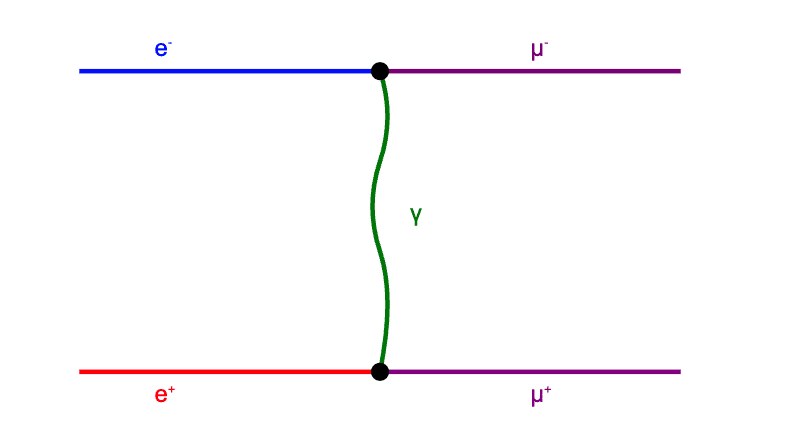
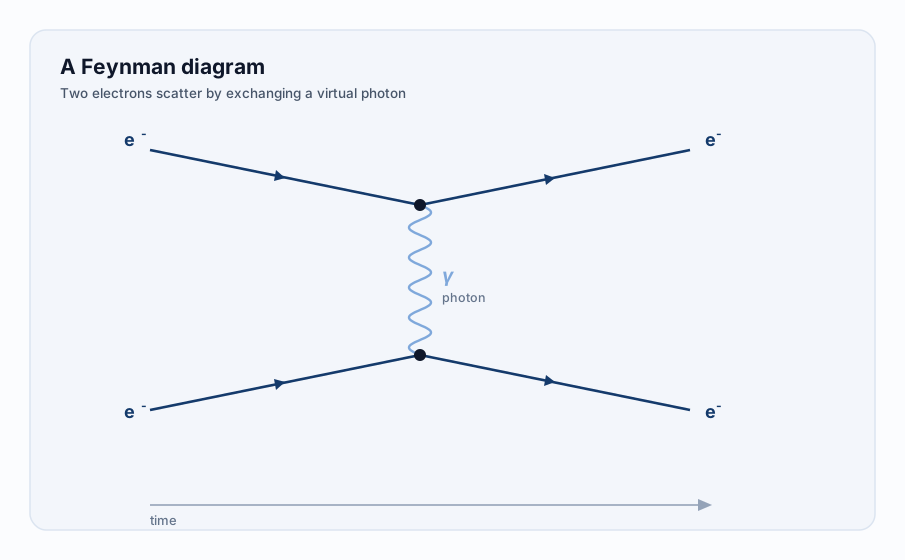
At its simplest, a Feynman diagram is a map of a particle interaction. Straight lines represent matter particles such as electrons, wavy or curly lines represent force carriers such as photons and gluons, and the points where lines meet, called vertices, represent the moments when particles interact. One axis of the diagram stands for time, so you can read a process as a story unfolding from one side to the other.
The classic example is two electrons repelling each other. Rather than imagining a continuous force, the diagrams picture the electrons exchanging a photon, the carrier of the electromagnetic force, at two vertices. The diagram below shows exactly this, with the incoming electrons, the exchanged photon, and the outgoing electrons all laid out in a single clean sketch.
The direction of the arrows on the matter lines also carries meaning, distinguishing particles from antiparticles. An arrow pointing backwards in time is read as the matching antiparticle moving forwards, a neat economy that lets one set of rules cover both cases. Small conventions like this are what let a quick sketch carry so much precise information.
Where Feynman diagrams came from
In the late 1940s quantum electrodynamics was in crisis, producing infinite and meaningless answers whenever physicists tried to calculate beyond the simplest case. Richard Feynman developed his diagrams around 1948 as a way to keep track of the bewildering number of terms involved, turning each contribution into a picture that could be written down and managed. The approach was so intuitive that it initially struck some senior physicists as suspiciously informal.
It was Freeman Dyson who proved that Feynman diagrams were mathematically equivalent to the more formal methods of Julian Schwinger and Sin-Itiro Tomonaga. Dyson’s work gave the diagrams a rigorous footing and helped them spread through the community with remarkable speed. Within a few years they had become the universal language of particle physics, and they have never been displaced.
The speed of that adoption was unusual in physics, where new formalisms are often resisted for years. Part of the appeal was practical, since the method simply made hard problems tractable, and part was pedagogical, because it could be taught to newcomers in an afternoon. By the 1950s the approach was everywhere in the field.
How the diagrams encode a calculation
The genius of the diagrams is that each element corresponds to a precise mathematical factor. Every line and every vertex translates into a specific term, and multiplying these together gives the contribution of that diagram to the overall probability of the process. A physicist can therefore draw the picture first and read off the equation afterwards.
Because a single process can happen in many ways, physicists add up many contributions to get the full answer. The simplest diagram, with the fewest vertices, gives the largest contribution, and each extra vertex adds a smaller correction tied to the strength of the force. This ordering, known as perturbation theory, lets calculations be carried out to whatever precision an experiment demands.
What makes the scheme work for quantum electrodynamics is that the electromagnetic interaction is fairly weak. Because each additional vertex multiplies the contribution by that small number, complicated pictures matter less and less, and the series settles toward a reliable answer. For the strong force the same trick is harder, since that interaction is not always weak.
Virtual particles and the lines between
The internal lines of these diagrams, the ones that begin and end at vertices without reaching the edge, represent what physicists call virtual particles. The exchanged photon in the electron scattering picture is one of these, a fleeting carrier that is never directly observed. Virtual particles are a bookkeeping device for the quantum field rather than tiny balls flying between electrons.
This is a point that even careful readers often misunderstand. The diagrams are not literal photographs of particles moving through space, but representations of mathematical terms in a calculation. Taking them too literally leads to confusion, yet used correctly they capture the physics with extraordinary economy.
Feynman diagrams in QED and the Standard Model
The first triumph of Feynman diagrams was quantum electrodynamics, where they helped produce predictions that match experiment to more than ten decimal places. That success made quantum electrodynamics the most precisely tested theory in the history of science, and it established the diagrams as indispensable tools.
As physics moved on to the strong and weak nuclear forces, the diagrams came along for the ride. The Standard Model of particle physics, which describes nearly every known particle and interaction, is built and calculated using the same diagrammatic language, now extended with gluons, W and Z bosons, and the Higgs. The loops in these more complex diagrams are where the subtle effects of the quantum vacuum show up.
Those loops describe the constant fizzing of the quantum vacuum, where particles appear and vanish too quickly to detect directly. Calculating loop corrections is delicate, and it was the taming of their infinities through renormalization that first made the whole approach trustworthy. The famous precision of quantum electrodynamics comes largely from carefully computed loops.
From paper sketches to supercomputers
What began as drawings on a blackboard has become an industrial process. Modern experiments require calculations involving thousands or even millions of Feynman diagrams, far beyond what any human could draw by hand, so physicists rely on software that generates and evaluates them automatically. These tools are essential to interpreting collisions at machines like the Large Hadron Collider.
The sheer number of diagrams at high precision has also pushed theorists to invent cleverer methods. New mathematical approaches, sometimes bypassing individual diagrams altogether, can compute the same results far more efficiently. Even so, Feynman diagrams remain the conceptual foundation on which these advanced techniques are understood and checked.
How to read a diagram step by step
Reading a Feynman diagram is easier once you know its grammar. Start at the incoming side, follow the matter lines through each vertex, and treat every junction as a moment where particles are created or destroyed according to fixed rules. The force carriers passed between vertices tell you which interaction is at work.
What you cannot read off is a literal sequence of events in space, because the picture is a calculational tool rather than a film of the collision. The lesson that beginners take longest to absorb is that the drawing is a guide to an equation. Once that idea clicks, the diagrams become a fast and reliable way to reason about the quantum world.
Why Feynman diagrams changed physics
The deeper achievement of the diagrams was to democratise a difficult subject. By giving physicists a shared visual language, they made quantum field theory teachable, checkable and collaborative in a way the older formalisms never were. A calculation that once demanded pages of dense algebra could be set up by sketching a few lines.
That blend of intuition and rigour is the hallmark of Richard Feynman’s style, and it is why his diagrams outlived their original purpose. They are now woven into how physicists think, not just how they calculate, and any tour of modern quantum theory passes through them. Few scientific tools have proved so simple to learn and so impossible to do without.
Frequently asked questions
What are Feynman diagrams?
Who invented Feynman diagrams?
What do the lines in a Feynman diagram mean?
Are Feynman diagrams real pictures of particles?
Why are Feynman diagrams important?




See today’s quantum computing news on Quantum Zeitgeist for the latest breakthroughs in qubits, hardware, algorithms, and industry deals.