The Nobel laureate who rebuilt quantum mechanics as a sum over every possible history, drew the diagrams that organised particle physics, and made the case for the quantum computer.
Richard Feynman is the physicist almost everyone can picture, the bongo-playing, safe-cracking, plain-spoken genius who seemed to enjoy science more than anyone around him. Beneath the showmanship sat one of the most original minds of the twentieth century, a thinker who rebuilt quantum mechanics from the ground up and handed working physicists a set of tools they still cannot do without. His path integral reframed how a quantum particle moves, his diagrams turned forbidding calculations into sketches, and his restless curiosity reached from the smallest particles to the first idea of a quantum computer.
What set Richard Feynman apart was not raw cleverness alone, since the field had no shortage of brilliant people. It was an insistence on understanding things his own way, from the foundations up, and a refusal to accept any explanation he could not rebuild for himself. That habit produced a body of work that runs through modern physics like a watermark, and a teaching legacy that still shapes how the subject is learned.
The making of a prodigy
Richard Feynman was born in New York City in 1918 and grew up in Far Rockaway, encouraged by a father who taught him to question the names of things and look for the mechanism underneath. He studied at the Massachusetts Institute of Technology and then at Princeton, where he worked under John Wheeler and began developing the ideas that would define his career. Even as a student he had a reputation for solving problems by inventing his own methods rather than following the textbook.
The Second World War pulled him to Los Alamos, where he became one of the youngest group leaders on the Manhattan Project and a notorious prankster who cracked the safes holding atomic secrets to prove how weak the security was. The same years brought private grief, as his first wife Arline died of tuberculosis while he worked in the desert. The combination of dazzling ability and personal loss marked him, and colleagues remembered both the humour and the seriousness underneath.
After the war Feynman took a post at Cornell and then settled at the California Institute of Technology, which remained his home for the rest of his life. There he turned to the deepest open problem in physics, the troubled theory of how light and matter interact.
The sum over histories
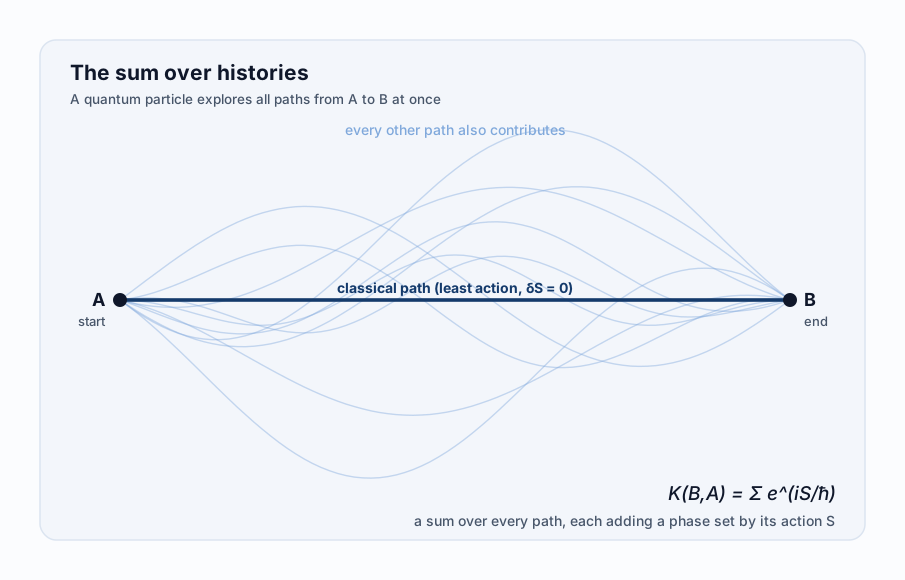
The idea most closely associated with Richard Feynman is the path integral, sometimes called the sum over histories. In classical physics a particle follows a single trajectory, the one that makes a quantity called the action as small as possible. Feynman proposed something stranger and more beautiful, that a quantum particle in some sense takes every possible path between two points at once.
Each path contributes a small arrow, a phase determined by its action, and the paths are added together to give the amplitude for the particle to arrive. Most of the wild, looping paths cancel against one another, while the paths near the classical route reinforce, which is why the everyday world looks orderly even though the quantum rules underneath are not. The familiar least action principle of classical mechanics emerges as the place where all those quantum arrows happen to line up.
The diagram below captures the picture. A particle travels from a starting point to an end point along countless histories at once, and the bold line marks the classical path where the action is stationary. This way of thinking is now standard far beyond its origins, underpinning quantum field theory and even the mathematics of finance.
Quantum electrodynamics and the Nobel Prize
The problem that made the name of Richard Feynman was quantum electrodynamics, the quantum theory of light and charged matter. By the late 1940s the theory was giving nonsensical infinite answers, and the best minds in physics were stuck. Feynman, along with Julian Schwinger and Sin-Itiro Tomonaga working independently, found a way to tame those infinities through a procedure called renormalization.
The three men approached the puzzle by very different routes and arrived at the same physical predictions, which agreed with experiment to a staggering number of decimal places. Quantum electrodynamics remains the most precisely tested theory in all of science. For this work Richard Feynman shared the 1965 Nobel Prize in Physics, cementing his place among the founders of modern field theory.
Feynman diagrams as a universal language
To carry out these calculations Feynman invented a kind of pictorial shorthand that has since become one of the most recognisable images in science. A Feynman diagram is a simple sketch in which straight lines represent particles such as electrons, wavy lines represent photons, and the points where they meet represent interactions. Each diagram stands for a precise mathematical expression, so a physicist can write down a fearsome calculation by drawing a few lines.
What began as a private bookkeeping trick spread through the whole of particle physics within a few years. The diagrams let physicists organise the endless terms of a quantum calculation by their complexity, tackling the simplest pictures first and adding corrections as needed. Today the same visual language describes everything from collisions at the Large Hadron Collider to the behaviour of materials, and the drawings are taught to every student of the field.
Plenty of room at the bottom
Feynman also planted one of the seed ideas of nanotechnology, decades before the word was in use. In a celebrated 1959 lecture at Caltech titled There is Plenty of Room at the Bottom, he argued that nothing in the laws of physics forbids us from arranging matter atom by atom. He imagined writing the entire Encyclopaedia Britannica on the head of a pin and building working machines on the scale of molecules.
To spur others into action he offered two prizes of a thousand dollars each, one for a working electric motor smaller than a grain of sand and one for shrinking a page of text by a factor of twenty five thousand. Both were eventually claimed, and the tiny motor arrived far sooner than he had expected. The talk read as playful speculation at the time, yet it set out an agenda that scanning probe microscopes and molecular engineering would pursue in earnest decades later.
What ties this vision to the rest of his work is the quantum scale at which it operates. Building things atom by atom means confronting the quantum behaviour of matter head on, the very behaviour his path integral was designed to describe. The nanoworld that Feynman sketched is the natural meeting point of his physics and the technologies that grew out of it, from advanced materials to the hardware of quantum machines.
The physicist who imagined quantum computers
Feynman saw, earlier than almost anyone, that computing and quantum physics would have to meet. In 1981 he posed a deceptively simple question, namely how one might simulate a quantum system on an ordinary computer. Such machines, he pointed out, choke on quantum problems because the number of possibilities grows explosively with the number of particles.
His answer was to build a computer that was itself quantum mechanical, so that it could imitate nature directly rather than struggling to calculate it. That single suggestion helped launch the entire effort that became quantum computing, and the machines now being built around the world are, in a real sense, attempts to realise the device he sketched in a lecture hall. The same reasoning runs through modern work on quantum simulation and quantum error correction.
A teacher above all else
For all his research achievements, Feynman may have shaped physics most through teaching. In the early 1960s he delivered an introductory course at Caltech that was published as the Feynman Lectures on Physics, a work that generations of students and researchers still read for its clarity and freshness. He had a gift for stripping a hard idea down to something you could almost hold in your hand.
His popular books, including the bestselling memoir Surely You Are Joking Mr Feynman, introduced millions of readers to the pleasures and frustrations of a scientific life. Asked to prepare a freshman lecture explaining why spin one half particles obey Fermi-Dirac statistics, he came back and admitted he could not reduce it to that level, which to him meant the physics was not yet properly understood. The combination of depth and plain speaking made him the rarest of things, a working genius who was also a great communicator.
Challenger and the public scientist
In 1986 Feynman, by then seriously ill, joined the commission investigating the Challenger space shuttle disaster. While officials spoke in cautious generalities, he cut to the heart of the matter in a single televised demonstration, compressing a piece of O-ring rubber in a small clamp and dipping it into a glass of ice water to show that it lost its resilience in the cold. The simple experiment exposed the physical cause of the accident for everyone to see.
His appendix to the official report warned, in language nobody could misread, that reality must take precedence over public relations, for nature cannot be fooled. It was a fitting late performance from a man who had spent his life refusing to let appearances substitute for understanding. The episode introduced his blunt honesty to an audience far beyond physics.
The character behind the physics
It is tempting to treat the bongo drums and the safe-cracking as colourful distractions from the real work, but for Feynman they were part of the same temperament. He approached a locked safe, a Mayan codex, or a problem in quantum theory with the same delight in figuring out how something worked. Curiosity, for him, was not a tool he switched on for science and off for everything else.
That outlook shaped how he chose problems and how he judged answers. He distrusted grand pronouncements and elaborate formalism when a clear physical picture would do, and he was famously willing to say that he did not understand something rather than hide behind impressive words. Colleagues recall a man who would rather be honestly confused than comfortably wrong.
The flip side was an impatience with pretension and a refusal to defer to reputation, his own included. He once remarked that science is the belief in the ignorance of experts, a deliberately provocative way of insisting that evidence outranks authority. That stance could make him difficult, yet it was inseparable from the originality that made his work matter.
The legacy of Richard Feynman
Richard Feynman died in 1988, and the blackboard in his office reportedly carried the line, what I cannot create, I do not understand. The sentence is as good a summary of his outlook as any, an insistence that genuine knowledge means being able to build a thing from scratch. He left behind not a grand unified system but a way of doing physics that prizes intuition, pictures and relentless honesty.
His influence is everywhere in the modern subject, from the path integrals at the heart of quantum field theory to the diagrams on every particle physicist’s notepad and the quantum machines now taking shape in laboratories. More than almost any scientist of his century, he made physics feel like an adventure rather than a chore. That spirit, as much as the equations, is the enduring legacy of Richard Feynman.
Frequently asked questions
Who was Richard Feynman?
What is the Feynman path integral?
What did Richard Feynman win the Nobel Prize for?
Did Feynman invent the idea of a quantum computer?
What are Feynman diagrams?
How did Feynman influence nanotechnology?




See today’s quantum computing news on Quantum Zeitgeist for the latest breakthroughs in qubits, hardware, algorithms, and industry deals.