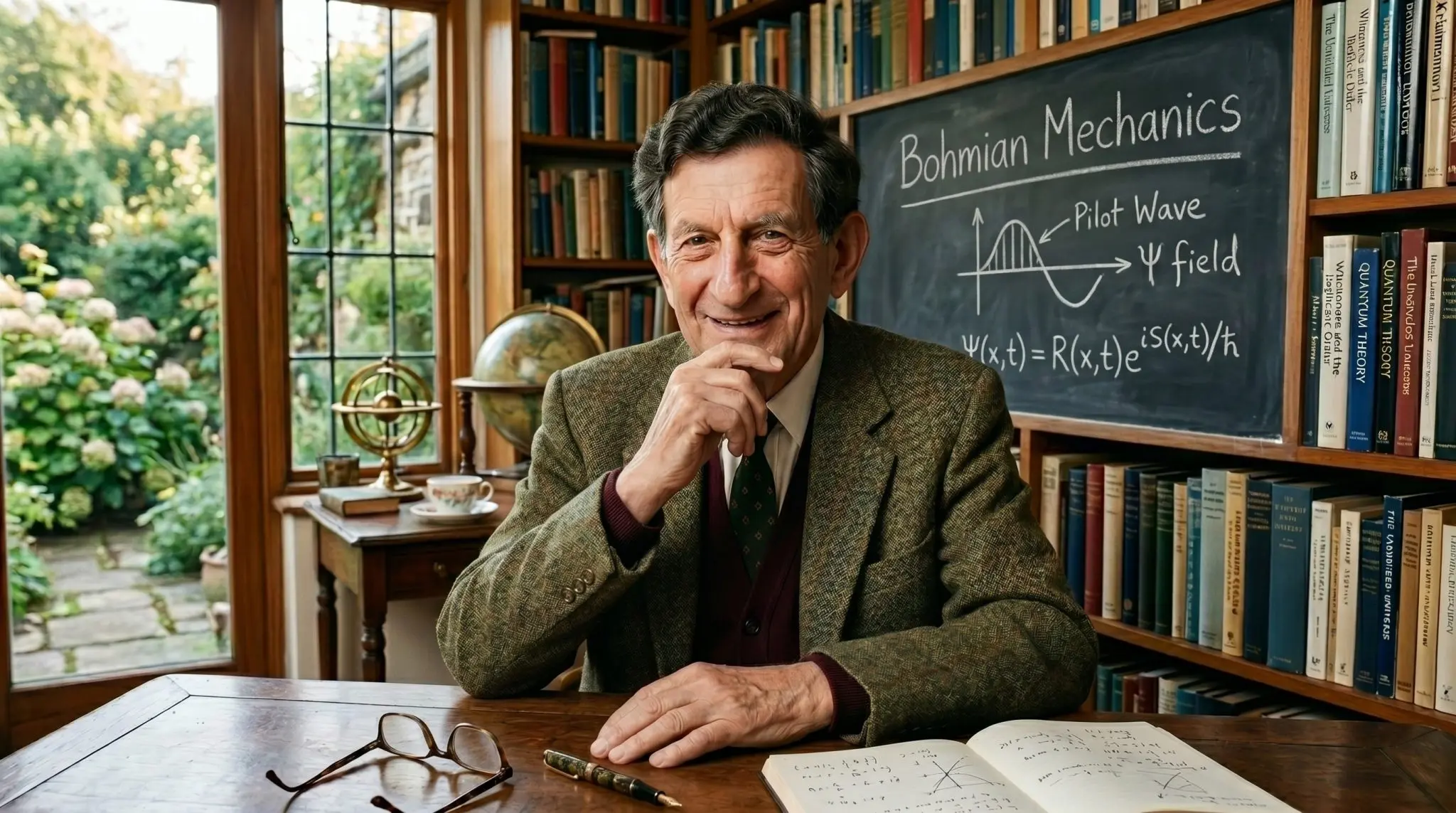
The exiled physicist who built a deterministic, nonlocal vision of quantum mechanics that reproduces every prediction of the standard theory, and refused to disappear.
Few physicists have been driven out of their own country by a congressional committee, elected to the Royal Society, and quietly written out of the textbooks all within a single career, yet David Bohm managed all three. His name is attached to an interpretation of quantum mechanics that insists the world is deterministic, that particles have definite positions whether or not anyone is watching, and that the strangeness of the quantum realm comes not from irreducible chance but from a hidden layer of order we have not yet learned to read.
That framework, known formally as the de Broglie-Bohm theory and informally as Bohmian mechanics or simply Bohmianism, has spent seventy years as the most respectable heresy in physics. It is mathematically rigorous, it reproduces every prediction of standard quantum theory, and it has been marginalised for reasons that have at least as much to do with history and personality as with science. As the broader field reconsiders the foundations of quantum theory, with pilot wave theory enjoying a genuine resurgence, Bohm’s deterministic vision deserves a closer and more sympathetic reading than it has often received.
The man behind the mechanics
David Joseph Bohm was born in Wilkes-Barre, Pennsylvania, in 1917, and he came of age scientifically inside the American physics establishment at the height of its wartime confidence. He completed his doctorate at Berkeley under J. Robert Oppenheimer, made early and lasting contributions to plasma physics, and lent his name to the phenomenon of Bohm diffusion that still appears in the study of ionised gases. With Yakir Aharonov he later predicted the 1959 effect that carries both their names, in which an electron responds to an electromagnetic potential in a region where the measurable field is zero, and he was elected a Fellow of the Royal Society in 1990.
His 1951 textbook, simply titled Quantum Theory, was for a time one of the clearest expositions of the orthodox view associated with Niels Bohr, and writing it appears to have convinced Bohm that the orthodoxy was incomplete rather than final. The political climate then intervened in the most direct way imaginable, because Bohm refused to testify before the House Un-American Activities Committee during the McCarthy era and found himself arrested, acquitted, and nonetheless quietly abandoned by Princeton. He spent the rest of his life abroad, first in Brazil at the University of Sao Paulo, then in Israel at the Technion, and finally in Britain, at the University of Bristol from 1957 and then at Birkbeck College in London from 1961, where he remained until his death in 1992.
What Bohmian mechanics actually claims
The core of the theory is disarmingly simple to state and surprisingly hard to dismiss. In Bohmian mechanics a quantum system is described by two things at once: a wavefunction that evolves smoothly according to the usual equations, and a set of actual particles that possess definite positions at every instant, even when nobody is looking at them. The wavefunction never collapses, never jumps, and never behaves capriciously, because it simply unfolds in time according to the Schrödinger equation exactly as it does in the standard formalism.
What the theory adds is a guiding equation, a precise mathematical rule that tells each particle how to move given the wavefunction that surrounds it, so that the particle is piloted along a definite trajectory rather than smeared across a cloud of possibilities. The velocity of a particle is given by the gradient of the phase of the wavefunction divided by the mass, written compactly as v = ∇S/m, which means the particle’s path is dictated continuously by the structure of the wave that carries it. The radical claim here is ontological rather than computational, because Bohm is not proposing new predictions but insisting that the mathematics already describes a real and definite world.
The quantum potential and the shape of determinism
What gives Bohmian mechanics its peculiar character is the object Bohm called the quantum potential, a term with no analogue in classical physics. Whereas an ordinary potential depends on where a particle sits in space, the quantum potential depends on the entire shape of the wavefunction, and it is written as Q = -(ℏ²/2m)(∇²R/R), where R is the amplitude of the wavefunction and ℏ is the reduced Planck constant. Because this potential is built from the form of the wave rather than its intensity, it does not weaken with distance in the way familiar forces do, and a faint, spread-out wavefunction can steer a particle just as decisively as a sharply peaked one.
This is the feature that produces the genuinely quantum behaviour we observe, from interference fringes to the tunnelling of particles through barriers that classical mechanics says should stop them cold. The quantum potential is also where the theory’s nonlocality lives, since the configuration of one particle can influence another instantaneously through the shared wavefunction, regardless of the distance between them. Bohm’s achievement was to take a phenomenon usually described as inherent randomness and recast it as the lawful, if deeply non-classical, motion of real objects under a real influence.
From de Broglie’s pilot wave to Bohm’s revival
Bohm did not invent the pilot wave, and he was always careful to credit the man who did. Louis de Broglie had presented a version of the guiding idea at the famous 1927 Solvay Conference, proposing that particles ride along on waves that direct their motion, only to abandon the programme after sharp criticism from Wolfgang Pauli and the general drift of opinion toward the Copenhagen view. For a quarter of a century the idea lay essentially dormant, treated as a curiosity that the founders had considered and wisely rejected.
Bohm revived it in 1952 with a pair of papers in Physical Review that gave the theory a complete and self-consistent formulation, crucially including a treatment of the measurement process that de Broglie had never fully supplied. The two formulations differ in emphasis, since de Broglie worked with a first-order guiding law for velocities while Bohm built a second-order dynamics around the quantum potential and accelerations, yet they describe the same underlying physics. When de Broglie saw what Bohm had done, the older man returned to the theory he had once given up, and the joint name it now carries reflects that genuine intellectual reunion across the decades.
Dissolving the measurement problem
The deepest selling point of Bohmian mechanics is the way it makes the notorious measurement problem simply evaporate. In the standard account a system exists in a superposition of possibilities until an observation forces the wavefunction to collapse onto a single outcome, a process that no equation describes and that has fuelled philosophical argument for nearly a century. Bohm’s theory needs no such collapse, because the particle always had a definite position, and what we call measurement is merely the act of finding out where it already was.
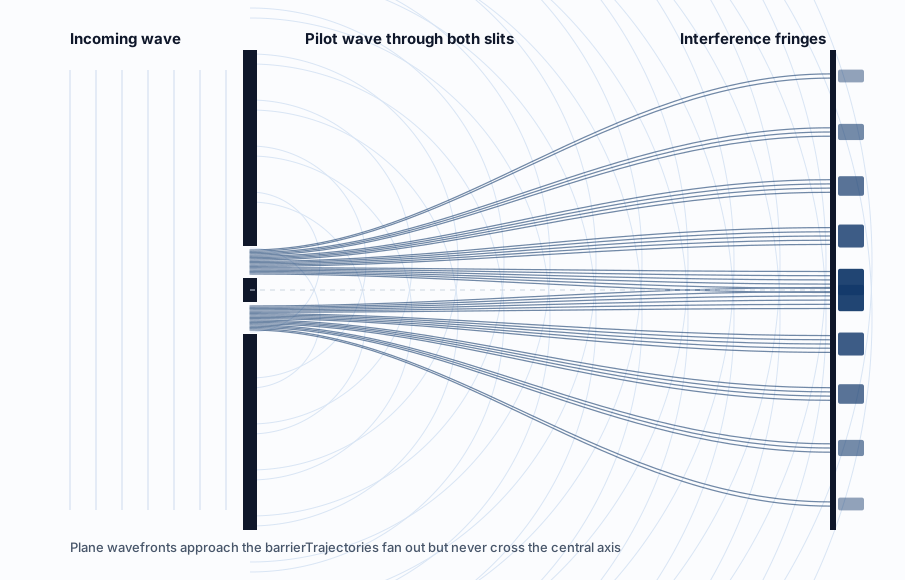
The double-slit experiment becomes almost mundane under this reading, since each particle passes through exactly one slit while its pilot wave passes through both, and the interference pattern emerges from the wave steering the population of particles into the observed fringes. There is no moment of mysterious selection and no special role for the observer, only continuous and lawful motion that produces the same statistics we measure in the laboratory. For those who find the orthodox dependence on the act of observation philosophically unsatisfying, the appeal of a theory that dispenses with it entirely is considerable.
Bohm, Bell, and the price of nonlocality
The irony of Bohm’s legacy is that his most consequential contribution to physics may have come through the work he inspired rather than the theory he championed. It was Bohm who, in his 1951 textbook, reformulated the Einstein-Podolsky-Rosen thought experiment in terms of the spins of paired particles, turning an abstract argument about position and momentum into something concrete enough to analyse and eventually to test. John Bell, who admired Bohm’s 1952 papers precisely because they proved that a hidden-variable account was possible at all, took up that spin version and used it to derive the inequalities that bear his name.
Bell’s theorem established that any theory reproducing the predictions of quantum mechanics must abandon locality, and this is the result that underwrites everything we now understand about quantum nonlocality and the deep correlations of entangled systems. Far from refuting Bohm, Bell’s work vindicated him on the central point, since Bohmian mechanics had been openly and unapologetically nonlocal from the start. The nonlocality that critics held against Bohm turned out to be a feature of nature itself rather than a defect of his particular theory.
The implicate order and Bohm’s wider vision
In his later years Bohm moved beyond the mechanics of particles toward a sweeping philosophical picture that he called the implicate order, and this is the part of his thought that most directly touches questions of mind, meaning, and the structure of reality. He argued that the world we perceive, the explicate order of separate objects in definite places, is the surface expression of a deeper, enfolded implicate order in which everything is woven together into an undivided whole. Bohm reached for the metaphor of the hologram, in which every fragment contains information about the entire image, to suggest that separateness itself might be a kind of appearance rather than a fundamental truth.
He developed these ideas in dialogue with the philosopher Jiddu Krishnamurti and in his 1980 book Wholeness and the Implicate Order, where he tried to bring physics, consciousness, and language into a single conversation. Mainstream physics has largely set this work aside as speculative metaphysics, yet it continues to attract readers drawn to the possibility that the universe is more deeply interconnected than the standard picture allows. For Bohm the mechanics and the metaphysics were never separate projects, because both grew from his conviction that reality is whole and intelligible rather than fragmented and irreducibly random.
Why the mainstream kept its distance
If Bohmian mechanics is empirically equivalent to standard quantum theory and free of the measurement problem, the obvious question is why it remains a minority view. Part of the answer is historical accident, since the theory arrived after the Copenhagen interpretation had already hardened into orthodoxy and after the founders had publicly closed the door on hidden variables. Part of it is a genuine scientific tension, because the explicit nonlocality of Bohm’s theory sits uncomfortably alongside special relativity, which forbids signals from travelling faster than light, and extending the framework to relativistic quantum field theory remains difficult and contested.
Critics also invoke a kind of parsimony argument, suggesting that the particle trajectories are surplus structure that does no observable work, since the wavefunction alone already yields the right statistics. Defenders reply that the trajectories are exactly what makes the theory intelligible, and that dismissing them is a philosophical preference rather than an experimental result. The debate is therefore not really about which theory makes better predictions, because on that score they are tied, but about what we are willing to accept as an explanation of the world.
Bohmian mechanics in the quantum era
The renewed interest in foundations has given Bohm’s ideas a practical second life that he might have found gratifying. Bohmian trajectories have become a useful computational tool in quantum simulation and quantum chemistry, where treating particles as following definite paths can make certain calculations more tractable and more intuitive than the purely statistical alternatives.
Analogue experiments with droplets bouncing on vibrating fluid baths have produced striking macroscopic imitations of pilot-wave behaviour, reigniting curiosity about whether the deterministic picture captures something real about the microscopic world. As the field builds practical machines and confronts the foundations afresh, the questions Bohm raised about determinism, locality, and the nature of measurement have stopped looking like settled history and started looking like open research again. Anyone tracing the long arc of quantum theory will find Bohm’s fingerprints in unexpected places, from the vocabulary of hidden variables catalogued in any quantum computing glossary to the experimental tests of nonlocality that define the modern field.
The persistence of an idea
David Bohm offered physics a way to keep its determinism and its definite reality without giving up a single experimental prediction, and the discipline mostly declined the offer. Whether that refusal reflects sound scientific judgement or merely the inertia of a settled consensus is a question that each generation of physicists seems compelled to ask again.
What is clear is that Bohmian mechanics has outlived every confident prediction of its irrelevance, surviving exile, neglect, and ridicule to remain a live option in the foundations of quantum theory. The man who was driven out of his own country for refusing to inform on his colleagues built a theory that refused, in its turn, to disappear. In an era newly willing to question what the founders took for granted, that quiet persistence may yet prove to have been prescience rather than stubbornness.
Frequently asked questions
Who was David Bohm?
What is Bohmian mechanics?
How is Bohmian mechanics different from standard quantum mechanics?
What is the quantum potential?
Why is Bohmian mechanics not the mainstream view?



See today’s quantum computing news on Quantum Zeitgeist for the latest breakthroughs in qubits, hardware, algorithms, and industry deals.