
A pair of superconducting qubits at the University of Illinois Urbana-Champaign and the University of Chicago have demonstrated that energy leakage, traditionally considered detrimental, can generate sustained quantum entanglement. Researchers realized this phenomenon, predicted by theory and recently published, using a new technique called synthetic squeezing.
“In the past, generating entanglement meant performing operations on different parts of a system and then transporting them away from each other,” said Wolfgang Pfaff, Illinois Grainger Engineering assistant professor at the University of Illinois Urbana-Champaign. This new method bypasses that vulnerable transport stage, potentially offering a more reliable path to long-distance quantum communication.
Dissipation-Driven Entanglement: A Theoretical Breakthrough
Entanglement, a cornerstone of quantum technology, is now being demonstrably sustained through a process once considered detrimental: dissipation. This achievement bypasses the need to physically transport delicate quantum states, a major obstacle in building large-scale quantum networks.
The team realized this counterintuitive phenomenon using a technique called synthetic squeezing, effectively replicating the conditions of idealized theoretical predictions within a laboratory setting with superconducting qubits. Synthetic squeezing allows for the creation of entanglement even with the imperfections inherent in physical systems, a significant step beyond previous demonstrations. Crucially, the entanglement achieved isn’t fleeting; it exists in a steady state, offering a potential solution to the decoherence problems plaguing current entanglement distribution methods.
Unlike traditional approaches that rely on transmitting entangled particles, this system maintains entanglement through continuous interaction and dissipation, eliminating the vulnerability of transport. Aashish Clerk, Professor of Molecular Engineering at the University of Chicago, described the process as akin to a refrigerator that actively maintains entanglement by pumping out external influences rather than heat. “Rather than preparing it at one instant and watching it decay, it emerges as the natural point of relaxation in this system,” he said.
This stability is a key advantage, as it can be maintained indefinitely over arbitrarily large distances. The implications extend to the potential for entanglement distillation, a process where multiple weakly entangled qubits are combined to create a smaller number of highly entangled qubits, essential for performing complex quantum computations. “Right now, the degree of entanglement we can achieve is quite good, but it’s still below the theoretical limit.
Protocols exist in which a collection of qubits with low entanglement can be combined so a few of them have a very high degree of entanglement. Such a protocol would let us start doing actual quantum computing operations with this system,” Clerk noted. The researchers are now focused on scaling this technique to multi-qubit systems.
I’ve worked with cascaded quantum systems before, but it was by working with professor Clerk and his research group that we could realize this prediction of high-quality steady-state entanglement.
Wolfgang Pfaff, Professor of Physics in the University of Illinois Urbana-Champaign Department of Physics
Synthetic Squeezing Realizes Steady-State Entanglement in Superconducting Qubits
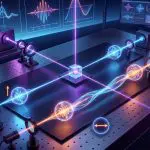
Instead of relying on the transmission of entangled particles, the team engineered a system where entanglement emerges as a natural consequence of energy dissipation, a process traditionally viewed as detrimental to quantum states. Central to this achievement is a technique called synthetic squeezing, developed to replicate the conditions of earlier theoretical models within a functioning laboratory setup. The researchers utilized a pair of superconducting qubits coupled to a unidirectional waveguide, driving them into a steady-state entanglement.
“Even though the overall system is in contact with an outside environment and is out of equilibrium, it naturally evolves towards a resting point in which select parts of it are entangled,” he added. The team’s success stems from addressing the imperfections inherent in real-world quantum systems.
Earlier cascaded quantum systems, while theoretically promising, often suffered from low entanglement quality due to noise. Synthetic squeezing provides a framework for tuning the system to mitigate these effects, effectively minimizing their impact on the entanglement.
“I’ve worked with cascaded quantum systems before, but it was by working with professor Clerk and his research group that we could realize this prediction of high-quality steady-state entanglement,” said Pfaff. “The work ahead is going to be figuring out how different protocols can be implemented on this kind of system and determining what, if any, advantage is to be gained by doing so,” Pfaff noted.
In the past, generating entanglement has meant performing a set of operations of different parts of a system then transporting them away from each other.
Wolfgang Pfaff, Professor of Physics in the University of Illinois Urbana-Champaign Department of Physics
Cascaded Systems Enable Entanglement Distribution Without Quantum Transfer
This achievement, detailed recently in Physical Review X, is featured as a viewpoint in Physics magazine and challenges conventional wisdom, opening avenues for more robust quantum networks. “As you can imagine, things often go wrong during the transport stage and environmental noise spoils the carefully prepared properties.” This idea has attracted theoretical attention for a long time because it runs counter to our experience with quantum entanglement, he said.
The system doesn’t simply prepare entanglement and watch it decay; instead, entanglement emerges as the natural, stable state achieved through a balance of energy absorption and dissipation. This precise control allows for the creation of a system where the qubits communicate without physically exchanging quantum particles. “What’s more, the quantum particles never need to move; they just need the ability to communicate,” Clerk added. The team’s next steps involve exploring protocols for entanglement distillation, aiming to further enhance the quality of entanglement and unlock the potential for practical quantum computing operations.
This idea has attracted theoretical attention for a long time because it runs counter to our experience with quantum entanglement.
Aashish Clerk, Professor of Molecular Engineering in the University of Chicago Pritzker School of Molecular Engineering


See today’s quantum computing news on Quantum Zeitgeist for the latest breakthroughs in qubits, hardware, algorithms, and industry deals.