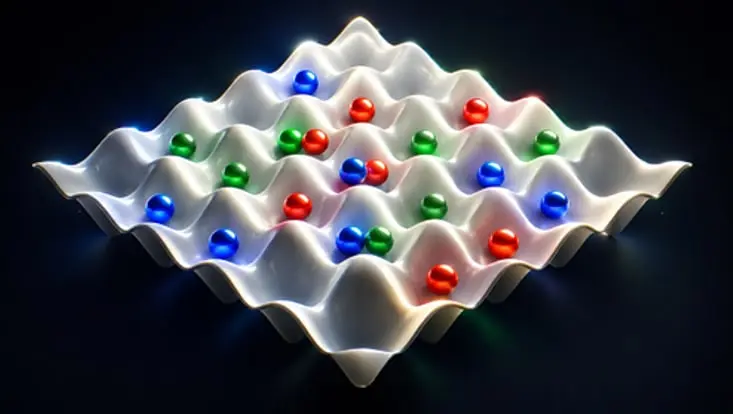
Researchers have, for the first time created a three-component Hubbard system using ultracold atoms, a setup previously unrealized. An international team led by Prof. Peter Schauss conducting research at the University of Hamburg and in the Cluster of Excellence “CUI: Advanced Imaging of Matter”, used a quantum gas microscope to individually detect fermionic atoms of three “flavors” and precisely control their interactions.
“It was particularly important to us to observe a so-called Mott state, in which the interactions suppress the double occupation of sites,” says Schauss, as this study published in Science builds upon the Hubbard model and potentially opens new avenues for quantum simulations of both nuclear physics and materials science.
Three-Component Hubbard System Realized with Tunable Interactions
The ability to individually address and observe fermionic atoms of three distinct “flavors” represents an advancement in quantum simulation, as demonstrated by a collaborative international team. Using a quantum gas microscope, researchers realized a three-component Hubbard system with tunable interactions in the laboratory and achieved precise control over interactions at the single-atom level. This experimental setup allows for investigations into quantum mechanical phases beyond those observable in standard two-spin-state models.
The team led by Peter Schauss focused on realizing a Hubbard model, a foundational framework for understanding high-temperature superconductivity, with an added third component. This expansion of the model’s dimensionality enables the exploration of richer quantum phases and opens avenues for simulating systems found in both nuclear physics and materials science. The researchers employed ultracold atoms confined within an optical lattice, where the atoms occupy discrete sites and can tunnel between them, mimicking the behavior of electrons in a solid.
By using different internal states of the atoms, they created three distinguishable fermionic species, analogous to the three colors of quarks in nuclear physics. A central goal of the study was the observation of a Mott state, a phase of matter where strong interactions between electrons prevent them from moving freely, resulting in insulating behavior.
The successful detection of this state is significant because Mott insulators often appear near the conditions necessary for high-temperature superconductivity, suggesting a potential link between the two phenomena. The team’s quantum gas microscope allowed for the visualization of individual atoms and the precise measurement of their interactions, which was essential for this endeavor.
The experimental realization of this three-component system proved surprisingly stable, given the potential for disruptive three-body collisions. “It turned out that the experimental realization is surprisingly stable,” said Schauss. “Usually, one fears that three-body collisions could quickly destroy the system. Despite this potential danger, we were able to successfully carry out the measurements and observe a Mott insulator.” This stability allowed for detailed characterization of the system’s phases, revealing the emergence of both ferromagnetic and antiferromagnetic correlations between different pairs of the three atomic states.
It was particularly important to us to observe a so-called Mott state, in which the interactions suppress the double occupation of sites.
Peter Schauss, Prof. at University of Hamburg and in the Cluster of Excellence “CUI: Advanced Imaging of Matter”

See today’s quantum computing news on Quantum Zeitgeist for the latest breakthroughs in qubits, hardware, algorithms, and industry deals.