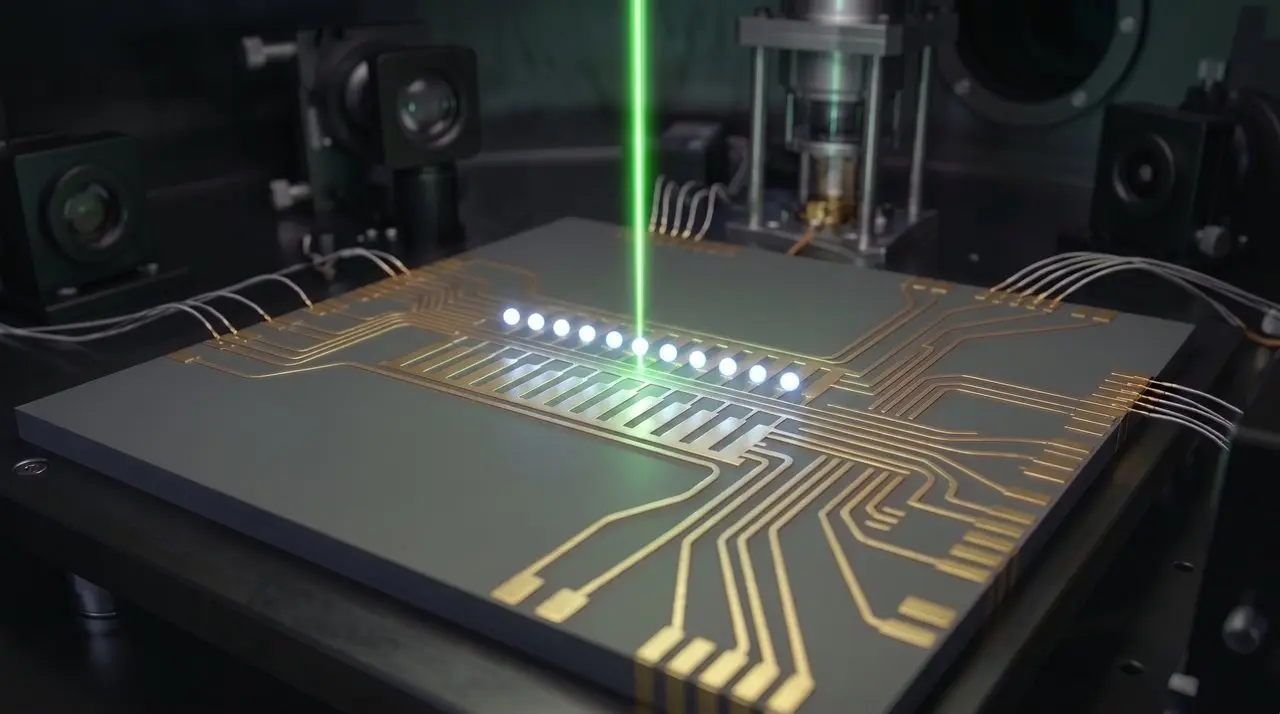
Researchers from ETH Zurich and the University of Copenhagen have calculated molecular energies to chemical accuracy using a 448 two-qubit gate circuit on the Quantinuum Helios trapped-ion quantum computer. The work introduces sparse quantum prolate diagonalization, or sparse QPD, a technique combining existing methods with compressed sensing to efficiently address Hamiltonian spectrum sparsity in molecular systems.
Sparse sampling reduces the computational demand of QPD from O(N_s) to O(log N_s), where is the number of sampled points, without increasing circuit depth. The team demonstrates the method’s potential for larger systems with numerical simulations in weakly correlated regimes.
Sparse Quantum Prolate Diagonalization Reduces Sample Complexity
The Quantinuum Helios trapped-ion quantum computer recently executed a circuit containing 448 two-qubit gates to determine Hamiltonian energies with chemical accuracy, a demonstration of scale for this type of quantum computation. This approach tackles a core challenge in quantum chemistry: the exponential growth of computational cost with system size. The team demonstrated that sparse sampling reduces the number of autocorrelation function samples, distinct circuits needed for the calculation, from a linear relationship with the number of samples, O(N_s), to a logarithmic one, O(log N_s).
This reduction in sample complexity does not increase the circuit depth required to achieve chemical accuracy, a critical factor for practical implementation on near-term quantum devices. The researchers tested sparse QPD using a two-orbital active-space-embedded Hamiltonian representing an interacting arginine-tryptophan residue pair in water, a biologically relevant system.
The theoretical basis for this improvement lies in the low-rank Hankel structure of the sampled signal, allowing for the application of compressed sensing techniques. As detailed in the team’s work, this matrix completion method enables the exponential speedup in evaluating QPD matrix elements, an essential step in determining energy levels. The team’s work builds on previous research demonstrating the potential of QPD to achieve chemically accurate results with shorter evolution times and fewer shots compared to standard quantum phase estimation and other quantum subspace methods.
This combination of theoretical advancement and experimental validation on a leading quantum computing platform positions sparse QPD as a promising technique for tackling increasingly complex molecular simulations. Future work will focus on extending the method’s applicability and exploring its potential for even larger systems.
Two-Orbital Arginine-Tryptophan System on Quantinuum Helios
The approach exploits Hamiltonian spectrum sparsity, a property of molecular systems that allows for a reduction in the complexity of calculations. This optimization is particularly important for near-term quantum computers, where qubit counts and coherence times are limited. By reducing the number of circuits required, sparse QPD alleviates the demand on these resources, making it possible to perform calculations that would otherwise be intractable. The team’s experiments on the Helios platform confirm the viability of this approach, achieving energy errors below 1 kcal/mol with the 448-gate circuits.
The theoretical framework underpinning sparse QPD involves representing the Hamiltonian in a filtered basis, effectively focusing the computation on the most relevant energy levels. This is achieved by applying spectral filter functions that suppress contributions from eigenstates outside a defined energy band. The resulting generalized eigenvalue problem is then solved using the sparse sampling and matrix completion techniques, significantly reducing the computational burden. As the authors state in their paper, the method’s performance is evaluated under realistic conditions, including shot noise, Trotter error and hardware noise, providing a comprehensive assessment of its practical applicability.
Quantum Prolate Diagonalization for Molecular Energies
This result stems from a technique that combines quantum prolate diagonalization with compressed sensing, exploiting inherent sparsity within the Hamiltonian spectrum of molecular systems to reduce computational demands. The theoretical foundation of sparse QPD relies on representing the Hamiltonian within a filtered basis, constructed by applying spectral filter functions that selectively amplify contributions from desired energy ranges while suppressing irrelevant high-energy states.
These techniques allow for accurate reconstruction of the Hamiltonian’s matrix elements from a significantly reduced set of samples, effectively streamlining the computational process without sacrificing precision. The researchers’ work builds on the established principle that the quantum Hamiltonian eigenvalue problem can be reframed as a signal recovery challenge, using the autocorrelation function to encode spectral information.
By focusing on the low-lying portion of the Hamiltonian spectrum, the energies most relevant to chemical processes, the method constructs a subspace representation of the Hamiltonian, ensuring that only the essential spectral features are retained. “In fact, it is easy to notice that the autocorrelation function C(t) contains all the spectral information within a state |Φ⟩,” the authors write, detailing the mathematical basis for this approach.
Active Space Hamiltonian and Electronic Structure Theory
The calculation of electronic Hamiltonian matrix elements benefits from a structured approach to representing the active space, as defined by the two-electron integrals and the creation/annihilation operators acting on spin-orbitals. These integrals, fundamental to describing electron interactions within a molecule, are incorporated into the Hamiltonian alongside one-electron kinetic energy and electron-nuclei repulsion terms. A key element of their approach lies in the projection of the Hamiltonian onto a filtered basis, achieved through the application of filter functions supported on a defined interval.
These functions, denoted as , effectively suppress eigenstates outside a designated energy band, concentrating computational effort on the most relevant portions of the Hamiltonian spectrum. The resulting generalized eigenvalue problem, expressed as (V†HV) = (V†V) , allows for the determination of eigenenergies within the filtered space. This projection technique, combined with a low-rank approximation, significantly reduces the computational burden associated with solving the eigenvalue equation.
The team’s work demonstrates that the accuracy of the estimated eigenvalues is dependent on several factors, including the dimension of the trial space and a parameter ‘c’ representing the product of the filter function width and the time interval. They define an intrinsic error, , which quantifies the representation of the Hamiltonian within the trial subspace.
The researchers constructed the filtered vectors |⟩ by applying filter functions to the initial state, ensuring that eigenstates outside the band are suppressed, and the |⟩ span the eigenstates inside the band that overlap with the initial state |Φ⟩. This careful construction of the trial space, coupled with the compressed sensing recovery, allows for an exponential speedup in evaluating the matrix elements of the projected Hamiltonian.
448-Gate Circuit Performance with Hardware and Trotter Noise
Numerical simulations demonstrate the scalability of sparse quantum prolate diagonalization (sparse QPD) to larger systems, provided a quantum processor of sufficient size is available, even within the weakly correlated regime. This finding builds on the method’s ability to reduce the complexity of quantum simulations by exploiting inherent sparsity within Hamiltonian spectra. Experiments conducted on the Quantinuum Helios trapped-ion device, and its emulator, Helios-1E, show that sparse QPD can resolve Hamiltonian energies to within chemical accuracy using circuits containing up to 448 two-qubit gates, totaling 1221 gates overall.
The researchers accounted for multiple error sources in their analysis, including discretization errors, shot noise, hardware noise, reconstruction errors and the approximations introduced by Trotterization. They note that the discretization error was consistently negligible compared to these other factors.
The team’s approach to error analysis incorporates a term, δ and δ , which encapsulates all deviations between the constructed sampled matrices and their exact continuous counterparts. This comprehensive error term extends beyond the prolate-sampling truncation and shot noise considered in previous work, encompassing quantum hardware noise and the reconstruction error inherent in the method. The accuracy bound derived from a prior study was adapted to focus specifically on the ground state energy, the primary target of this work.
“λ^*_(max) is the largest eigenvalue of the matrix sum in the parentheses, which is defined in terms of the error matrices,” the researchers state, detailing the mathematical framework used to quantify these errors. Samples of the real and imaginary parts of the autocorrelation function, C(t_k), were obtained using a Hadamard test circuit, a standard technique for extracting information about the Hamiltonian’s spectrum.
This method allows for efficient measurement of the necessary data for sparse QPD, enabling the reconstruction of the Hamiltonian’s eigenvalues. The researchers built on previous experimental demonstrations of quantum phase estimation for chemistry, using existing techniques to validate their new approach. The combination of advanced numerical simulations and hardware experiments provides a robust assessment of sparse QPD’s potential for advancing quantum chemistry calculations.
👉 More information
🗞 Molecular energies from sparse quantum prolate diagonalization on a trapped-ion quantum processor
✍️ Davide Castaldo, Marvin Kronenberger and Markus Reiher (Department of Chemistry and Applied Biosciences, ETH Zurich, Vladimir-Prelog-Weg 2, Zurich, Switzerland); Marek Miller and Matthias Christandl (Quantum for Life Centre, Department of Mathematical Sciences, University of Copenhagen, Universitetsparken 5, Copenhagen Ø, Denmark); Sélène Forget and Gemma C. Solomon (NNF Quantum Computing Programme, Niels Bohr Institute, University of Copenhagen, Blegdamsvej 17, Copenhagen Ø, Denmark); Kresten Lindorff-Larsen (Linderstrøm-Lang Centre for Protein Science, University of Copenhagen, Ole Maaløes Vej 5, Copenhagen N, Denmark)
🧠 ArXiv: https://arxiv.org/abs/2611.22834v1



See today’s quantum computing news on Quantum Zeitgeist for the latest breakthroughs in qubits, hardware, algorithms, and industry deals.