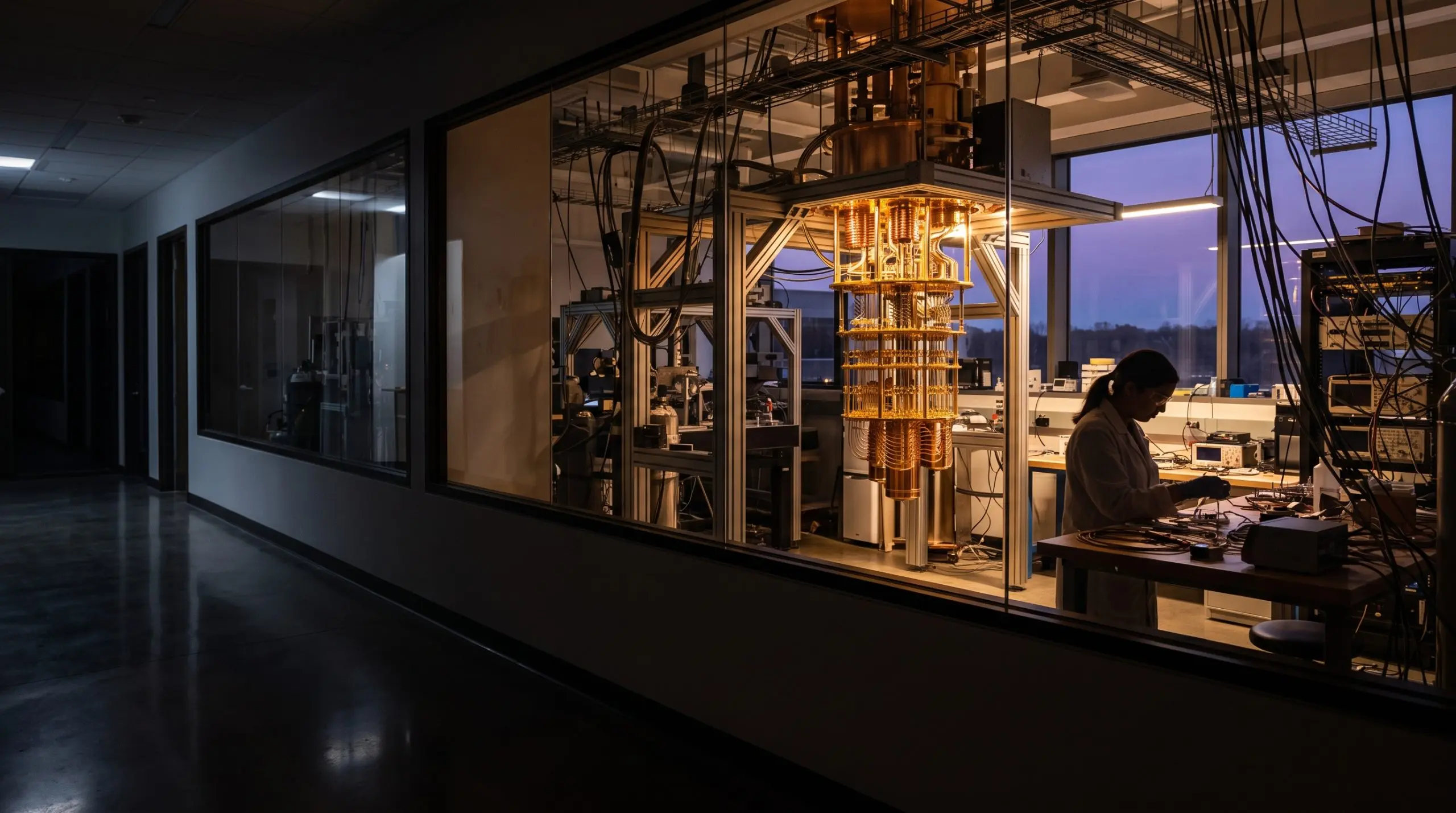
QuEra Computing and Lawrence Berkeley National Laboratory observed quantum dynamics using up to 180 qubits in a new study published in Nature. Pairing QuEra’s Aquila quantum computer with NERSC’s Perlmutter supercomputer, researchers explored how quantum systems settle after sudden changes, revealing unexpected behaviors at the quantum scale, the company says.
“NERSC is focused on giving scientists access to useful computational tools,” said Katie Klymko, NERSC Quantum Adviser, “As quantum computing continues to advance, exact classical calculations are essential for validating what these machines tell us.” The team identified long-lived intermediate states, resonant melting and a unique two-dimensional transition.
Aquila and Perlmutter Enable Observation of Quantum Dynamics
The observation of prethermal dynamical phase transitions and resonant melting formed the core of a recent study using up to 180 qubits, a feat accomplished through the combined power of QuEra Computing’s Aquila quantum computer and the NERSC Perlmutter supercomputer. Researchers detailed in a Nature publication how Aquila’s neutral-atom qubits were used to model quantum systems, revealing previously unseen behavior in how these systems settle after a sudden disturbance.
This approach bypassed limitations inherent in classical simulations, which struggle with the exponential growth of quantum entanglement over time. The collaboration between QuEra and NERSC was intentionally co-designed, with NERSC using QuEra’s open-source Bloqade software to perform precise classical calculations on Perlmutter for smaller systems.
Calculations on Perlmutter gave confidence in Aquila’s results at small scales, so the team could trust the new physics it revealed at larger ones. This interplay between quantum computation and classical verification is becoming increasingly vital as quantum computers tackle more complex problems.
The experimental setup involved initializing the atomic qubits of Aquila into their lowest-energy state, then applying a laser field to induce evolution over a few millionths of a second, followed by measurement of each qubit, according to NERSC. Repeating this process across arrays ranging from 52-atom chains to 180-atom two-dimensional grids yielded three key findings.
The team observed long-lived intermediate states, a phenomenon known as prethermalization, where the system maintained stable patterns for an unexpectedly long duration. They also identified resonant melting, where these prethermalization patterns abruptly broke down at predictable points, and a novel two-dimensional transition lacking a corresponding equilibrium counterpart. This last discovery, a dynamical phase transition without an equilibrium analogue, is particularly noteworthy.
Researchers typically conceptualize phase transitions as changes in a material’s state, like water freezing into ice. However, the team found that quantum matter can undergo abrupt changes in how it evolves over time, independent of its final state.
“Using Aquila, we discovered such a” “dynamical” phase transition far from equilibrium, with no corresponding transition in the equilibrium phase diagram,” said Milan Kornjača, Senior Quantum Scientist at QuEra and paper co-author. The ability to observe these dynamics demonstrates the increasing capabilities of programmable quantum computers. The team’s findings demonstrate that these machines are not merely tools for calculation, but also instruments for revealing fundamentally new physics, the company says.
“This demonstrates how programmable quantum computers can reveal and explain fundamentally new physics. What excites me most is imagining what else we might discover as fault-tolerant quantum computers allow us to explore far beyond the constraints of analog computers,” Kornjača added. This research builds upon a growing body of peer-reviewed work produced on Aquila, which has been available on Amazon Braket since 2022. QuEra intends to apply the experience gained from building and operating Aquila to inform the development of Libra, its first fault-tolerant quantum computer, also slated for deployment on Amazon Braket in 2028.
NERSC is focused on giving scientists access to useful computational tools. As quantum computing continues to advance, exact classical calculations are essential for validating what these machines tell us.
Katie Klymko, NERSC Quantum Adviser


See today’s quantum computing news on Quantum Zeitgeist for the latest breakthroughs in qubits, hardware, algorithms, and industry deals.