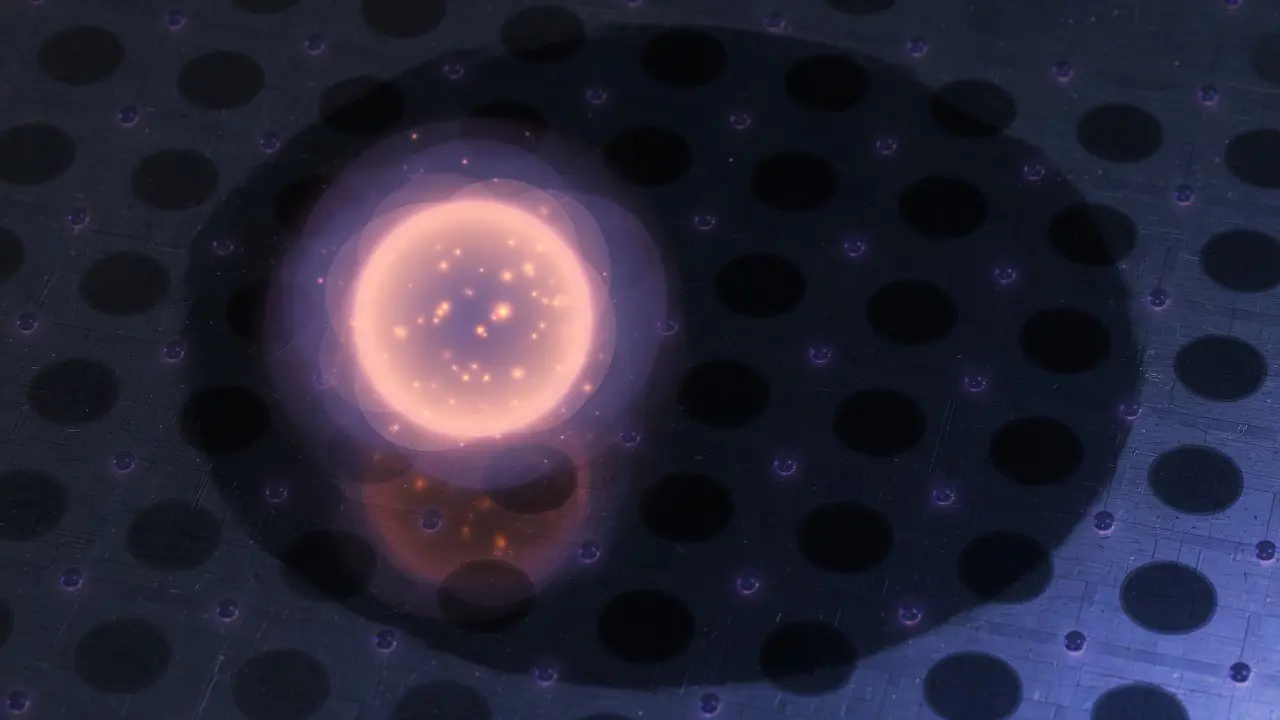
Pasqal inaugurated AtomIQ-Lab in November 2025, a joint laboratory with CNRS and Institut d’Optique, solidifying a research partnership originating at Laboratoire Charles Fabry where Pasqal’s core technology was first developed. The collaboration aims to tackle fundamental physics challenges critical to advancing neutral-atom quantum computing, including “measuring a qubit without losing the atom or refilling a register while it runs.” Pasqal views this shared program as essential for addressing the physics challenges that remain as quantum computing transitions from an engineering problem to a field demanding continuous scientific innovation.
Laboratoire Charles Fabry Origins of Pasqal’s Neutral-Atom Technology
Pasqal’s core technology originated from experiments conducted at Laboratoire Charles Fabry, a joint research unit established by CNRS, Institut d’Optique and Université Paris-Saclay, providing the foundational impetus for the company’s recent collaborative efforts. The laboratory, hosted by Institut d’Optique on the Université Paris-Saclay campus, has spent decades investigating the behavior and control of individual atoms using light, expertise Pasqal acknowledges is difficult and time-consuming to replicate internally.
This established history directly informed the creation of AtomIQ-Lab, inaugurated in November 2025 as a means of solidifying a long-standing relationship rather than relying on ad-hoc collaboration. The Quantum Optics, Atoms group at Laboratoire Charles Fabry’s research is particularly valuable as Pasqal tackles the challenges of translating fundamental physics into a functional commercial quantum computer. The company recognizes that addressing these hurdles requires close collaboration with a leading academic team, and the joint lab provides a shared program and framework to facilitate that partnership.
Since October 2025, a dedicated academic position, a Pasqal Research Chair at Institut d’Optique, has further cemented this connection, supporting a physicist focused on topics relevant to both organizations. Pasqal’s contribution to the collaboration extends beyond funding and personnel; the company also provides specialized knowledge and engineering capabilities often absent in academic settings, the company says. This support enables the Laboratoire Charles Fabry team to upgrade its experimental platforms, allowing for research that would otherwise be impractical.
The joint lab’s structure allows each partner to focus on its strengths, accelerating the transition from promising research results to tangible technological advancements and encouraging long-term investment in fundamental research. In the competitive landscape of quantum computing, Pasqal views maintaining a strong connection to fundamental research as a key advantage. The gap between current machines and future capabilities remains largely scientific, and companies that prioritize collaboration with academic institutions are better positioned to bridge that divide.
For Pasqal, AtomIQ-Lab represents a commitment to nurturing the relationship whose work made its technology possible, ensuring a continued flow of innovation and expertise. The company believes this approach will help close the gap between theoretical potential and practical quantum computing applications.
Lossless Measurement & Register Reloading Drive Joint Research Priorities
The inauguration of AtomIQ-Lab in November 2025 formalized a longstanding partnership between Pasqal, CNRS and Institut d’Optique Graduate School, establishing a dedicated shared research program focused on advancing neutral-atom quantum computing. This collaborative structure differs from typical ad-hoc partnerships, signaling a commitment to sustained, integrated research aimed at overcoming key physics challenges. Pasqal recognizes that incremental engineering improvements alone are insufficient; continued progress demands tackling fundamental scientific hurdles alongside leading academic experts.
Specifically, the joint laboratory prioritizes lossless measurement of atomic states and continuous reloading of atom registers, identified in a 2025 workshop involving approximately 50 to 60 researchers from both Pasqal and Laboratoire Charles Fabry, according to the company. These improvements represent the “next frontier” for neutral-atom quantum processing units, essential for achieving fault-tolerant operation and scaling quantum computers. This knowledge base, honed over years of academic investigation, is difficult and time-consuming to replicate within a commercial setting.
The collaborative effort extends beyond simply tackling immediate technical obstacles. Pasqal also gains early access to potentially disruptive ideas and a pipeline of highly qualified talent. Projects like PANDA, funded by a 2022 European Innovation Council Pathfinder grant, explore novel quantum computing schemes based on light-matter interactions, offering a glimpse into technologies beyond current development roadmaps. Joint CIFRE theses provide students with dual training in both academic research and industrial R&D, creating a valuable recruitment channel for Pasqal.
“What it provides is a shared program and a clear framework for a long-standing relationship,” explains a Pasqal representative. The lab’s structure is designed to accelerate the transition from promising research to practical implementation by strategically dividing responsibilities. Exploratory R&D is not confined solely to either a company or a laboratory, but rather benefits from the combined strengths of both. This approach allows for rapid iteration and validation of new concepts, bridging the gap between theoretical potential and demonstrable results.

See today’s quantum computing news on Quantum Zeitgeist for the latest breakthroughs in qubits, hardware, algorithms, and industry deals.